
BIS ISI Certification for Electrical Appliances in India: All Six IS 302 Standards and the Complete Licensing Process
Household electrical appliances are the products Indians touch most and think about least. A ceiling fan runs for months without a pause, a mixer grinder is used with wet hands in a wet kitchen, a hair dryer is held against the head, and a washing machine combines a motor, water, and a spinning drum in the same enclosure. Each is safe only because someone engineered it to be — and where that engineering is absent, the failure modes are electric shock, fire, and mechanical injury.
The government has brought these appliances under compulsory BIS certification through a family of Quality Control Orders notified in March 2024, making the ISI mark mandatory under Scheme-I of the BIS (Conformity Assessment) Regulations, 2018, as listed on the BIS list of products under compulsory certification.
What makes this category distinctive is its structure. Rather than one order covering all appliances, the government issued separate QCOs by appliance type — kitchen appliances, skin and hair care, fans, commercial dispensing and vending, and domestic clothes washing — each mapping to a section of the IS 302 (Part 2) family of household appliance safety standards. Six standards are covered in total. For a manufacturer with a broad appliance range, that means several licences, several test programmes, and several sets of dates to track.
This guide explains all six standards and their orders, what the testing covers, the licensing process, documents, timelines, costs, common mistakes, and how appliance certification fits alongside BEE star labelling and EPR.
Why Electrical Appliances Fall Under Mandatory BIS Certification
Quality Control Orders are the government’s instrument for making an Indian Standard mandatory. Once a QCO is notified under the BIS Act, 2016, no person can manufacture, import, distribute, sell, hire, lease, store, or exhibit for sale any covered product without the ISI mark granted under a valid BIS licence.
The IS 302 family exists because household appliances present a specific and well-understood set of hazards. Electric shock is the first: appliances are handled by ordinary users, often with wet hands, and the barrier between mains voltage and the user is insulation and earthing that must not degrade over years of use. Fire is the second: motors that stall, heating elements that run without airflow, and wiring that overheats at a loose connection have caused domestic fires for as long as appliances have existed. Mechanical hazard is the third and is specific to certain products — a ceiling fan is a heavy assembly rotating above people’s heads, a mixer has exposed blades, and a washing machine drum spins at speed.
The commercial reality reinforces the need. Appliances are bought on price and appearance in a market with intense competition, and quality compromises — thinner insulation, cheaper thermal protection, an earthing arrangement that is present but marginal — are invisible to the buyer and cheap for the maker. Certified conformity to the Indian Standard verifies these protections at the factory. For manufacturers, the QCO is also a commercial gate: organised retail, institutional procurement, and e-commerce marketplaces verify BIS licences, and customs authorities check compliance at import.
Which Appliances Are Covered: All Six Standards and Their Orders
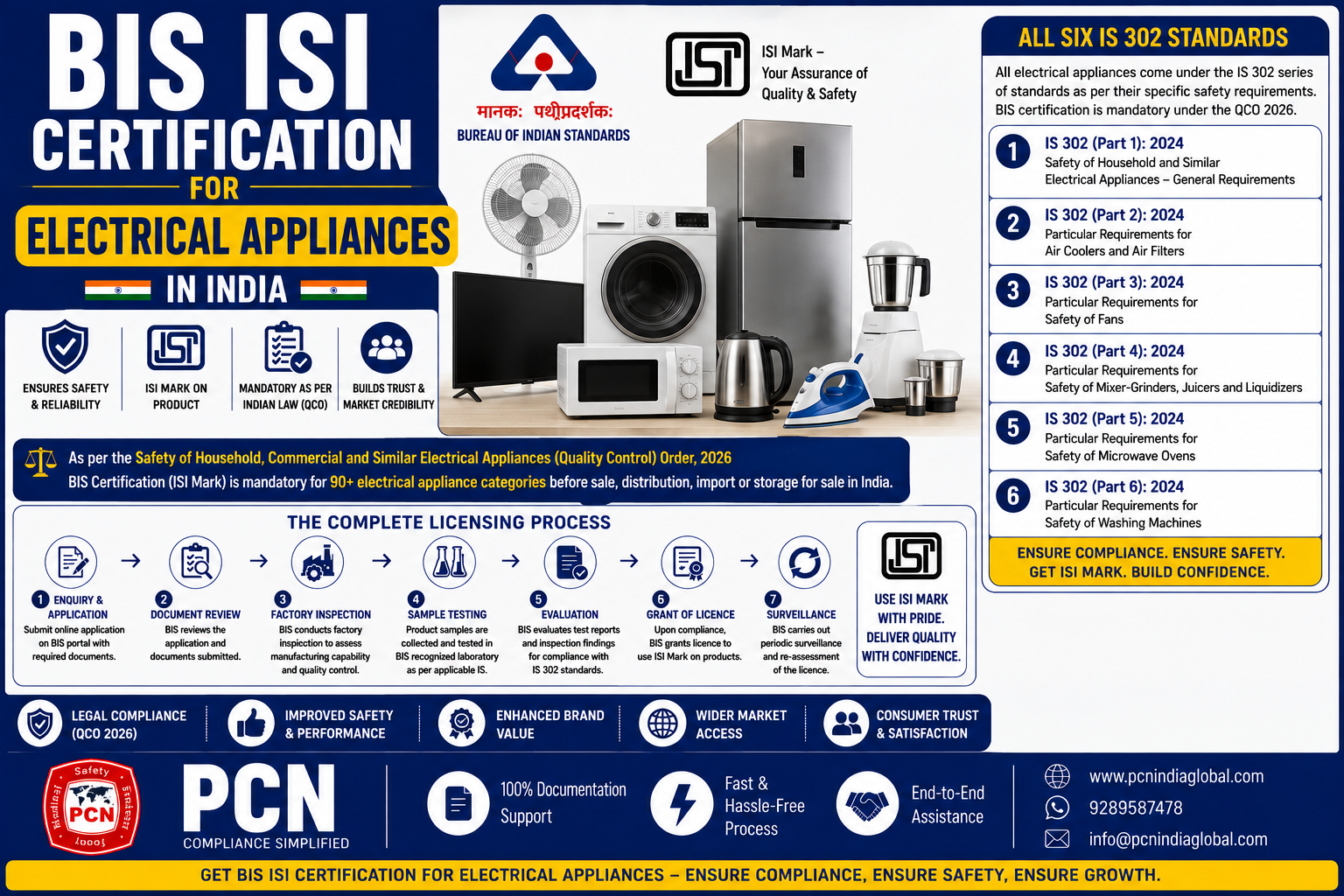
Six Indian Standards are covered, notified through five separate Quality Control Orders:
| Indian Standard | Appliance Category | Governing Order |
|---|---|---|
| IS 302 (Part 2/Sec 9):2009 | Toasters, grills, roasters | Electrical Appliances (Kitchen) QCO |
| IS 302 (Part 2/Sec 31):2009 | Range hoods | Electrical Appliances (Kitchen) QCO |
| IS 302 (Part 2/Sec 23):2009 | Skin or hair care appliances | Electrical Appliances (Skin/Hair Care) QCO |
| IS 302 (Part 2/Sec 80):2017 | Electric fans | Electrical Appliance Fans QCO, 2023 — S.O. 1124(E) dated 5 March 2024 |
| IS 302 (Part 2/Sec 75):2018 | Commercial dispensing appliances and vending machines | Electrical Appliances (Dispensing/Vending) QCO |
| IS 302 (Part 2/Sec 7):2010 | Domestic electric clothes washing machines | Electrical Appliances (Clothes Washing) QCO |
Three practical points follow from this structure. First, the kitchen QCO covers two standards — toasters/grills/roasters and range hoods — so a kitchen appliance maker may need conformity under both from a single order. Second, the vending and clothes-washing categories have each been addressed by successive orders, so manufacturers in those segments must work from the latest notification rather than the original March 2024 order. Third, IS 302 (Part 2) is a large family and other sections cover appliances under separate orders, including water heating appliances and appliances for aquariums and garden ponds — so a diversified manufacturer should map its whole range against the full IS 302 structure rather than assuming these six are exhaustive of its obligations.
Who Must Comply
The QCOs bind every link in the supply chain. Indian manufacturers need a BIS licence under Scheme-I for each manufacturing premises and each applicable standard. Importers cannot clear covered appliances through customs unless the foreign manufacturing site itself holds a BIS licence — obtained through the Foreign Manufacturers Certification Scheme (FMCS), under which BIS audits the overseas factory and grants the ISI licence to the foreign entity, which must also appoint an Authorised Indian Representative (AIR) resident in India. The Indian importer cannot hold the licence on the factory’s behalf.
Traders, distributors, and marketplaces are equally barred from storing or selling non-compliant stock. Manufacturers should confirm the operative implementation dates for their enterprise category — general, small, and micro enterprises are given staggered timelines — against the current notification for each applicable order, since the dates differ by category and several orders have been reissued. DPIIT has also issued cross-cutting exemption orders for goods and articles against import and against purchase (S.O. 775(E) and S.O. 776(E), both dated 13 February 2026) applying across several QCO categories, and goods manufactured domestically for export are typically outside scope.
What the IS 302 Standards Actually Test
The IS 302 series is aligned with the international IEC 60335 household appliance safety family, and the testing follows a consistent structure across sections with particular requirements added per appliance type.
- Protection against electric shock — insulation resistance and dielectric strength are verified, including after humidity conditioning. Access to live parts is tested with standard test probes to confirm a user or child cannot reach energised components. Earthing continuity is measured on Class I appliances, and leakage current is assessed under normal and fault conditions.
- Heating and abnormal operation — the appliance is run to thermal equilibrium and temperature rise is measured at windings, enclosures, handles, and adjacent surfaces. It is then subjected to abnormal conditions — a stalled motor, a blocked air path, a failed thermostat, continuous operation — to confirm that protective devices intervene before fire or hazard. This is where thermal cut-outs and motor protection earn their place.
- Mechanical strength and stability — enclosures are impact tested, moving parts and their guarding assessed, and stability verified for free-standing appliances. Fan testing includes specific attention to the security of the rotating assembly and blade mounting, since a released blade is a serious hazard.
- Construction, components, and materials — creepage and clearance distances, the quality and rating of switches, capacitors, motors and cords, the security of internal wiring and connections, resistance to heat and fire of insulating materials, and moisture resistance are examined. Cord anchorage and strain relief are checked on portable appliances.
- Section-specific requirements — each section adds particular tests. Skin and hair care appliances under Section 23 receive special attention to surface temperature and to hazards arising from use near the body and near water. Range hoods under Section 31 are assessed for behaviour above a cooking surface, including grease and heat exposure. Washing machines under Section 7 combine water and electricity and are tested accordingly, with attention to door interlocks and drum safety. Commercial dispensing and vending appliances under Section 75 address the demands of unattended public-use equipment.
Marking requirements are verified in all cases, including the ISI mark with the licence (CM/L) number, the IS number, and electrical ratings. Products must pass at a BIS-recognised laboratory, and the factory must demonstrate ongoing capability — Scheme-I is a licence to a manufacturing process, not a one-time product approval. The Scheme of Inspection and Testing (SIT) requires specified in-house electrical safety test equipment and quality records operating at the factory.
Step-by-Step: Obtaining the BIS ISI Licence
- Product-standard mapping. Map every model to the correct IS 302 section and identify which QCO governs it, then structure applications per standard and manufacturing location.
- Gap assessment and in-house testing setup. Establish the electrical safety testing equipment — dielectric, earth continuity, leakage current, temperature measurement — and quality records the SIT requires.
- Application filing. Submit on the BIS portal with factory details, product details, circuit diagrams, manufacturing process flow, and prescribed fees — for foreign manufacturers, via FMCS with AIR nomination.
- Factory inspection. A BIS officer visits the premises to verify the production and assembly process, in-house testing capability, and quality control arrangements, and draws samples across models.
- Independent laboratory testing. Samples are tested against the applicable section at a BIS-recognised laboratory — shock protection, heating, abnormal operation, mechanical, and component tests as prescribed.
- Grant of licence. On satisfactory inspection and test results, BIS grants the licence (CM/L number), authorising use of the Standard Mark.
- Marking and ongoing compliance. Apply the ISI mark with the CM/L number and IS number as prescribed, operate the SIT, maintain test records, undergo periodic surveillance inspections and market sample testing, and renew on time.
Documents Required
- Company registration and factory establishment documents
- Manufacturing process flow chart for each appliance line
- List of manufacturing machinery and in-house testing equipment
- Critical component list with ratings and sources — motors, switches, capacitors, thermal cut-outs, cords, insulating materials
- Circuit diagrams and wiring details
- Product drawings, specifications, and the model/variety list per standard
- In-house test records per the Scheme of Inspection and Testing
- Third-party laboratory test reports against the applicable IS section (where drawn in advance)
- Calibration certificates for testing equipment
- Layout plan of the factory premises
- For foreign manufacturers: FMCS application, AIR nomination and undertakings, and factory audit logistics
- Authorised signatory details and application declarations
Timeline and Cost Planning
A realistic schedule for a domestic manufacturer is three to five months per standard from a well-prepared application to grant of licence, with inspection scheduling and laboratory testing as the pacing items — IS 302 testing includes heating and abnormal-operation sequences that take laboratory time by design. Foreign manufacturers under FMCS should plan for five to seven months.
The cost driver in this category is breadth. A manufacturer making fans, kitchen appliances, and hair care products needs a licence under each applicable section, each with its own testing programme. Costs fall into four buckets: BIS application and licence fees per standard, the marking fee (linked to production), laboratory testing charges per standard and model family, and — for FMCS applicants — inspection travel and the AIR arrangement. Sensible grouping of models on shared electrical platforms is the main lever on testing cost. Budget separately for BEE star labelling, which ceiling fans and several other appliances carry. Estimate your obligation with our India Compliance Cost Calculator.
Common Mistakes That Delay an Appliance Licence
- Mapping to the wrong section. The IS 302 family is granular; a product tested against the wrong section produces an unusable report.
- Working from a superseded order. Vending and clothes-washing categories have been reissued; using the original March 2024 dates risks miscalculating obligations.
- Weak abnormal-operation protection. Designs that rely on a single thermal control without backup protection fail fault-condition testing.
- Uncontrolled critical components. Substituting motors, capacitors, switches, or cords after grant without managing the change undermines conformity at surveillance.
- Missing in-house electrical safety equipment. Scheme-I requires SIT testing at the factory; inspections fail without it.
- Importer-as-licensee confusion. The licence must be held by the foreign factory under FMCS. Consignments from unlicensed factories are stopped at customs.
- Overlooking BEE. Star labelling for fans and other rated appliances runs parallel to, not instead of, the ISI licence.
Appliances Within the Wider Compliance Picture
The ISI licence is the centrepiece, but an appliance business carries several adjacent obligations. Ceiling fans and other rated appliances fall under the BEE star labelling programme — see our BEE Registration service. Producers and importers of electrical and electronic equipment must hold EPR registration for e-waste with CPCB, and appliances containing batteries additionally engage EPR registration for battery waste. Packaged retail products require Legal Metrology (LMPC) registration, and plastic packaging brings EPR registration for plastic waste. Appliances with wireless connectivity — increasingly common in smart appliances — engage WPC-ETA approval. Importers require valid import documentation and IEC via our DGFT license services. A coordinated plan brings the BIS ISI licence, BEE, EPR, and LMPC together.
Pre-Launch Compliance Checklist
Before committing to production or a shipment, run this verification sequence. First, map every model to the correct IS 302 section and confirm which QCO and which edition of that order governs it. Second, verify the manufacturing site holds or has applied for the Scheme-I licence for each applicable standard, with an AIR in place for foreign factories. Third, confirm in-house electrical safety testing and SIT records are operational. Fourth, check the ISI mark, CM/L number, IS number, and electrical ratings appear correctly on the appliance and packaging. Fifth, verify the critical component list matches what will actually be built. Sixth, close the adjacent items: BEE star labelling where applicable, e-waste and battery EPR, LMPC declarations, wireless approvals for smart models, and import documentation.
For ongoing operations, maintain a compliance register per model: CM/L number and validity, the IS section and edition, critical component sources, surveillance inspection dates, market sample results, and renewal timelines.
Frequently Asked Questions
Is BIS certification mandatory for household electrical appliances in India?
Yes, for notified categories. Separate Quality Control Orders notified in March 2024 cover kitchen appliances, skin and hair care appliances, fans, commercial dispensing and vending appliances, and domestic clothes washing machines, each requiring the ISI mark under a valid BIS licence.
Which Indian Standards are covered?
Six sections of IS 302 (Part 2): Sec 9 (toasters, grills, roasters), Sec 31 (range hoods), Sec 23 (skin or hair care appliances), Sec 80 (fans), Sec 75 (commercial dispensing appliances and vending machines), and Sec 7 (domestic electric clothes washing machines).
Why are there several QCOs instead of one?
The government notified appliance categories through separate orders — kitchen, skin and hair care, fans, dispensing and vending, and clothes washing. A manufacturer with a broad range must therefore track several orders, each with its own dates, and the kitchen order alone covers two standards.
Are ceiling fans covered?
Yes. Fans fall under IS 302 (Part 2/Sec 80):2017 through the Electrical Appliance Fans (Quality Control) Order, 2023 — S.O. 1124(E) dated 5 March 2024. Fans also carry BEE star labelling obligations separately.
Do these six standards cover all my appliances?
Not necessarily. IS 302 (Part 2) is a large family and other sections are notified under separate orders, including appliances for domestic water heating and appliances for use with aquariums and garden ponds. Map your full range against the complete IS 302 structure.
Can importers get the BIS licence themselves?
No. Under FMCS the licence is granted to the foreign manufacturing site, which must appoint an Authorised Indian Representative resident in India. Importers can only source covered appliances from factories holding a valid BIS licence.
Does the ISI licence replace BEE star labelling?
No. They are separate programmes. The ISI licence covers safety conformity; BEE star labelling covers energy performance for rated appliance categories such as ceiling fans.
What are the penalties for non-compliance?
Manufacturing or selling covered appliances without the ISI mark is an offence under the BIS Act, 2016, attracting imprisonment of up to two years and/or fines starting at ₹2 lakh, alongside seizure of non-compliant stock and customs detention of imports.
Why Choose PCN India Global
- IS 302 family expertise — precise section mapping across the appliance range and identification of every governing QCO, including reissued orders
- Multi-licence programme management — we sequence applications across standards so a broad appliance range reaches market without gaps
- Factory readiness — we prepare your electrical safety testing setup and SIT records so the BIS inspection passes the first time
- FMCS for foreign manufacturers — end-to-end management of the overseas audit, and we act as your Authorised Indian Representative
- BEE alongside BIS — star labelling planned together with the ISI licence for fans and other rated appliances
- Integrated compliance — EPR, LMPC, and wireless approvals handled alongside certification
PCN India Global manages the complete BIS ISI certification process for electrical appliance manufacturers and importers — from IS 302 section mapping and factory preparation to licence grant and renewal across multiple standards, coordinated with the BEE, EPR, and LMPC obligations this category carries. Contact us: WhatsApp +91 80109 05029, email bdm@pcnindiaglobal.com, or start your application today.