
BIS ISI Certification for Air Coolers and Air Filters in India: IS 3315, IS 17570 (Part 1) and the Complete Licensing Process
The evaporative air cooler is one of India’s most characteristic products. In the dry heat of the north and west, a desert cooler delivers meaningful comfort at a fraction of the running cost of air conditioning, which is why tens of millions of homes, workshops, and small offices rely on them through the summer. Air filters, by contrast, work invisibly — sitting inside ventilation and HVAC systems, capturing the particulate matter that Indian urban air carries in abundance. The two products sit together in one Quality Control Order because both determine the quality of the air people breathe indoors, and both have been dominated by unregulated manufacturing. This guide covers BIS certification for air coolers in India: the applicable IS standards, testing, documents and the licensing process.
The government has brought the category under compulsory BIS certification through the Air Cooler and Air Filters (Quality Control) Order — first notified as the 2023 Order vide S.O. 1114(E) dated 5 March 2024, reissued as the 2025 Order vide S.O. 529(E) dated 30 January 2025, and further amended by S.O. 777(E) dated 13 February 2026 — making the ISI mark mandatory under Scheme-I of the BIS (Conformity Assessment) Regulations, 2018, as listed on the BIS list of products under compulsory certification.
The order covers two Indian Standards. This guide explains both, what they test, the licensing process, documents, timelines, costs, common mistakes, and how certification fits into the wider India compliance picture.
Why Air Coolers and Air Filters Fall Under Mandatory BIS Certification
Quality Control Orders are the government’s instrument for making an Indian Standard mandatory. Once a QCO is notified under the BIS Act, 2016, no person can manufacture, import, distribute, sell, hire, lease, store, or exhibit for sale any covered product without the ISI mark granted under a valid BIS licence.
For air coolers, the case combines electrical safety with honest performance. A cooler is a mains-powered appliance containing a water tank, a pump, and a motor — electricity and water in one plastic or metal cabinet, operated in homes and often left running unattended. Poor earthing, inadequate insulation, or a pump whose wiring is exposed to water creates a shock hazard in a product that is frequently topped up by hand. Beyond safety, cooling performance is the reason the product is bought, and it is easily overstated: cooling efficiency depends on pad quality, water distribution, and airflow, none of which a buyer can assess in a showroom. There is also a public-health dimension, since standing water in a poorly designed cooler tank is a known mosquito breeding site.
For air filters, the rationale is measurement honesty. A filter is sold on a claimed efficiency — how much particulate matter it removes — and that claim is entirely unverifiable by the purchaser. In a country with serious ambient particulate pollution, filters underperforming their claims mean building occupants breathe air they believe has been cleaned. IS 17570 (Part 1) adopts the international ISO 16890 classification based on particulate matter efficiency, replacing older and less meaningful rating conventions with a system tied to the PM fractions that actually matter for health. Certified conformity means a filter’s ePM rating has been demonstrated, not asserted.
For manufacturers, the QCO is also a commercial gate: organised retail, HVAC contractors, institutional and government procurement, and e-commerce marketplaces verify BIS licences, and customs authorities check compliance at import.
Which Products Are Covered: Both Notified Standards
| Indian Standard | Product Category | Scope |
|---|---|---|
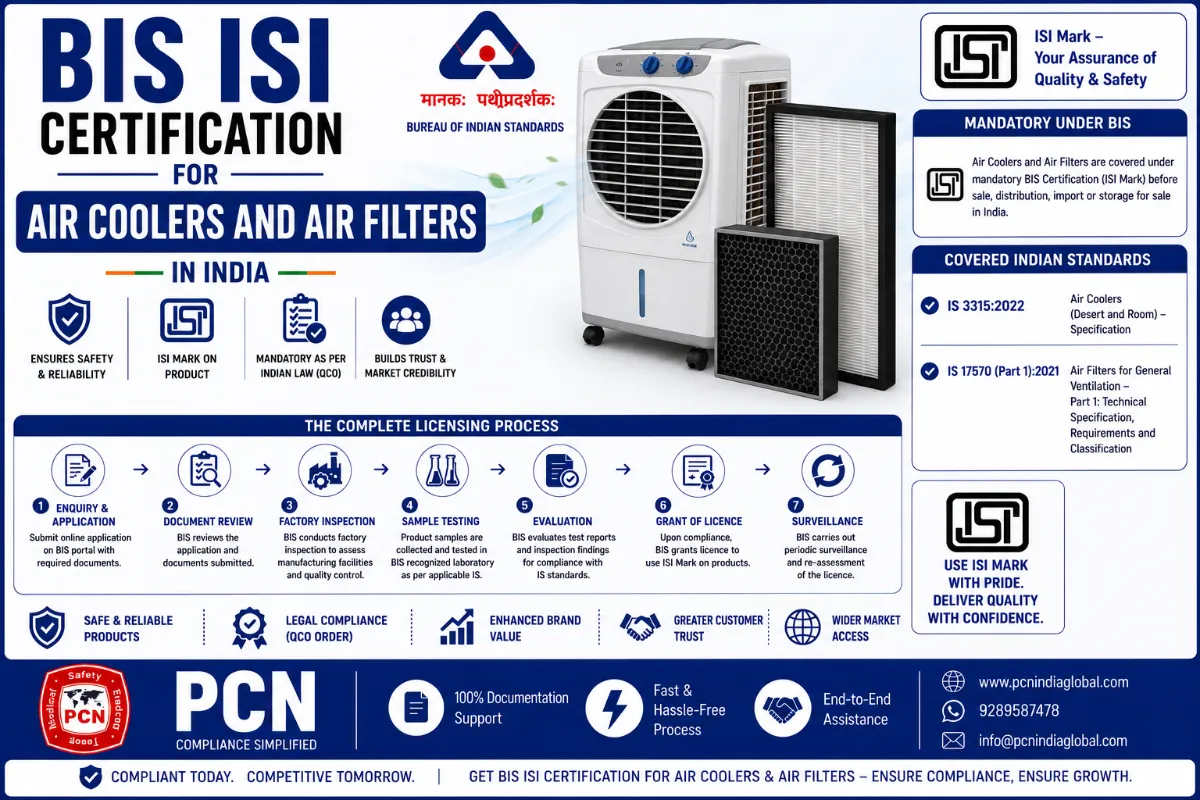
| IS 3315:2019 | Evaporative air coolers | Desert coolers and similar evaporative cooling appliances for domestic and commercial use |
| IS 17570 (Part 1):2021 / ISO 16890-2:2016 | Air filters for general ventilation | Filters classified by particulate matter efficiency (ePM) for HVAC and ventilation systems |
The two standards address very different products with very different test regimes, and a business operating in both segments needs a licence under each. Manufacturers should confirm the exact covered products, standards, and current editions against the latest notification before testing, because the licence is granted per standard, per manufacturing location — and this category has been reissued and amended, so working from the current order matters.
Who Must Comply
The QCO binds every link in the supply chain. Indian manufacturers need a BIS licence under Scheme-I for each manufacturing premises and each applicable standard. Importers cannot clear covered coolers or filters through customs unless the foreign manufacturing site itself holds a BIS licence — obtained through the Foreign Manufacturers Certification Scheme (FMCS), under which BIS audits the overseas factory and grants the ISI licence to the foreign entity, which must also appoint an Authorised Indian Representative (AIR) resident in India. The Indian importer cannot hold the licence on the factory’s behalf.
Traders, distributors, HVAC contractors, and marketplaces are equally barred from storing or selling non-compliant stock. The air cooler segment has a large unorganised manufacturing base, and this is where the QCO bites hardest. Small workshops assembling coolers from bought-in cabinets, pumps, and motors are manufacturers for QCO purposes and need a licence for the premises where assembly happens — a significant shift for a segment that has operated informally.
Manufacturers should confirm the operative implementation dates for their enterprise category — general, small, and micro enterprises are given staggered timelines — against the current notification, noting the 2025 reissue and the February 2026 amendment. DPIIT has also issued cross-cutting exemption orders for goods and articles against import and against purchase (S.O. 775(E) and S.O. 776(E), both dated 13 February 2026), and goods manufactured domestically for export are typically outside scope.
What the Standards Actually Test
Air coolers under IS 3315 are assessed on both safety and performance. Electrical safety testing covers insulation resistance and dielectric strength, earthing continuity, leakage current, and protection against access to live parts — with particular attention to the wet environment inside the cabinet and to the water pump’s electrical integrity. Cooling performance is measured: the temperature drop the cooler achieves under defined conditions, air delivery volume, and the effectiveness of the cooling pads and water distribution system. Construction requirements cover cabinet material quality and corrosion resistance, water tank integrity and freedom from leakage, pump performance, fan or blower assembly security, and the durability of components exposed to constant wetting. Marking requirements including the ISI mark with the licence (CM/L) number, the IS number, and electrical and performance ratings are verified.
Air filters under IS 17570 (Part 1) are tested to the ISO 16890 methodology, which is fundamentally different. The filter is challenged with test aerosols and its efficiency measured against the particulate fractions PM1, PM2.5, and PM10 to establish its ePM classification. Efficiency is measured both initially and after conditioning, because a filter’s clean-state performance can overstate its behaviour in service. Pressure drop across the filter is measured at rated airflow, since a filter that captures well but chokes airflow imposes an energy penalty on the ventilation system. Dust-holding capacity is assessed to indicate service life, and the mechanical integrity of the filter media, frame, and seals is verified — a filter that bypasses air around a poorly sealed frame delivers none of its rated efficiency in practice.
Products must pass at a BIS-recognised laboratory, and the factory must demonstrate ongoing capability to manufacture conforming products — Scheme-I is a licence to a manufacturing process, not a one-time product approval. The Scheme of Inspection and Testing (SIT) requires specified in-house test equipment and quality records at the factory: electrical safety testing for coolers, and for filters, capability appropriate to verifying media and assembly quality.
Step-by-Step: Obtaining the BIS ISI Licence
- Product-standard mapping. Confirm whether your products fall under IS 3315, IS 17570 (Part 1), or both, and structure applications per standard and manufacturing location.
- Gap assessment and in-house testing setup. Establish the test equipment and quality records the SIT requires — electrical safety instrumentation for coolers, media and assembly verification for filters.
- Application filing. Submit on the BIS portal with factory details, product details, manufacturing process flow, and prescribed fees — for foreign manufacturers, via FMCS with AIR nomination.
- Factory inspection. A BIS officer visits the premises to verify the production and assembly process, in-house testing capability, and quality control arrangements, and draws samples across the model range.
- Independent laboratory testing. Samples are tested against the applicable standard at a BIS-recognised laboratory — safety and cooling performance for coolers, ePM efficiency, pressure drop, and dust-holding for filters.
- Grant of licence. On satisfactory inspection and test results, BIS grants the licence (CM/L number), authorising use of the Standard Mark.
- Marking and ongoing compliance. Apply the ISI mark with the CM/L number and IS number as prescribed, operate the SIT, maintain test records, undergo periodic surveillance inspections and market sample testing, and renew on time.
Documents Required
- Company registration and factory establishment documents
- Manufacturing process flow chart — cabinet moulding or fabrication, assembly, testing and packing for coolers; media pleating, frame assembly and sealing for filters
- List of manufacturing machinery and in-house testing equipment
- Details of bought-out components and materials — motors, pumps, cooling pads, filter media, frames, sealants — and their sources
- Product drawings, specifications, capacity and size range, and the model/variety list
- Circuit diagrams and wiring details (coolers)
- In-house test records per the Scheme of Inspection and Testing
- Third-party laboratory test reports against the applicable IS (where drawn in advance)
- Calibration certificates for testing equipment
- Layout plan of the factory premises
- For foreign manufacturers: FMCS application, AIR nomination and undertakings, and factory audit logistics
- Authorised signatory details and application declarations
Timeline and Cost Planning
A realistic schedule for a domestic manufacturer is three to five months from a well-prepared application to grant of licence, with inspection scheduling and laboratory testing as the pacing items. Air cooler performance testing requires controlled ambient conditions, and filter testing to ISO 16890 is a specialised procedure available at a limited number of laboratories — so booking laboratory capacity early matters more in this category than in most. Foreign manufacturers under FMCS should plan for five to seven months.
Costs fall into four buckets: BIS application and licence fees per standard, the marking fee (linked to production), laboratory testing charges per model or filter class, and — for FMCS applicants — inspection travel and the AIR arrangement. For filter manufacturers, testing cost scales with the number of distinct media and ePM classes submitted, so rationalising the range before application is the main cost lever. Air cooler makers should group models sharing a common electrical and pump platform. Estimate your obligation with our India Compliance Cost Calculator.
Common Mistakes That Delay a Licence
- Working from the superseded order. This category was reissued in 2025 and amended in 2026; obligations must be read from the current notification.
- Treating assembly as outside scope. Small workshops assembling coolers from bought-in parts are manufacturers and need their own licence.
- Weak wet-environment electrical design. Pump wiring and earthing in a water-filled cabinet is where cooler safety testing most often fails.
- Overstated filter claims. A filter whose measured ePM class falls short of its marketed rating cannot be certified to that rating.
- Ignoring pressure drop. Filters optimised purely for efficiency may fail on airflow resistance; both are assessed.
- Poor frame sealing. Air bypassing a badly sealed filter frame negates rated efficiency and is caught in testing.
- Importer-as-licensee confusion. The licence must be held by the foreign factory under FMCS. Consignments from unlicensed factories are stopped at customs.
Air Coolers and Filters Within the Wider Compliance Picture
The ISI licence is the centrepiece, but this category carries adjacent obligations. Air coolers fall within the BEE star labelling framework for rated appliance categories — see our BEE Registration service to confirm current applicability for your product. Producers and importers of electrical and electronic equipment must hold EPR registration for e-waste with CPCB. Packaged retail products require Legal Metrology (LMPC) registration and compliant declarations, and plastic packaging brings EPR registration for plastic waste — relevant for cooler manufacturers, whose cabinets and packaging are substantially plastic. Importers require valid import documentation and IEC via our DGFT license services. A coordinated plan brings the BIS ISI licence, EPR, and LMPC together.
Pre-Launch Compliance Checklist
Before committing to production or a shipment, run this verification sequence. First, confirm which standard applies to each product and read your obligations from the current order, not the 2024 original. Second, verify the manufacturing site — including any assembly premises — holds or has applied for the Scheme-I licence, with an AIR in place for foreign factories. Third, confirm in-house testing equipment and SIT records are operational. Fourth, check the ISI mark, CM/L number, IS number, and ratings appear correctly on the product and packaging, and that filter ePM claims match the certified class. Fifth, align model, size, and factory address across product, test reports, and licence scope. Sixth, close the adjacent items: BEE where applicable, e-waste and plastic EPR, LMPC declarations, and import documentation.
For ongoing operations, maintain a compliance register per model: CM/L number and validity, standard and edition, licensed models and filter classes, component and media sources, surveillance inspection dates, market sample results, and renewal timelines.
Frequently Asked Questions
Is BIS certification mandatory for air coolers in India?
Yes. Under the Air Cooler and Air Filters (Quality Control) Order — notified as the 2023 Order vide S.O. 1114(E) dated 5 March 2024, reissued as the 2025 Order vide S.O. 529(E) dated 30 January 2025, and amended by S.O. 777(E) dated 13 February 2026 — covered evaporative air coolers cannot be manufactured, imported, or sold in India without the ISI mark under a valid BIS licence.
Which Indian Standards are covered?
Two: IS 3315:2019 for evaporative air coolers (desert coolers), and IS 17570 (Part 1):2021, aligned with ISO 16890-2:2016, for air filters for general ventilation classified by particulate matter efficiency (ePM).
What is ePM classification?
ePM is the ISO 16890 system that rates a filter by its efficiency against particulate matter fractions — PM1, PM2.5, and PM10 — rather than by older rating conventions. It ties a filter’s rating to the particle sizes that matter for health, and certification requires that the claimed class be demonstrated by testing.
Do small workshops assembling coolers need a licence?
Yes. A business assembling coolers from bought-in cabinets, pumps, and motors is a manufacturer for QCO purposes and needs a BIS licence for the premises where assembly takes place.
Can importers get the BIS licence themselves?
No. Under FMCS the licence is granted to the foreign manufacturing site, which must appoint an Authorised Indian Representative resident in India. Importers can only source covered products from factories holding a valid BIS licence.
What does air cooler testing cover?
Electrical safety — insulation, earthing, leakage current, protection against live parts in a wet environment — plus cooling performance including temperature drop and air delivery, water tank and pump integrity, construction and corrosion resistance, and marking.
How long does the ISI licence take?
Typically three to five months for Indian manufacturers and five to seven months for foreign manufacturers under FMCS. Booking laboratory capacity early is advisable, since ISO 16890 filter testing is available at a limited number of laboratories.
What are the penalties for non-compliance?
Manufacturing or selling covered air coolers or air filters without the ISI mark is an offence under the BIS Act, 2016, attracting imprisonment of up to two years and/or fines starting at ₹2 lakh, alongside seizure of non-compliant stock and customs detention of imports.
Why Choose PCN India Global
- Current-order expertise — we read your obligations from the 2025 order and 2026 amendment, not the superseded original
- Dual-standard capability — licence structuring for businesses spanning both coolers and filters
- Factory readiness — we prepare your in-house testing setup and SIT records so the BIS inspection passes the first time
- Lab coordination — early booking at BIS-recognised laboratories, including ISO 16890 filter testing capacity
- FMCS for foreign manufacturers — end-to-end management of the overseas audit, and we act as your Authorised Indian Representative
- Integrated compliance — BEE, EPR, and LMPC handled alongside the ISI licence
PCN India Global manages the complete BIS ISI certification process for air cooler and air filter manufacturers and importers — from standard mapping and factory preparation to licence grant and renewal. Contact us: WhatsApp +91 80109 05029, email bdm@pcnindiaglobal.com, or start your application today.
Related Compliance Guides
- BIS Certification (ISI Mark) — Complete Service Overview
- BEE Registration and Star Labelling
- EPR Registration for Plastic Waste
Related Guides
- BIS ISI Certification for Flashlights in India
- BIS ISI Certification for Electrical Appliances in India
- BIS ISI Certification for Solar Thermal Systems, Devices and Components in India
- BIS ISI Certification for Water Meters and Accessories in India
Need expert help? See our BIS ISI mark certification services.