BIS ISI Certification for Bicycles in India (IS 10613): The Bicycle & Bicycle Parts QCO Explained

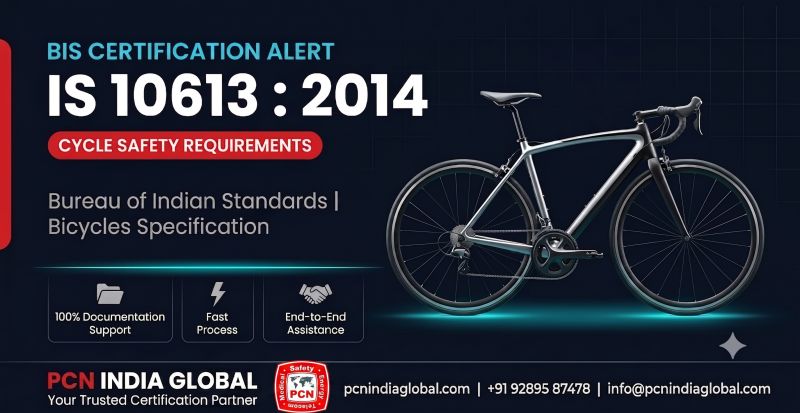
India is one of the largest bicycle markets in the world, serving everyone from school children and daily commuters to a fast-growing segment of fitness and recreational riders. With that scale comes a clear safety imperative: a bicycle with a weak frame, faulty brakes, or poor reflectors is a genuine road hazard. To raise and enforce safety standards across the market, the government has brought bicycles and bicycle parts under mandatory BIS certification through a dedicated Quality Control Order. For manufacturers and importers, this changes the rules of market entry. A bicycle can no longer simply be assembled or imported and sold; it must carry the ISI mark, certified against the relevant Indian Standard. This guide explains the Bicycle & Bicycle Parts QCO, the IS 10613 safety standard, what is covered, and exactly how to obtain certification. 1. Is BIS Certification Mandatory for Bicycles? Yes. The Central Government issued the Bicycle & Bicycle Parts (Quality Control) Order, 2023, under Section 16 of the Bureau of Indian Standards Act, 2016. Under this order, bicycles and covered bicycle parts must comply with the relevant Indian Standards and bear the ISI mark obtained through a BIS licence (or, where applicable, a Certificate of Conformity). Production, trade, sale, stocking, or importation of these items without the ISI mark is prohibited. The order does not apply to products manufactured exclusively for export. 2. The IS 10613 Standard The core safety standard for bicycles is IS 10613, titled “Cycles — Safety and Performance Requirements for Bicycles.” The current version is IS 10613: 2023. It sets out the safety and performance requirements a bicycle must meet — covering structural integrity, braking, steering, and the other characteristics that determine whether a bicycle is safe to ride. Beyond the complete bicycle, the QCO framework also extends to bicycle parts and components, including retro-reflective devices, which have their own applicable standards and certification requirements. 3. What Is Covered The scope spans the complete bicycle and a range of safety-relevant parts. Manufacturers and importers should map their entire product line against the order, because individual components may require their own certification: If you manufacture or import both complete bicycles and separate spare parts, do not assume one licence covers everything — clarify which components require their own certification at the outset. 4. The Certification Route Bicycles are certified under the ISI mark route. For products covered by QCOs, the Central Government directs the use of the Standard Mark under a licence or Certificate of Conformity from BIS. The broad process is: 5. Foreign Manufacturers Overseas bicycle makers certify through the Foreign Manufacturers Certification Scheme (FMCS) version of the ISI route. As with all FMCS applications, the foreign manufacturer must appoint an Authorised Indian Representative (AIR) resident in India, and BIS inspectors audit the overseas factory — which extends the timeline and adds travel cost. Given the volume of bicycles and components imported into India, foreign manufacturers serious about the market should treat certification as a planned, scheduled part of market entry rather than an afterthought, and should align their AIR appointment and factory readiness well before their intended launch. 6. Documents, Timeline, and Validity Typical documentation includes the manufacturing licence or business registration, details of the production process and testing facilities, technical specifications and drawings, trademark or brand authorisation, and — for foreign applicants — the AIR appointment. Timelines depend on factory readiness and lab queues: a domestic application commonly takes a few months, while foreign FMCS applications run longer because of overseas audit scheduling. The ISI licence is granted for a defined term and is renewable, subject to continued compliance and periodic surveillance. 7. Why the Bicycle QCO Was Introduced Understanding the intent behind the order helps manufacturers approach it constructively. For years, India’s bicycle market included a long tail of low-cost products of inconsistent quality, some of which posed real safety risks — frames that could fail under load, brakes that did not stop reliably, and reflectors too poor to make a rider visible at dusk. The QCO is a deliberate move to lift the floor: by making IS 10613 mandatory, the government ensures that every bicycle sold in India meets a verified baseline of structural and braking safety. For reputable manufacturers, this is good news — it levels the playing field against sub-standard competition and rewards those who already build to a proper standard. There is also a road-safety dimension. Bicycles share busy Indian roads with fast-moving traffic, and components like retro-reflective devices are not cosmetic — they are what makes a cyclist visible to a driver in low light. Bringing these parts under mandatory certification reflects a recognition that bicycle safety is also public safety. 8. Common Mistakes That Delay Certification Bicycle manufacturers and importers tend to encounter the same avoidable issues, and anticipating them keeps an application on track: 9. Surveillance, Renewal, and the Business Case Once granted, an ISI licence comes with ongoing responsibilities. BIS conducts periodic surveillance to confirm that production continues to meet the standard, and the licence must be renewed before it expires to keep the right to use the ISI mark intact. Beyond the legal mechanics, certification carries a clear commercial upside. Organised retail chains and major e-commerce platforms increasingly require the ISI mark before they will stock a bicycle, and safety-conscious consumers recognise the mark as a signal of quality. In a competitive market, a certified, well-documented product is easier to sell and harder to dislodge — making compliance not just a legal obligation but a genuine market advantage. 10. Documents Checklist and Practical Tips A disciplined, well-prepared application is the surest route to a smooth certification. Practically, that means: 11. The Broader Push to Certify Consumer Products The bicycle QCO does not exist in isolation. It is part of a sustained, deliberate expansion of India’s mandatory certification regime across consumer products — from toys and footwear to furniture, appliances, and now bicycles. The common thread is a policy decision that products reaching ordinary households should meet a verified

BIS Certification for Gas Cylinder Service Valves in India: Standards, Process & Compliance

A service valve is a small component carrying an enormous responsibility. It is the controlled opening through which liquefied petroleum gas (LPG) and other compressed gases flow in and out of a cylinder, and a defective or sub-standard valve is a direct safety hazard — a potential source of leaks, fires, and explosions. For that reason, valves and valve fittings for gas cylinders are among the most strictly regulated components in India, requiring mandatory BIS certification under a notified Quality Control Order before they can be manufactured, imported, or sold. For manufacturers and importers of cylinder valves, regulators, and related fittings, compliance is not optional and not a formality. This guide explains exactly what BIS certification for service valves involves: the applicable Indian Standards, how the BIS requirement interacts with PESO’s separate safety regime, the certification route and process, the documents you will need, realistic timelines, and the consequences of getting it wrong. 1. Is BIS Certification Mandatory for Service Valves? Yes. Cylinders, valves, and regulators are covered by notified Quality Control Orders (QCOs) issued under the authority of the Bureau of Indian Standards Act, 2016. Once a product is brought under a QCO, manufacturing, importing, storing for sale, selling, or distributing it without a valid BIS licence and the ISI mark is prohibited. There is no minimum-quantity exemption: the requirement applies to every unit placed on the Indian market, whether produced domestically or imported. The rationale is straightforward. Because gas cylinder valves are safety-critical, the government uses the QCO mechanism to ensure that every valve sold in India is built to a verified standard and produced by a manufacturer whose process BIS has audited and approved. Unlike a voluntary quality badge, the ISI mark on a valve is a legal precondition for placing it on the market. 2. The Applicable Indian Standards Several Indian Standards govern valves and fittings depending on the gas, the cylinder, and the application. The most relevant include: Standard Scope IS 8776 Service valves for LPG cylinders / containers IS 8737 Valve fittings for LPG cylinders of capacity greater than 5 litres IS 3224 Valve fittings for compressed gas cylinders (excluding LPG cylinders) IS 3745 / IS 15100 Other valve and fitting specifications for gas cylinder applications Selecting the correct standard for your exact valve type and gas application is the essential first step. A valve intended for LPG service is certified against a different standard than one for industrial compressed gases, and applying under the wrong standard is one of the most common causes of rejection and delay. Because the standards specify materials, dimensions, sealing performance, and endurance requirements, the design and manufacture of the valve must be matched precisely to the standard from the outset. 3. The Dual Framework: BIS and PESO Valves for gas cylinders sit at the intersection of two regulatory regimes, and it is important not to confuse them. BIS, through the ISI mark, certifies that the valve conforms to the relevant Indian Standard for design, materials, and performance. PESO — the Petroleum and Explosives Safety Organisation — separately administers the safety framework around gas cylinders, valves, and regulators under the Gas Cylinder Rules. Depending on the product and activity, a manufacturer or importer may need to satisfy both BIS certification requirements and PESO approval requirements. In practice this means valve compliance should be planned holistically. Treating the BIS ISI mark and PESO approval as a single coordinated workstream — rather than two disconnected tasks — prevents the situation where a product is certified under one regime but blocked under the other. Importers in particular should map both requirements before placing an order, because a consignment can be held if either approval is missing. 4. The Certification Route: ISI Mark (Scheme-I) Service valves are certified under the ISI mark route, Scheme-I of the BIS (Conformity Assessment) Regulations, 2018. Unlike the registration-based CRS used for electronics, Scheme-I includes a factory inspection: BIS verifies not just that a sample valve passes testing, but that the manufacturing unit has the systems to produce conforming valves consistently. The broad process is: 5. Special Requirements for Foreign Manufacturers Overseas valve manufacturers certify through the Foreign Manufacturers Certification Scheme (FMCS) version of the ISI route. Two points are critical. First, the foreign manufacturer must appoint an Authorised Indian Representative (AIR) — a person or entity resident in India who acts as the official liaison with BIS and bears certain responsibilities for the licence. Second, the factory audit requires BIS inspectors to travel to the overseas plant, adding time and cost. Foreign applicants should budget for audit travel and the longer timeline this entails, typically several months, and should ensure the AIR’s details match exactly across every document to avoid avoidable delays. 6. Documents and Timeline Typical documentation includes the manufacturing licence or business registration, details of the production process and in-house testing facilities, material and design specifications for the valve, trademark or brand authorisation, and — for foreign applicants — the AIR appointment and authorisation letters. On timeline, a domestic application with an inspection-ready factory and clean documentation commonly runs a few months from application to grant; foreign applications run longer because of audit scheduling. The licence is typically valid for two years and is renewable subject to continued compliance and surveillance. 7. Why Valve Quality Is Non-Negotiable It is worth pausing on why valves attract such intense regulatory attention. A gas cylinder valve is the single point that contains pressurised, flammable gas and controls its release. If the seal fails, the body cracks, or the materials corrode, the result is a leak — and a leak of LPG or another flammable gas in a confined space is a fire or explosion waiting for an ignition source. The standards exist precisely because the failure mode is catastrophic, not cosmetic. For a manufacturer, this means quality control cannot be an afterthought: material traceability, dimensional accuracy, pressure testing, and endurance verification are the substance of compliance, and they are exactly what a BIS factory audit examines. For

Solar Panel Compliance in India: BIS Standards & the ALMM List Explained

India’s solar push is one of the largest clean-energy programmes in the world, and the compliance framework behind it has become correspondingly strict. For anyone manufacturing, importing, or supplying solar photovoltaic (PV) modules, two acronyms dominate the conversation: BIS and ALMM. They are related but distinct, and understanding how they fit together is the difference between a module that can be used in subsidised projects and one that is effectively locked out of the market. In simple terms, BIS certification proves a module meets India’s technical safety and quality standards, while ALMM — the Approved List of Models and Manufacturers, maintained by the Ministry of New and Renewable Energy (MNRE) — is the gateway list that determines which modules and manufacturers are eligible for government and government-assisted projects. BIS is the foundation; ALMM is the door it unlocks. This guide explains both, including the significant List-II change that took effect in June 2026. 1. The Two Layers: BIS and ALMM It helps to think of solar compliance in India as two stacked layers: The relationship is sequential: a manufacturer first secures BIS certification for its module, then applies to have that model and manufacturing line enrolled on the ALMM. Without the BIS foundation, ALMM is simply not possible. 2. The BIS Standards for Solar Modules Solar PV modules are certified against a set of Indian Standards harmonised with international IEC norms. The core standards include: Standard Scope IS 14286 Design qualification and type approval of terrestrial PV modules (aligned with IEC 61215) IS / IEC 61730 PV module safety qualification — construction and testing requirements IS 16077 / IS 16221 Safety and performance requirements for terrestrial PV modules These standards test a module’s ability to withstand real-world conditions — thermal cycling, humidity, mechanical load, insulation, and more. Certification is handled through the BIS conformity process applicable to PV modules, and it forms the technical evidence MNRE relies on for ALMM enrolment. 3. Understanding ALMM List-I and List-II ALMM is structured in two lists that correspond to different points in the solar supply chain: This two-list structure reflects a deliberate policy: it is not enough for the finished panel to be approved; increasingly, the cells inside it must also come from approved sources. 4. The June 2026 Change: Cell Sourcing Under List-II Key development: ALMM List-II for domestically produced solar cells came into force on 1 June 2026. From that date, modules must use cells sourced from List-II-approved manufacturers in order to qualify for government subsidies and project approvals. In practice this means a module maker can no longer rely solely on its own List-I module listing — it must also ensure the cells it uses come from an approved List-II source. For importers and integrators, this is a structural shift. A panel that was acceptable purely on the strength of List-I module approval may now fall short if its cells are not from a List-II source. Supply-chain documentation — proving where the cells originate — has become a compliance requirement in its own right. Manufacturers planning to supply the government-driven segment of the market must map their cell sourcing against List-II well ahead of bidding. 5. Why ALMM Matters Commercially ALMM is not a safety mandate that applies to every single solar sale; rather, it is a powerful market-access gate. The vast majority of India’s solar deployment is connected in some way to government schemes, subsidies, open access, or net metering — and all of those channels require ALMM-listed modules. A module that is BIS-certified but not ALMM-listed can still exist in the market, but it is shut out of the largest and most bankable segment of demand. In other words, for a serious solar business in India, ALMM listing is effectively commercial oxygen. That is why manufacturers treat the BIS-then-ALMM pathway as a strategic priority rather than a paperwork afterthought. 6. The Pathway: From BIS to ALMM 7. Common Pitfalls 8. Domestic Content Requirements and the Push for Local Manufacturing ALMM does not exist in isolation. It is one instrument in a broader policy that aims to build a self-reliant Indian solar manufacturing base — from modules down to cells and, eventually, wafers and ingots. A related concept that solar suppliers encounter is the Domestic Content Requirement (DCR), which mandates that modules used in certain government schemes be made in India using domestically manufactured components. The List-II cell-sourcing rule that took effect in June 2026 should be read against this backdrop: the direction of travel is steadily toward deeper localisation of the supply chain. For an importer or an assembler, this matters strategically. A business model built purely on importing finished modules — or on assembling modules from imported cells — faces a narrowing path into the subsidised and government-linked segments of the market. Conversely, manufacturers who invest in domestic cell sourcing and List-II-compliant supply chains position themselves to capture the largest and most policy-protected share of demand. Understanding where your products sit on this spectrum is now a core part of solar business planning, not just a compliance detail. 9. Practical Steps for Importers and Developers Whether you are a module supplier or a developer specifying panels for a project, a disciplined approach keeps you on the right side of both BIS and ALMM: 10. Quality, Bankability, and Why Standards Matter Behind the regulatory machinery, the purpose of BIS certification and ALMM is to ensure that the solar modules deployed across India actually perform and last. Solar projects are long-term assets, often financed on the expectation of 20 or 25 years of generation. A module that degrades prematurely or fails in the field does not just disappoint a single buyer — it undermines the financial model of the entire project and the confidence of the lenders and investors behind it. This is where standards and bankability intersect. Financiers and large developers increasingly treat BIS certification and ALMM listing as baseline criteria for a module to be considered bankable. A panel that cannot demonstrate compliance is difficult to
BIS QCO Deadlines 2026 mandatory certification

BIS QCO Deadlines 2026: New Mandatory Certifications Importers Can’t Ignore

If you import, manufacture, or sell products in India, 2026 is shaping up to be one of the most consequential years for compliance in recent memory. The government has notified a fresh round of Quality Control Orders (QCOs) — legal instruments that make BIS certification mandatory for entire product categories — and several of them hit their enforcement dates this year. A QCO is not a guideline. Once it takes effect, manufacturing, importing, storing for sale, or selling a covered product without a valid BIS licence becomes a punishable offence. Consignments get held at customs, e-commerce listings get pulled, and penalties have grown sharper. This guide breaks down the key 2026 deadlines and what you need to do before they arrive. 1. Electrical Appliances — Deadline 1 October 2026 The Safety of Household, Commercial and Similar Electrical Appliances (Quality Control) Order, 2026, issued by DPIIT on 6 April 2026, is the headline change. It brings roughly 90 categories of electrical appliances under mandatory BIS certification against IS 302 (Part 1): 2024. Key dates: general manufacturers must comply by 1 October 2026 (moved from the earlier 19 March 2026 date), while small enterprises get until 1 January 2027. If your appliances aren’t certified by your applicable date, they cannot legally be sold in India. 2. Furniture Products — Already in Force Beds, bunk beds, tables, desks, chairs, stools, work chairs, and storage units became mandatory under BIS from 13 February 2026. Micro, small and medium enterprises were given a grace period until 13 August 2026. Importers of furniture — a category that previously faced little certification scrutiny — are now squarely in scope. 3. Aluminium & Aluminium Alloy Products The Aluminium and Aluminium Alloy Products (Quality Control) Order, 2026, issued by the Ministry of Commerce and Industry on 11 March 2026, came into force on publication. Covered products must meet specified Indian Standards with BIS certification under Scheme-I (ISI mark). This affects a long supply chain of producers, importers, and downstream fabricators. 4. The Electronics Safety Standard Shift: IS/IEC 62368-1 Beyond new categories, India is modernising the safety standards behind existing ones. Audio, video, and IT products are transitioning from the older IS 13252 and IS 616 safety rules to the globally harmonised IS/IEC 62368-1: 2023. Manufacturers who certified under the old standard will need to re-test and re-document against the new one as the transition windows close. If your product was certified years ago, do not assume the licence carries forward automatically. 5. What Happens If You Miss a Deadline Enforcement has teeth, and 2026 reforms have made the consequences steeper: 6. Your 2026 Compliance Checklist How PCN India Global Can Help Our compliance team manages documentation, lab-test coordination, AIR/AR appointment, and end-to-end filing so your application clears the first time. Call +91 80109 05029, email bdm@pcnindiaglobal.com, or visit pcnindiaglobal.com to get started. Related Compliance Guides