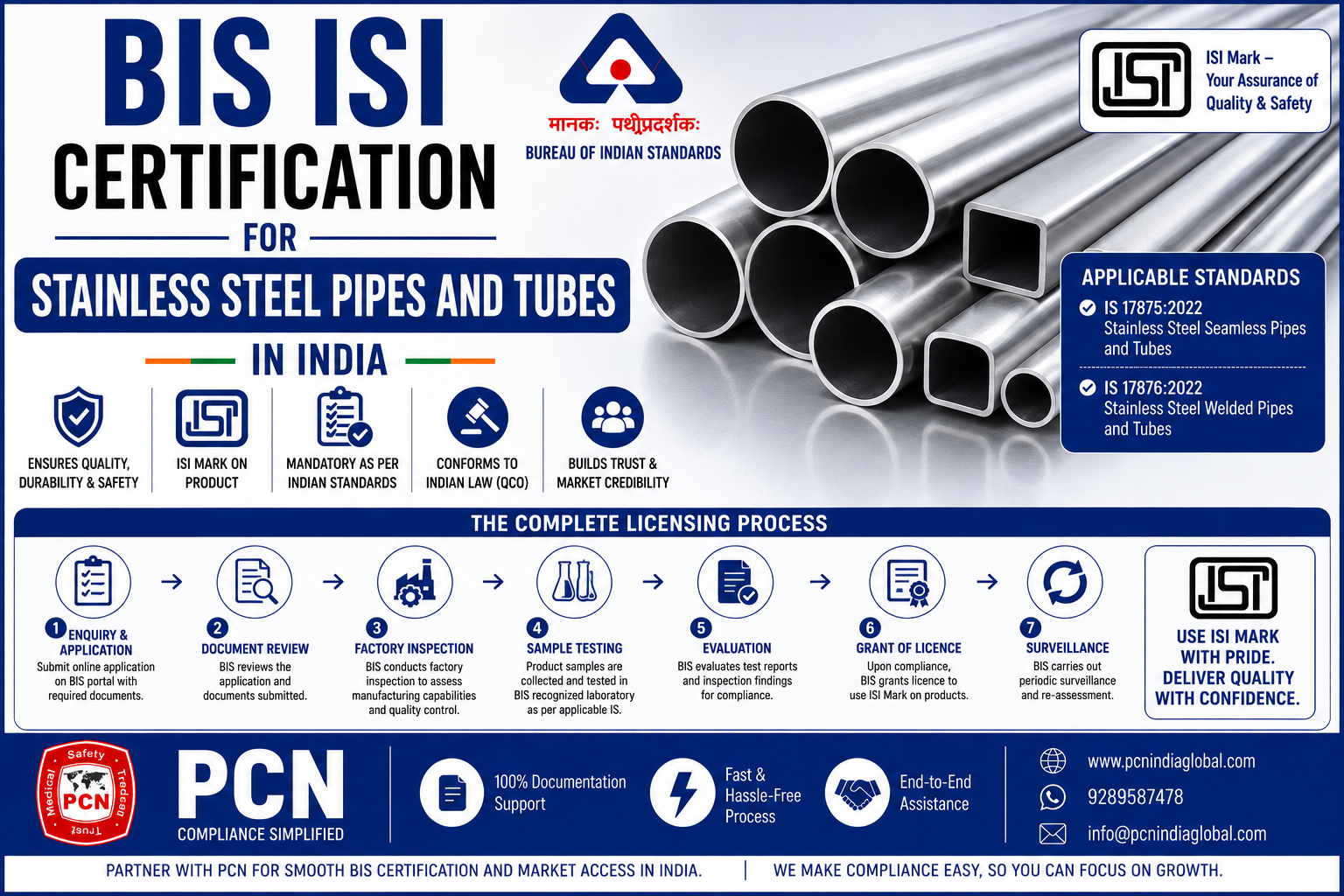
BIS ISI Certification for Stainless Steel Pipes and Tubes in India: IS 17875, IS 17876 and the Complete Licensing Process

Stainless steel pipes and tubes are the arteries of modern industry — carrying water, chemicals, food products, and gases through plants, buildings, dairies, breweries, pharmaceutical facilities, and process industries across India. Because failures in piping mean leaks, contamination, and safety hazards, the government has brought this category under compulsory BIS certification. The Stainless Steel Pipes and Tubes (Quality Control) Order, 2025 — notified by the Department for Promotion of Industry and Internal Trade (DPIIT) vide S.O. 693(E) dated 10 February 2025 — makes the ISI mark mandatory for stainless steel seamless and welded pipes and tubes for general service, certified under Scheme-I of the BIS (Conformity Assessment) Regulations, 2018, the same ISI Mark Scheme that governs steel products on the BIS list of products under compulsory certification. The QCO came into force on 1 August 2025, which means the obligation is already live: no manufacturer — Indian or foreign — can manufacture, import, distribute, sell, hire, lease, store, or exhibit for sale covered stainless steel pipes and tubes in India without a valid BIS licence and the Standard Mark. For an industry with hundreds of domestic mills and a substantial import flow from overseas producers, the order reshapes sourcing, production, and customs clearance in one stroke. This guide explains the covered products and standards, the step-by-step ISI licensing process, documents, timelines, common mistakes, and how pipe and tube certification fits into the wider India compliance picture. Why Stainless Steel Pipes and Tubes Fall Under Mandatory BIS Certification Quality Control Orders are the government’s instrument for making an Indian Standard mandatory. Once a QCO is notified under the BIS Act, 2016, covered products cannot be placed on the Indian market without the ISI mark granted under a valid BIS licence. The stainless steel pipes QCO follows the same policy logic the government has applied across the steel sector since 2020: raise the quality floor, curb substandard and misdeclared imports, and protect downstream users who cannot verify metallurgy at the point of purchase. The safety and quality rationale is substantial. A stainless steel pipe that fails in service can leak aggressive chemicals, contaminate food or pharmaceutical product streams, or burst under pressure. Substandard material — wrong grade chemistry, poor weld integrity, inadequate wall thickness, or defective surface finish — is invisible to the buyer but decisive in service life and safety. Certified conformity to the Indian Standard verifies chemical composition, mechanical properties, dimensional tolerances, and testing regimes at the mill itself. For manufacturers, the QCO is also a commercial gate: project buyers, EPC contractors, government procurement, and organised distribution now verify BIS licences for covered pipes and tubes, and customs authorities check compliance at import. Which Products Are Covered: IS 17875 and IS 17876 The QCO covers stainless steel pipes and tubes for general service under two dedicated Indian Standards published in 2022: Indian Standard Product Category Typical Products Covered IS 17875:2022 Stainless Steel Seamless Pipes and Tubes for General Service Seamless SS pipes and tubes in austenitic, ferritic and duplex grades for water lines, plumbing, structural and general industrial service IS 17876:2022 Stainless Steel Welded Pipes and Tubes for General Service ERW / welded SS pipes and tubes for general engineering, water distribution, railings, furniture tube and industrial applications The distinction between the two standards is the manufacturing route — seamless versus welded — and each has its own test regime reflecting the risks of that route: weld integrity testing matters for IS 17876, while seamless production controls dominate IS 17875. Related stainless tube products carry their own separate compulsory standards — notably IS 6913 for stainless steel tubes for the food and beverage industry — so a mill producing both general-service and food-grade tube ranges should map every product line to its correct standard before applying. As always, manufacturers should confirm the exact applicability and current edition of each standard against the latest BIS notification, because the licence is granted per standard, per manufacturing location. Who Must Comply — and From When The QCO binds every link in the supply chain. Indian mills need a BIS licence under Scheme-I for each manufacturing premises and each applicable standard. Importers cannot clear covered pipes and tubes through customs unless the foreign manufacturing site itself holds a BIS licence — obtained through the Foreign Manufacturers Certification Scheme (FMCS), under which BIS audits the overseas mill and grants the ISI licence to the foreign entity, which must also appoint an Authorised Indian Representative (AIR). Traders, stockists, and distributors are equally barred from storing or selling non-compliant material. The order came into force on 1 August 2025 — roughly 180 days from notification — and applies to all covered production and imports from that date. Products manufactured for export are outside the QCO’s scope, a standard exemption that lets export-oriented mills serve overseas customers to their specifications. Every consignment destined for the Indian market, however, must originate from a licensed site. A year into enforcement, BIS market surveillance and customs scrutiny of stainless pipe consignments are well established, and unlicensed material faces seizure and penal action under the BIS Act, 2016 — imprisonment of up to two years and/or fines starting at ₹2 lakh for a first offence. What IS 17875 and IS 17876 Actually Test Understanding what conformity requires clarifies why certification takes preparation. The standards evaluate stainless steel pipes and tubes across four broad areas. Chemical composition — the steel must match the specified grade chemistry. Spectrometric analysis verifies the percentages of chromium, nickel, molybdenum, carbon, and other elements that define corrosion resistance and mechanical behaviour. Grade substitution — supplying a cheaper grade against a higher-grade declaration — is precisely the malpractice the QCO targets. Mechanical properties — tensile strength, yield strength, elongation, and hardness are tested to confirm the material performs under load. Flattening and flaring tests verify ductility and the tube’s ability to withstand forming and installation stresses. Weld and structural integrity — for welded tubes under IS 17876, weld soundness is examined through bend tests and non-destructive examination; for
BIS ISI Certification for Ropes and Cordages in India: QCO 2024, Covered IS Standards and the Complete Licensing Process

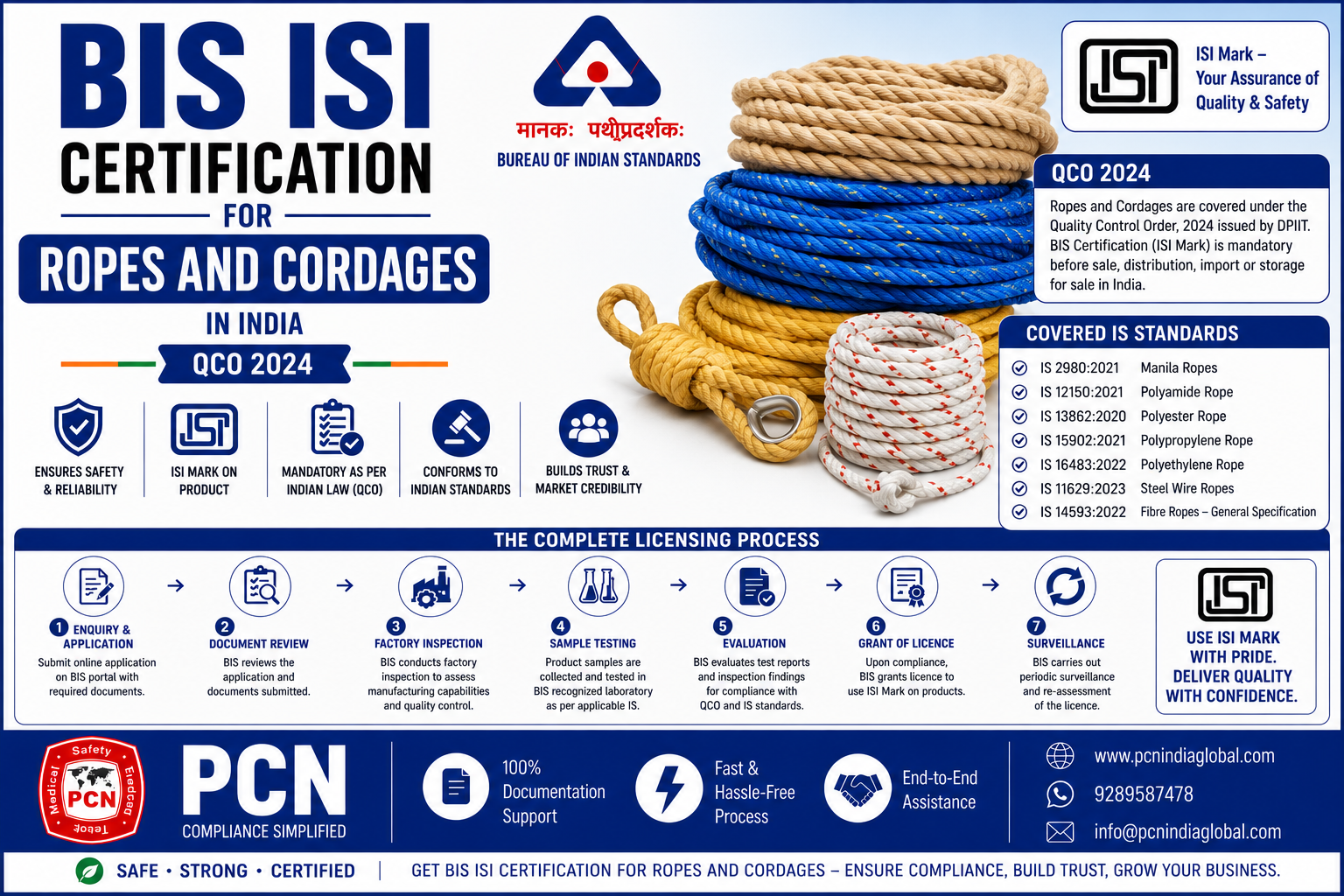
Ropes and cordages do quiet, critical work across the Indian economy — mooring fishing boats and cargo vessels, rigging scaffolds, lifting loads, securing cargo, hauling nets, and anchoring everything from tents to transmission towers. When a rope fails under load, the consequences are immediate and often severe: dropped loads, snapped mooring lines, and injuries to the people working around them. The government has brought this category under compulsory BIS certification through the Ropes and Cordages (Quality Control) Order, 2024 — notified vide S.O. 4327(E) dated 3 October 2024 — which makes the ISI mark mandatory across nine Indian Standards under Scheme-I of the BIS (Conformity Assessment) Regulations, 2018, the same ISI Mark Scheme that governs the products on the BIS list of products under compulsory certification. The QCO came into force on 1 April 2025 for general and large manufacturers, and from 1 July 2025 for small and micro enterprises manufacturing for the domestic market — which means the obligation is now fully live across the industry. Covered ropes cannot be manufactured, imported, stored, or sold in India without a valid BIS licence and the Standard Mark. For an industry spanning organised extrusion plants, traditional rope-making units, and a significant import flow, certification is now the gateway to the Indian market. This guide explains the covered products and standards, the step-by-step ISI licensing process, documents, timelines, common mistakes, and how rope certification fits into the wider India compliance picture. Why Ropes and Cordages Fall Under Mandatory BIS Certification Quality Control Orders are the government’s instrument for making an Indian Standard mandatory. Once a QCO is notified under the BIS Act, 2016, no person can manufacture, import, distribute, sell, hire, lease, store, or exhibit for sale any covered product without the ISI mark granted under a valid BIS licence. The ropes QCO, driven by the Ministry of Textiles, serves the technical textiles policy agenda: raise the quality floor of a safety-critical product, curb substandard imports, and build credibility for Indian technical textiles at home and abroad. The safety rationale is stark because rope strength is invisible. Two ropes of identical diameter and appearance can differ enormously in breaking strength depending on fibre quality, yarn construction, strand geometry, and lay. A buyer cannot test a rope at purchase — trust rests entirely on the label. Sub-specification rope sold as full-strength is a direct hazard to fishermen, riggers, construction workers, and anyone under a suspended load. Certified conformity to the Indian Standard verifies linear density, construction, and minimum breaking strength through laboratory testing at the source. For manufacturers, the QCO is also a commercial gate: shipping, fishing, defence, and construction procurement verify BIS licences for covered ropes, and customs authorities check compliance at import. Which Ropes Are Covered: All Nine Notified Standards The schedule to the QCO covers nine Indian Standards spanning natural fibre, synthetic fibre, and fibre-core products: Indian Standard Product Category Typical Products Covered IS 1084:2005 Manila Ropes Natural fibre manila ropes for marine, rigging and general purposes IS 4572:2022 Polyamide (Nylon) Ropes Polyamide 3-, 4-, 8- and 12-strand ropes for mooring, towing and lifting IS 5175:2022 Polypropylene Ropes PP split film, monofilament and multifilament (PP2) and high-tenacity multifilament (PP3) 3-, 4-, 8- and 12-strand ropes IS 8674:2013 Polyethylene Ropes Polyethylene 3- and 4-strand ropes for fishing and general use IS 11066:2022 Polyester Ropes Polyester 3-, 4-, 8- and 12-strand ropes for marine and industrial use IS 14928:2001 Composite Synthetic Fibre Ropes Ropes combining multiple synthetic fibres in composite construction IS 14929:2022 Mixed Polyolefin Fibre Ropes Ropes made from mixed polyolefin fibres for general and marine service IS 17609:2021 Polyester/Polyolefin Dual Fibre Ropes Ropes made of polyester and polyolefin dual fibres IS 1804:2004 Steel Wire Ropes — Fibre Main Cores Fibre main cores used in the construction of steel wire ropes Manufacturers should confirm the exact covered products, standards, and current editions against the latest notification before testing, because the licence is granted per standard, per manufacturing location — a plant producing PP, nylon, and polyester ranges needs conformity under each applicable standard. Note that the schedule reaches beyond fibre ropes themselves: IS 1804 covers the fibre main cores supplied into steel wire rope manufacturing, so core producers are also within the QCO. Specialised products with their own dedicated standards outside the notified schedule — such as climbing ropes — follow their own regulatory routes. Who Must Comply — and From When The QCO binds every link in the supply chain. Indian manufacturers of covered ropes need a BIS licence under Scheme-I for each manufacturing premises and each applicable standard. Importers cannot clear covered ropes through customs unless the foreign manufacturing site itself holds a BIS licence — obtained through the Foreign Manufacturers Certification Scheme (FMCS), under which BIS audits the overseas plant and grants the ISI licence to the foreign entity, which must also appoint an Authorised Indian Representative (AIR). Traders and distributors are equally barred from storing or selling non-compliant stock. The enforcement calendar was staggered by enterprise size: Both dates have passed, and the framework has since been refined by the Ropes and Cordages (Quality Control) Amendment Order, 2026 — S.O. 2871(E) dated 5 June 2026 — so manufacturers and importers should confirm the current operative position for their specific standard against the latest notification. A year into enforcement, BIS market surveillance and customs scrutiny of rope consignments are established, and unlicensed material faces seizure and penal action under the BIS Act, 2016 — imprisonment of up to two years and/or fines starting at ₹2 lakh for a first offence. Ropes manufactured for export remain outside the QCO’s scope, preserving export production, but every coil destined for the Indian market must originate from a licensed site. Manufacturers still selling uncertified stock should regularise immediately. What the Rope Standards Actually Test Understanding what the laboratory examines clarifies why certification takes preparation. The standards evaluate ropes against the properties that determine safe performance under load. Breaking strength — the defining test. Rope specimens are pulled to destruction on tensile

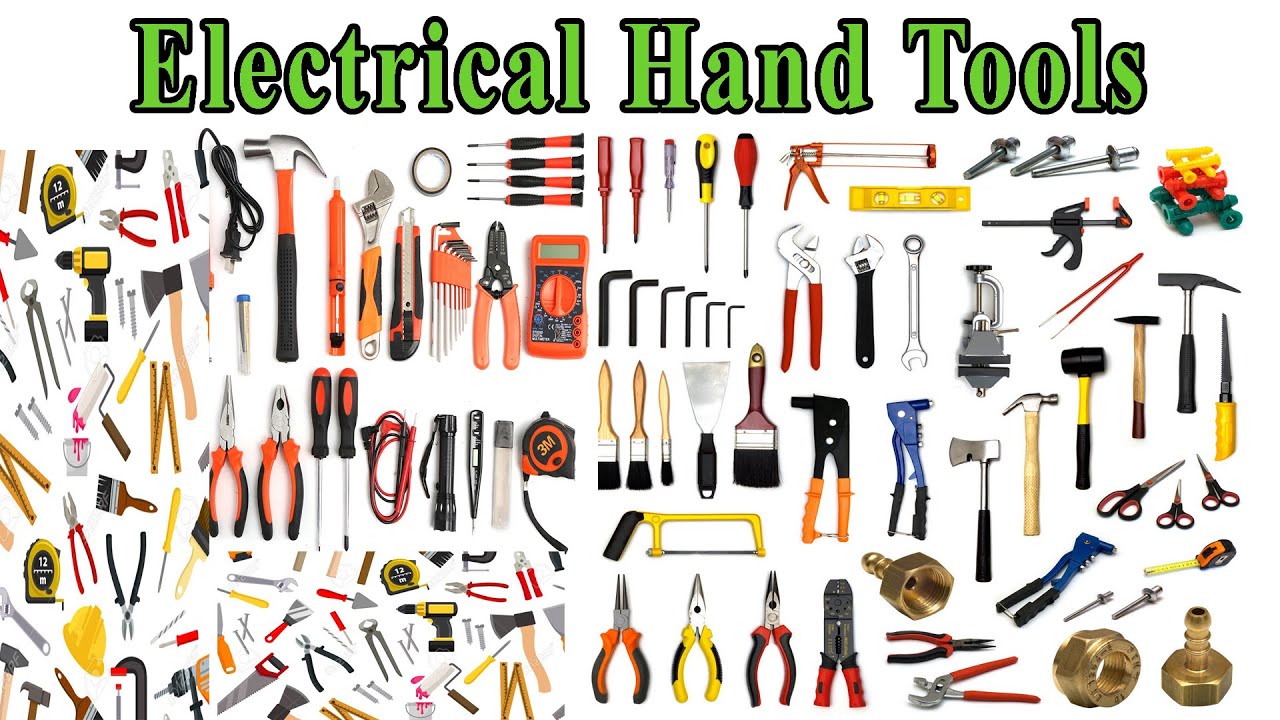
BIS ISI Certification for Hand Tools in India: Hand Tools QCO, Covered IS Standards and the Complete Licensing Process

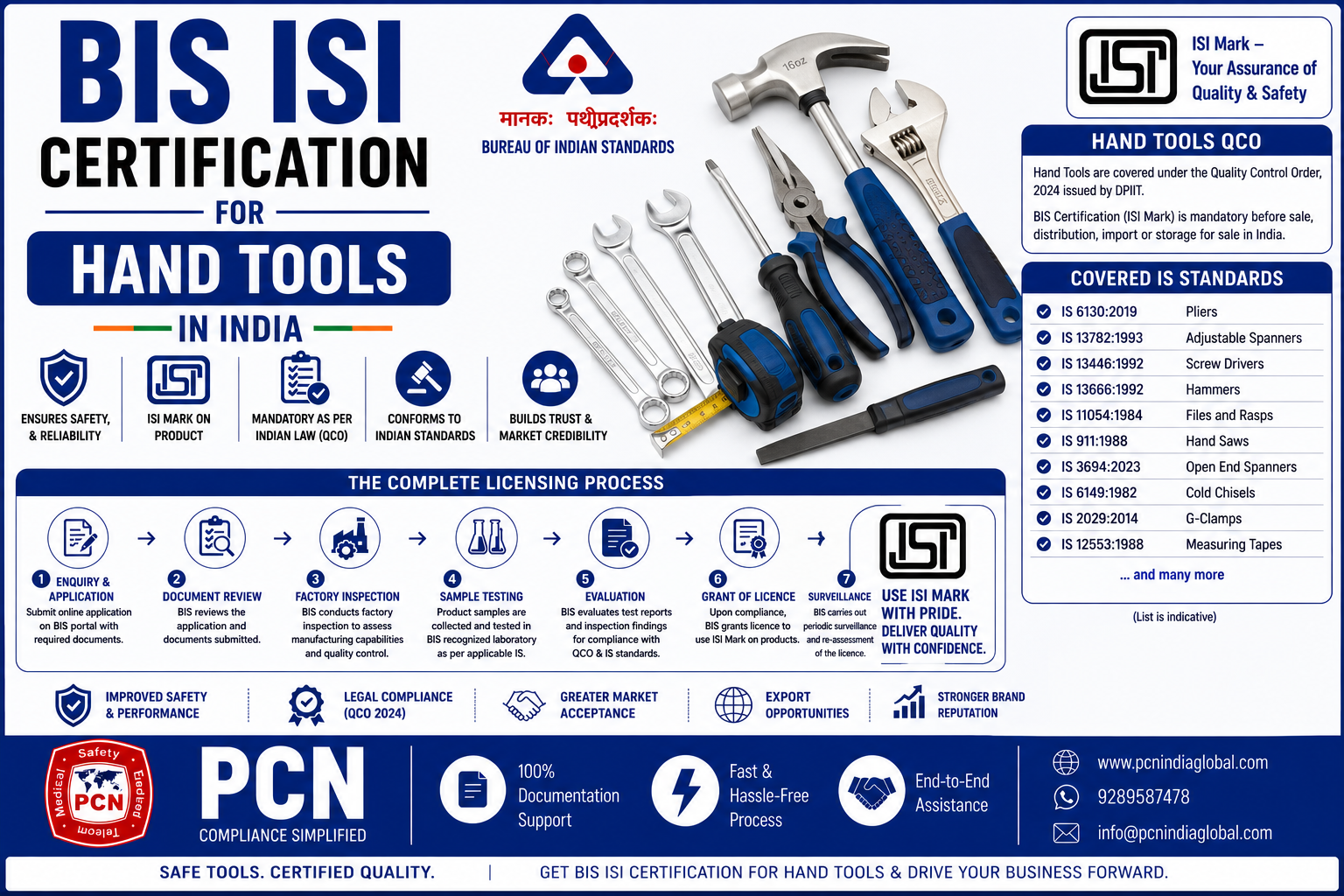
Hand tools are the most basic equipment of India’s workshops, factories, garages, and households — wrenches, spanners, and pliers pass through millions of hands every day, gripping, turning, and cutting under real force. A spanner that rounds off, a wrench whose jaw slips, or a plier whose joint fails is not just a bad purchase; it is an injury waiting to happen. The government has now brought this category under compulsory BIS certification: the Hand Tools (Quality Control) Order — notified by the Department for Promotion of Industry and Internal Trade (DPIIT) in July 2025 and revised by a fresh notification dated 4 December 2025 — makes the ISI mark mandatory for notified hand tools under Scheme-I of the BIS (Conformity Assessment) Regulations, 2018, the same ISI Mark Scheme that governs the products on the BIS list of products under compulsory certification. India’s hand tool market spans large organised manufacturers in hubs like Jalandhar and Ludhiana, thousands of MSME forges and finishing units, and a heavy import flow. The QCO reshapes all of it: covered tools cannot be manufactured, imported, stored, or sold in India without a valid BIS licence once the enforcement dates arrive — from 1 October 2026 for general and large enterprises, with extended timelines for small (1 January 2027) and micro (1 April 2027) units. This guide explains the covered products and standards, the step-by-step ISI licensing process, documents, timelines, common mistakes, and how hand tool certification fits into the wider India compliance picture. Why Hand Tools Fall Under Mandatory BIS Certification Quality Control Orders are the government’s instrument for making an Indian Standard mandatory. Once a QCO is notified under the BIS Act, 2016, no person can manufacture, import, distribute, sell, hire, lease, store, or exhibit for sale any covered product without the ISI mark granted under a valid BIS licence. The hand tools QCO follows the template applied to footwear, toys, and furniture: raise the quality floor of the domestic market, curb the inflow of substandard imports, and strengthen Indian manufacturing against low-cost, low-quality competition. The safety rationale is direct. Hand tools concentrate human force through hardened steel — and when the steel is not what it should be, that force finds the user. Soft jaws deform and slip off fasteners; brittle, poorly heat-treated tools chip and shatter, throwing fragments; undersized or mis-dimensioned openings round off nuts and send knuckles into machinery. Quality is invisible at the point of sale — a polished, chrome-plated spanner of poor metallurgy looks identical to a professional tool. Certified conformity to the Indian Standard verifies the hardness, torque strength, dimensional accuracy, and durability that separate a safe tool from a hazardous one. For manufacturers, the QCO is also a commercial gate: institutional buyers, industrial procurement, and organised retail verify BIS licences for covered tools, and customs authorities check compliance at import. Which Hand Tools Are Covered: All Nine Notified Standards The schedule to the QCO covers nine Indian Standards spanning the wrench, spanner, and plier families: Indian Standard Product Category Typical Products Covered IS 4003 (Part 1) Pipe Wrenches — General Purpose Stillson pattern pipe wrenches used in plumbing and fitting work IS 4003 (Part 2) Pipe Wrenches — Heavy Duty Heavy-duty pipe wrenches for industrial piping work IS 2028 Open Jaw Spanners (Wrenches) Single and double ended open-jaw wrenches in metric sizes IS 2029 Ring Spanners (Wrenches) Single and double ended ring wrenches (bi-hexagonal) IS 6149 Adjustable Wrenches Adjustable jaw wrenches (crescent pattern) for general use IS 4123 Chain Pipe Wrenches Chain-type pipe wrenches for large-diameter pipe gripping IS 4508 Open Ended Slugging Wrenches Open-ended slugging (striking) spanners for heavy bolting with hammer blows IS 4509 Ring Slugging Wrenches Ring-type slugging (striking) spanners for heavy industrial bolting IS 3650 Combination Side Cutting Pliers Combination pliers with side cutters used in electrical and general work The notified list is defined by the schedule to the QCO, and the government has signalled that the hand tool family may expand through further notifications — screwdrivers, hammers, and other categories have dedicated Indian Standards that could follow the same route. Manufacturers should confirm the exact covered products, standards, and current editions against the latest notification before testing, because the licence is granted per standard, per manufacturing location, and a multi-product range needs a licence for each applicable standard. Who Must Comply — and By When The QCO binds every link in the supply chain. Indian manufacturers of covered tools need a BIS licence under Scheme-I for each manufacturing premises and each applicable standard. Importers cannot clear covered tools through customs unless the foreign manufacturing site itself holds a BIS licence — obtained through the Foreign Manufacturers Certification Scheme (FMCS), under which BIS audits the overseas factory and grants the ISI licence to the foreign entity, which must also appoint an Authorised Indian Representative (AIR). Traders, distributors, and marketplaces are equally barred from storing or selling non-compliant stock after the enforcement dates. The enforcement calendar is staggered by enterprise size: The order also carves out a limited exemption for research and development: up to 200 units per year may be imported on a non-commercial basis, subject to record-keeping and scrap-disposal conditions. Tools manufactured for export are outside the QCO’s scope — a critical exemption for India’s substantial hand tool export industry, which can continue serving overseas buyers to their specifications. But every tool destined for the Indian market must be licensed by the applicable date. The runway looks comfortable today, but the ISI process involves factory inspection and laboratory testing across hardness, torque, and durability parameters — and with thousands of manufacturers and importers needing licences in the same window, testing capacity and inspection scheduling will tighten as the deadline approaches. Early movers avoid the queue. What the Hand Tool Standards Actually Test Understanding what the laboratory examines clarifies why certification takes preparation. The standards evaluate hand tools against the real forces of use across four broad areas. Material and hardness — the tool steel must meet specified composition and heat-treatment

BIS ISI Certification for Cross Recessed Screws in India: IS 7483, IS 7485, IS 7486, IS 18480 and the Complete Licensing Process

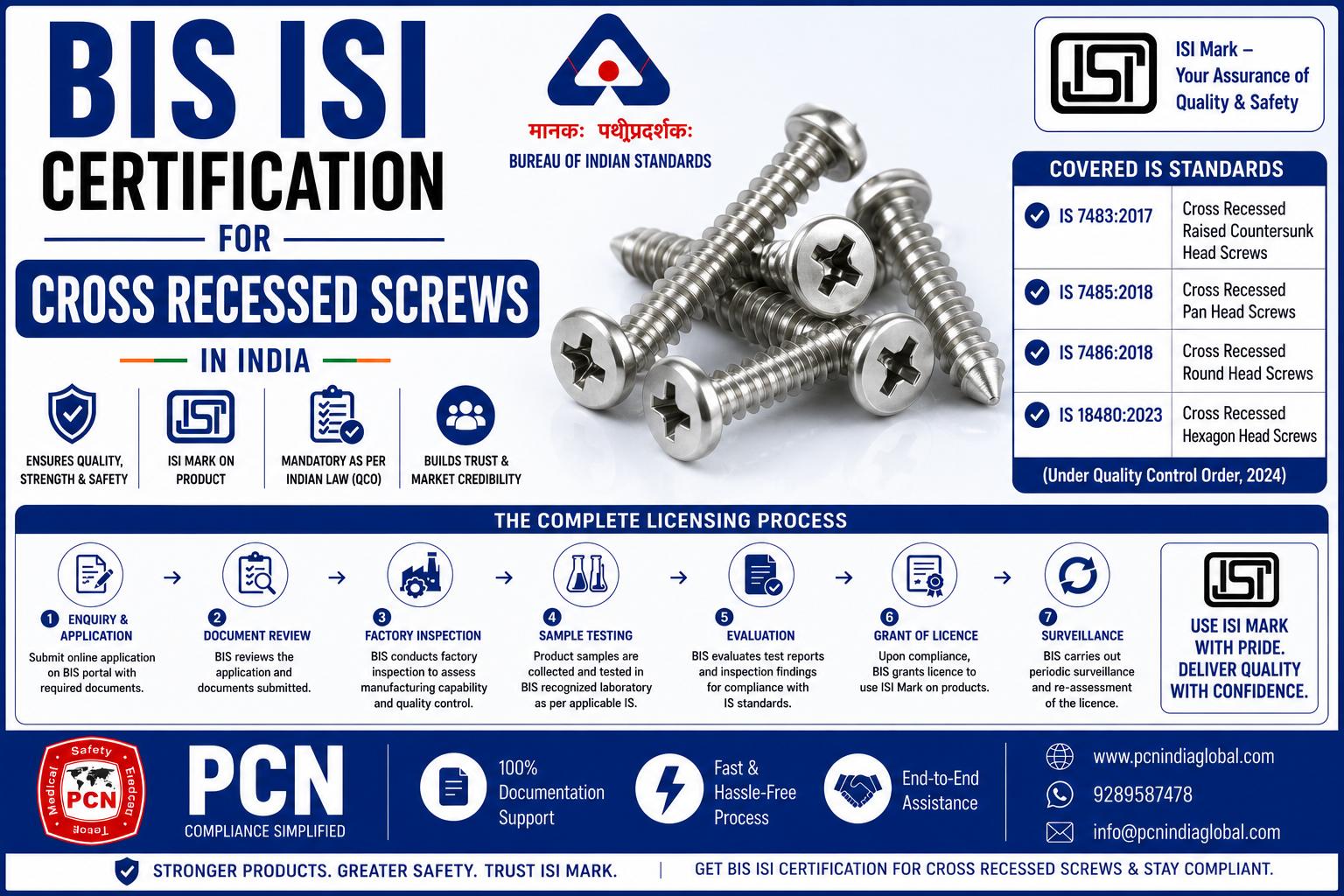
Cross recessed screws — the familiar Phillips-type screws with a cross-shaped drive slot — are the most ubiquitous fastener in modern manufacturing. They hold together appliances, electronics, furniture, automotive interiors, switchboards, and countless assemblies in every Indian factory and home. Precisely because they are everywhere and bought by the million, quality failures propagate at scale: soft screws whose recesses cam out and strip, brittle screws that snap in the joint, and mis-dimensioned threads that fail under load. The government has brought this category under compulsory BIS certification through the Cross Recessed Screws (Quality Control) Order, 2024 — notified by the Department for Promotion of Industry and Internal Trade (DPIIT) vide S.O. 4099(E) dated 17 September 2024 — making the ISI mark mandatory across 14 Indian Standards under Scheme-I of the BIS (Conformity Assessment) Regulations, 2018, the same ISI Mark Scheme that governs the products on the BIS list of products under compulsory certification. The enforcement calendar has now fully arrived: the order applied from six months after publication for general enterprises, nine months for small enterprises, and twelve months for micro enterprises — meaning that as of today, no covered cross recessed screw can be manufactured, imported, stored, or sold in India without a valid BIS licence and the Standard Mark, whatever the size of the maker. For fastener manufacturers, importers feeding OEM assembly lines, and distributors holding inventory, certification is the licence to operate. This guide explains all 14 covered standards, the step-by-step ISI licensing process, documents, timelines, the specific exemptions the order grants, and how fastener certification fits into the wider India compliance picture. Why Cross Recessed Screws Fall Under Mandatory BIS Certification Quality Control Orders are the government’s instrument for making an Indian Standard mandatory. Once a QCO is notified under the BIS Act, 2016, no person can manufacture, import, distribute, sell, hire, lease, store, or exhibit for sale any covered product without the ISI mark granted under a valid BIS licence. The screws QCO is part of a broader fastener quality drive — and it is unusually wide, sweeping machine screws, self-tapping screws, self-drilling screws, drywall screws, chipboard screws, and cross-recessed wood screws into a single order — aimed at raising the quality floor of a high-volume import category and strengthening domestic fastener manufacturing. The quality rationale is about scale and hidden failure. A single substandard screw is trivial; a production lot of them inside an assembly line is not. Screws that strip during driving slow production and damage assemblies; screws that fail in service loosen joints, create electrical hazards, and generate warranty claims across thousands of units. Fastener quality is invisible at purchase — plating hides metallurgy, and thread geometry defects emerge only under torque. Certified conformity verifies the material, hardness, torque resistance, recess geometry, and thread accuracy that make a screw perform. The QCO is also a commercial gate: OEM procurement, organised distribution, and marketplaces verify BIS licences, and customs checks compliance at import. Which Screws Are Covered: All 14 Notified Standards The schedule to the QCO lists 14 Indian Standards, each aligned to its ISO equivalent, spanning drilling screws, tapping screws, machine screws, and specialist construction screws: Sl. No. Indian Standard / ISO Title of Indian Standard 1 IS 18471 (Part 1):2023 / ISO 15481:1999 Fasteners — Cross Recessed Drilling Screws with Tapping Screw Thread, Part 1 Pan Head 2 IS 18471 (Part 2):2023 / ISO 15482:1999 Fasteners — Cross Recessed Drilling Screws with Tapping Screw Thread, Part 2 Countersunk Head 3 IS 18471 (Part 3):2023 / ISO 15483:1999 Fasteners — Cross Recessed Drilling Screws with Tapping Screw Thread, Part 3 Raised Countersunk Head 4 IS 18476:2023 / ISO 15480:2019 Fasteners — Hexagon Washer Head Drilling Screws with Tapping Screw Thread 5 IS 18480 (Part 1):2023 / ISO 7049:2011 Cross Recessed Tapping Screws: Part 1 Pan Head 6 IS 18480 (Part 2):2023 / ISO 7050:2011 Cross Recessed Tapping Screws: Part 2 Countersunk Flat Head 7 IS 18480 (Part 3):2023 / ISO 7051:2011 Cross Recessed Tapping Screws: Part 3 Raised Countersunk Oval Head 8 IS 7483:2018 / ISO 7045:2011 Pan Head Screws with Type H or Type Z Cross Recess — Product Grade A 9 IS 7485 (Part 1):2018 / ISO 7046-1:2011 Countersunk Flat Head Screws (Common Head Style) with Type H or Type Z Cross Recess — Product Grade A, Part 1 Steel Screws of Property Class 4.8 10 IS 7485 (Part 2):2018 / ISO 7046-2:2011 Countersunk Flat Head Screws — Product Grade A, Part 2 Steel Screws of Property Class 8.8, Stainless Steel Screws and Non-Ferrous Metal Screws 11 IS 7486:2018 / ISO 7047:2011 Raised Countersunk Head Screws (Common Head Style) with Type H or Type Z Cross Recess — Product Grade A 12 IS 18507:2024 Drywall Screws — Specification 13 IS 18508:2024 Chipboard Screws — Specification 14 IS 18509:2023 Cross-recessed Countersunk Head Wood Screws — Specification Two points deserve attention. First, the order distinguishes property classes: IS 7485 is split into Part 1 for Property Class 4.8 steel screws and Part 2 for Property Class 8.8 steel, stainless steel, and non-ferrous screws — so a manufacturer producing both grades of the same countersunk head style needs conformity under both parts. Second, the schedule extends well beyond machine screws into construction and joinery fasteners: drywall screws (IS 18507), chipboard screws (IS 18508), and cross-recessed countersunk head wood screws (IS 18509) are all inside this order, which catches many manufacturers who assumed those product lines sat outside it. Manufacturers should confirm the exact covered products and current editions against the latest notification before testing, because the licence is granted per standard, per manufacturing location. Who Must Comply — and From When The QCO binds every link in the supply chain. Indian fastener manufacturers need a BIS licence under Scheme-I for each manufacturing premises and each applicable standard. Importers cannot clear covered screws through customs unless the foreign manufacturing site itself holds a BIS licence — obtained through the Foreign Manufacturers Certification Scheme (FMCS), under which BIS audits the overseas plant and grants

BIS ISI Certification for Furniture in India: Furniture QCO 2025, IS 17631 to IS 17636 and the Complete Licensing Process

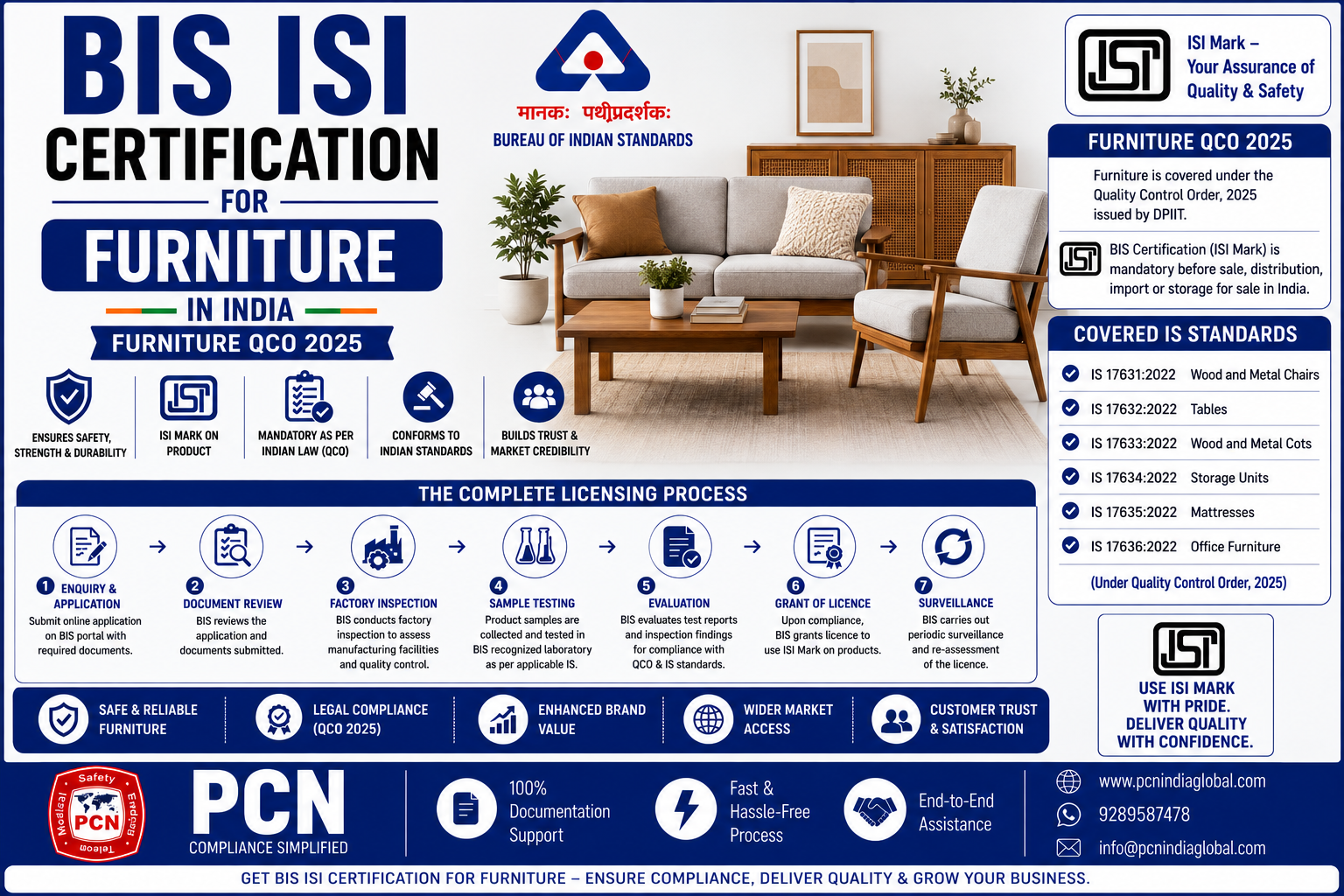
Furniture has joined the list of products that cannot be manufactured, imported, stored, or sold in India without the ISI mark. With the Furniture (Quality Control) Order, 2025 — notified by the Department for Promotion of Industry and Internal Trade (DPIIT) vide S.O. 801(E) dated 13 February 2025 — six major furniture categories now fall under compulsory BIS certification under Scheme-I of the BIS (Conformity Assessment) Regulations, 2018, the same ISI Mark Scheme that governs cement, steel, and household electrical goods on the BIS list of products under compulsory certification. The change is significant for an industry that has historically operated with minimal regulatory oversight. India’s furniture market — spanning large organised manufacturers, thousands of MSME workshops, importers of ready-to-assemble furniture, and global brands selling through e-commerce — must now demonstrate conformity to Indian Standards IS 17631 through IS 17636 before placing covered products on the market. For general and large enterprises the obligation is already in force since 14 February 2026; micro and small enterprises must comply by 14 August 2026. This guide explains which products are covered, the applicable standards, the step-by-step ISI licensing process, documents, timelines, common mistakes, and how furniture certification fits into the wider India compliance picture. Why Furniture Now Falls Under Mandatory BIS Certification Quality Control Orders are the government’s instrument for making an Indian Standard mandatory. Once a QCO is notified under the BIS Act, 2016, no person can manufacture, import, distribute, sell, hire, lease, store, or exhibit for sale any covered product without the Standard Mark — the ISI mark — granted under a valid BIS licence. The Furniture QCO 2025 follows the same template the government has applied to footwear, toys, and kitchen appliances: raise the quality floor of the domestic market, curb the inflow of substandard imports, and align Indian products with international quality benchmarks. The safety rationale is real. Chairs that collapse under load, bunk beds with entrapment gaps, storage units that tip over onto children, and tables with unstable structures cause injuries that standardised testing is designed to prevent. The furniture standards evaluate stability, structural strength, durability under repeated use, and surface safety — hazards that are invisible at the point of sale but critical over a product’s life. For manufacturers, the QCO is also a commercial gate: institutional buyers, government procurement, organised retail, and e-commerce marketplaces now verify BIS licences for covered furniture, and customs authorities check compliance at import. Which Furniture Products Are Covered: IS 17631 to IS 17636 The Furniture QCO 2025 covers six product categories, each mapped to a dedicated Indian Standard published in 2022: Indian Standard Product Category Typical Products Covered IS 17631:2022 Work Chairs Office chairs, task chairs, swivel chairs, ergonomic desk chairs IS 17632:2022 General Purpose Chairs and Stools Dining chairs, visitor chairs, plastic moulded chairs, stools IS 17633:2022 Tables and Desks Office desks, dining tables, study tables, workstations IS 17634:2022 Storage Units Wardrobes, cabinets, bookshelves, filing cabinets, cupboards IS 17635:2022 Beds Single and double beds, fully assembled and ready-to-assemble cots IS 17636:2022 Bunk Beds Bunk beds and loft beds for domestic and institutional use The standards are material-agnostic in scope — wood, metal, plastic, and combination constructions are all covered when the product falls within a listed category. Ready-to-assemble (RTA) and knock-down furniture, the dominant format for imports and e-commerce, is explicitly within scope for beds and other categories. Manufacturers should confirm the exact applicability of each standard and its current edition against the latest BIS notification before testing, because the licence is granted per standard, per manufacturing location. Who Must Comply — and By When The QCO binds every link in the supply chain. Indian manufacturers of covered furniture need a BIS licence under Scheme-I for each manufacturing premises and each applicable standard. Importers cannot clear covered furniture through customs unless the foreign manufacturing site itself holds a BIS licence — obtained through the Foreign Manufacturers Certification Scheme (FMCS), under which BIS audits the overseas factory and grants the ISI licence to the foreign entity, which must also appoint an Authorised Indian Representative (AIR). Traders, distributors, and marketplaces are equally barred from storing or selling non-compliant stock. The enforcement calendar is staggered by enterprise size: The MSE deadline is now days away. A micro or small furniture unit that has not yet begun its BIS application faces a real risk of being unable to legally sell covered products, because the licensing process involves factory inspection and laboratory testing that cannot be compressed into days. Starting immediately — and manufacturing under the correct documentation while the application is in process — is the only realistic path for late movers. The 2026 Amendment Orders: Practical Relief for Industry Two amendments have refined the QCO since notification, and both matter operationally. The Furniture (Quality Control) Amendment Order, 2026 — S.O. 774(E) dated 12 February 2026 — introduced targeted exemptions: furniture imported for research and development purposes (in limited quantity, not for commercial sale), provisions for clearing legacy stock manufactured before the enforcement date, and relief for components imported for use in export-oriented manufacturing, so that exporters are not forced to certify inputs destined for overseas markets. The Furniture (Quality Control) Second Amendment Order, 2026 — S.O. 1125(E) dated 2 March 2026 — further clarified the compliance framework for imports and transitional stock. Manufacturers and importers relying on any exemption should document their eligibility carefully, because the burden of proving an exemption applies rests with the party claiming it, and customs officers and BIS enforcement teams will ask for evidence. What the Furniture Standards Actually Test Understanding what the laboratory examines clarifies why certification takes preparation. The IS 17631–17636 series evaluates furniture against the hazards of real use, and each standard prescribes tests across four broad areas. Stability — the product must not tip over under defined loading conditions. Storage units are tested with loaded drawers and open doors; chairs are tested for forward, sideways, and rearward overturning; bunk beds for stability under a user’s weight at the guardrail. Strength — static

BIS Certification for Phosphoric Acid & Phosphite Chemicals in India: IS 798, IS 17439, IS 17412 and the Complete Compliance Process

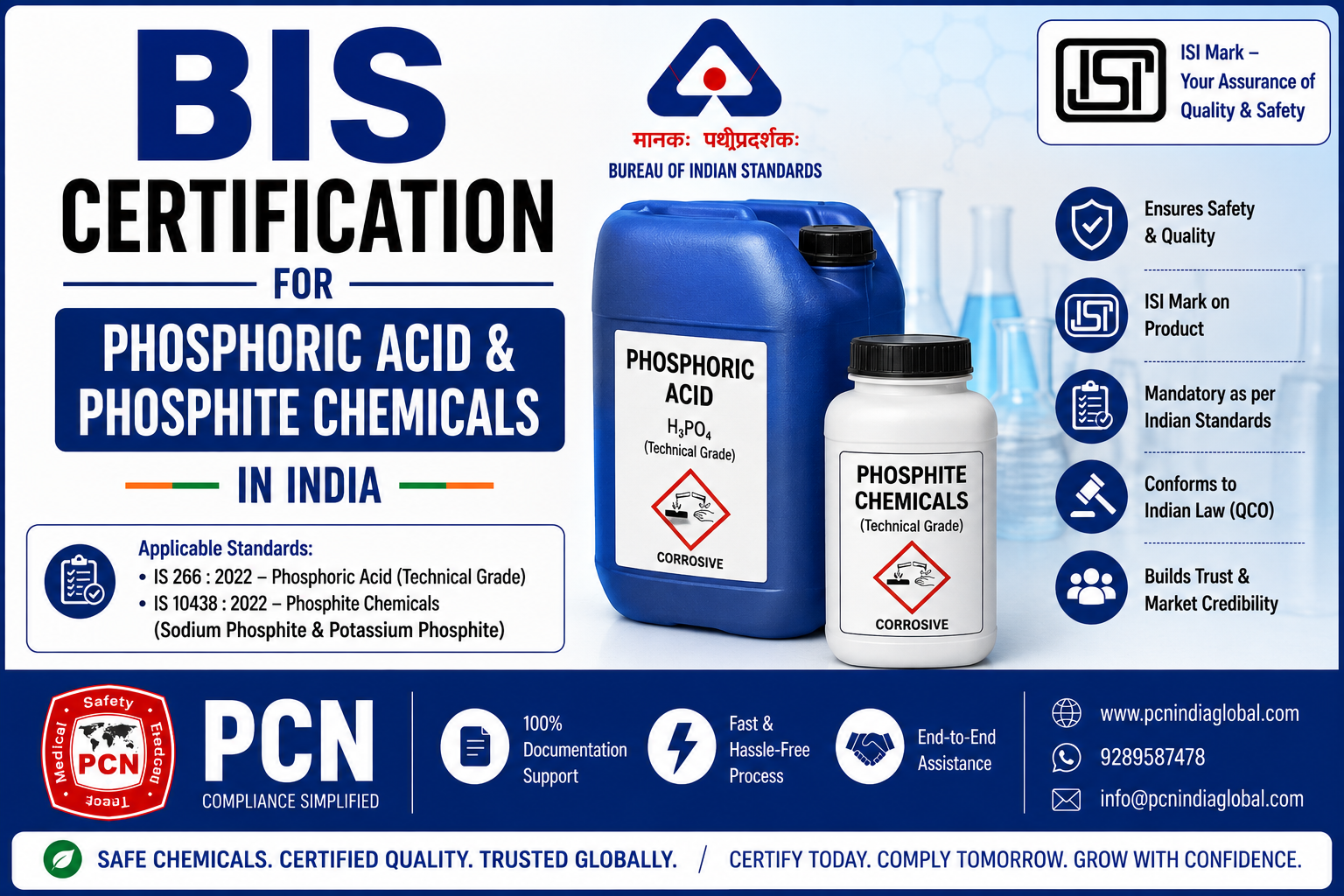
Beyond the electronics and appliances most associated with BIS, India’s mandatory-certification framework has extended firmly into industrial chemicals — and phosphorus chemicals are a notable example. Ortho phosphoric acid, polyphosphoric acid, and trimethyl phosphite are important industrial inputs used across fertilisers, food and beverage processing, water treatment, metal finishing, flame retardants, and chemical synthesis. To ensure quality and consistency, these chemicals have been brought under mandatory BIS certification against their respective Indian Standards. For manufacturers and importers, BIS certification against the applicable standard is now the gateway to lawfully supplying these chemicals in India. This is a distinct area from the electronics categories, but the underlying principle is the same: a notified product must conform to its Indian Standard and be certified by BIS before it can be placed on the market. This guide covers the three phosphorus chemicals and their standards, the mandatory framework, the certification process, the documents required, realistic timelines, and the key points chemical manufacturers should understand. The Chemicals and Their Standards Three phosphorus chemicals are covered, each under its own Indian Standard, with defined implementation dates under their Quality Control Orders: Ortho Phosphoric Acid — IS 798:2020. A widely used mineral acid found in fertiliser production, food-grade applications (as a food additive and acidulant), metal treatment, and many industrial processes. Polyphosphoric Acid — IS 17439:2020. A condensed phosphoric acid used in chemical synthesis, catalysis, and specialised industrial applications. Trimethyl Phosphite (Technical Grade) — IS 17412:2020. An organophosphorus compound used as a chemical intermediate and reagent in synthesis, including in the manufacture of other chemicals. Each Indian Standard specifies the requirements for its chemical — including composition, purity, permissible impurities, and the test methods used to verify conformity. Manufacturers should obtain the current text of the applicable standard (IS 798, IS 17439, or IS 17412) and confirm the exact requirements and the current notification against the latest BIS position, since certification rests on demonstrated conformity to the correct standard and its current edition. The Mandatory Framework: QCOs and BIS Certification BIS certification operates under the Bureau of Indian Standards Act, 2016. When the Central Government issues a Quality Control Order for a product, it makes conformity to the corresponding Indian Standard — and BIS certification — mandatory. From the effective date of such an order, the product cannot lawfully be manufactured, stored, sold, or imported in India unless it conforms to the standard and carries the required BIS certification. Products manufactured solely for export are generally outside the order’s scope. For these phosphorus chemicals, the respective Quality Control Orders bring IS 798, IS 17439, and IS 17412 into mandatory effect, each with its own implementation date. Because the precise scheme mechanics and enforcement dates for chemical products are set by the applicable notification — and can differ from the electronics registration route — manufacturers should confirm the exact certification pathway, the effective dates, and any turnover-linked or category-specific provisions against the current BIS position for each chemical. What is constant is the underlying obligation: once notified, the chemical must conform to its Indian Standard and be BIS-certified, and non-compliance exposes a business to penalties under the BIS Act. Why These Chemicals Are Regulated The rationale for bringing these chemicals under mandatory certification is quality assurance and consumer and industrial safety. Phosphorus chemicals are used in sensitive applications — food-grade phosphoric acid enters the food chain, fertiliser-grade acid affects agricultural output, and technical-grade reagents feed into further chemical manufacturing. Substandard or contaminated product can compromise the safety and quality of everything downstream, from processed food and beverages to fertilisers and manufactured chemicals. A consistent, verified quality baseline protects buyers and the many industries that depend on these inputs, and it also curbs the entry of substandard imports. For manufacturers, certification is therefore both a legal requirement and a mark of the quality that serious industrial and food-sector customers increasingly demand. Why Grade and Purity Are Everything for These Chemicals For phosphorus chemicals, the entire value of the product lies in its grade and purity, which is exactly what the Indian Standards pin down and what mandatory certification protects. The same chemical name can span very different quality levels: phosphoric acid, for instance, is supplied as fertiliser grade, technical grade, and food grade, and the difference between them is a matter of controlled composition and strictly limited impurities. Food-grade phosphoric acid used as an acidulant in beverages must meet purity limits that keep harmful impurities such as heavy metals well below safe thresholds, because it enters the food chain directly; a fertiliser-grade product diverted into food use, or a contaminated batch, could cause real harm. Technical-grade reagents such as trimethyl phosphite feed into further chemical synthesis, where an off-specification input propagates defects into every downstream product. This is why the standards specify not just the headline assay but the permissible impurities and the test methods to verify them, and why certification hinges on demonstrating consistent conformity batch after batch rather than a one-off sample. For a manufacturer, the practical implication is that certification is fundamentally about proving reliable process control — that the plant can produce to grade consistently — which is the same capability that serious industrial and food-sector customers demand. Getting the quality system right is therefore both the route to certification and the foundation of a credible position in these quality-sensitive markets. The Certification Process BIS certification for a notified product follows the applicable scheme under the BIS conformity-assessment framework. For chemical products, the process centres on demonstrating that the product conforms to its Indian Standard, typically involving the following elements — though manufacturers should confirm the exact pathway for each chemical against the current notification. Confirm applicability and standard. Verify that the chemical falls within the notified scope and obtain the current text of the applicable standard (IS 798, IS 17439, or IS 17412). Establish testing and quality control. Ensure the manufacturing facility can produce product conforming to the standard, with the testing capability to verify composition, purity, and the other specified parameters

BIS CRS Registration for Television Sets under IS 18112:2025 in India: The New Performance Standard and the Complete Compliance Process

Television sets have long been among the most tightly regulated consumer-electronics products in India, and a significant new requirement is now reshaping their compliance. Alongside the established safety registration, television sets are being brought under a dedicated performance standard, IS 18112:2025, with a defined implementation date of 26 July 2026. This marks an important evolution: where TV regulation previously centred on electrical safety, it now increasingly addresses performance as well, under the BIS Compulsory Registration Scheme (CRS). For every TV manufacturer, brand owner, and importer, understanding this new IS 18112:2025 requirement — and how it sits alongside the existing safety standard — is essential, and BIS CRS registration remains the gateway to the Indian television market. This guide explains the new IS 18112:2025 requirement for television sets, how it complements the long-standing IS 616 safety standard, the CRS self-declaration process, the documents required, realistic timelines, and what TV brands should do to be ready for the implementation date. A New Layer: Performance Alongside Safety Television sets have been registered under CRS against the safety standard IS 616:2017 (the audio-video apparatus safety standard) — the requirement that ensures a TV is electrically safe. The significant development is the addition of IS 18112:2025, a dedicated Indian Standard for television sets that is being applied to the category with effect from 26 July 2026. As the official BIS listing indicates, television sets are moving toward a requirement that references IS 616:2017 together with IS 18112:2025 — in other words, both a safety dimension and this new standard. For manufacturers, the practical significance is that TV compliance is expanding from a purely safety-based registration to one that also engages IS 18112:2025. Because this is a recent standard with a specific implementation date, manufacturers should confirm the exact applicable requirements, the precise scope, and how IS 616 and IS 18112:2025 are to be applied together against the latest BIS notification — the details of a newly implemented standard are exactly the kind of thing that must be verified against the current position rather than assumed. What is clear is that TV brands need to prepare for the IS 18112:2025 requirement ahead of the July 2026 date, so that their products remain registrable and saleable once it takes effect. Why This Matters for the Television Category Television is one of India’s largest consumer-electronics categories, spanning entry-level HD models to premium 4K and 8K smart TVs, sold in enormous volumes and increasingly manufactured or assembled domestically. Regulation of such a large, high-volume category has significant market impact, and the introduction of a dedicated television-set standard reflects the maturing of India’s product-quality framework for this product. The core obligation under CRS remains constant: a covered television must be tested against the applicable Indian Standard(s), registered with BIS, and marked with its registration number before it can be manufactured, imported, sold, distributed, or stored for sale in India. Selling an unregistered notified television is an offence under the BIS Act, 2016, with the usual consequences of penalties and removal from sale. What changes with IS 18112:2025 is the content of what a television must demonstrate — adding the dimension covered by the new standard to the established safety registration. For brands, being ready means ensuring products can meet the applicable requirements and complete registration in time for the implementation date, so there is no gap in saleability. How IS 616 and IS 18112:2025 Fit Together The essential point for a TV manufacturer is that these are complementary requirements, not alternatives, and understanding how they combine is the key to a smooth transition. IS 616:2017 addresses the safety of the television as audio-video apparatus — protection against electric shock, energy and thermal hazards, fire, and mechanical construction — the long-standing basis for TV registration. IS 18112:2025 is the dedicated television-set standard now being applied to the category with effect from 26 July 2026, adding its dimension to the compliance picture. The official position indicates television sets moving to a requirement referencing IS 616:2017 together with IS 18112:2025, so a manufacturer should plan on demonstrating conformity to both as applicable rather than treating the new standard as a replacement for the safety requirement. For a manufacturer, the practical approach is to treat the TV’s compliance file as encompassing both the established safety standard and the new IS 18112:2025 requirement, and to confirm — against the current BIS notification — exactly how the two are to be tested and registered together for a given product. Because IS 18112:2025 is newly implemented, this verification against the live position is especially important, and it is precisely where working with a partner who tracks BIS developments closely adds value. The goal is a television that satisfies the full, updated requirement set and completes its CRS registration in good time before the July 2026 implementation date. Step-by-Step: BIS CRS Registration for a Television Set CRS is a test-and-register scheme with no factory inspection. Our team manages each stage end to end, but every applicant should understand the sequence. Confirm the applicable standards. Verify the current requirement for television sets — IS 616:2017 for safety and IS 18112:2025 as applicable — and the implementation timeline. Test at a BIS-recognised laboratory. Submit TV samples for testing against the applicable standard(s). Prepare documentation. Compile technical details, panel and critical-component data, company and brand documents, and — for foreign makers — the Authorised Indian Representative (AIR) nomination. File the online application. Submit on the BIS portal with the test report(s) and documents. BIS scrutiny and grant. BIS reviews and grants the registration with a unique R-number. Mark and self-declare. Apply the standard mark and R-number on the TV and packaging, and issue the self-declaration. Maintain and renew. Keep conformity under BIS surveillance and renew periodically; act on the registration if critical components change. Documents Required A complete file at the outset is the biggest single lever on approval speed. You will typically need: Test report(s) from a BIS-recognised laboratory against the applicable standard(s) — IS 616:2017 and IS 18112:2025

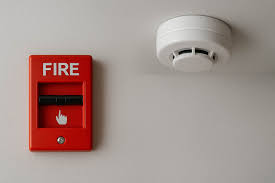
BIS Certification for Fire Detection & Alarm Systems in India: IS 2189, IS/ISO 7240 & the 2025 QCO

Few products carry as direct a life-safety responsibility as a fire detection and alarm system. When a fire starts, the difference between a controlled evacuation and a tragedy can come down to whether a smoke detector triggers in time and whether the alarm actually sounds. Because these systems protect lives in homes, offices, factories, hospitals, and public buildings, India is bringing fire detection and alarm products firmly under mandatory BIS certification. For manufacturers and importers of detectors, control panels, and alarm devices, this marks a significant shift toward verified, standardised quality. This guide explains the standards that govern fire detection and alarm systems, the move toward mandatory certification under the 2025 Quality Control Order, what is covered, and how to obtain certification. 1. The Move to Mandatory Certification Historically, India’s fire alarm industry operated primarily under IS 2189 — a code of practice first established decades ago and last revised in 2008 — without comprehensive mandatory product certification. That is changing. India’s adoption of the IS/ISO 7240 series as its national fire-alarm product standard, combined with the Fire Detection and Alarm Systems (Quality Control) Order, 2025, brings mandatory BIS certification to fire safety products. Once enforced, covered products cannot be manufactured, imported, or sold without a valid BIS licence and the Standard Mark. 2. The Applicable Standards Fire detection and alarm compliance draws on a family of standards, and it is important to distinguish the system code of practice from the product standards: Standard Scope IS 2189 Code of practice for selection, installation and maintenance of automatic fire detection and alarm systems IS/ISO 7240 (series) Product standards for fire detection and alarm system components — India’s modern national framework IS 11360 Specification for smoke detectors for use in automatic electrical fire alarm systems IS 2189 governs how a system is designed, installed, and maintained, while the IS/ISO 7240 series and standards such as IS 11360 govern the products themselves. The shift toward IS/ISO 7240 also reflects the industry’s move to support modern technologies, including wireless fire alarm systems, and aligns India’s product requirements with international practice. 3. What Is Covered A fire detection and alarm system is made up of several distinct product types, and certification applies at the component level. Typical covered products include: Manufacturers and importers should map every component in their range against the applicable standard, since a complete system is only as compliant as its individual certified parts. 4. The Certification Route Fire detection and alarm products are certified under the BIS framework with the Standard Mark. The broad process mirrors other product certifications: 5. Foreign Manufacturers Overseas manufacturers of fire detection products certify through the Foreign Manufacturers Certification Scheme (FMCS): they appoint an Authorised Indian Representative (AIR) resident in India and undergo a BIS assessment of the overseas facility where required. As with all foreign-manufacturer routes, this adds time and coordination, so importers should plan certification well ahead of the enforcement date and their intended supply schedule. 6. Documents, Timeline, and Validity Typical documentation includes the manufacturing licence or business registration, production-process and testing details, technical specifications for each product, trademark or brand authorisation, and — for foreign applicants — the AIR appointment. Timelines depend on testing queues and documentation readiness; foreign applications run longer due to overseas assessment scheduling. The licence is granted for a defined term and is renewable, subject to continued compliance and surveillance. 7. Why Standardisation Is Transforming the Industry The shift to mandatory certification under IS/ISO 7240 is more than a procedural change — it is reshaping the fire-safety market in India. For years, the absence of comprehensive product certification meant that detectors and panels of widely varying quality circulated in the market, and buyers had limited means to tell a reliable product from a poor one. Standardisation closes that gap: it gives building owners, consultants, and contractors a clear, verifiable benchmark, and it pushes sub-standard products out of a sector where reliability is literally a matter of life and death. The move also supports modern system design. The IS/ISO 7240 framework accommodates newer technologies such as addressable and wireless systems, which makes it easier to deploy fire detection in heritage buildings, large complexes, and retrofits where wiring is difficult. For manufacturers, aligning with the new standard is not just a compliance task — it is a chance to bring better, more capable products to a market that increasingly demands them. 8. Common Pitfalls Fire-product certification tends to stall on the same recurring issues: 9. Penalties and Why It Matters Selling uncertified fire detection or alarm products once the QCO is enforced exposes a business to penalties under the BIS Act, 2016 — fines, imprisonment, and seizure of stock — and imported consignments can be detained at customs. But for life-safety products, the stakes go beyond regulatory penalties. A detector that fails to trigger or an alarm that does not sound can cost lives, and the legal and reputational consequences of supplying a defective life-safety product are severe. Certification is, in the end, both a legal requirement and an ethical one — and for serious manufacturers, a way to stand apart in a market where trust is everything. 10. Maintaining Compliance Over the System’s Life For fire detection products, compliance does not end at the moment a licence is granted — and nor does responsibility. BIS conducts periodic surveillance to confirm that products continue to meet the standard, and the licence must be renewed before expiry to keep the Standard Mark valid. But the deeper point is that a fire system’s value lies entirely in its reliability years after installation, when it finally has to perform. That places a premium on consistent manufacturing quality, traceable components, and a quality system that genuinely holds up between audits. Manufacturers who view certification as the start of an ongoing commitment — rather than a one-time gate — are the ones whose products earn the trust of consultants, contractors, and building owners over the long term. In a sector where a single failure

BIS Certification for Hand-Held Motor-Operated Electric Tools in India: IS/IEC 62841 & the QCO

Hand-held power tools — drills, angle grinders, circular saws, sanders, impact wrenches, and the like — are everywhere in India’s construction, manufacturing, and DIY markets. They are also inherently hazardous products: high-speed motors, sharp moving parts, and mains electricity combine in a device held directly in the user’s hands. A poorly built tool can cause electric shock, fire, or serious mechanical injury. For that reason, the safety of hand-held motor-operated electric tools is moving firmly into India’s mandatory BIS certification framework. For manufacturers and importers of power tools, this is a development to get ahead of rather than react to. This guide explains the safety standard that governs these tools (the IS/IEC 62841 series), what the emerging Quality Control Order means, the certification route, and why preparing early is the smart commercial move. 1. The Regulatory Direction: A QCO for Power Tools India has been steadily expanding the list of products requiring mandatory BIS certification, and hand-held motor-operated electric tools are part of that expansion. A draft Safety of Hand-Held Motor-Operated Electric Tools (Quality Control) Order has been issued through the Department for Promotion of Industry and Internal Trade (DPIIT), signalling the government’s intent to bring these tools under mandatory ISI-mark certification. Once such a QCO takes effect, manufacturing, importing, or selling covered tools without a valid BIS licence becomes prohibited — just as with appliances, toys, and other notified categories. Because QCOs move from draft to enforcement on defined timelines, manufacturers and importers should treat the direction of travel as settled and begin preparing now rather than waiting for the final enforcement date to arrive. 2. The Safety Standard: IS/IEC 62841 Hand-held electric tools are governed internationally by the IEC 62841 series, which India aligns with through its corresponding IS/IEC 62841 standards. The series is structured in two layers: This structure means a manufacturer must certify against both the general requirements and the particular requirements that match the specific tool. The standards cover electrical safety (insulation, earthing, protection against shock), mechanical strength and durability, temperature and fire resistance, and ergonomic factors such as vibration. The IEC 62841 series has largely superseded the older IEC 60745 framework for hand-held power tools. 3. What Is Covered The scope of hand-held motor-operated electric tools is broad. Typical products include: If your product is a hand-held tool driven by an electric motor, assume it falls within the scope of the standard and confirm the exact particular-requirements part that applies. 4. The Certification Route Hand-held electric tools fall under the ISI mark route (Scheme-I of the BIS Conformity Assessment Regulations), which includes a factory inspection in addition to sample testing. The broad process is: 5. Foreign Manufacturers A large share of power tools sold in India is imported, so the foreign-manufacturer route is especially relevant here. Overseas manufacturers certify through the Foreign Manufacturers Certification Scheme (FMCS): they must appoint an Authorised Indian Representative (AIR) resident in India, and BIS inspectors audit the overseas factory. This adds travel cost and lengthens the timeline to several months — which is precisely why early preparation matters for importers planning to keep supplying the Indian market once the QCO is enforced. 6. Documents, Timeline, and Validity Typical documentation includes the manufacturing licence or business registration, the technical file (specifications, drawings, bill of materials, and list of test and manufacturing equipment with calibration certificates), the factory layout, trademark or brand authorisation, and — for foreign applicants — the AIR appointment. Timelines depend on factory readiness and lab queues: domestic applications commonly run a few months, while foreign FMCS applications run longer because of overseas audit scheduling. The licence is granted for a defined term and is renewable, subject to continued compliance and periodic surveillance. 7. Common Pitfalls Power-tool certification tends to stall on the same recurring issues, most of which are avoidable with preparation: 8. Why Prepare Now When a QCO moves to enforcement, demand for testing and certification spikes as the deadline approaches, lab slots fill up, and factory-audit scheduling becomes congested. Businesses that begin the process early — confirming standards, booking testing, appointing an AIR, and getting their factory audit-ready — clear certification smoothly. Those that wait risk being caught with uncertified stock that cannot be sold or imported once the order takes effect, leading to detained consignments and lost market access. For a category as import-heavy as power tools, the cost of being unprepared is high. There is a competitive angle too. The first manufacturers to secure certification can keep supplying the market without interruption when the order takes effect, while less-prepared competitors are forced to pause sales. Early certification is not just risk management — it is a chance to take share from rivals who left it too late. 9. A Practical Pre-Application Checklist To move smoothly through certification, work through a short checklist before you file: 10. The Bigger Picture: India’s Expanding Safety Net The move to certify hand-held power tools is one strand of a much broader trend. Over recent years India has steadily widened its mandatory certification regime to cover an ever-larger share of the products its citizens use and work with — electronics, appliances, toys, furniture, bicycles, and now power tools. The logic is consistent: products that pose a real risk of injury or that consume significant energy should meet a verified national standard before they reach the market. For manufacturers and importers, the strategic takeaway is that compliance capability is becoming a core business competence rather than an occasional project. A company that knows how to track QCOs, select the right standard, prepare a factory for a BIS audit, appoint an AIR, and keep a licence in good standing can move quickly when a new category is notified — and can keep selling while less-prepared rivals scramble. In the power-tool market specifically, where imports dominate and the QCO is on the horizon, that readiness is about to become a decisive commercial advantage. Frequently Asked Questions Q. Which standard applies to hand-held power tools? The IS/IEC 62841 series. Tools are

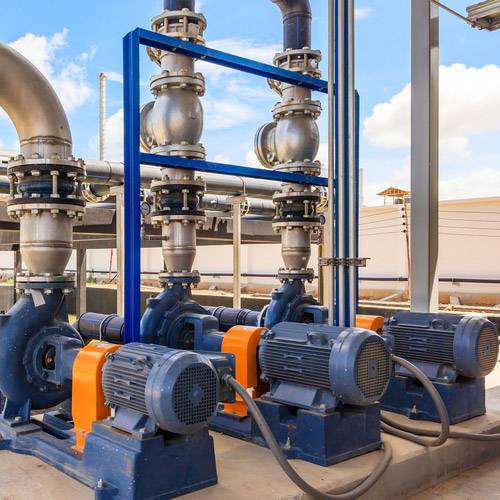
BIS Certification for Pumps in India: IS 8034 & IS 9079 Under the Pumps QCO 2023

Pumps are the quiet workhorses of India’s agriculture, water supply, and industrial sectors — moving water for irrigation, lifting it from borewells, and circulating it through countless systems. Because they are sold in enormous volumes and run for years under demanding conditions, their quality and energy efficiency matter a great deal. To raise baseline standards across the market, the government has brought several pump categories under mandatory BIS certification through the Pumps Quality Control Order. For pump manufacturers and importers, this means the ISI mark is now a precondition for selling in India. This guide explains the Pumps QCO, the applicable Indian Standards for different pump types, how BIS certification interacts with energy-efficiency labelling, and exactly how to obtain certification. 1. Is BIS Certification Mandatory for Pumps? Yes, for covered categories. The Ministry of Commerce & Industry introduced the Pumps (Quality Control) Order, 2023, mandating the ISI mark for notified pump types. Once a pump category is covered, it cannot be manufactured, imported, stored for sale, or sold in India without a valid BIS licence and the ISI mark. As with other QCOs, the order does not apply to pumps manufactured exclusively for export. 2. The Applicable Indian Standards Different pump types are certified against different Indian Standards. Matching your specific pump to the correct standard is the essential first step. Key standards include: Standard Pump type IS 8034 Submersible pumpsets IS 9079 Monoset pumps for clear, cold water (agricultural and water-supply use) IS 14220 / others Openwell submersible pumpsets and related categories Applicable IS Centrifugal jet pumps, horizontal centrifugal self-priming pumps, and other notified types Because the QCO covers a family of pump types, manufacturers with a broad range should map each model to its correct standard rather than assuming one certification covers the whole portfolio. The standards specify performance parameters such as head, discharge, and efficiency, along with construction and safety requirements — so the pump must be designed and tested against the precise standard that matches its type. 3. BIS Certification and BEE Energy Labelling Pumps illustrate how more than one compliance requirement can apply to the same product. BIS certification under the QCO addresses safety and performance to the Indian Standard. Separately, India’s Bureau of Energy Efficiency (BEE) operates a star-rating programme that covers certain pump categories — notably agricultural pump-sets — requiring an energy-efficiency label. Where it applies, BEE labelling is additional to, not a substitute for, BIS certification. Manufacturers should confirm whether their specific pump falls under a BEE labelling requirement so they do not satisfy one obligation while overlooking the other. Building a simple compliance matrix — each model against BIS certification and any BEE labelling — keeps the picture clear. 4. The Certification Route: ISI Mark (Scheme-I) Pumps are certified under the ISI mark route, Scheme-I of the BIS (Conformity Assessment) Regulations, 2018, which includes a factory inspection alongside sample testing. The broad process is: 5. Foreign Manufacturers Overseas pump manufacturers certify through the Foreign Manufacturers Certification Scheme (FMCS) version of the ISI route. The foreign manufacturer must appoint an Authorised Indian Representative (AIR) resident in India, and BIS inspectors audit the overseas factory — adding travel cost and lengthening the timeline. Given the scale of India’s pump market, foreign manufacturers should plan certification well ahead of their intended launch and ensure their AIR’s details are consistent across all documents. 6. Documents, Timeline, and Validity Typical documentation includes the manufacturing licence or business registration, production-process and testing-facility details, technical specifications for each pump model, trademark or brand authorisation, and — for foreign applicants — the AIR appointment. Domestic applications with inspection-ready factories commonly take a few months; foreign applications run longer due to overseas audit scheduling. The ISI licence is granted for a defined term and is renewable, subject to continued compliance and periodic surveillance. 7. Why Pump Quality and Efficiency Matter The push to certify pumps is about more than ticking a regulatory box. Pumps are among the largest consumers of electricity in India — agricultural pumping alone accounts for a significant share of the country’s power demand — so an inefficient pump is not just a poor product; it is a lifelong drain on energy and money. A pump that delivers less water per unit of electricity, or that fails prematurely, imposes real costs on farmers and water utilities who rely on it daily. Standards such as IS 8034 and IS 9079 set the performance and construction baseline that ensures a pump does its job reliably and efficiently over years of hard use. For manufacturers, this dual focus on safety and efficiency is also why the BIS and BEE frameworks coexist. A genuinely good pump is both safe and efficient, and certification is the mechanism that verifies and signals both qualities to buyers — increasingly important as agricultural and municipal purchasers become more cost- and energy-conscious. 8. Common Mistakes That Delay Certification Pump manufacturers commonly run into the same avoidable problems. Anticipating them keeps the process moving: 9. Renewal, Surveillance, and Market Context After grant, an ISI licence carries ongoing obligations: BIS conducts periodic surveillance to confirm continued conformity, and the licence must be renewed before expiry to keep the ISI mark valid. Beyond compliance mechanics, the market context rewards certification. Government tenders, large agricultural buyers, and organised dealers increasingly require the ISI mark — and, where relevant, the BEE label — before purchasing. A manufacturer with a clean, well-maintained certification record is better positioned to win institutional business and to compete in a market that is steadily moving away from uncertified, low-quality product. Treating certification as a continuing discipline rather than a one-off task is what keeps that advantage intact. 10. A Practical Checklist for Pump Manufacturers Working through a short checklist before filing prevents the most common delays: 11. The Direction of Travel for Pump Regulation The Pumps QCO is best understood as one step in a steadily expanding framework rather than a final, fixed rulebook. India continues to add pump categories and update the underlying standards