
BIS ISI Certification for Cross Recessed Screws in India: IS 7483, IS 7485, IS 7486, IS 18480 and the Complete Licensing Process
Cross recessed screws — the familiar Phillips-type screws with a cross-shaped drive slot — are the most ubiquitous fastener in modern manufacturing. They hold together appliances, electronics, furniture, automotive interiors, switchboards, and countless assemblies in every Indian factory and home. Precisely because they are everywhere and bought by the million, quality failures propagate at scale: soft screws whose recesses cam out and strip, brittle screws that snap in the joint, and mis-dimensioned threads that fail under load. The government has brought this category under compulsory BIS certification through the Cross Recessed Screws (Quality Control) Order, 2024 — notified by the Department for Promotion of Industry and Internal Trade (DPIIT) vide S.O. 4099(E) dated 17 September 2024 — making the ISI mark mandatory across 14 Indian Standards under Scheme-I of the BIS (Conformity Assessment) Regulations, 2018, the same ISI Mark Scheme that governs the products on the BIS list of products under compulsory certification.
The enforcement calendar has now fully arrived: the order applied from six months after publication for general enterprises, nine months for small enterprises, and twelve months for micro enterprises — meaning that as of today, no covered cross recessed screw can be manufactured, imported, stored, or sold in India without a valid BIS licence and the Standard Mark, whatever the size of the maker. For fastener manufacturers, importers feeding OEM assembly lines, and distributors holding inventory, certification is the licence to operate. This guide explains all 14 covered standards, the step-by-step ISI licensing process, documents, timelines, the specific exemptions the order grants, and how fastener certification fits into the wider India compliance picture.
Why Cross Recessed Screws Fall Under Mandatory BIS Certification
Quality Control Orders are the government’s instrument for making an Indian Standard mandatory. Once a QCO is notified under the BIS Act, 2016, no person can manufacture, import, distribute, sell, hire, lease, store, or exhibit for sale any covered product without the ISI mark granted under a valid BIS licence. The screws QCO is part of a broader fastener quality drive — and it is unusually wide, sweeping machine screws, self-tapping screws, self-drilling screws, drywall screws, chipboard screws, and cross-recessed wood screws into a single order — aimed at raising the quality floor of a high-volume import category and strengthening domestic fastener manufacturing.
The quality rationale is about scale and hidden failure. A single substandard screw is trivial; a production lot of them inside an assembly line is not. Screws that strip during driving slow production and damage assemblies; screws that fail in service loosen joints, create electrical hazards, and generate warranty claims across thousands of units. Fastener quality is invisible at purchase — plating hides metallurgy, and thread geometry defects emerge only under torque. Certified conformity verifies the material, hardness, torque resistance, recess geometry, and thread accuracy that make a screw perform. The QCO is also a commercial gate: OEM procurement, organised distribution, and marketplaces verify BIS licences, and customs checks compliance at import.
Which Screws Are Covered: All 14 Notified Standards
The schedule to the QCO lists 14 Indian Standards, each aligned to its ISO equivalent, spanning drilling screws, tapping screws, machine screws, and specialist construction screws:
| Sl. No. | Indian Standard / ISO | Title of Indian Standard |
|---|---|---|
| 1 | IS 18471 (Part 1):2023 / ISO 15481:1999 | Fasteners — Cross Recessed Drilling Screws with Tapping Screw Thread, Part 1 Pan Head |
| 2 | IS 18471 (Part 2):2023 / ISO 15482:1999 | Fasteners — Cross Recessed Drilling Screws with Tapping Screw Thread, Part 2 Countersunk Head |
| 3 | IS 18471 (Part 3):2023 / ISO 15483:1999 | Fasteners — Cross Recessed Drilling Screws with Tapping Screw Thread, Part 3 Raised Countersunk Head |
| 4 | IS 18476:2023 / ISO 15480:2019 | Fasteners — Hexagon Washer Head Drilling Screws with Tapping Screw Thread |
| 5 | IS 18480 (Part 1):2023 / ISO 7049:2011 | Cross Recessed Tapping Screws: Part 1 Pan Head |
| 6 | IS 18480 (Part 2):2023 / ISO 7050:2011 | Cross Recessed Tapping Screws: Part 2 Countersunk Flat Head |
| 7 | IS 18480 (Part 3):2023 / ISO 7051:2011 | Cross Recessed Tapping Screws: Part 3 Raised Countersunk Oval Head |
| 8 | IS 7483:2018 / ISO 7045:2011 | Pan Head Screws with Type H or Type Z Cross Recess — Product Grade A |
| 9 | IS 7485 (Part 1):2018 / ISO 7046-1:2011 | Countersunk Flat Head Screws (Common Head Style) with Type H or Type Z Cross Recess — Product Grade A, Part 1 Steel Screws of Property Class 4.8 |
| 10 | IS 7485 (Part 2):2018 / ISO 7046-2:2011 | Countersunk Flat Head Screws — Product Grade A, Part 2 Steel Screws of Property Class 8.8, Stainless Steel Screws and Non-Ferrous Metal Screws |
| 11 | IS 7486:2018 / ISO 7047:2011 | Raised Countersunk Head Screws (Common Head Style) with Type H or Type Z Cross Recess — Product Grade A |
| 12 | IS 18507:2024 | Drywall Screws — Specification |
| 13 | IS 18508:2024 | Chipboard Screws — Specification |
| 14 | IS 18509:2023 | Cross-recessed Countersunk Head Wood Screws — Specification |
Two points deserve attention. First, the order distinguishes property classes: IS 7485 is split into Part 1 for Property Class 4.8 steel screws and Part 2 for Property Class 8.8 steel, stainless steel, and non-ferrous screws — so a manufacturer producing both grades of the same countersunk head style needs conformity under both parts. Second, the schedule extends well beyond machine screws into construction and joinery fasteners: drywall screws (IS 18507), chipboard screws (IS 18508), and cross-recessed countersunk head wood screws (IS 18509) are all inside this order, which catches many manufacturers who assumed those product lines sat outside it. Manufacturers should confirm the exact covered products and current editions against the latest notification before testing, because the licence is granted per standard, per manufacturing location.
Who Must Comply — and From When
The QCO binds every link in the supply chain. Indian fastener manufacturers need a BIS licence under Scheme-I for each manufacturing premises and each applicable standard. Importers cannot clear covered screws through customs unless the foreign manufacturing site itself holds a BIS licence — obtained through the Foreign Manufacturers Certification Scheme (FMCS), under which BIS audits the overseas plant and grants the ISI licence to the foreign entity, which must also appoint an Authorised Indian Representative (AIR). OEMs sourcing loose screws for assembly in India must ensure their supply chains draw from licensed sites. Traders and distributors are equally barred from storing or selling non-compliant stock.
The enforcement calendar was staggered by enterprise size, measured from the date of publication — and every date has now passed:
- Six months from publication — the QCO took effect for general enterprises (other than micro and small).
- Nine months from publication — deadline for small enterprises.
- Twelve months from publication — deadline for micro enterprises.
With the order published on 17 September 2024, those dates fell in March, June, and September 2025 respectively. The category is therefore under full enforcement across all enterprise sizes. BIS market surveillance and customs scrutiny of fastener consignments are active, and unlicensed material faces seizure and penal action under the BIS Act, 2016 — imprisonment of up to two years and/or fines starting at ₹2 lakh for a first offence. Because subsequent amendment orders have adjusted implementation dates for certain entries, manufacturers should confirm the operative date for their specific standard and enterprise category before relying on any timeline. Manufacturers and importers still operating without a licence should regularise immediately.
The Exemptions the Order Actually Grants
The QCO carves out five specific exemptions, and understanding them precisely matters because several are commercially significant:
- Domestic manufacture for export — screws made in India for export markets are outside the order, preserving India’s fastener export business.
- Screws imported as part of a finished good, sub-assembly, or component — this is the exemption most often misread. A screw already installed inside an imported appliance or sub-assembly is not separately caught by the order; a loose screw imported for assembly in India is.
- Imports by domestic manufacturers for export production — screws imported as inputs for goods that will be exported are exempt.
- Small Udyam-registered units — enterprises registered on the Udyam portal whose investment in plant, machinery, or equipment at original cost does not exceed ₹25 lakh and whose turnover does not exceed ₹2 crore in the previous financial year, as certified by a Chartered Accountant, are exempt from implementation.
- R&D imports up to 200 kg per year — OEMs may import up to two hundred kilograms of covered screws annually for research and development. Such goods cannot be sold commercially and must be disposed of as scrap, and the OEM must maintain financial-year-wise records and furnish them to government authorities on request, signed by an authorised signatory.
Anyone relying on an exemption should document eligibility carefully — the burden of proof rests with the party claiming it, and customs officers and BIS enforcement teams will ask for evidence.
What the Screw Standards Actually Test
Understanding what the laboratory examines clarifies why certification takes preparation. The standards evaluate cross recessed screws against the properties that determine performance in the joint.
Material and mechanical properties — the screw must meet its specified property class: tensile strength, hardness (core and, for case-hardened tapping screws, surface), and freedom from embrittlement. Heat treatment control is decisive — too soft strips, too hard snaps.
Recess geometry and torque performance — the cross recess is precision geometry. Penetration depth, wing dimensions, and recess soundness are gauged, and torsional tests verify the recess transmits the specified driving torque without cam-out. This is the defining test for a cross recessed screw.
Thread and dimensional accuracy — thread profile, pitch, major/minor diameters, head dimensions, and length tolerances are checked. For tapping and drilling screws, thread-forming and drilling performance in specified test plates is verified.
Finish and coating — plating type, thickness, and corrosion resistance (salt spray where specified) are examined, along with freedom from hydrogen embrittlement after electroplating — critical for hardened screws — and prescribed packaging marking including size, property class, standard reference, and the ISI mark with the CM/L number.
Products must pass at a BIS-recognised laboratory, and the plant must demonstrate ongoing capability — Scheme-I is a licence to a manufacturing process, not a one-time product approval. The Scheme of Inspection and Testing (SIT) requires specified in-house equipment — hardness testers, torque test apparatus, thread and recess gauges — operating at the factory.
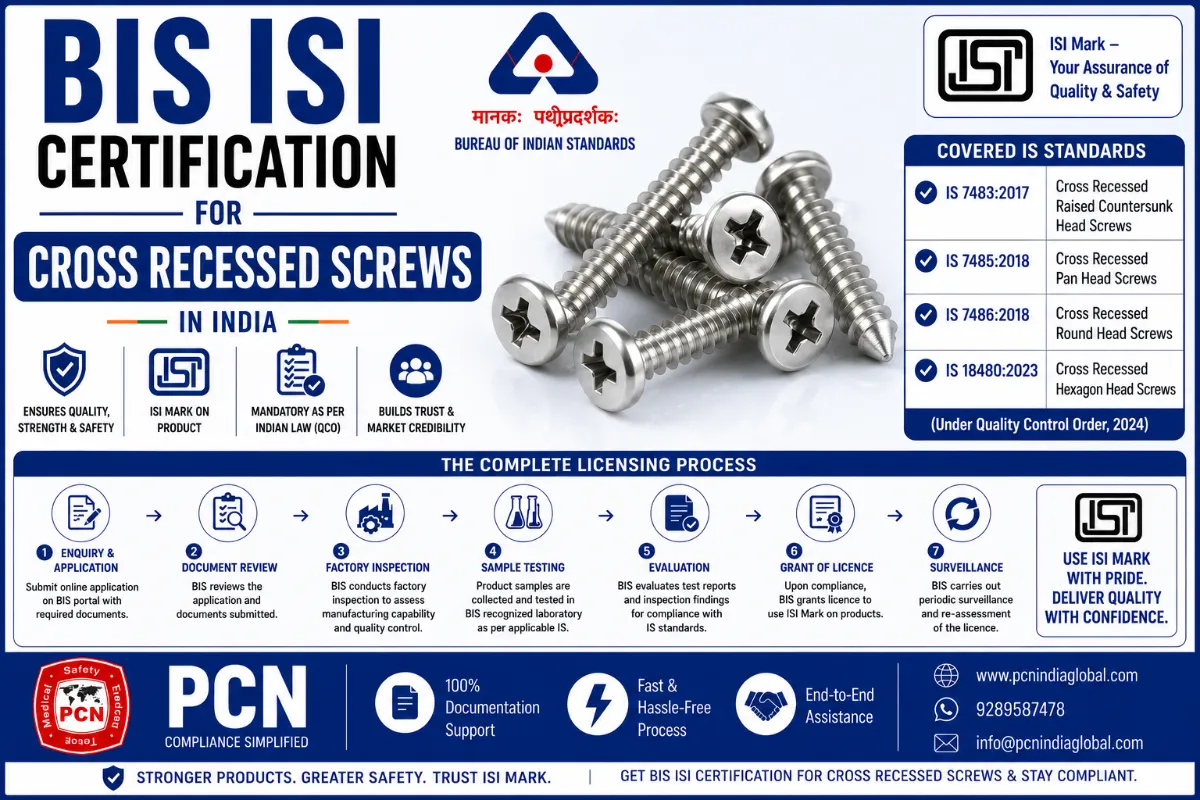
Step-by-Step: Obtaining the BIS ISI Licence for Cross Recessed Screws
The ISI licensing route under Scheme-I includes factory assessment. Our team manages each stage end to end, but every applicant should understand the sequence.
- Product-standard mapping. Confirm which standards apply across your head styles — pan, countersunk, raised countersunk, tapping — and group diameters and lengths sensibly under each licence.
- Gap assessment and in-house testing setup. Establish the hardness, torque, and gauging equipment and quality records the SIT requires before applying.
- Application filing. Submit the application on the BIS portal with factory details, product details, manufacturing process flow, and prescribed fees — for foreign manufacturers, via FMCS with AIR nomination.
- Factory inspection. A BIS officer visits the plant to verify the production process — cold heading, thread rolling, heat treatment, plating — in-house testing capability, and quality control arrangements, and draws samples across sizes.
- Independent laboratory testing. Samples are tested against the applicable standard at a BIS-recognised laboratory — mechanical, torsional, dimensional, recess, and coating tests as prescribed.
- Grant of licence. On satisfactory inspection and test results, BIS grants the licence (CM/L number), authorising use of the Standard Mark.
- Marking and ongoing compliance. Apply the ISI mark with the CM/L number and IS number on packaging as prescribed, operate the SIT, maintain test records, undergo periodic surveillance inspections and market sample testing, and renew the licence on time.
Documents Required
A complete file at the outset is the biggest single lever on approval speed. A fastener manufacturer will typically need:
- Company registration and factory establishment documents
- Manufacturing process flow chart — wire drawing/procurement, cold heading, thread rolling, heat treatment, plating
- List of manufacturing machinery and in-house testing equipment
- Details of raw materials — steel wire grades — and their sources with material certificates
- Product specifications: head styles, diameters, lengths, property classes, and variety list per standard
- In-house test records per the Scheme of Inspection and Testing
- Third-party laboratory test reports against the applicable IS (where drawn in advance)
- Calibration certificates for hardness testers, torque apparatus, and gauges
- Layout plan of the factory premises
- For foreign manufacturers: FMCS application, AIR nomination and undertakings, and factory audit logistics
- Authorised signatory details and application declarations
Timeline and Cost Planning
A realistic schedule for a domestic manufacturer is three to four months from a well-prepared application to grant of licence, with inspection scheduling and laboratory testing as the pacing items. Foreign manufacturers under FMCS should plan for five to seven months, driven by overseas audit scheduling and travel logistics.
Costs fall into four buckets: BIS application and licence fees, the marking fee (linked to production), laboratory testing per standard and size group, and — for FMCS applicants — inspection travel and the AIR arrangement. With 14 standards in the schedule, a plant producing several head styles needs a licence per standard, so sensible variety grouping across each diameter-length matrix is the main cost lever. Estimate your obligation with our India Compliance Cost Calculator.
Common Mistakes That Delay a Screw Licence
- Operating unlicensed under full enforcement. All enforcement dates have passed; unlicensed screws in production or in the channel are exposed to seizure and penalties now.
- Heat-treatment and embrittlement gaps. Hardness variation and post-plating hydrogen embrittlement are the classic fastener failure modes; process control and baking practice must be demonstrable.
- Missing gauging and torque equipment. Scheme-I requires recess gauges, thread gauges, hardness and torque testing at the plant; inspections fail without them.
- Wrong standard mapping. A tapping screw tested as a machine screw, or head styles outside the applied scope, produce unusable reports.
- Importer misunderstanding of FMCS. The licence must be held by the foreign plant, not the Indian importer. Consignments from unlicensed plants are stopped at customs.
- Packaging marking mismatches. The size, property class, standard reference, and manufacturing address on packaging, test report, and application must match exactly.
Screws Within the Wider Compliance Picture
The ISI licence is the centrepiece, but a fastener business usually carries adjacent obligations. Packaged retail screws are pre-packaged commodities requiring Legal Metrology (LMPC) registration. Manufacturers and importers using plastic packaging need EPR registration for plastic waste with CPCB. Importers require valid import documentation and IEC — see our DGFT license services. OEMs should note that fastener compliance is now part of sourcing due diligence: loose screws bought into an Indian assembly line must come from licensed sites, even though screws already embedded in an imported sub-assembly are exempt. A coordinated plan brings the BIS ISI licence, LMPC, and EPR together.
Pre-Launch Compliance Checklist for Cross Recessed Screws
Before committing to production or a shipment, run this verification sequence. First, map every SKU to the correct standard among the 14 — including the property-class split between IS 7485 (Part 1) and (Part 2), and the construction fasteners IS 18507, IS 18508, and IS 18509 — and confirm current editions. Second, verify the manufacturing site — Indian or foreign — holds or has applied for the Scheme-I licence, with an AIR in place for foreign plants. Third, confirm in-house gauging, hardness, and torque testing and SIT records are operational. Fourth, check the ISI mark, CM/L number, IS number, size, and property class appear correctly on packaging. Fifth, align head styles, sizes, and factory address across product, test reports, and licence scope. Sixth, close the adjacent items: LMPC declarations, plastic-waste EPR, and import documentation.
For ongoing operations, maintain a compliance register per standard: CM/L number and validity, standard edition, licensed sizes and classes, surveillance inspection dates, market sample results, and renewal timelines — so licence conditions are managed proactively rather than at customs or during enforcement.
Frequently Asked Questions
Is BIS certification mandatory for cross recessed screws in India?
Yes. Under the Cross Recessed Screws (Quality Control) Order, 2024 — S.O. 4099(E) dated 17 September 2024 — notified screws cannot be manufactured, imported, or sold in India without the ISI mark under a valid BIS licence. Enforcement now covers all enterprise sizes.
How many Indian Standards does the QCO cover?
Fourteen. They are IS 18471 (Parts 1, 2 and 3):2023 for cross recessed drilling screws, IS 18476:2023 for hexagon washer head drilling screws, IS 18480 (Parts 1, 2 and 3):2023 for cross recessed tapping screws, IS 7483:2018 for pan head screws, IS 7485 (Part 1 and Part 2):2018 for countersunk flat head screws, IS 7486:2018 for raised countersunk head screws, IS 18507:2024 for drywall screws, IS 18508:2024 for chipboard screws, and IS 18509:2023 for cross-recessed countersunk head wood screws.
Are drywall, chipboard and wood screws really included?
Yes. IS 18507 (drywall screws), IS 18508 (chipboard screws), and IS 18509 (cross-recessed countersunk head wood screws) are entries 12, 13 and 14 of the schedule. Manufacturers of construction and joinery fasteners are within this QCO, not outside it.
What were the compliance deadlines?
Six months from publication for general enterprises, nine months for small enterprises, and twelve months for micro enterprises — falling in March, June, and September 2025 respectively. All have passed, though later amendment orders have adjusted dates for some entries, so confirm the operative date for your standard.
Can importers get the BIS licence themselves?
No. Under FMCS the licence is granted to the foreign manufacturing plant, which must appoint an Authorised Indian Representative. Importers can only source covered screws from plants holding a valid BIS licence.
Are screws inside an imported product covered?
No. The order exempts goods imported as part of a finished good, sub-assembly, or component — so screws already installed inside an imported product are not separately caught. Loose screws imported for assembly in India are covered.
Are exported screws covered?
No. Screws manufactured domestically for export are exempt, as are screws imported by a domestic manufacturer as inputs for export production. Everything sold in the Indian market must be licensed.
How long does the screws ISI licence take?
Typically three to four months for Indian manufacturers and five to seven months for foreign manufacturers under FMCS, assuming complete documentation and prompt inspection scheduling.
What are the penalties for non-compliance?
Manufacturing or selling covered screws without the ISI mark is an offence under the BIS Act, 2016, attracting imprisonment of up to two years and/or fines starting at ₹2 lakh, alongside seizure of non-compliant stock and customs detention of imports.
Why Choose PCN India Global
- Fastener QCO expertise — precise product-to-standard mapping across the cross recessed screw standards, with licence structuring for wide diameter-length ranges
- Factory readiness — we prepare your gauging, hardness, and torque testing setup and SIT records so the BIS inspection passes the first time
- FMCS for foreign manufacturers — end-to-end management of the overseas audit, and we act as your Authorised Indian Representative
- Lab coordination — testing at BIS-recognised laboratories with efficient variety grouping to minimise cost
- OEM supply-chain support — we help OEMs verify and regularise notified fasteners in their sourcing
- Surveillance and renewal tracking — so your CM/L stays valid and licence conditions are managed proactively
PCN India Global manages the complete BIS ISI certification process for fastener manufacturers and importers — from standard mapping and plant preparation to licence grant and renewal, coordinated with the LMPC and EPR obligations these businesses carry. With the QCO under full enforcement across all enterprise sizes, unlicensed screws cannot enter the market. Contact us: WhatsApp +91 80109 05029, email bdm@pcnindiaglobal.com, or start your application today.
Related Compliance Guides
- BIS Certification (ISI Mark) — Complete Service Overview
- BIS Scheme-X Certification
- Legal Metrology (LMPC) Registration
Related Guides
- BIS ISI Certification for Furniture in India
- BIS ISI Certification for Hand Tools in India
- BIS Certification for Phosphoric Acid & Phosphite Chemicals in India
- BIS ISI Certification for Ropes and Cordages in India
Need expert help? See our BIS ISI mark certification services.