
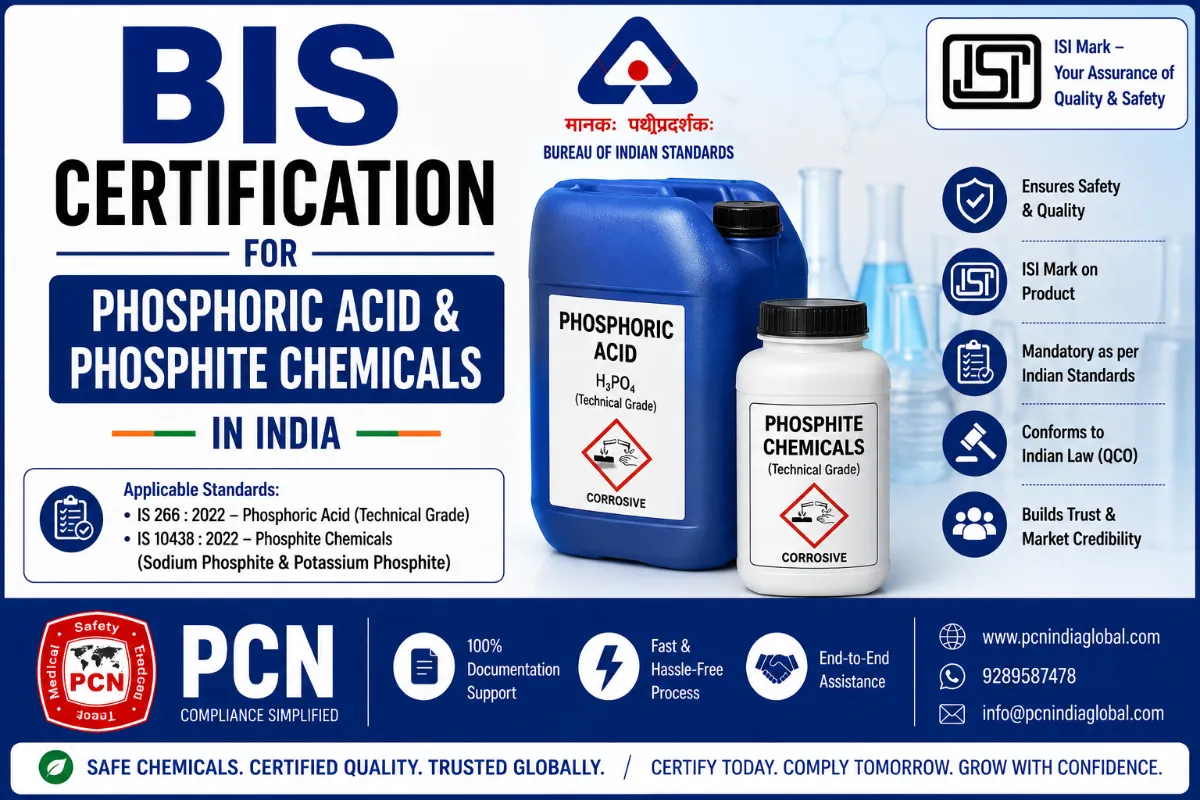

BIS Certification for Phosphoric Acid & Phosphite Chemicals in India: IS 798, IS 17439, IS 17412 and the Complete Compliance Process
Beyond the electronics and appliances most associated with BIS, India’s mandatory-certification framework has extended firmly into industrial chemicals — and phosphorus chemicals are a notable example. Ortho phosphoric acid, polyphosphoric acid, and trimethyl phosphite are important industrial inputs used across fertilisers, food and beverage processing, water treatment, metal finishing, flame retardants, and chemical synthesis. To ensure quality and consistency, these chemicals have been brought under mandatory BIS certification against their respective Indian Standards.
For manufacturers and importers, BIS certification against the applicable standard is now the gateway to lawfully supplying these chemicals in India. This is a distinct area from the electronics categories, but the underlying principle is the same: a notified product must conform to its Indian Standard and be certified by BIS before it can be placed on the market. This guide covers the three phosphorus chemicals and their standards, the mandatory framework, the certification process, the documents required, realistic timelines, and the key points chemical manufacturers should understand.
The Chemicals and Their Standards
Three phosphorus chemicals are covered, each under its own Indian Standard, with defined implementation dates under their Quality Control Orders:
- Ortho Phosphoric Acid — IS 798:2020. A widely used mineral acid found in fertiliser production, food-grade applications (as a food additive and acidulant), metal treatment, and many industrial processes.
- Polyphosphoric Acid — IS 17439:2020. A condensed phosphoric acid used in chemical synthesis, catalysis, and specialised industrial applications.
- Trimethyl Phosphite (Technical Grade) — IS 17412:2020. An organophosphorus compound used as a chemical intermediate and reagent in synthesis, including in the manufacture of other chemicals.
Each Indian Standard specifies the requirements for its chemical — including composition, purity, permissible impurities, and the test methods used to verify conformity. Manufacturers should obtain the current text of the applicable standard (IS 798, IS 17439, or IS 17412) and confirm the exact requirements and the current notification against the latest BIS position, since certification rests on demonstrated conformity to the correct standard and its current edition.
The Mandatory Framework: QCOs and BIS Certification
BIS certification operates under the Bureau of Indian Standards Act, 2016. When the Central Government issues a Quality Control Order for a product, it makes conformity to the corresponding Indian Standard — and BIS certification — mandatory. From the effective date of such an order, the product cannot lawfully be manufactured, stored, sold, or imported in India unless it conforms to the standard and carries the required BIS certification. Products manufactured solely for export are generally outside the order’s scope.
For these phosphorus chemicals, the respective Quality Control Orders bring IS 798, IS 17439, and IS 17412 into mandatory effect, each with its own implementation date. Because the precise scheme mechanics and enforcement dates for chemical products are set by the applicable notification — and can differ from the electronics registration route — manufacturers should confirm the exact certification pathway, the effective dates, and any turnover-linked or category-specific provisions against the current BIS position for each chemical. What is constant is the underlying obligation: once notified, the chemical must conform to its Indian Standard and be BIS-certified, and non-compliance exposes a business to penalties under the BIS Act.
Why These Chemicals Are Regulated
The rationale for bringing these chemicals under mandatory certification is quality assurance and consumer and industrial safety. Phosphorus chemicals are used in sensitive applications — food-grade phosphoric acid enters the food chain, fertiliser-grade acid affects agricultural output, and technical-grade reagents feed into further chemical manufacturing. Substandard or contaminated product can compromise the safety and quality of everything downstream, from processed food and beverages to fertilisers and manufactured chemicals. A consistent, verified quality baseline protects buyers and the many industries that depend on these inputs, and it also curbs the entry of substandard imports. For manufacturers, certification is therefore both a legal requirement and a mark of the quality that serious industrial and food-sector customers increasingly demand.
Why Grade and Purity Are Everything for These Chemicals
For phosphorus chemicals, the entire value of the product lies in its grade and purity, which is exactly what the Indian Standards pin down and what mandatory certification protects. The same chemical name can span very different quality levels: phosphoric acid, for instance, is supplied as fertiliser grade, technical grade, and food grade, and the difference between them is a matter of controlled composition and strictly limited impurities. Food-grade phosphoric acid used as an acidulant in beverages must meet purity limits that keep harmful impurities such as heavy metals well below safe thresholds, because it enters the food chain directly; a fertiliser-grade product diverted into food use, or a contaminated batch, could cause real harm. Technical-grade reagents such as trimethyl phosphite feed into further chemical synthesis, where an off-specification input propagates defects into every downstream product.
This is why the standards specify not just the headline assay but the permissible impurities and the test methods to verify them, and why certification hinges on demonstrating consistent conformity batch after batch rather than a one-off sample. For a manufacturer, the practical implication is that certification is fundamentally about proving reliable process control — that the plant can produce to grade consistently — which is the same capability that serious industrial and food-sector customers demand. Getting the quality system right is therefore both the route to certification and the foundation of a credible position in these quality-sensitive markets.
The Certification Process
BIS certification for a notified product follows the applicable scheme under the BIS conformity-assessment framework. For chemical products, the process centres on demonstrating that the product conforms to its Indian Standard, typically involving the following elements — though manufacturers should confirm the exact pathway for each chemical against the current notification.
- Confirm applicability and standard. Verify that the chemical falls within the notified scope and obtain the current text of the applicable standard (IS 798, IS 17439, or IS 17412).
- Establish testing and quality control. Ensure the manufacturing facility can produce product conforming to the standard, with the testing capability to verify composition, purity, and the other specified parameters on an ongoing basis.
- Product testing. Test the chemical against the applicable Indian Standard, establishing conformity of composition and quality through the standard’s test methods.
- Application to BIS. File the application through the BIS process with the required technical and company documentation. Foreign manufacturers apply through the applicable route for overseas producers and appoint an Authorised Indian Representative.
- Assessment and grant. BIS assesses the application, testing, and (where applicable) the manufacturing facility, and grants certification on satisfactory results.
- Marking and compliance. Mark the product / documentation as required under the certification, and maintain conformity under ongoing BIS surveillance, with periodic renewal.
Documents Required
A complete file at the outset is the biggest single lever on approval speed. For these chemicals you will typically need:
- Test report(s) demonstrating conformity to the applicable Indian Standard (IS 798, IS 17439, or IS 17412)
- Details of the manufacturing unit and process
- Manufacturing process flow and quality-control arrangements
- Details of in-house / laboratory testing capability against the standard
- Raw-material and specification details
- Company registration and business documents
- For foreign manufacturers: Authorised Indian Representative nomination and related undertakings
- Authorised signatory details and application declarations
Foreign manufacturers must certify through the applicable route for overseas producers and appoint an Authorised Indian Representative; Indian importers should ensure their overseas suppliers are properly certified.
Timeline and Cost Planning
A realistic certification schedule for a chemical product is typically a few weeks to a few months, driven by product testing against the standard, the readiness of the manufacturing and quality-control arrangements, and the BIS assessment. Testing to establish conformity of composition and purity is usually the pacing item, and where the facility and its quality controls are prepared in advance, the process moves faster. BIS charges testing, application, and certification fees, with additional costs for overseas assessment where applicable. Because the Quality Control Orders set enforcement dates, the sound approach is to begin certification well ahead of the applicable date so the product remains lawfully saleable, rather than facing a gap.
Common Mistakes That Delay a Chemical Certification
- Testing to a superseded standard. Certification rests on the current edition of IS 798, IS 17439, or IS 17412; confirm it before testing.
- Inadequate quality-control capability. The facility must be able to verify conformity on an ongoing basis; gaps stall the assessment.
- Assuming the electronics route applies. Chemical certification pathways can differ from the electronics registration route; confirm the exact scheme for each chemical.
- Foreign makers overlooking the AIR requirement. Overseas producers must certify through the applicable route and appoint an Authorised Indian Representative.
- Incomplete raw-material and process documentation. Missing process or specification details stall the file.
- Leaving it to the deadline. QCO enforcement dates are fixed; late certification risks a gap in saleability.
These Chemicals Within the Wider Compliance Picture
Chemical certification connects to a broader compliance environment:
- Other BIS certifications — a manufacturer’s wider product range may carry its own BIS obligations; see our BIS certification service.
- DGFT / import compliance — imported chemicals may involve DGFT licensing and import-policy considerations.
- Legal Metrology (LMPC) — pre-packaged chemical products require LMPC registration and correct package declarations.
- PESO / hazardous-materials rules — where a chemical is hazardous, flammable, or corrosive, applicable safety and transport regulations (including PESO where relevant) apply separately from BIS certification.
A coordinated plan aligns the chemical’s BIS certification with import, packaging, and hazardous-materials obligations.
Pre-Supply Compliance Checklist for Phosphorus Chemicals
Before committing to supply, run this verification sequence. First, confirm the applicable standard (IS 798, IS 17439, or IS 17412) and its current edition, and the certification pathway and effective date for the chemical. Second, obtain test reports demonstrating conformity of composition and purity. Third, ensure the manufacturing facility has the quality-control and testing capability the standard requires. Fourth, for foreign producers, confirm the applicable route and appoint an Authorised Indian Representative. Fifth, align the certification with import, LMPC packaging, and any hazardous-materials obligations, and diarise the renewal.
For ongoing operations, maintain a compliance file per product: the certification and validity, the standard and edition, test records, and quality-control history — so renewals and BIS surveillance are handled proactively.
Frequently Asked Questions
Is BIS certification mandatory for these phosphorus chemicals?
Yes. Ortho phosphoric acid (IS 798), polyphosphoric acid (IS 17439), and trimethyl phosphite technical grade (IS 17412) are notified under their Quality Control Orders and must conform to the applicable Indian Standard and carry BIS certification to be manufactured, stored, sold, or imported in India. Confirm the exact dates and pathway against the current notification.
Which standards apply?
IS 798:2020 for ortho phosphoric acid, IS 17439:2020 for polyphosphoric acid, and IS 17412:2020 for trimethyl phosphite (technical grade). Confirm the current editions.
Does the certification process differ from electronics?
It can. Chemical certification centres on demonstrating conformity of composition and quality to the Indian Standard, and the exact pathway may differ from the electronics registration route. Confirm the applicable scheme for each chemical.
Are exports covered?
Products manufactured solely for export are generally outside the scope of the QCO; check the applicable notification.
How does a foreign manufacturer get certified?
Through the applicable route for overseas producers, which requires appointing an Authorised Indian Representative and demonstrating conformity to the standard.
How long does certification take?
Typically a few weeks to a few months, driven by testing and the readiness of the manufacturing and quality-control arrangements.
Why Choose PCN India Global
- Chemical-QCO expertise — we confirm the applicable standard, pathway, and effective date for each phosphorus chemical
- Conformity support — we help establish the testing and quality-control evidence the standard demands
- Foreign-producer representation — we act as your Authorised Indian Representative and manage the overseas route
- End-to-end handling — testing coordination, application, and certification driven to completion
- Coordinated compliance — BIS certification aligned with import, LMPC, and hazardous-materials obligations
- Surveillance and renewal tracking — so your certification stays valid without disruption
PCN India Global manages the complete BIS certification process for ortho phosphoric acid, polyphosphoric acid, and trimethyl phosphite under IS 798, IS 17439, and IS 17412 — from conformity testing to certification and renewal, coordinated with the import and packaging obligations these chemicals carry. Contact us: WhatsApp +91 80109 05029, email bdm@pcnindiaglobal.com, or start your application today.
Related Compliance Guides
- BIS Certification for Pumps
- BIS Certification for Hand-held Motor-Operated Electric Tools
- BIS Certification for Fire Detection & Alarm Systems
Related Guides
- BIS ISI Certification for Domestic Gas Stoves for PNG in India
- BIS ISI Certification for Furniture in India
- BIS ISI Certification for Wheeled Fire Extinguishers in India
- BIS ISI Certification for Cross Recessed Screws in India
Need expert help? See our BIS ISI mark certification services.