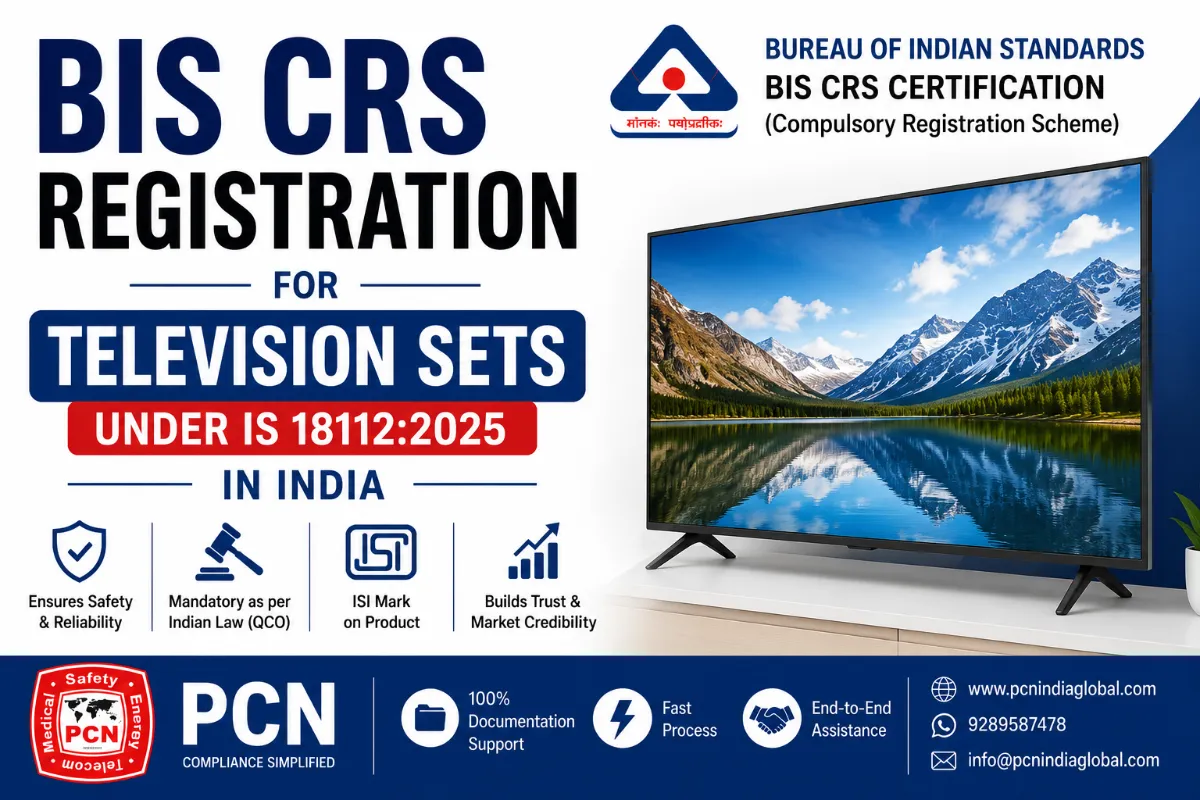

BIS CRS Registration for Television Sets under IS 18112:2025 in India: The New Performance Standard and the Complete Compliance Process
Television sets have long been among the most tightly regulated consumer-electronics products in India, and a significant new requirement is now reshaping their compliance. Alongside the established safety registration, television sets are being brought under a dedicated performance standard, IS 18112:2025, with a defined implementation date of 26 July 2026. This marks an important evolution: where TV regulation previously centred on electrical safety, it now increasingly addresses performance as well, under the BIS Compulsory Registration Scheme (CRS).
For every TV manufacturer, brand owner, and importer, understanding this new IS 18112:2025 requirement — and how it sits alongside the existing safety standard — is essential, and BIS CRS registration remains the gateway to the Indian television market. This guide explains the new IS 18112:2025 requirement for television sets, how it complements the long-standing IS 616 safety standard, the CRS self-declaration process, the documents required, realistic timelines, and what TV brands should do to be ready for the implementation date.
A New Layer: Performance Alongside Safety
Television sets have been registered under CRS against the safety standard IS 616:2017 (the audio-video apparatus safety standard) — the requirement that ensures a TV is electrically safe. The significant development is the addition of IS 18112:2025, a dedicated Indian Standard for television sets that is being applied to the category with effect from 26 July 2026.
As the official BIS listing indicates, television sets are moving toward a requirement that references IS 616:2017 together with IS 18112:2025 — in other words, both a safety dimension and this new standard. For manufacturers, the practical significance is that TV compliance is expanding from a purely safety-based registration to one that also engages IS 18112:2025.
Because this is a recent standard with a specific implementation date, manufacturers should confirm the exact applicable requirements, the precise scope, and how IS 616 and IS 18112:2025 are to be applied together against the latest BIS notification — the details of a newly implemented standard are exactly the kind of thing that must be verified against the current position rather than assumed. What is clear is that TV brands need to prepare for the IS 18112:2025 requirement ahead of the July 2026 date, so that their products remain registrable and saleable once it takes effect.
Why This Matters for the Television Category
Television is one of India’s largest consumer-electronics categories, spanning entry-level HD models to premium 4K and 8K smart TVs, sold in enormous volumes and increasingly manufactured or assembled domestically. Regulation of such a large, high-volume category has significant market impact, and the introduction of a dedicated television-set standard reflects the maturing of India’s product-quality framework for this product.
The core obligation under CRS remains constant: a covered television must be tested against the applicable Indian Standard(s), registered with BIS, and marked with its registration number before it can be manufactured, imported, sold, distributed, or stored for sale in India. Selling an unregistered notified television is an offence under the BIS Act, 2016, with the usual consequences of penalties and removal from sale.
What changes with IS 18112:2025 is the content of what a television must demonstrate — adding the dimension covered by the new standard to the established safety registration. For brands, being ready means ensuring products can meet the applicable requirements and complete registration in time for the implementation date, so there is no gap in saleability.
How IS 616 and IS 18112:2025 Fit Together
The essential point for a TV manufacturer is that these are complementary requirements, not alternatives, and understanding how they combine is the key to a smooth transition. IS 616:2017 addresses the safety of the television as audio-video apparatus — protection against electric shock, energy and thermal hazards, fire, and mechanical construction — the long-standing basis for TV registration. IS 18112:2025 is the dedicated television-set standard now being applied to the category with effect from 26 July 2026, adding its dimension to the compliance picture.
The official position indicates television sets moving to a requirement referencing IS 616:2017 together with IS 18112:2025, so a manufacturer should plan on demonstrating conformity to both as applicable rather than treating the new standard as a replacement for the safety requirement.
For a manufacturer, the practical approach is to treat the TV’s compliance file as encompassing both the established safety standard and the new IS 18112:2025 requirement, and to confirm — against the current BIS notification — exactly how the two are to be tested and registered together for a given product. Because IS 18112:2025 is newly implemented, this verification against the live position is especially important, and it is precisely where working with a partner who tracks BIS developments closely adds value. The goal is a television that satisfies the full, updated requirement set and completes its CRS registration in good time before the July 2026 implementation date.
Step-by-Step: BIS CRS Registration for a Television Set
CRS is a test-and-register scheme with no factory inspection. Our team manages each stage end to end, but every applicant should understand the sequence.
- Confirm the applicable standards. Verify the current requirement for television sets — IS 616:2017 for safety and IS 18112:2025 as applicable — and the implementation timeline.
- Test at a BIS-recognised laboratory. Submit TV samples for testing against the applicable standard(s).
- Prepare documentation. Compile technical details, panel and critical-component data, company and brand documents, and — for foreign makers — the Authorised Indian Representative (AIR) nomination.
- File the online application. Submit on the BIS portal with the test report(s) and documents.
- BIS scrutiny and grant. BIS reviews and grants the registration with a unique R-number.
- Mark and self-declare. Apply the standard mark and R-number on the TV and packaging, and issue the self-declaration.
- Maintain and renew. Keep conformity under BIS surveillance and renew periodically; act on the registration if critical components change.
Documents Required
A complete file at the outset is the biggest single lever on approval speed. You will typically need:
- Test report(s) from a BIS-recognised laboratory against the applicable standard(s) — IS 616:2017 and IS 18112:2025 as applicable
- Product technical specifications and datasheets
- Panel, power-supply (SMPS), and main-board critical-component details
- Bill of materials
- Company registration and business documents
- Trademark / brand authorisation documents
- Details of the manufacturing unit
- For foreign manufacturers: Authorised Indian Representative (AIR) nomination and undertakings
- Marking / label artwork showing the standard reference(s) and R-number
- Authorised signatory details and application declarations
Foreign manufacturers hold the CRS registration in their own name and must appoint an AIR resident in India; the importer relies on that registration.
Timeline and Cost Planning
A realistic CRS schedule for a television is commonly a few weeks to a couple of months end to end, with laboratory testing the pacing item. Once complete test reports and a full application are filed, BIS scrutiny and grant follow.
Costs are dominated by laboratory testing fees, followed by BIS application and registration fees and, for foreign makers, the AIR arrangement. Because TV ranges span many screen sizes on shared electronic platforms, BIS series/family guidelines that allow closely related models to be grouped are valuable.
The overriding planning consideration for this category right now is the 26 July 2026 implementation date for IS 18112:2025: manufacturers should confirm the applicable requirements and complete the necessary testing and registration ahead of that date so their televisions remain registrable and saleable, rather than facing a last-minute scramble. Given how large and fast-moving the TV market is, early action is a genuine competitive advantage.
Common Mistakes to Avoid
- Assuming IS 616 alone still suffices. With IS 18112:2025 being applied from 26 July 2026, confirm the full applicable requirement set rather than relying only on the safety standard.
- Leaving it to the deadline. The implementation date is fixed; late testing and registration risk a gap in saleability.
- Not verifying the new-standard details. IS 18112:2025 is newly implemented; confirm its exact scope and how it combines with IS 616 against the current BIS position.
- Importer-as-registrant confusion. The manufacturer holds the CRS registration; foreign makers must appoint an AIR.
- Critical-component changes. Changing the registered panel or power supply can require action on the registration.
- Model/brand mismatches. The brand and model on the TV, label, test report, and application must match exactly.
Television Sets Within the Wider Compliance Picture
TV certification connects to a broad compliance picture:
- IS 616:2017 safety registration — the established safety basis for TVs under CRS; see our BIS CRS registration service.
- WPC ETA — smart TVs’ Wi-Fi and Bluetooth radios require WPC ETA approval.
- BEE Star Labelling — televisions fall under the BEE energy-labelling programme.
- EPR for e-waste — producers and importers must hold EPR registration for e-waste with CPCB; imported packs require LMPC registration.
A coordinated plan handles the TV’s updated CRS requirement (IS 616 plus IS 18112:2025) alongside WPC, BEE, EPR, and LMPC so the product reaches market fully compliant.
Pre-Launch Compliance Checklist for Television Sets
Before committing to a shipment, run this verification sequence. First, confirm the current applicable requirement for television sets — IS 616:2017 and IS 18112:2025 as applicable — and the 26 July 2026 implementation date, and obtain passing test reports. Second, ensure the manufacturer is set up as the CRS registration holder, with a resident AIR for foreign makers. Third, verify the parallel approvals — WPC for smart TVs, BEE for energy labelling, EPR for e-waste, LMPC for the package — are progressing. Fourth, confirm the registered panel and power supply match what will actually ship. Fifth, align the brand and model across the TV, box, label artwork, test reports, and application, using series grouping to cover screen sizes.
For ongoing operations, maintain a compliance register per model: R-number and validity, the applicable standards and editions, critical-component details, and the linked WPC/BEE/EPR records — so component changes and renewals, and the IS 18112:2025 transition, are handled proactively.
Frequently Asked Questions
What is changing for television sets under BIS?
Television sets are being brought under the dedicated performance standard IS 18112:2025, with an implementation date of 26 July 2026, alongside the established IS 616:2017 safety standard. TV compliance is expanding to reference both.
Does IS 18112:2025 replace the IS 616 safety requirement?
No. The official position indicates television sets moving to a requirement referencing IS 616:2017 together with IS 18112:2025 — they are complementary. Confirm exactly how they apply together against the current BIS notification.
When does the IS 18112:2025 requirement take effect?
The listed implementation date is 26 July 2026. Manufacturers should be ready ahead of it to avoid a gap in saleability.
Do smart TVs still need WPC and BEE?
Yes. Smart TVs need WPC ETA for their radios, and televisions fall under the BEE energy-labelling programme — both distinct from the CRS requirement.
Who holds the registration?
The manufacturer, Indian or foreign. Foreign manufacturers register in their own name and must appoint an Authorised Indian Representative resident in India.
How long does registration take?
Commonly a few weeks to a couple of months, with laboratory testing the pacing item — plan ahead of the July 2026 date.
Why Choose PCN India Global
- Up-to-date on the new standard — we track the IS 18112:2025 requirement and its implementation so you act on the current rules
- Combined-requirement handling — we manage the TV’s safety (IS 616) and new (IS 18112:2025) requirements together
- Deadline-aware planning — we complete testing and registration ahead of the 26 July 2026 date
- Full multi-agency coordination — CRS aligned with WPC, BEE, EPR, and LMPC for televisions
- AIR for foreign makers — we act as your Authorised Indian Representative and hold the India compliance interface
- Surveillance and renewal tracking — so your R-numbers stay valid and the transition is smooth
PCN India Global manages the complete BIS CRS registration process for television sets — including the new IS 18112:2025 requirement effective 26 July 2026 alongside the IS 616 safety standard — from testing to R-number grant and renewal, coordinated with the WPC, BEE, and EPR approvals every TV needs.
Contact us: WhatsApp +91 80109 05029, email bdm@pcnindiaglobal.com, or start your application today.
Related Compliance Guides
- BIS CRS Registration for Thin-Film Solar PV Modules
- BIS CRS Registration for Franking & Mail-Processing Machines
- BIS CRS Registration for LED Hand Lamps
Related Guides
- BIS CRS Registration for Audio Amplifiers in India
- BIS CRS Registration for Recessed LED Luminaires (Downlights) in India
- BIS CRS Registration for Fingerprint, Iris & Barcode Scanners in India
- BIS CRS Registration for Electronic Musical Systems & Keyboards in India
Need expert help? See our BIS CRS registration services.