
BIS ISI Certification for Furniture in India: Furniture QCO 2025, IS 17631 to IS 17636 and the Complete Licensing Process
Furniture has joined the list of products that cannot be manufactured, imported, stored, or sold in India without the ISI mark. With the Furniture (Quality Control) Order, 2025 — notified by the Department for Promotion of Industry and Internal Trade (DPIIT) vide S.O. 801(E) dated 13 February 2025 — six major furniture categories now fall under compulsory BIS certification under Scheme-I of the BIS (Conformity Assessment) Regulations, 2018, the same ISI Mark Scheme that governs cement, steel, and household electrical goods on the BIS list of products under compulsory certification.
The change is significant for an industry that has historically operated with minimal regulatory oversight. India’s furniture market — spanning large organised manufacturers, thousands of MSME workshops, importers of ready-to-assemble furniture, and global brands selling through e-commerce — must now demonstrate conformity to Indian Standards IS 17631 through IS 17636 before placing covered products on the market. For general and large enterprises the obligation is already in force since 14 February 2026; micro and small enterprises must comply by 14 August 2026. This guide explains which products are covered, the applicable standards, the step-by-step ISI licensing process, documents, timelines, common mistakes, and how furniture certification fits into the wider India compliance picture.
Why Furniture Now Falls Under Mandatory BIS Certification
Quality Control Orders are the government’s instrument for making an Indian Standard mandatory. Once a QCO is notified under the BIS Act, 2016, no person can manufacture, import, distribute, sell, hire, lease, store, or exhibit for sale any covered product without the Standard Mark — the ISI mark — granted under a valid BIS licence. The Furniture QCO 2025 follows the same template the government has applied to footwear, toys, and kitchen appliances: raise the quality floor of the domestic market, curb the inflow of substandard imports, and align Indian products with international quality benchmarks.
The safety rationale is real. Chairs that collapse under load, bunk beds with entrapment gaps, storage units that tip over onto children, and tables with unstable structures cause injuries that standardised testing is designed to prevent. The furniture standards evaluate stability, structural strength, durability under repeated use, and surface safety — hazards that are invisible at the point of sale but critical over a product’s life. For manufacturers, the QCO is also a commercial gate: institutional buyers, government procurement, organised retail, and e-commerce marketplaces now verify BIS licences for covered furniture, and customs authorities check compliance at import.
Which Furniture Products Are Covered: IS 17631 to IS 17636
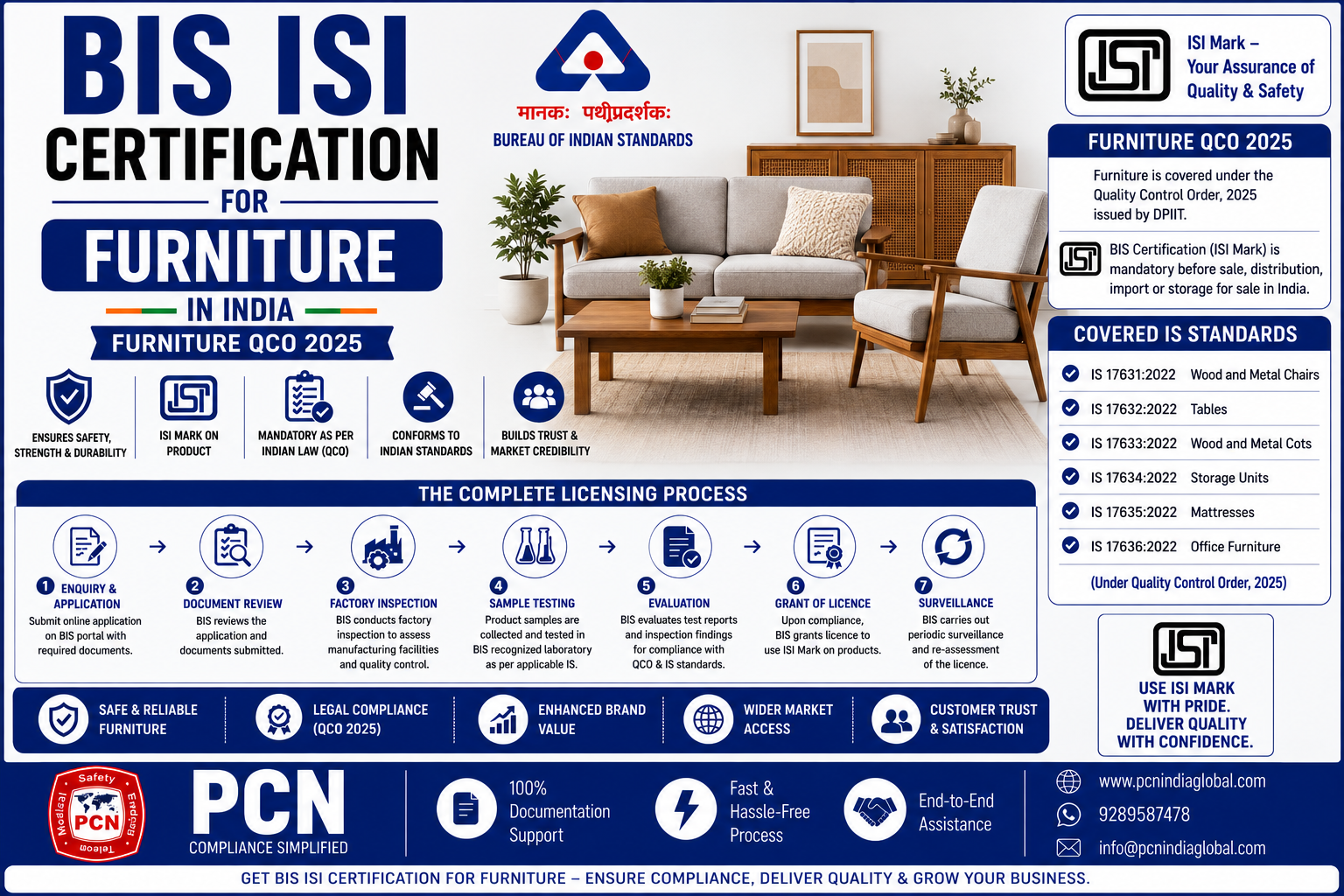
The Furniture QCO 2025 covers six product categories, each mapped to a dedicated Indian Standard published in 2022:
| Indian Standard | Product Category | Typical Products Covered |
|---|---|---|
| IS 17631:2022 | Work Chairs | Office chairs, task chairs, swivel chairs, ergonomic desk chairs |
| IS 17632:2022 | General Purpose Chairs and Stools | Dining chairs, visitor chairs, plastic moulded chairs, stools |
| IS 17633:2022 | Tables and Desks | Office desks, dining tables, study tables, workstations |
| IS 17634:2022 | Storage Units | Wardrobes, cabinets, bookshelves, filing cabinets, cupboards |
| IS 17635:2022 | Beds | Single and double beds, fully assembled and ready-to-assemble cots |
| IS 17636:2022 | Bunk Beds | Bunk beds and loft beds for domestic and institutional use |
The standards are material-agnostic in scope — wood, metal, plastic, and combination constructions are all covered when the product falls within a listed category. Ready-to-assemble (RTA) and knock-down furniture, the dominant format for imports and e-commerce, is explicitly within scope for beds and other categories. Manufacturers should confirm the exact applicability of each standard and its current edition against the latest BIS notification before testing, because the licence is granted per standard, per manufacturing location.
Who Must Comply — and By When
The QCO binds every link in the supply chain. Indian manufacturers of covered furniture need a BIS licence under Scheme-I for each manufacturing premises and each applicable standard. Importers cannot clear covered furniture through customs unless the foreign manufacturing site itself holds a BIS licence — obtained through the Foreign Manufacturers Certification Scheme (FMCS), under which BIS audits the overseas factory and grants the ISI licence to the foreign entity, which must also appoint an Authorised Indian Representative (AIR). Traders, distributors, and marketplaces are equally barred from storing or selling non-compliant stock.
The enforcement calendar is staggered by enterprise size:
- 14 February 2026 — the QCO came into force for general, large, and medium enterprises, twelve months from notification.
- 14 August 2026 — extended deadline for micro and small enterprises, which received an additional six months.
The MSE deadline is now days away. A micro or small furniture unit that has not yet begun its BIS application faces a real risk of being unable to legally sell covered products, because the licensing process involves factory inspection and laboratory testing that cannot be compressed into days. Starting immediately — and manufacturing under the correct documentation while the application is in process — is the only realistic path for late movers.
The 2026 Amendment Orders: Practical Relief for Industry
Two amendments have refined the QCO since notification, and both matter operationally.
The Furniture (Quality Control) Amendment Order, 2026 — S.O. 774(E) dated 12 February 2026 — introduced targeted exemptions: furniture imported for research and development purposes (in limited quantity, not for commercial sale), provisions for clearing legacy stock manufactured before the enforcement date, and relief for components imported for use in export-oriented manufacturing, so that exporters are not forced to certify inputs destined for overseas markets.
The Furniture (Quality Control) Second Amendment Order, 2026 — S.O. 1125(E) dated 2 March 2026 — further clarified the compliance framework for imports and transitional stock. Manufacturers and importers relying on any exemption should document their eligibility carefully, because the burden of proving an exemption applies rests with the party claiming it, and customs officers and BIS enforcement teams will ask for evidence.
What the Furniture Standards Actually Test
Understanding what the laboratory examines clarifies why certification takes preparation. The IS 17631–17636 series evaluates furniture against the hazards of real use, and each standard prescribes tests across four broad areas.
Stability — the product must not tip over under defined loading conditions. Storage units are tested with loaded drawers and open doors; chairs are tested for forward, sideways, and rearward overturning; bunk beds for stability under a user’s weight at the guardrail.
Strength — static load tests apply defined forces to seats, backrests, armrests, table tops, bed frames, and shelves to verify the structure withstands the heaviest plausible user and use. Impact tests simulate dropping into a chair or sitting down heavily on a bed edge.
Durability — cyclic tests repeat loading thousands of times to simulate years of use: a work chair’s seat and back are cycled, drawers are opened and closed repeatedly, and moving mechanisms such as swivel and tilt functions are exercised to failure thresholds.
Safety of construction — the standards check for sharp edges and points, shear and squeeze points in moving parts, entrapment gaps (critical for bunk beds, where guardrail heights and gap dimensions are tightly specified), and the general integrity of fittings and fasteners. Ready-to-assemble products are assembled per the manufacturer’s instructions before testing — which is why clear, accurate assembly instructions are themselves a compliance item.
Products must pass at a BIS-recognised laboratory, and the factory must demonstrate ongoing capability to manufacture conforming products — Scheme-I is a licence to a manufacturing process, not a one-time product approval.
Step-by-Step: Obtaining the BIS ISI Licence for Furniture
The ISI licensing route under Scheme-I is more involved than the self-declaration schemes that govern electronics, because it includes factory assessment. Our team manages each stage end to end, but every applicant should understand the sequence.
- Product-standard mapping. Confirm which of IS 17631–17636 applies to each product in your range, and group models sensibly — the licence covers varieties within a standard’s scope at one manufacturing location.
- Gap assessment and in-house testing setup. Scheme-I requires the manufacturer to maintain specified in-house testing equipment and follow the Scheme of Inspection and Testing (SIT) for the standard. Establish the required equipment and quality records before applying.
- Application filing. Submit the application on the BIS portal with factory details, product details, manufacturing process flow, and the prescribed fees — for foreign manufacturers, via FMCS with AIR nomination.
- Factory inspection. A BIS officer visits the manufacturing premises to verify the production process, in-house testing capability, and quality control arrangements, and draws samples.
- Independent laboratory testing. Samples are tested against the applicable standard at a BIS-recognised laboratory — stability, strength, durability, and safety tests as prescribed.
- Grant of licence. On satisfactory inspection and test results, BIS grants the licence (CM/L number), authorising use of the Standard Mark on covered products.
- Marking and ongoing compliance. Apply the ISI mark with the CM/L number and IS number on products as prescribed, operate the SIT, maintain test records, and undergo periodic surveillance inspections and market sample testing. Renew the licence on time.
Documents Required
A complete file at the outset is the biggest single lever on approval speed. A furniture manufacturer will typically need:
- Company registration and factory establishment documents
- Manufacturing process flow chart for each product category
- List of manufacturing machinery and in-house testing equipment
- Details of raw materials, bought-out components, and their sources
- Product drawings, specifications, and model/variety list
- In-house test records per the Scheme of Inspection and Testing
- Third-party laboratory test report against the applicable IS (where drawn in advance)
- Trademark/brand ownership or authorisation documents
- Layout plan of the factory premises
- For foreign manufacturers: FMCS application, AIR nomination and undertakings, and factory audit logistics
- Authorised signatory details and application declarations
Timeline and Cost Planning
A realistic schedule for a domestic furniture manufacturer is three to four months from a well-prepared application to grant of licence, with the factory inspection scheduling and laboratory testing as the pacing items — durability tests are cyclic and take laboratory time by design. Foreign manufacturers under FMCS should plan for five to seven months, driven by overseas audit scheduling and travel logistics.
Costs fall into four buckets: BIS application and licence fees, the marking fee (based on production), laboratory testing charges per standard and variety, and — for FMCS applicants — inspection travel costs and the AIR arrangement. Multi-category manufacturers should budget per standard: a company making chairs, tables, and storage units needs conformity across IS 17631/17632, IS 17633, and IS 17634 respectively. Sensible grouping of models and varieties under each licence keeps testing costs proportionate. You can estimate your overall obligation with our India Compliance Cost Calculator.
Common Mistakes That Delay a Furniture Licence
- Waiting for the deadline. The licensing process includes inspection and cyclic testing; it cannot be compressed into weeks. Late applicants face a sales gap.
- Missing in-house testing equipment. Scheme-I requires specified test equipment at the factory; inspections fail without it.
- Wrong standard mapping. A visitor chair tested as a work chair, or a loft bed treated as a regular bed, produces an unusable test report.
- Ignoring RTA assembly instructions. Ready-to-assemble products are tested as assembled per your instructions — unclear instructions cause failures.
- Importer misunderstanding of FMCS. The licence must be held by the foreign manufacturing site, not the Indian importer. Shipments from unlicensed factories will be stopped at customs.
- Brand and model mismatches. The brand, model, and manufacturing address on the product, test report, and application must match exactly.
Furniture Within the Wider Compliance Picture
The ISI licence is the centrepiece, but a furniture business touching the Indian market usually carries adjacent obligations. Packaged furniture sold at retail is a pre-packaged commodity requiring Legal Metrology (LMPC) registration and compliant declarations on the pack. Manufacturers and importers using plastic packaging need EPR registration for plastic waste with CPCB. Importers require valid import documentation and IEC — see our DGFT license services. Furniture with integrated electrical elements — powered recliners, height-adjustable desks, beds with built-in lighting — may separately engage electrical safety requirements for those components. A coordinated plan brings the BIS ISI licence, LMPC, and EPR together so the product reaches market fully compliant.
Pre-Launch Compliance Checklist for Furniture
Before committing to production or a shipment, run this verification sequence. First, map every SKU to the correct standard among IS 17631–17636 and confirm the current edition. Second, verify the manufacturing site — Indian or foreign — holds or has applied for the Scheme-I licence, with an AIR in place for foreign factories. Third, confirm in-house testing equipment and SIT records are operational. Fourth, check the ISI mark, CM/L number, and IS number appear correctly on products and packaging. Fifth, align brand, model, and factory address across product, test report, and licence. Sixth, close the adjacent items: LMPC declarations, plastic-waste EPR, and import documentation.
For ongoing operations, maintain a compliance register per category: CM/L number and validity, standard edition, surveillance inspection dates, market sample results, and renewal timelines — so licence conditions are managed proactively rather than at customs or during enforcement.
Frequently Asked Questions
Is BIS certification mandatory for all furniture in India?
It is mandatory for the six notified categories — work chairs, general purpose chairs and stools, tables and desks, storage units, beds, and bunk beds — under the Furniture (Quality Control) Order, 2025. Furniture outside these categories is not yet covered, but the scope may expand through future notifications.
Which Indian Standards apply to furniture?
IS 17631:2022 (work chairs), IS 17632:2022 (general purpose chairs and stools), IS 17633:2022 (tables and desks), IS 17634:2022 (storage units), IS 17635:2022 (beds), and IS 17636:2022 (bunk beds).
What are the compliance deadlines?
The QCO came into force on 14 February 2026 for general, large, and medium enterprises. Micro and small enterprises have until 14 August 2026.
Can importers get the BIS licence themselves?
No. Under FMCS the licence is granted to the foreign manufacturing site, which must appoint an Authorised Indian Representative. Importers can only source covered furniture from factories holding a valid BIS licence.
Does the QCO cover ready-to-assemble and imported furniture?
Yes. RTA and knock-down furniture within the notified categories is covered, and imported furniture must originate from BIS-licensed factories. The 2026 amendment orders provide limited exemptions for R&D imports, legacy stock, and export-oriented component imports.
How long does the furniture ISI licence take?
Typically three to four months for Indian manufacturers and five to seven months for foreign manufacturers under FMCS, assuming complete documentation and prompt inspection scheduling.
What are the penalties for non-compliance?
Manufacturing or selling covered furniture without the ISI mark is an offence under the BIS Act, 2016, attracting imprisonment of up to two years and/or fines starting at ₹2 lakh, alongside seizure of non-compliant stock and customs detention of imports.
Why Choose PCN India Global
- Furniture QCO expertise — precise product-to-standard mapping across IS 17631–17636 and licence structuring for multi-category ranges
- Factory readiness — we prepare your in-house testing setup and SIT records so the BIS inspection passes the first time
- FMCS for foreign manufacturers — end-to-end management of the overseas audit, and we act as your Authorised Indian Representative
- Lab coordination — testing at BIS-recognised laboratories with correct sample and variety selection to minimise cost
- Integrated compliance — LMPC, plastic-waste EPR, and import documentation handled alongside the ISI licence
- Surveillance and renewal tracking — so your CM/L stays valid and licence conditions are managed proactively
PCN India Global manages the complete BIS ISI certification process for furniture manufacturers and importers — from standard mapping and factory preparation to licence grant and renewal, coordinated with the LMPC and EPR obligations furniture businesses carry. With the MSE deadline of 14 August 2026 upon us, the time to act is now. Contact us: WhatsApp +91 80109 05029, email bdm@pcnindiaglobal.com, or start your application today.
Related Compliance Guides
- BIS Certification (ISI Mark) — Complete Service Overview
- BIS Scheme-X Certification
- Legal Metrology (LMPC) Registration