
BIS ISI Certification for Solar Thermal Systems, Devices and Components in India: IS 12933, IS 16542, IS 16544 and the Complete Licensing Process
Solar water heating is one of India’s oldest and most widespread renewable energy applications — rooftop systems on homes, hostels, hotels, hospitals, and industrial facilities convert sunlight directly into hot water, cutting electricity and fuel bills every day they operate. As the market has grown, so has the inflow of low-quality collectors and tanks that corrode, leak, or underperform within a few seasons. The government’s response is the Solar Thermal Systems, Devices and Components (Quality Control) Order, 2024 — issued by the Ministry of New and Renewable Energy (MNRE) on 8 October 2024 and published in the Gazette on 14 October 2024 — which brings solar thermal products under compulsory BIS certification with the ISI mark, under Scheme-I of the BIS (Conformity Assessment) Regulations, 2018, alongside the other products on the BIS list of products under compulsory certification.
The QCO came into force on 13 April 2025 — 180 days from publication — which means the obligation is already live: covered solar thermal products cannot be manufactured, imported, stored, or sold in India without a valid BIS licence and the Standard Mark. For domestic manufacturers, importers of collectors and tanks, and brands assembling systems from bought-out components, certification is now the gateway to the Indian market. This guide explains the covered products and standards, the step-by-step ISI licensing process, documents, timelines, common mistakes, and how solar thermal certification fits into the wider India compliance picture.
Why Solar Thermal Products Fall Under Mandatory BIS Certification
Quality Control Orders are the government’s instrument for making an Indian Standard mandatory. Once a QCO is notified under the BIS Act, 2016, no person can manufacture, import, distribute, sell, hire, lease, store, or exhibit for sale any covered product without the ISI mark granted under a valid BIS licence. The solar thermal QCO serves a dual policy purpose: consumer protection and renewable energy credibility. A solar water heating system is a decade-plus investment sold substantially on trust — the buyer cannot judge absorber coating quality, glass durability, insulation performance, or tank corrosion resistance at purchase.
Substandard products damage more than the individual buyer. Early failures — leaking collectors, burst tanks, collapsed vacuum tubes, corroded heat exchangers — erode public confidence in solar thermal technology itself, undermining national renewable energy goals. By mandating conformity to Indian Standards, the QCO raises the quality floor, protects the reputation of the technology, and gives serious manufacturers a level field against low-cost, low-quality competition. For manufacturers, certification is also a commercial gate: government procurement, institutional buyers, and organised retail verify BIS licences for covered products, and customs authorities check compliance at import.
Which Products Are Covered: IS 12933, IS 16544 and IS 16542
The QCO covers three categories of solar thermal products, each mapped to its Indian Standard:
| Indian Standard | Product Category | Typical Products Covered |
|---|---|---|
| IS 12933 (Part 1):2003 | Solar Flat Plate Collector — Requirements | Flat plate collectors for solar water heating systems — the glazed absorber panels installed on rooftops |
| IS 12933 (Part 2):2003 | Solar Flat Plate Collector — Components | Components of flat plate collectors — absorbers, glazing, casings, insulation |
| IS 16544:2016 | All Glass Evacuated Tubes Solar Water Heating System | Complete evacuated tube collector (ETC) based solar water heating systems |
| IS 16542:2016 | Storage Water Tank for All Glass Evacuated Tube Solar Collector | Direct insertion type storage water tanks used with ETC systems |
One clarification matters for importers: MNRE has clarified that the bare glass evacuated solar collector tubes themselves are excluded from the QCO’s scope — the order applies to the systems and tanks, not the individual glass tubes as components. Manufacturers and importers should confirm the exact applicability and current edition of each standard against the latest notification before testing, because the licence is granted per standard, per manufacturing location, and scope questions — system versus component, complete unit versus sub-assembly — determine what must be certified.
Who Must Comply — and From When
The QCO binds every link in the supply chain. Indian manufacturers of covered collectors, systems, and tanks need a BIS licence under Scheme-I for each manufacturing premises and each applicable standard. Importers cannot clear covered products through customs unless the foreign manufacturing site itself holds a BIS licence — obtained through the Foreign Manufacturers Certification Scheme (FMCS), under which BIS audits the overseas factory and grants the ISI licence to the foreign entity, which must also appoint an Authorised Indian Representative (AIR). Assemblers and brand owners sourcing collectors or tanks from third parties must ensure every notified product in their bill of materials originates from a licensed site. Traders and distributors are equally barred from storing or selling non-compliant stock.
The order has been in force since 13 April 2025. More than a year into enforcement, BIS market surveillance and customs scrutiny are established, and unlicensed products face seizure and penal action under the BIS Act, 2016 — imprisonment of up to two years and/or fines starting at ₹2 lakh for a first offence. Manufacturers still selling uncertified stock, and importers with un-cleared consignments, should regularise immediately.
What the Solar Thermal Standards Actually Test
Understanding what the laboratory examines clarifies why certification takes preparation. The standards evaluate solar thermal products against the conditions of a decade on an Indian rooftop.
Thermal performance — collectors are tested for instantaneous efficiency, time constant, and incident angle behaviour; systems for daily hot water output. This verifies the product actually delivers the energy performance it is sold on.
Durability and weather resistance — exposure tests, thermal shock (cold water spray on a hot collector, simulating a sudden shower on a stagnating panel), internal and external thermal cycling, and rain penetration tests simulate years of rooftop weathering. Materials must withstand stagnation temperatures — the extreme condition when a collector sits full in the sun with no draw-off.
Pressure and leakage integrity — absorbers, piping connections, and storage tanks are pressure tested; tanks for ETC systems are checked for structural adequacy at operating conditions, and insulation performance is verified so stored water stays hot overnight.
Materials and construction — corrosion resistance of wetted materials, quality of absorber coatings, glazing strength (including impact resistance), insulation properties, and the integrity of seals and gaskets are examined, along with dimensional checks and marking requirements.
Products must pass at a BIS-recognised laboratory, and the factory must demonstrate ongoing capability to manufacture conforming products — Scheme-I is a licence to a manufacturing process, not a one-time product approval. The Scheme of Inspection and Testing (SIT) requires specified in-house test equipment and quality records operating at the factory.
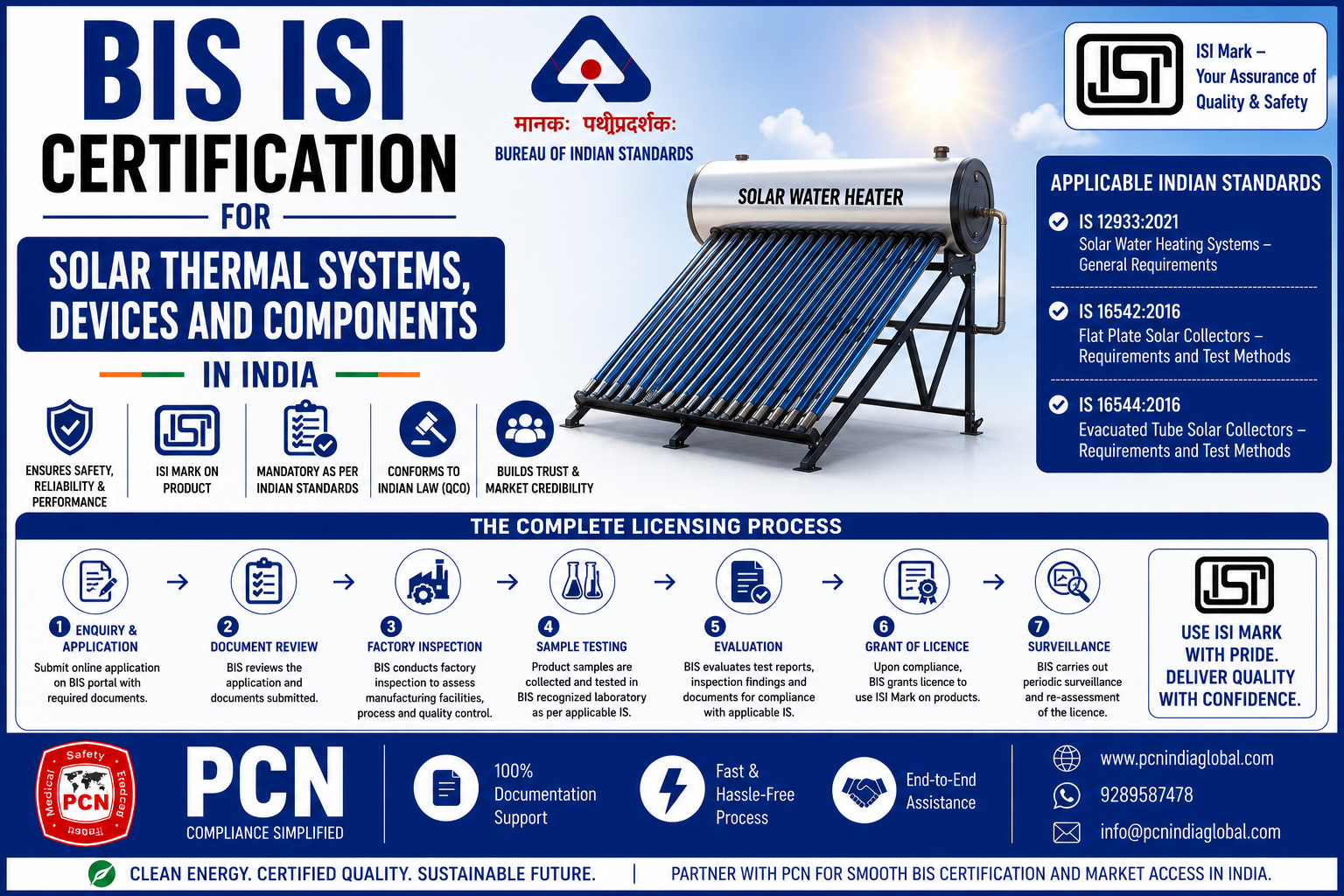
Step-by-Step: Obtaining the BIS ISI Licence for Solar Thermal Products
The ISI licensing route under Scheme-I includes factory assessment. Our team manages each stage end to end, but every applicant should understand the sequence.
- Product-standard mapping. Confirm which of IS 12933 (Parts 1 and 2), IS 16544, and IS 16542 applies to each product — collector, complete system, or tank — and structure the application per standard and manufacturing location.
- Gap assessment and in-house testing setup. Establish the test equipment and quality records the SIT requires — pressure testing, dimensional inspection, material verification — before applying.
- Application filing. Submit the application on the BIS portal with factory details, product details, manufacturing process flow, and prescribed fees — for foreign manufacturers, via FMCS with AIR nomination.
- Factory inspection. A BIS officer visits the manufacturing premises to verify the production process, in-house testing capability, and quality control arrangements, and draws samples.
- Independent laboratory testing. Samples are tested against the applicable standard at a BIS-recognised laboratory — thermal performance, durability, pressure, and materials tests as prescribed. Solar thermal testing includes exposure sequences that take laboratory time by design.
- Grant of licence. On satisfactory inspection and test results, BIS grants the licence (CM/L number), authorising use of the Standard Mark.
- Marking and ongoing compliance. Apply the ISI mark with the CM/L number and IS number on products as prescribed, operate the SIT, maintain test records, undergo periodic surveillance inspections and market sample testing, and renew the licence on time.
Documents Required
A complete file at the outset is the biggest single lever on approval speed. A solar thermal manufacturer will typically need:
- Company registration and factory establishment documents
- Manufacturing process flow chart for each product category
- List of manufacturing machinery and in-house testing equipment
- Details of raw materials and bought-out components — absorbers, glass, insulation, tanks — and their sources
- Product drawings, specifications, and model/variety list
- In-house test records per the Scheme of Inspection and Testing
- Third-party laboratory test reports against the applicable IS (where drawn in advance)
- Calibration certificates for testing equipment
- Layout plan of the factory premises
- For foreign manufacturers: FMCS application, AIR nomination and undertakings, and factory audit logistics
- Authorised signatory details and application declarations
Timeline and Cost Planning
A realistic schedule for a domestic manufacturer is three to five months from a well-prepared application to grant of licence — solar thermal testing includes exposure and durability sequences that are inherently time-consuming, making laboratory testing the pacing item. Foreign manufacturers under FMCS should plan for five to seven months, driven by overseas audit scheduling.
Costs fall into four buckets: BIS application and licence fees, the marking fee (linked to production), laboratory testing charges per standard and model family, and — for FMCS applicants — inspection travel costs and the AIR arrangement. A manufacturer covering flat plate collectors, ETC systems, and storage tanks needs licences across multiple standards and should budget per standard. Sensible grouping of models and capacities keeps testing proportionate. You can estimate your overall obligation with our India Compliance Cost Calculator.
Common Mistakes That Delay a Solar Thermal Licence
- Scope confusion. Treating a complete ETC system, its storage tank, and a flat plate collector as one certification — each falls under its own standard and needs its own conformity.
- Waiting out enforcement. The QCO has been in force since April 2025; uncertified stock in the channel is now exposed to seizure and penalties.
- Missing in-house testing equipment. Scheme-I requires specified test equipment at the factory; inspections fail without it.
- Underestimating durability testing. Exposure, thermal shock, and cycling tests take weeks; budget laboratory time realistically.
- Importer misunderstanding of FMCS. The licence must be held by the foreign manufacturing site, not the Indian importer. Consignments from unlicensed factories are stopped at customs.
- Brand and model mismatches. The brand, model, and manufacturing address on the product, test report, and application must match exactly.
Solar Thermal Within the Wider Compliance Picture
The ISI licence is the centrepiece, but a solar thermal business usually carries adjacent obligations. Systems with electrical backup heaters or pumped circulation involve electrical components that may carry their own certification requirements. Packaged retail products are pre-packaged commodities requiring Legal Metrology (LMPC) registration and compliant declarations. Importers require valid import documentation and IEC — see our DGFT license services. Manufacturers using plastic packaging need EPR registration for plastic waste with CPCB. A coordinated plan brings the BIS ISI licence, LMPC, and EPR together so the product reaches market fully compliant.
Pre-Launch Compliance Checklist for Solar Thermal Products
Before committing to production or a shipment, run this verification sequence. First, map every product to the correct standard among IS 12933 (Parts 1 and 2), IS 16544, and IS 16542, and confirm current editions — including whether your product is a system, collector, tank, or excluded component. Second, verify the manufacturing site — Indian or foreign — holds or has applied for the Scheme-I licence, with an AIR in place for foreign factories. Third, confirm in-house testing equipment and SIT records are operational. Fourth, check the ISI mark, CM/L number, and IS number appear correctly on products and packaging. Fifth, align brand, model, and factory address across product, test report, and licence. Sixth, close the adjacent items: LMPC declarations, plastic-waste EPR, and import documentation.
For ongoing operations, maintain a compliance register per category: CM/L number and validity, standard edition, surveillance inspection dates, market sample results, and renewal timelines — so licence conditions are managed proactively rather than at customs or during enforcement.
Frequently Asked Questions
Is BIS certification mandatory for solar water heating systems in India?
Yes. Under the Solar Thermal Systems, Devices and Components (Quality Control) Order, 2024 — in force since 13 April 2025 — covered solar thermal products cannot be manufactured, imported, or sold in India without the ISI mark under a valid BIS licence.
Which Indian Standards apply?
IS 12933 (Part 1):2003 and (Part 2):2003 for solar flat plate collectors and their components, IS 16544:2016 for all glass evacuated tube solar water heating systems, and IS 16542:2016 for direct insertion type storage water tanks for ETC collectors.
Are glass evacuated solar collector tubes covered?
No. MNRE has clarified that bare all-glass evacuated solar collector tubes are excluded from the QCO’s scope — the order applies to the systems and storage tanks, not the individual glass tubes.
Who issued the solar thermal QCO?
The Ministry of New and Renewable Energy (MNRE) issued the order on 8 October 2024; it was published in the Gazette on 14 October 2024 and came into force 180 days later, on 13 April 2025. Certification is administered by BIS under Scheme-I.
Can importers get the BIS licence themselves?
No. Under FMCS the licence is granted to the foreign manufacturing site, which must appoint an Authorised Indian Representative. Importers can only source covered products from factories holding a valid BIS licence.
How long does the solar thermal ISI licence take?
Typically three to five months for Indian manufacturers — durability and exposure testing takes laboratory time — and five to seven months for foreign manufacturers under FMCS.
What are the penalties for non-compliance?
Manufacturing or selling covered solar thermal products without the ISI mark is an offence under the BIS Act, 2016, attracting imprisonment of up to two years and/or fines starting at ₹2 lakh, alongside seizure of non-compliant stock and customs detention of imports.
Do assemblers and brand owners need their own licence?
The licence attaches to the manufacturing site of the notified product. A brand owner assembling systems from bought-out collectors and tanks must ensure each notified item in the bill of materials comes from a licensed factory — and if the assembler itself manufactures a notified product, such as the storage tank, that activity needs its own Scheme-I licence for the premises where it takes place.
Why Choose PCN India Global
- Solar thermal QCO expertise — precise scope and standard mapping across IS 12933, IS 16544, and IS 16542, including system-versus-component questions
- Factory readiness — we prepare your in-house testing setup and SIT records so the BIS inspection passes the first time
- FMCS for foreign manufacturers — end-to-end management of the overseas audit, and we act as your Authorised Indian Representative
- Lab coordination — testing at BIS-recognised laboratories with realistic scheduling of exposure and durability sequences
- Integrated compliance — LMPC, plastic-waste EPR, and import documentation handled alongside the ISI licence
- Surveillance and renewal tracking — so your CM/L stays valid and licence conditions are managed proactively
PCN India Global manages the complete BIS ISI certification process for solar thermal manufacturers and importers — from standard mapping and factory preparation to licence grant and renewal, coordinated with the LMPC and EPR obligations these businesses carry. With the QCO fully in force, the time to regularise is now. Contact us: WhatsApp +91 80109 05029, email bdm@pcnindiaglobal.com, or start your application today.