
BIS ISI Certification for Flashlights in India: Flashlight QCO 2025, IS 2083:2024 and the Complete Licensing Process
The flashlight is one of the most widely owned products in India. Torches sit in kitchen drawers, glove boxes, shop counters, and toolkits across the country, and in regions where power cuts remain routine they are not a convenience but essential safety equipment. India’s torch market spans large branded manufacturers, a vast unorganised sector, and a heavy inflow of low-cost imports — a combination that has historically produced enormous quality variation. The government has now brought the category under compulsory BIS certification through the Flashlight (Quality Control) Order, 2025, notified vide S.O. 501(E) dated 28 January 2025, which makes the ISI mark mandatory under Scheme-I of the BIS (Conformity Assessment) Regulations, 2018 — the same ISI Mark Scheme listed on the BIS list of products under compulsory certification.
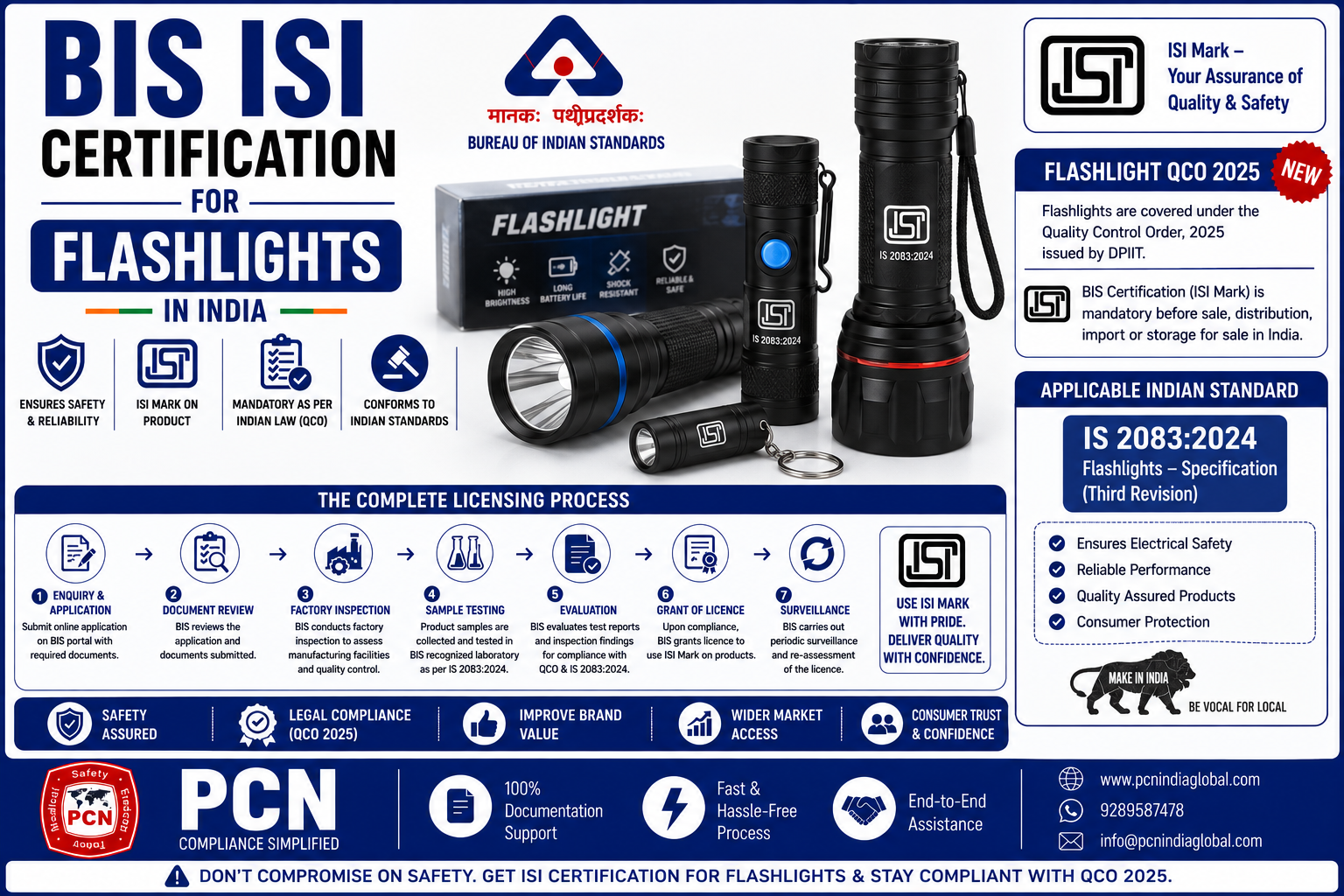
The order is refreshingly simple in scope: a single Indian Standard, IS 2083:2024, governs the entire category. But simplicity of scope does not mean simplicity of compliance. Every manufacturer and importer of covered flashlights needs a BIS licence granted after factory inspection and laboratory testing, and unlicensed torches cannot be manufactured, imported, stored, or sold in India. This guide explains the standard and what it tests, who must comply, the step-by-step ISI licensing process, documents, timelines, costs, common mistakes, and how flashlight certification connects to the wider India compliance picture — particularly the battery and e-waste obligations that modern LED and rechargeable torches carry.
Why Flashlights Fall Under Mandatory BIS Certification
Quality Control Orders are the government’s instrument for making an Indian Standard mandatory. Once a QCO is notified under the BIS Act, 2016, no person can manufacture, import, distribute, sell, hire, lease, store, or exhibit for sale any covered product without the ISI mark granted under a valid BIS licence. The flashlight QCO follows the pattern the government has applied across consumer goods — footwear, toys, furniture, hand tools — with a clear objective: lift the quality floor of a mass-market product, curb substandard imports, and give organised domestic manufacturers a level field.
The consumer-protection rationale is concrete. A torch is bought on the promise that it will work when it is needed — during a power cut, a breakdown on a dark road, a night-time emergency. Substandard torches fail exactly then: weak or inconsistent light output, poor battery contact that cuts out when jolted, switches that break after a few weeks, casings that crack on the first drop, and water ingress that corrodes contacts after a single monsoon. None of this is visible at the point of purchase, where a poorly made torch looks identical to a well-engineered one under shop lighting.
There is a safety dimension too. Modern flashlights are increasingly rechargeable, containing lithium-ion cells and charging circuitry. Poor cell quality, absent protection circuits, and badly designed charging arrangements introduce genuine fire and thermal runaway risks into a product people leave charging overnight. Certified conformity to the Indian Standard verifies construction, electrical safety, mechanical robustness, and performance at the factory rather than leaving it to chance. For manufacturers, the QCO is also a commercial gate: organised retail, institutional and government procurement, and e-commerce marketplaces verify BIS licences for covered products, and customs authorities check compliance at import.
The Applicable Standard: IS 2083:2024
The Flashlight QCO maps the whole category to one standard:
| Indian Standard | Scope | Products Covered |
|---|---|---|
| IS 2083:2024 | Flashlight — Specification | The entire flashlight/torch category, including LED and rechargeable models covered by the QCO |
IS 2083 is a long-established Indian Standard for flashlights, revised in 2024 to reflect the technology shift that has transformed the category — the near-total replacement of incandescent bulbs by LEDs, the growth of rechargeable models, and modern expectations of light output and runtime. Because the QCO references the 2024 edition, manufacturers working from older editions of the standard must confirm they are testing to the current revision; certification rests on demonstrated conformity to the edition the QCO names.
A single-standard category has one practical advantage: a manufacturer producing a wide range of torch models generally needs one licence per manufacturing location rather than several, with the model range covered as varieties under that licence. That makes the licence structure straightforward — but it also means every covered model must sit within the tested variety scope, so range planning at application stage matters.
Who Must Comply
The QCO binds every link in the supply chain. Indian manufacturers of covered flashlights need a BIS licence under Scheme-I for each manufacturing premises. Importers cannot clear covered torches through customs unless the foreign manufacturing site itself holds a BIS licence — obtained through the Foreign Manufacturers Certification Scheme (FMCS), under which BIS audits the overseas factory and grants the ISI licence to the foreign entity, which must also appoint an Authorised Indian Representative (AIR) resident in India. This is the point most often misunderstood: the Indian importer cannot hold the licence on the factory’s behalf. Traders, distributors, and marketplaces are equally barred from storing or selling non-compliant stock.
Assemblers deserve particular attention. A business that imports torch components and assembles them in India is a manufacturer for QCO purposes and needs its own licence for the premises where assembly happens. Brand owners who have torches made by third-party factories must ensure that each manufacturing site supplying them holds a valid licence, since the licence attaches to the factory, not the brand. As with comparable QCOs, goods manufactured domestically for export sit outside the order, allowing export-oriented torch manufacturers to continue producing to overseas specifications.
Manufacturers should confirm the operative implementation dates for their enterprise category — general, small, and micro enterprises are typically given staggered timelines — against the current notification, and should note that DPIIT has issued cross-cutting exemption orders for goods and articles against import and against purchase (S.O. 775(E) and S.O. 776(E), both dated 13 February 2026) that apply across several QCO categories.
What IS 2083 Actually Tests
Understanding what the laboratory examines clarifies why certification takes preparation. The standard evaluates flashlights across four broad areas.
Photometric performance — light output and beam characteristics are measured to verify the torch delivers the illumination it claims. Luminous intensity, beam distance, and the uniformity of the beam are assessed, along with runtime: how long the torch maintains usable output on a fresh set of cells or a full charge. This is where cheap torches most often fail, delivering a bright initial flash that decays rapidly.
Electrical construction and safety — battery contacts, switch construction, and internal wiring are examined for reliability and safety. Contacts must maintain connection under vibration and shock; switches must operate reliably through repeated cycles. For rechargeable models, the charging arrangement and cell protection come under scrutiny, because a torch left charging unattended must not present a fire hazard.
Mechanical robustness — a torch is a product that gets dropped. Drop and impact testing verifies the body, lens, and internal assembly survive the falls a handheld product inevitably suffers. Casing material quality, lens integrity, and the security of threaded joints and end caps are all assessed.
Environmental protection and durability — resistance to water and dust ingress is checked where the product claims such protection, along with corrosion resistance of contacts and metal parts. Marking and labelling requirements are verified, including the ISI mark with the licence (CM/L) number, the IS number, and product particulars.
Products must pass at a BIS-recognised laboratory, and the factory must demonstrate ongoing capability to manufacture conforming torches — Scheme-I is a licence to a manufacturing process, not a one-time product approval. The Scheme of Inspection and Testing (SIT) requires specified in-house test equipment and quality records operating at the factory.
Step-by-Step: Obtaining the BIS ISI Licence for Flashlights
The ISI licensing route under Scheme-I includes factory assessment. Our team manages each stage end to end, but every applicant should understand the sequence.
- Scope and variety mapping. Confirm which models fall within the QCO and structure the variety list — body materials, cell configurations, LED types, rechargeable versus dry-cell — so the licence covers the commercial range.
- Gap assessment and in-house testing setup. Establish the photometric, electrical, and mechanical test equipment and quality records the SIT requires before applying. Light-output measurement capability is the item manufacturers most often lack.
- Application filing. Submit the application on the BIS portal with factory details, product details, manufacturing process flow, and prescribed fees — for foreign manufacturers, via FMCS with AIR nomination.
- Factory inspection. A BIS officer visits the manufacturing premises to verify the production and assembly process, in-house testing capability, and quality control arrangements, and draws samples across the variety range.
- Independent laboratory testing. Samples are tested against IS 2083:2024 at a BIS-recognised laboratory — photometric, electrical, mechanical, and durability tests as prescribed.
- Grant of licence. On satisfactory inspection and test results, BIS grants the licence (CM/L number), authorising use of the Standard Mark on covered flashlights.
- Marking and ongoing compliance. Apply the ISI mark with the CM/L number and IS number on the torch and packaging as prescribed, operate the SIT, maintain test records, undergo periodic surveillance inspections and market sample testing, and renew the licence on time.
Documents Required
A complete file at the outset is the biggest single lever on approval speed. A flashlight manufacturer will typically need:
- Company registration and factory establishment documents
- Manufacturing process flow chart — moulding or metal forming, assembly, testing, packing
- List of manufacturing machinery and in-house testing equipment
- Details of bought-out components — LEDs, cells, switches, lenses, reflectors — and their sources
- Product drawings, specifications, and the model/variety list
- In-house test records per the Scheme of Inspection and Testing
- Third-party laboratory test report against IS 2083:2024 (where drawn in advance)
- Calibration certificates for testing equipment
- Trademark / brand ownership or authorisation documents
- Layout plan of the factory premises
- For foreign manufacturers: FMCS application, AIR nomination and undertakings, and factory audit logistics
- Authorised signatory details and application declarations
Timeline and Cost Planning
A realistic schedule for a domestic manufacturer is three to four months from a well-prepared application to grant of licence, with factory inspection scheduling and laboratory testing as the pacing items. Foreign manufacturers under FMCS should plan for five to seven months, driven by overseas audit scheduling and travel logistics — an important planning point for importers, who cannot compress the process once a deadline is close.
Costs fall into four buckets: BIS application and licence fees, the marking fee (linked to production volume), laboratory testing charges, and — for FMCS applicants — inspection travel costs and the AIR arrangement. Because flashlights sit under a single standard, testing cost is driven by the number of distinct varieties submitted rather than by multiple standards, so sensible grouping of models sharing a common platform is the main lever on cost. You can estimate your overall obligation with our India Compliance Cost Calculator.
Common Mistakes That Delay a Flashlight Licence
- Testing to a superseded edition. The QCO references IS 2083:2024; reports drawn against an older edition are not usable.
- Missing photometric capability. Scheme-I requires in-house testing per the SIT; light-output measurement is the equipment gap that most often stalls an inspection.
- Variety scope too narrow. Selling a model outside the licensed variety range is a violation — map the full commercial range before applying.
- Component quality drift. Switching LED, cell, or switch suppliers after grant without managing the change undermines conformity at surveillance.
- Importer-as-licensee confusion. The licence must be held by the foreign factory under FMCS, not the Indian importer. Shipments from unlicensed factories are stopped at customs.
- Ignoring battery obligations for rechargeables. Rechargeable torches bring battery-waste EPR and cell-safety considerations that must be planned alongside the ISI licence.
Flashlights Within the Wider Compliance Picture
The ISI licence is the centrepiece, but a torch business touching the Indian market usually carries adjacent obligations, and rechargeable LED products carry several. Producers and importers of electrical and electronic equipment must hold EPR registration for e-waste with CPCB, and rechargeable torches additionally engage EPR registration for battery waste under the Battery Waste Management Rules. Packaged retail torches are pre-packaged commodities requiring Legal Metrology (LMPC) registration and compliant declarations on the pack. Manufacturers and importers using plastic packaging need EPR registration for plastic waste. Importers require valid import documentation and IEC — see our DGFT license services. A coordinated plan brings the BIS ISI licence, EPR, and LMPC together so the product reaches market fully compliant.
Pre-Launch Compliance Checklist for Flashlights
Before committing to production or a shipment, run this verification sequence. First, confirm every model falls within the QCO scope and that testing is against IS 2083:2024, the edition the order names. Second, verify the manufacturing site — Indian or foreign — holds or has applied for the Scheme-I licence, with an AIR in place for foreign factories. Third, confirm in-house testing equipment and SIT records are operational, including photometric measurement. Fourth, check the ISI mark, CM/L number, and IS number appear correctly on the torch and packaging. Fifth, align brand, model, and factory address across product, test report, and licence scope. Sixth, close the adjacent items: e-waste EPR, battery-waste EPR for rechargeable models, LMPC declarations, and import documentation.
For ongoing operations, maintain a compliance register per model: CM/L number and validity, licensed varieties, component sources, surveillance inspection dates, market sample results, and renewal timelines — so component changes and renewals are handled proactively rather than at customs or during enforcement.
Frequently Asked Questions
Is BIS certification mandatory for flashlights in India?
Yes. Under the Flashlight (Quality Control) Order, 2025 — S.O. 501(E) dated 28 January 2025 — covered flashlights cannot be manufactured, imported, stored, or sold in India without the ISI mark under a valid BIS licence.
Which Indian Standard applies to flashlights?
IS 2083:2024, Flashlight — Specification. The QCO maps the entire category to this single standard, so manufacturers must test against the 2024 edition rather than any earlier revision.
Does the QCO cover LED and rechargeable torches?
Yes. IS 2083:2024 was revised to reflect the shift to LED lighting and rechargeable designs, and covered flashlights of these types require the ISI mark. Rechargeable models additionally engage battery-safety considerations and battery-waste EPR.
Can importers get the BIS licence themselves?
No. Under FMCS the licence is granted to the foreign manufacturing site, which must appoint an Authorised Indian Representative resident in India. Importers can only source covered flashlights from factories holding a valid BIS licence.
Are flashlights made for export covered?
Products manufactured domestically for export are outside the QCO’s scope, allowing export-oriented manufacturers to produce to overseas specifications. Everything sold in the Indian market must be licensed.
Do assemblers need their own licence?
Yes. A business importing components and assembling torches in India is a manufacturer for QCO purposes and needs a licence for the premises where assembly takes place. The licence attaches to the factory, not the brand.
How long does the flashlight ISI licence take?
Typically three to four months for Indian manufacturers and five to seven months for foreign manufacturers under FMCS, assuming complete documentation and prompt inspection scheduling.
What are the penalties for non-compliance?
Manufacturing or selling covered flashlights without the ISI mark is an offence under the BIS Act, 2016, attracting imprisonment of up to two years and/or fines starting at ₹2 lakh, alongside seizure of non-compliant stock and customs detention of imports.
Why Choose PCN India Global
- Flashlight QCO expertise — scope confirmation and variety structuring under IS 2083:2024 so your full model range sits inside the licence
- Factory readiness — we prepare your in-house testing setup, including photometric capability, and SIT records so the BIS inspection passes the first time
- FMCS for foreign manufacturers — end-to-end management of the overseas audit, and we act as your Authorised Indian Representative
- Lab coordination — testing at BIS-recognised laboratories with efficient variety grouping to minimise cost
- Battery-aware for rechargeables — we bring cell-safety and battery-waste EPR into the plan for rechargeable torches
- Integrated compliance — e-waste EPR, LMPC, and import documentation handled alongside the ISI licence
PCN India Global manages the complete BIS ISI certification process for flashlight manufacturers and importers — from scope mapping and factory preparation to licence grant and renewal, coordinated with the EPR, battery, and LMPC obligations that modern torches carry. Contact us: WhatsApp +91 80109 05029, email bdm@pcnindiaglobal.com, or start your application today.