BIS Certification for Hand-held Motor-Operated Electric Tools in India: IS/IEC 62841, Drills, Grinders, Saws, Hammers and the Complete ISI Process

Electric drills, angle grinders, circular saws, and hammers are the everyday tools of construction, fabrication, workshops, and home improvement across India. They are also inherently hazardous products — high-speed rotating machinery held in the hand, often used in demanding conditions — where a design or manufacturing defect can cause serious injury. To ensure these tools meet robust safety requirements, the Bureau of Indian Standards (BIS) has brought hand-held motor-operated electric tools under mandatory certification through a Quality Control Order. For manufacturers and importers, BIS ISI certification against the applicable Indian Standard is the gateway to lawfully selling these tools in India. The safety of these tools is governed by the IS/IEC 62841 series, India’s adoption of the international IEC 62841 standards for electric motor-operated hand-held tools. The series is built as a general safety standard plus a set of particular standards for specific tool types — drills and impact drills, grinders, circular saws, hammers, and more. A covered tool must carry the ISI Mark under a valid BIS licence before it can be manufactured, stocked, sold, or imported. This guide explains how the series is structured, how the certification process works for Indian and foreign manufacturers, the documents required, realistic timelines and costs, and the mistakes that most often delay a licence. The Legal Framework: The QCO and the ISI Mark BIS certification operates under the Bureau of Indian Standards Act, 2016. When the Central Government issues a Quality Control Order for hand-held electric tools, it makes conformity to the corresponding Indian Standard — and display of the ISI Mark under a BIS licence — mandatory. From the effective date, a covered tool cannot be produced, traded, stocked, sold, or imported in India unless it bears the ISI Mark with a valid CM/L number. Products manufactured solely for export are generally outside the order’s scope. Enforcement is phased and periodically clarified, so manufacturers should confirm the exact covered tool types, standard editions, and effective dates against the current BIS position. The core obligation is constant: for each notified tool type, the ISI Mark under a BIS licence is the passport to the Indian market, and non-compliance invites penalties under the BIS Act, including fines and seizure of stock. The IS/IEC 62841 Series: How the Standards Are Structured The defining feature of tool certification is that safety is specified through a series of standards rather than a single document. IS/IEC 62841 follows the international IEC 62841 architecture: a general standard sets the safety requirements common to all electric motor-operated hand-held tools, and a set of particular standards supplement or modify those requirements for each specific tool type. A tool is certified against the general standard together with the particular standard for its type. The table below summarises the general standard and the particular standards for the tool types covered by this guide. Standard Scope IS/IEC 62841-1 General requirements — common safety requirements for all hand-held motor-operated electric tools IS/IEC 62841-2-1 Particular requirements for hand-held drills and impact drills IS/IEC 62841-2-3 Particular requirements for hand-held grinders, disc-type polishers and disc-type sanders IS/IEC 62841-2-5 Particular requirements for hand-held circular saws IS/IEC 62841-2-6 Particular requirements for hand-held hammers Together with the general standard, these particular standards cover the mainstream power tools — drills, grinders, circular saws, and hammers — that dominate the Indian market. A manufacturer certifies each tool type against the general standard plus its applicable particular standard, so a company producing several tool types will hold several licences. Manufacturers should confirm the exact list of covered tool types, the applicable standard editions, and the enforcement timelines under the current notification, since coverage and editions are periodically updated. Who Needs BIS Certification for Electric Tools The requirement reaches across the power-tool supply chain: Indian manufacturers of hand-held electric tools, who must hold a BIS licence to apply the ISI Mark to each covered tool type before selling in India. Importers and foreign manufacturers, whose tools must be certified — foreign factories through the BIS Foreign Manufacturers Certification Scheme (FMCS) — before import. Given how much of India’s power-tool market is imported, FMCS is central to this category. Brand owners who source tools from contract manufacturers, and who must ensure the tools they sell under their brand are properly certified. Because a single brand typically sells drills, grinders, saws, and hammers together, the practical planning question is how many licences the range requires and in what order to pursue them. Step-by-Step: The BIS ISI Certification Process BIS grants ISI licences under Scheme-I of the BIS (Conformity Assessment) Regulations. Our team manages each stage end to end, but every applicant should understand the sequence. Confirm applicability and standards. Map each tool to the general standard (IS/IEC 62841-1) plus its particular standard, and confirm it falls within the notified scope. Prepare the factory and in-house testing. BIS certification is factory-based; the unit must have the manufacturing capability and the in-house testing facilities to verify conformity on an ongoing basis. File the application on the BIS portal. Submit through the BIS Manak online system with the required documentation, per tool type. Foreign manufacturers apply under FMCS and nominate an Authorised Indian Representative (AIR). Factory inspection. A BIS officer inspects the unit, verifies the process and testing capability, and witnesses testing. Sample testing. Samples are drawn and tested — in the factory and/or at a BIS-recognised laboratory — against the general and particular standards. Grant of licence. On satisfactory inspection and results, BIS grants the licence with a CM/L number for that tool type. Marking and surveillance. The manufacturer applies the ISI Mark and CM/L number, and maintains conformity under ongoing BIS surveillance, renewing the licence periodically. Documents Required for BIS Certification of Electric Tools A complete file at the outset is the biggest single lever on approval speed. You will typically need: Details of the manufacturing unit (name, address, ownership/constitution) Manufacturing process flow chart for the tool type List of manufacturing machinery and plant List of in-house testing equipment against the requirements of the general and
BIS Certification for Fire Detection & Alarm Systems in India: The 2025 Quality Control Order, IS/ISO 7240 and the Complete ISI Process

A fire detection and alarm system is a product whose failure is measured in lives. Smoke detectors, flame detectors, control panels, and alarm devices are the silent guardians of homes, offices, factories, hospitals, and public buildings, and when a fire starts they have one job: to detect it early and raise the alarm reliably. Because so much depends on these devices performing exactly as intended, the Bureau of Indian Standards (BIS) has brought fire detection and alarm systems under mandatory certification. For manufacturers and importers, BIS ISI certification against the applicable Indian Standards is now the gateway to lawfully supplying these products in India. The requirement is anchored in the Fire Detection and Alarm Systems (Quality Control) Order, 2025, through which the Government of India has reinforced its commitment to fire safety and product standardisation. Under the order, covered fire-detection components must comply with the corresponding Indian Standard — largely the IS/ISO 7240 series, India’s adoption of the international fire-detection standards that align with the well-known EN 54 family — and bear the ISI Mark under a valid BIS licence. This guide explains what the order covers, how the standards are structured across detector types, how the certification process works for Indian and foreign manufacturers, the documents required, realistic timelines and costs, and the mistakes that most often delay a licence. The Legal Framework: The 2025 QCO and the ISI Mark BIS certification operates under the Bureau of Indian Standards Act, 2016. Through the Fire Detection and Alarm Systems (Quality Control) Order, 2025, the Central Government has made conformity to the corresponding Indian Standards — and display of the ISI Mark under a BIS licence — mandatory for covered products. From the effective date, a covered fire-detection component cannot be produced, traded, stocked, sold, or imported in India unless it bears the ISI Mark with a valid CM/L number. Entities that do not comply may be penalised under the BIS Act, 2016, including fines and legal consequences. Products manufactured solely for export are generally outside the order’s scope. Because the order is recent and enforcement is phased, manufacturers should confirm the exact covered components, applicable standard editions, and effective dates against the current BIS position. The underlying obligation is constant: for each notified component, the ISI Mark under a BIS licence is the passport to the Indian market — and, in this category more than most, it is also a statement that the device will perform when it matters. The Standards: The IS/ISO 7240 Series Across Detector Types Like other safety-critical categories, fire detection is specified through a family of standards, each covering a different component or detector type. India’s standards align with the international IS/ISO 7240 series (which parallels the EN 54 family), so a complete fire-detection system is built from components each certified against the standard for its type. The table below summarises the main detector and component types the order addresses. Component / detector type Standard basis (IS/ISO 7240 series, aligned with EN 54) Fire alarm control and indicating equipment (panel) Control-panel part of the series Point smoke detectors Smoke-detector part (parallels EN 54-7) Flame detectors Flame-detector part (parallels EN 54-10) Heat detectors Heat-detector part Multi-sensor detectors with carbon monoxide (CO) CO / multi-sensor parts (parallel EN 54-30 / 54-31) Video fire detectors IS/ISO 7240-29 (video fire detection) Sounders / alarm devices and input-output devices Corresponding parts of the series Across these, the order captures the core building blocks of a modern fire-detection system — the control panel that manages the system, the smoke, heat, and flame detectors that sense a fire in different ways, the newer multi-sensor and carbon-monoxide detectors that improve reliability and reduce false alarms, and the video fire detectors used in large or challenging spaces. A manufacturer certifies each component against its applicable standard, so a company supplying a full system will hold multiple licences. Manufacturers should confirm the exact list of covered components and the applicable standard editions under the 2025 order as implementation proceeds. Who Needs BIS Certification for Fire Detection Systems The requirement reaches across the fire-safety supply chain: Indian manufacturers of fire-detection components, who must hold a BIS licence to apply the ISI Mark to each covered component before selling in India. Importers and foreign manufacturers, whose components must be certified — foreign factories through the BIS Foreign Manufacturers Certification Scheme (FMCS) — before import. Much of the advanced detection hardware in India is imported, making FMCS central to this category. System integrators and panel builders, who must ensure the detectors and devices they install and supply are certified components. Because a functioning system combines many certified parts, the compliance picture for a full-line supplier can involve several licences, which should be planned together. Step-by-Step: The BIS ISI Certification Process BIS grants ISI licences under Scheme-I of the BIS (Conformity Assessment) Regulations. Our team manages each stage end to end, but every applicant should understand the sequence. Confirm applicability and standards. Map each component to its Indian Standard within the IS/ISO 7240 series and confirm it falls within the notified scope. Prepare the factory and in-house testing. BIS certification is factory-based; the unit must have the manufacturing capability and the in-house testing facilities to verify conformity on an ongoing basis. File the application on the BIS portal. Submit through the BIS Manak online system with the required documentation, per component. Foreign manufacturers apply under FMCS and nominate an Authorised Indian Representative (AIR). Factory inspection. A BIS officer inspects the unit, verifies the process and testing capability, and witnesses testing. Sample testing. Samples are drawn and tested — in the factory and/or at a BIS-recognised laboratory — against the applicable standard, including the demanding performance and reliability tests fire-detection standards require. Grant of licence. On satisfactory inspection and results, BIS grants the licence with a CM/L number for that component. Marking and surveillance. The manufacturer applies the ISI Mark and CM/L number, and maintains conformity under ongoing BIS surveillance, renewing the licence periodically. Documents Required for BIS Certification A

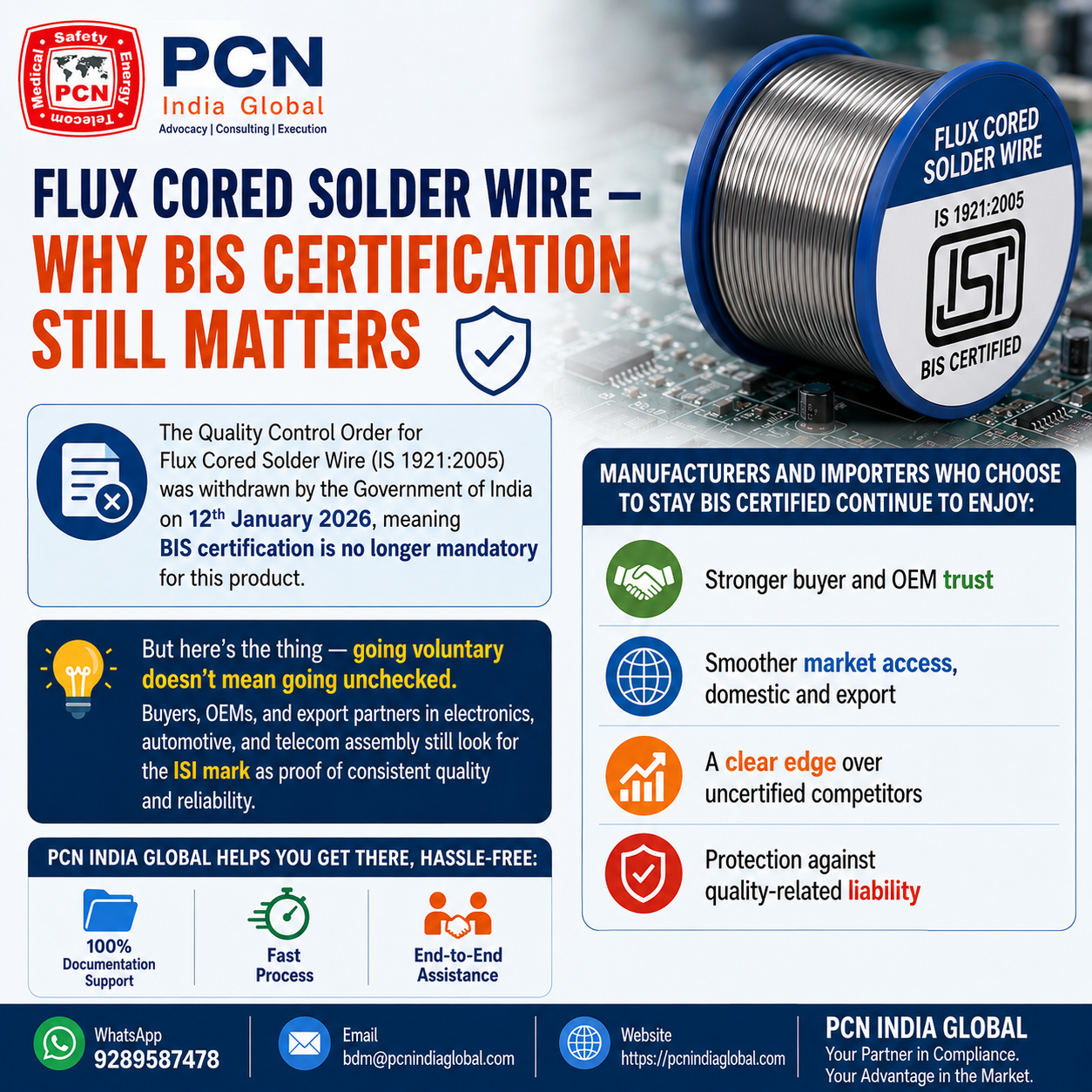
BIS Certification for Flux Cored Solder Wire in India: IS 1921, the Withdrawn Quality Control Order and What It Means Now

Flux cored solder wire is a small but essential input to electronics and electrical manufacturing — the consumable that joins components to boards and wires to terminals, with the flux built into the core of the wire to clean the joint as it forms. Because solder quality affects the reliability of everything from consumer gadgets to industrial equipment, the Bureau of Indian Standards (BIS) maintains an Indian Standard for it, IS 1921, and for a period made certification against that standard mandatory. Understanding the current position is important for manufacturers, importers, and users of solder wire, because the regulatory status of this product has recently changed. At PCN India Global we track these BIS certification developments closely so that businesses always act on the current rules rather than outdated ones. The headline for 2026 is straightforward: the Quality Control Order that had made BIS certification mandatory for flux cored solder wire under IS 1921:2005 was rescinded, with the withdrawal taking effect on 12 January 2026. In practical terms, this means flux cored solder wire is — as of now — no longer a product that requires a mandatory BIS licence and ISI Mark to be manufactured, imported, or sold in India. This guide explains the standard, the history of the order, what the withdrawal means in practice, and why staying alert to possible future changes still matters. The Standard: IS 1921 IS 1921 is the Indian Standard specification for flux cored solder wire. It defines the requirements for the product — including the composition of the solder alloy, the flux content and type carried within the wire’s core, dimensional tolerances, and the quality characteristics that determine how cleanly and reliably the wire forms a solder joint. As a specification standard, it gives manufacturers a clear technical benchmark and gives buyers a reference against which to judge quality. Importantly, the withdrawal of the mandatory certification order does not abolish the standard itself. IS 1921 continues to exist as a technical reference, and manufacturers may still choose to make and test their solder wire to it. What has changed is the legal compulsion: conformity to IS 1921 is no longer enforced through a mandatory Quality Control Order. A manufacturer can still design and produce to IS 1921 as a mark of quality, and buyers can still specify it contractually — but it is now a voluntary benchmark rather than a legal gate. Why Solder-Wire Quality Matters Regardless of the Rules It is worth stepping back to understand why a humble consumable attracted a Quality Control Order in the first place, because that logic survives the order’s withdrawal. In electronics manufacturing, the solder joint is one of the most common points of failure. A joint made with poor-quality solder — the wrong alloy composition, inconsistent flux content, or contamination — can look fine yet fail in service through cracking, cold joints, corrosion, or poor wetting, and such failures are notoriously difficult and expensive to trace after the fact. Because a single finished product may contain hundreds or thousands of solder joints, the reliability of the solder wire propagates directly into the reliability of the end product, whether that is a phone charger, a medical device, an automotive controller, or an industrial power supply. The flux carried in the core of the wire is central to this. As the joint is heated, the flux cleans the metal surfaces of oxides so the molten solder can wet and bond properly; too little or the wrong flux gives weak joints, while overly aggressive flux residues can corrode the assembly over time. IS 1921 exists precisely to pin down these characteristics so that a spool of solder wire behaves predictably on the production line. This is why quality-focused manufacturers specify and test to the standard on their own initiative — the physics of a good solder joint does not change just because a mandatory order has been lifted. For buyers, the practical lesson is that removing the ISI-Mark requirement shifts the burden of quality assurance onto their own supplier qualification and incoming-inspection processes, which should be robust regardless of the regulatory status. The History: From Mandatory QCO to Withdrawal The regulatory journey of flux cored solder wire illustrates how India’s Quality Control Order framework evolves. The QCO notification for flux cored solder wire under IS 1921:2005 was released on 18 September 2023 and was implemented from 18 March 2024 for medium and large enterprises. During that period, covered manufacturers and importers were required to hold a BIS licence and carry the ISI Mark to place the product on the Indian market — the standard mandatory-certification regime that applies to notified products under the BIS Act, 2016. Then, in a notable reversal, the Government of India formally rescinded that Quality Control Order, with the revocation in effect as of 12 January 2026. From that date, manufacturers, importers, and suppliers are no longer required to obtain BIS certification for flux cored solder wire, and businesses can manufacture, import, sell, distribute, or offer the product for sale in the Indian market without a mandatory BIS licence. This kind of withdrawal is relatively unusual and typically reflects a policy reassessment of whether mandatory certification is the right tool for a given product at a given time. What the Withdrawal Means in Practice For businesses across the solder-wire supply chain, the practical implications of the rescission are clear: Manufacturers are no longer legally required to obtain and maintain a BIS licence for flux cored solder wire, removing the associated application, factory-inspection, testing, and surveillance obligations that a mandatory QCO entails. Importers can bring flux cored solder wire into India without needing the product to carry a mandatory ISI Mark under a BIS licence, simplifying customs clearance for this specific item. Buyers and users of solder wire — electronics and electrical manufacturers — will no longer see a mandatory ISI Mark as a purchasing prerequisite for this product, and should rely on their own quality specifications and supplier qualification. None of this

BIS Certification for Bicycles in India: IS 10613, IS 15533 (Bicycles for Young Children) and the Complete ISI Licensing Process

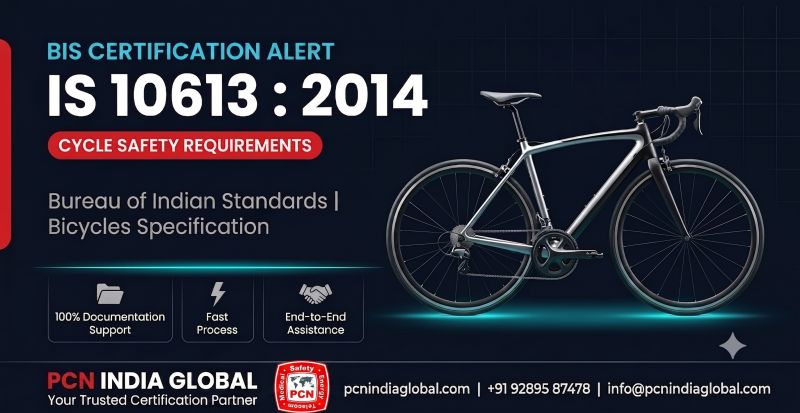
The bicycle is one of India’s most important products — a mass-market means of transport, a fitness and leisure product, and, in the case of children’s cycles, a product used by the most vulnerable users of all. Because a bicycle’s safety depends on the integrity of its frame, brakes, steering, wheels, and countless small parts, the Bureau of Indian Standards (BIS) regulates bicycles and their components through mandatory quality certification. For manufacturers and importers, BIS ISI certification against the applicable Indian Standards is the gateway to lawfully selling bicycles in India. Bicycles are governed under the Bicycle & Bicycle Parts (Quality Control) Order, issued under the BIS Act, 2016, which makes conformity to the relevant Indian Standards — and display of the ISI Mark under a BIS licence — mandatory. Two standards sit at the centre of the finished-bicycle requirement: IS 10613, which specifies safety requirements for bicycles generally, and IS 15533 (aligned with ISO 8098), which specifies safety requirements for bicycles for young children. This guide explains what these standards cover, how the QCO works, the certification process for Indian and foreign manufacturers, the documents required, realistic timelines and costs, and the mistakes that most often delay a licence. The Legal Framework: The Bicycle QCO and the ISI Mark BIS certification operates under the Bureau of Indian Standards Act, 2016. Through the Bicycle & Bicycle Parts (Quality Control) Order, the Central Government has made it mandatory that bicycles and covered bicycle parts comply with the corresponding Indian Standard and bear the ISI Mark under a licence from BIS. From the effective date, a covered product cannot be manufactured, stocked, sold, or imported in India unless it carries the ISI Mark with a valid CM/L licence number. Products made solely for export are generally outside the order’s scope. The order reaches beyond the complete bicycle. Bicycle parts and safety components — for example, retro-reflective devices, which have their own standard and QCO treatment — are also brought within the quality-certification net, reflecting the reality that a bicycle is only as safe as its critical parts. Manufacturers should confirm the exact list of covered products, the applicable standards, and the enforcement timelines (which the government phases and periodically clarifies) against the current BIS position. The underlying obligation is constant: for notified products, the ISI Mark under a BIS licence is the passport to the Indian market, and non-compliance invites penalties under the BIS Act. The Standards: IS 10613 and IS 15533 Two standards define the safety of the finished bicycle for different user groups. IS 10613 — Safety Requirements for Bicycles. This is the core standard for adult and general-use bicycles, specifying the safety and performance requirements and test methods that a bicycle must meet — covering braking performance, frame and fork strength, steering and handlebar security, wheel and tyre requirements, and the many detailed provisions that ensure the machine is safe to ride. It also references safety features such as retro-reflective devices through its provisions and related standards. IS 15533 — Safety Requirements for Bicycles for Young Children. Aligned with ISO 8098, this standard addresses bicycles designed for young children — a category defined by saddle-height limits — and sets safety and performance requirements and test methods tailored to the specific risks of children’s cycles, along with guidance on instructions for use and care. The latest Indian adoption reflects the current ISO edition, so manufacturers of children’s bicycles should certify against the applicable version. Because the two standards address different products, a manufacturer selling both adult and children’s bicycles must satisfy each on its own terms; a licence against one does not cover the other. Obtaining and designing to the current text of each standard is the foundation of a successful certification. It is worth emphasising why the children’s category is treated separately at all: young children ride differently, react more slowly, and are far less able to cope with a mechanical failure, so IS 15533 imposes requirements calibrated to their size, strength, and behaviour — from sharp-edge and projection limits to brake-lever reach and stability provisions. For a manufacturer, this means a children’s model cannot simply be a scaled-down adult bicycle certified under IS 10613; it must be designed and tested against the child-specific standard from the outset, which is both a safety imperative and a legal one. Who Needs BIS Certification for Bicycles The requirement reaches across the bicycle supply chain: For a brand that both imports finished cycles and assembles from parts, the compliance picture can involve multiple licences across the finished bicycle and its critical components, all of which should be planned together. Step-by-Step: The BIS ISI Certification Process BIS grants ISI licences under Scheme-I of the BIS (Conformity Assessment) Regulations. Our team manages each stage end to end, but every applicant should understand the sequence. Documents Required for BIS Certification A complete file at the outset is the biggest single lever on approval speed. For bicycles you will typically need: Foreign manufacturers must certify through FMCS and appoint an Authorised Indian Representative; Indian importers should ensure their overseas suppliers are properly licensed. Timeline and Cost Planning A realistic first-licence schedule is typically a few months end to end, paced by factory readiness (including in-house testing capability), the scheduling of the BIS factory inspection, and sample-testing turnaround. Where the in-house lab and documentation are prepared ahead of the application, the process moves faster. BIS charges application, inspection, testing, and licence/marking fees, with additional costs for FMCS overseas inspection. Because the QCO sets enforcement dates and phases them by enterprise size, the smartest plan is to begin certification well ahead of the applicable date so the product is licensed before the market closes to uncertified goods. Common Mistakes That Delay a Bicycle Licence Bicycles Sit Within a Wider Compliance Picture BIS certification of the bicycle and its parts may sit alongside other requirements: A coordinated plan ensures the finished-bicycle licence and any part-level and import obligations move together. Pre-Application Compliance Checklist for Bicycles Before filing, run

BIS Certification for Service Valves for Air Conditioning & Refrigeration in India: IS 19409:2025 and the Complete ISI Licensing Process

Service valves are small components with an outsized role in every air conditioner and refrigeration system. They are the ports through which refrigerant is charged, recovered, and serviced, and through which the system is sealed against leaks for its entire working life. A poorly made service valve can leak refrigerant, fail under pressure, or make servicing unsafe — which is exactly why the Bureau of Indian Standards (BIS) has brought service valves for air conditioning and refrigeration purposes under a dedicated Indian Standard, IS 19409:2025. For manufacturers and importers of these components, BIS ISI certification against this standard is becoming the gateway to the Indian market. The move fits a wider pattern. India has been steadily expanding mandatory quality certification across the air-conditioning and refrigeration supply chain — from finished units and hermetic compressors to copper tubes and now the valves and fittings that hold the refrigerant circuit together. As these components come under Quality Control Orders (QCOs), a covered product must carry the ISI Mark under a valid BIS licence before it can be manufactured, stocked, sold, or imported. This guide explains what IS 19409:2025 covers, how the BIS certification process works for both Indian and foreign manufacturers, the documents required, realistic timelines and costs, and the mistakes that most often delay a licence. The Legal Framework: QCOs and the ISI Mark BIS certification operates under the Bureau of Indian Standards Act, 2016. When the Central Government issues a Quality Control Order for a product, it makes conformity to the corresponding Indian Standard — and the display of the ISI Mark under a BIS licence — mandatory. From the effective date of such an order, the product cannot lawfully be produced, traded, stocked, sold, or imported in India unless it bears the ISI Mark with a valid licence (CM/L) number. Products manufactured solely for export are generally outside the order’s scope. For service valves, IS 19409:2025 is the technical specification that a QCO would reference. Manufacturers should confirm the exact notification, its effective dates, and any turnover-linked implementation timelines against the current BIS position, because the government phases enforcement and periodically issues clarifications and extensions. What does not change is the underlying obligation: once the product is notified, the ISI Mark under a BIS licence is the passport to the Indian market, and non-compliance exposes a business to penalties under the BIS Act, including fines and seizure. What IS 19409:2025 Covers IS 19409:2025 is the Indian Standard titled, in effect, Service Valves for Air Conditioning and Refrigeration Purposes — Specification. It sets out the material, construction, dimensional, performance, and testing requirements for the service valves used in air-conditioning and refrigeration systems — the access and shut-off valves through which refrigerant is handled during manufacture, installation, and servicing. A specification standard of this kind typically addresses the pressure integrity of the valve, its leak-tightness, the durability of its sealing under repeated operation, corrosion resistance of the materials, and the dimensional interfaces that let it mate reliably with the rest of the refrigerant circuit. Because the valve sits in a sealed, pressurised system carrying refrigerant, these characteristics are safety- and performance-critical: a valve that passes the standard’s tests gives assurance that it will hold pressure, resist leakage, and survive the servicing cycles a real system demands. Manufacturers should obtain the current text of IS 19409:2025 and design and test explicitly to its clauses, since the certification stands or falls on demonstrated conformity to the standard. Who Needs BIS Certification for Service Valves The requirement reaches across the supply chain for these components: Indian manufacturers of service valves for AC and refrigeration, who must hold a BIS licence to apply the ISI Mark before selling in India. Importers and foreign manufacturers, whose products must be certified — foreign factories through the BIS Foreign Manufacturers Certification Scheme (FMCS) — before the valves can be imported into India. OEMs and system builders who source valves, and who increasingly require their suppliers to hold valid BIS licences so the finished AC or refrigeration product’s own compliance file is clean. Because the valve is a component in a larger regulated ecosystem, its certification status affects everyone downstream. An AC or refrigeration manufacturer building compliant finished goods will expect ISI-marked valves from a licensed source, making certification a commercial as well as a legal necessity. Step-by-Step: The BIS ISI Certification Process BIS grants ISI licences under Scheme-I of the BIS (Conformity Assessment) Regulations. Our team manages each stage end to end, but every applicant should understand the sequence. Confirm applicability and standard. Verify that the product falls within the notified scope for IS 19409:2025 and obtain the current standard text. Prepare the factory and in-house testing. BIS certification is factory-based. The manufacturing premises must have the machinery and, importantly, the in-house testing facilities (or a demonstrated arrangement) needed to verify conformity to the standard on an ongoing basis. File the application on the BIS portal. Submit the application (through the BIS Manak online system) with the required technical and company documentation. Foreign manufacturers apply under FMCS and must nominate an Authorised Indian Representative (AIR). Factory inspection. A BIS officer inspects the manufacturing unit, verifies the production process and testing capability, and witnesses testing. Sample testing. Samples are drawn and tested — in the factory and/or at a BIS-recognised laboratory — against IS 19409:2025 to confirm conformity. Grant of licence. On satisfactory inspection and test results, BIS grants the licence with a CM/L number authorising use of the ISI Mark. Marking and surveillance. The manufacturer marks the ISI Mark and CM/L number on the product, and maintains conformity under ongoing BIS surveillance, with periodic renewal of the licence. Documents Required for BIS Certification A complete file at the outset is the biggest single lever on approval speed. For service valves you will typically need: Details of the manufacturing unit (name, address, ownership/constitution) Manufacturing process flow chart for the service valves List of manufacturing machinery and plant List of in-house testing equipment against the requirements of IS 19409:2025
BEE Registration for Office Automation Products (Printer, Copier, Scanner, MFD) in India — Indian Standard Schedule 16

BEE Star Rating & Registration for Office Automation Products in India: Energy Efficiency, Star Labelling and the Complete Process

Printers, photocopiers, scanners, and multifunction devices are fixtures of every office, and they have a distinctive energy profile: they spend the overwhelming majority of their time idle or in standby, punctuated by short bursts of active printing or copying. Because there are so many of them and they are so often left powered on, their standby and low-power behaviour has an outsized effect on an organisation’s electricity use. The Bureau of Energy Efficiency (BEE) includes office automation products in its Standards & Labelling programme so that buyers can compare them on energy efficiency. For manufacturers and importers, understanding the BEE Star Label and registration framework for this category is a valuable way to appeal to efficiency- and sustainability-focused corporate and government buyers. Office automation products sit in the voluntary column of the BEE labelling scheme. Voluntary status means labelling is at the manufacturer’s discretion — but for a product class sold heavily into corporate, institutional, and government procurement, where green criteria increasingly matter, a voluntary efficiency label can be a real competitive advantage. This guide explains how the certification works, the metric behind the stars, the process, documents, timelines, and the mistakes to avoid. Voluntary Labelling for a Procurement-Driven Category BEE Star Labelling operates under the Energy Conservation Act, 2001, administered by the Bureau of Energy Efficiency under the Ministry of Power. Product categories sit in either the mandatory or voluntary column, and office automation products are currently voluntary, alongside other lower-consumption and office equipment. The commercial logic of the voluntary label is strongest precisely here. Office automation products are rarely bought one at a time by individual consumers; they are bought in fleets by businesses, institutions, and government departments through structured procurement, and those buyers increasingly apply sustainability and total-cost-of-ownership criteria. An energy-efficiency label backed by BEE gives a purchasing manager an objective basis to prefer one device over another, and it aligns the product with green-procurement policies that many large organisations and public bodies now follow. For a manufacturer, the star is therefore less about the individual retail shelf and more about qualifying for and winning volume institutional orders. Energy Efficiency: The Metric Behind the Stars For office automation products, the rating is based on energy efficiency across a representative usage pattern that reflects how these devices actually operate — long periods in standby and sleep, interspersed with active print, copy, or scan operations. Rather than judging a device on its peak power draw, the measure captures the energy it consumes over a typical duty cycle, which for this category is dominated by low-power states. The principle is consistent with other BEE categories: a device that delivers the same office function while consuming less energy over the usage pattern earns a higher star rating, up to five stars. Design factors — power-management firmware, sleep-mode behaviour, fuser and imaging efficiency in printers, and standby power in all modes — determine the result. Because standby and sleep dominate the duty cycle, how quickly and how deeply a device powers down when idle often matters more to its rating than its active efficiency. As always, the certified figure comes from standardised testing rather than marketing claims. Two printers with similar print speeds can post different efficiency results depending on how well their low-power states are engineered, which is exactly the difference the label is designed to reveal. What Counts, and Why the Duty Cycle Is Unusual Office automation is a broad umbrella. It typically covers desktop and workgroup printers, photocopiers, scanners, and the multifunction devices that combine printing, copying, scanning, and faxing in a single unit. What unites them from an energy standpoint is an unusual duty cycle: unlike a refrigerator that runs continuously or an air conditioner that runs at high load, these machines are overwhelmingly idle. A busy office multifunction device might spend well under an hour a day actively printing and the remaining twenty-plus hours in some low-power state — ready, sleep, or deep sleep. This is why the rating framework weights standby and sleep so heavily, and why features such as automatic power-down, fast wake-from-sleep (so users are not tempted to disable sleep), and low deep-sleep draw are the levers that move a device up the star scale. For manufacturers, it reframes the design challenge: the efficiency win is less about making printing itself cheaper and more about making the long hours of doing nothing consume almost nothing at all. Step-by-Step: How to Get a BEE Star Label for an Office Automation Product Our team manages each stage end to end, but every applicant should understand the sequence. Documents Required for BEE Certification of Office Automation Products A complete file at the outset is the biggest single lever on approval speed. You will typically need: For testing and the model application For company and brand registration Foreign manufacturers cannot register directly on the BEE portal unless they have an Indian-registered entity; overseas brands must appoint an authorised Indian representative or work through their Indian importer. Timeline and Cost Planning A realistic first-model schedule runs roughly four to nine weeks end to end. Energy testing across the defined usage pattern is usually the longest single element, commonly two to four weeks depending on the lab queue and the number of models. Document preparation and company/brand registration can run in parallel and add one to two weeks, and portal processing generally takes a further two to three weeks. Because product families often share imaging engines and power-management firmware across models, test evidence and documentation leverage well across the range. For a category sold heavily into institutional procurement, the testing investment is typically modest against the value of qualifying for large fleet tenders. Common Mistakes That Delay Registration Office Automation Products Also Need These Approvals BEE labelling is often one part of a broader compliance picture: Pre-Launch Compliance Checklist for Office Automation Products Before committing to a production run or booking an import consignment, run this verification sequence. First, confirm the exact model designation that will appear on the
BEE Registration for Computers (Notebook / Laptops) in India — Indian Standard Schedule 14

BEE Star Rating & Registration for Computers (Laptops & Notebooks) in India: Energy Efficiency, Schedule 14 and the Complete Process

Laptops and notebook computers are among the most widely sold electronic products in India, shipping in enormous volumes to students, professionals, businesses, and government buyers. While each individual laptop consumes far less power than a refrigerator or air conditioner, the sheer number in use — and the many hours they run — makes their collective energy footprint significant. The Bureau of Energy Efficiency (BEE) includes computers in its Standards & Labelling programme so that buyers can compare models on energy efficiency. For manufacturers and importers, understanding the BEE Star Label and registration framework for computers — and how it sits alongside the mandatory BIS registration these products already require — is an important part of a complete India compliance plan. Computers are covered under a dedicated BEE schedule (commonly referenced as Schedule 14) and currently sit in the voluntary column. Importantly, the BEE computer category is defined to include laptops and notebooks but generally excludes desktop PCs and server or storage systems. Because laptops are already subject to mandatory BIS Compulsory Registration Scheme (CRS) requirements for safety, the BEE energy star is an additional, voluntary layer that lets a brand signal efficiency. This guide explains how the certification works, the metric behind the stars, the process, documents, timelines, and how BEE and BIS fit together. Voluntary Energy Labelling for a Mandatory-Safety Product BEE Star Labelling operates under the Energy Conservation Act, 2001, administered by the Bureau of Energy Efficiency under the Ministry of Power. Product categories sit in either the mandatory or voluntary column, and computers (laptops/notebooks) are currently voluntary for the BEE energy star. This creates an important distinction that brands must understand. The safety compliance of a laptop — via mandatory BIS CRS registration against the applicable Indian Standard — is compulsory; no laptop can be sold in India without it. The energy efficiency label under BEE, by contrast, is currently voluntary. The two are entirely separate: BIS CRS certifies that the product is safe, while the BEE star communicates how energy-efficient it is. A brand can therefore be fully compliant on the mandatory safety side while choosing whether to add the voluntary BEE energy star as a differentiator. Given the environmental positioning of many technology buyers — especially large corporate and government purchasers with sustainability criteria — the voluntary star can be a meaningful advantage in tenders and procurement. Why the Voluntary Star Is Worth It for Computers The business case for adding the voluntary energy star to a laptop range rests on who buys computers in bulk. Large enterprises, educational institutions, and government departments increasingly run procurement through sustainability and total-cost-of-ownership lenses, and many public tenders now award points for — or outright require — recognised energy-efficiency credentials. In that environment, a BEE star rating is not a decorative badge but a qualifying criterion that can decide whether a model even reaches the shortlist for a large fleet order. There is also a brand dimension: efficiency labelling signals engineering quality and environmental responsibility to retail buyers who are more climate-conscious than ever. Because the incremental cost of the voluntary star is small relative to the value of a single institutional contract, many brands treat it as a low-risk investment with a clear commercial upside, especially when it can be secured in parallel with the mandatory BIS and WPC approvals the product needs anyway. Energy Efficiency: The Metric Behind the Stars For computers, the rating is based on energy efficiency — broadly, how much energy the machine consumes across a representative pattern of use, capturing active, idle, sleep, and off states rather than a single operating point. Because a laptop spends its life cycling through these modes, an efficiency measure that reflects typical usage gives buyers a realistic picture of running cost and battery-relevant efficiency. The principle mirrors other BEE categories: lower energy consumption for the same computing service earns a higher star rating, up to five stars. Design factors — processor and platform efficiency, display technology, power-management firmware, and power-supply efficiency — all influence the result. Because the measure reflects a defined usage pattern rather than marketing claims about battery life, the certified figure comes from standardised testing. For manufacturers, this means the energy star rewards genuine platform and firmware efficiency, not headline specifications. Two laptops with similar processors can post different efficiency results depending on how well their power management is tuned, which is exactly the kind of real-world difference the label is designed to surface. Step-by-Step: How to Get a BEE Star Label for a Computer Our team manages each stage end to end, but every applicant should understand the sequence. Documents Required for BEE Certification of Computers A complete file at the outset is the biggest single lever on approval speed. You will typically need: For testing and the model application For company and brand registration Foreign manufacturers cannot register directly on the BEE portal unless they have an Indian-registered entity; overseas brands must appoint an authorised Indian representative or work through their Indian importer. Timeline and Cost Planning A realistic first-model schedule runs roughly four to nine weeks end to end. Energy testing across the defined usage pattern is usually the longest single element, commonly two to four weeks depending on the lab queue and the number of models. Document preparation and company/brand registration can run in parallel and add one to two weeks, and portal processing generally takes a further two to three weeks. Because laptop ranges often share platforms and power-management firmware across models, test evidence and documentation leverage well across the range. The most important sequencing point is that the mandatory BIS CRS registration is the gating requirement for sale; the voluntary BEE star is added on top, ideally in parallel so it is ready at launch. Common Mistakes That Delay Computer Registration Computers Also Need These Approvals For laptops, one related approval is not optional — it is mandatory and sits alongside the voluntary BEE star: Because a laptop touches several regimes at once, a coordinated compliance

BEE Star Rating & Registration for Submersible Pump Sets in India: Pump Efficiency, IS 8034 and the Complete Process

Submersible pump sets are the backbone of water supply across India — lifting water from borewells and deep wells for agriculture, drinking water, industry, and buildings. They often run for long hours, sometimes on subsidised or metered power, which makes their efficiency a matter of real economic and national importance. A more efficient pump delivers the same water for less electricity, cutting running costs for farmers and utilities alike. The Bureau of Energy Efficiency (BEE) includes submersible pump sets in its Standards & Labelling programme so that buyers can compare pumps on verified efficiency. For manufacturers and importers, understanding the BEE Star Label and registration framework is a valuable way to stand out in a competitive, price-sensitive market. Submersible pump sets currently sit in the voluntary column of the BEE labelling scheme, with the applicable Indian Standard being IS 8034 for submersible pump sets. Voluntary status means labelling is at the manufacturer’s discretion — but leading pump makers have actively pursued BEE star ratings, precisely because efficiency is a genuine differentiator for the water-users who pay the electricity bills. This guide explains how the certification works, the efficiency metric behind the stars, the step-by-step process, the documents required, realistic timelines and costs, and the mistakes to avoid. Voluntary Today, Valuable Nonetheless BEE Star Labelling operates under the Energy Conservation Act, 2001, administered by the Bureau of Energy Efficiency under the Ministry of Power. Products sit in either the mandatory or voluntary column, and submersible pump sets are currently voluntary, alongside other pump categories. Voluntary does not mean marginal. Pumping is one of the largest single uses of electricity in Indian agriculture, and government efficiency programmes have actively encouraged the shift toward star-labelled pump sets to cut that consumption. A voluntary star label lets a manufacturer prove, with independent test data, that its pump uses less power for the same output — a claim that resonates strongly with farmers, water utilities, and bulk buyers under energy-saving pressure. Star-rated pumps also feature in various efficiency and subsidy-linked procurement initiatives. In short, a brand that earns BEE star ratings for its submersible pumps gains a credible, quantified efficiency story in a market where running cost is often the deciding factor. Pump-Set Efficiency: The Metric Behind the Stars For submersible pump sets, the rating is based on overall pump-set efficiency — how effectively the unit converts the electrical energy supplied to the motor into useful hydraulic work, that is, into lifting and delivering water. Efficiency captures the combined performance of the motor and the pump hydraulics, expressed against the flow and head at which the unit is designed to operate. The principle is straightforward: a pump set that delivers the required flow at the required head while drawing less power is more efficient and earns a higher star rating, up to five stars. Because efficiency varies across a pump’s operating range, testing establishes performance at the duty point defined by the standard, and the measured efficiency determines the star band. Design factors — impeller and diffuser hydraulics, motor efficiency, internal clearances, and materials — all influence where a pump lands. This is why standardised testing matters. Two pumps with the same nameplate power can deliver quite different real efficiencies depending on hydraulic design and manufacturing quality, and only proper testing against the relevant standard establishes the certified figure that the star rating reflects. IS 8034 provides the reference framework for submersible pump sets, and the test must reflect the configuration actually supplied. The Agricultural Energy Context To understand why pump efficiency carries such weight in India, it helps to look at where the electricity goes. Agricultural pumping is among the very largest consumers of power in the country, and in many states farm supply is subsidised, which means inefficient pumps impose a cost not only on the farmer but on the state exchequer and the grid as a whole. A large fraction of the installed pump base was designed decades ago to price rather than efficiency, so the headroom for improvement is enormous — replacing an old, poorly matched pump with a modern star-rated one can cut its energy use substantially while delivering the same water. Government and utility programmes have repeatedly targeted this opportunity, promoting efficient, star-labelled pump sets and, in some schemes, linking incentives or replacement drives to BEE ratings. For a manufacturer, this policy backdrop turns a voluntary label into a meaningful commercial asset: it aligns the product with the direction of national energy policy and with the buyers most motivated to act on efficiency, from individual farmers to large water utilities managing thousands of connections. Step-by-Step: How to Get a BEE Star Label for a Submersible Pump Set Our team manages each stage end to end, but every applicant should understand the sequence. Documents Required for BEE Certification of Submersible Pump Sets A complete file at the outset is the biggest single lever on approval speed. You will typically need: For testing and the model application For company and brand registration Foreign manufacturers cannot register directly on the BEE portal unless they have an Indian-registered entity; overseas brands must appoint an authorised Indian representative or work through their Indian importer. Timeline and Cost Planning A realistic first-model schedule runs roughly five to nine weeks end to end. Performance testing to establish efficiency at the duty point is usually the longest single element, commonly two to four weeks depending on the lab queue and the number of models. Document preparation and company/brand registration can run in parallel and add one to two weeks, and portal processing generally takes a further two to three weeks. Because pump ranges often share hydraulic and motor platforms across sizes and stage counts, test evidence and documentation leverage well across models, so the per-model effort falls after the first registrations. As a voluntary programme with strong buyer resonance, the return on the modest testing investment is high. Common Mistakes That Delay Pump Set Registration Submersible Pump Sets Also Relate to These Approvals BEE labelling is