
BIS CRS Registration for Mobile Phones in India: Standards, Process and the Complete Compliance Picture
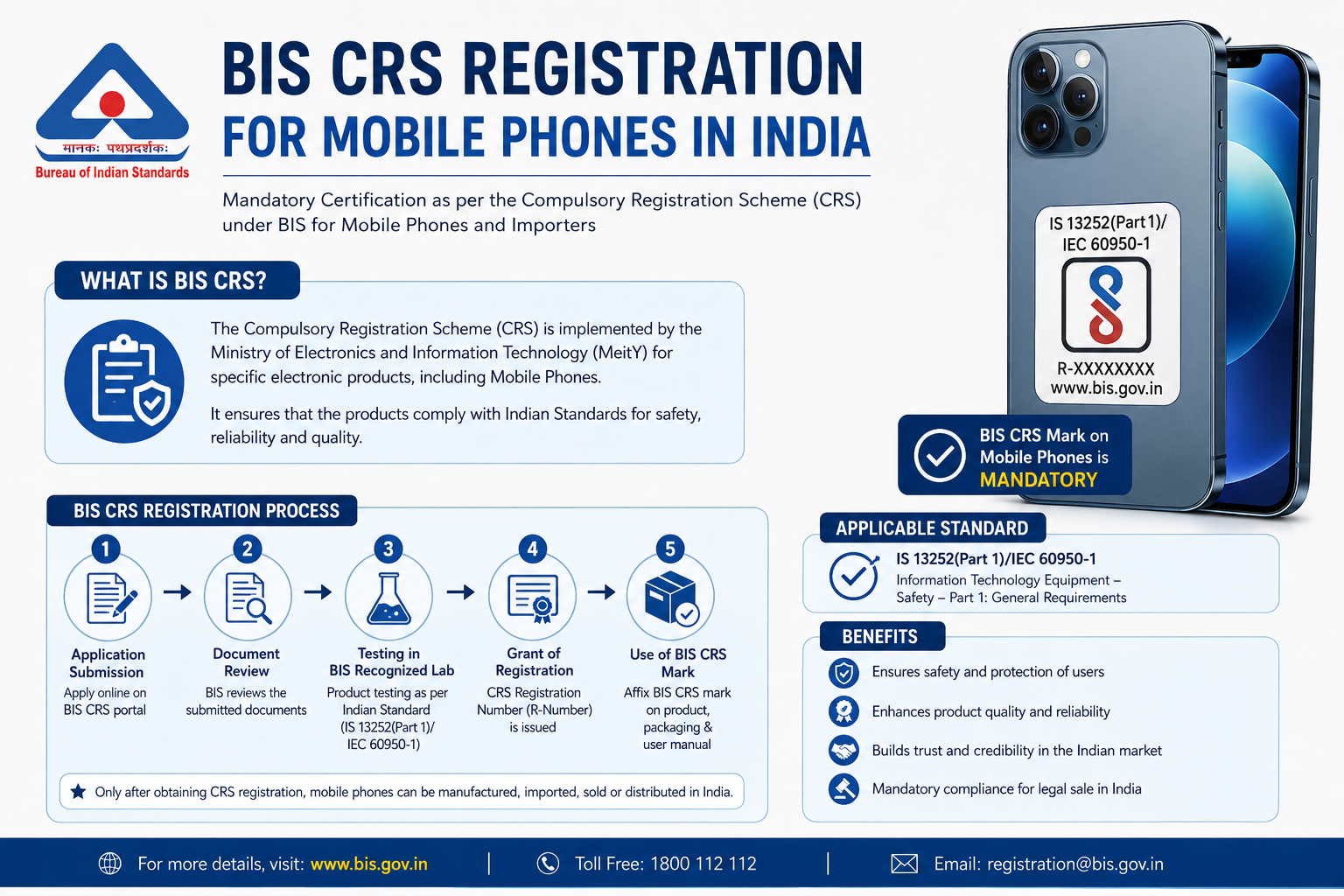
The mobile phone is the single highest-volume electronic product in India, shipping in the hundreds of millions across every price point, from entry-level feature phones to flagship smartphones. It is also one of the most tightly regulated, because a device that billions of hours are spent holding, charging, and carrying must be safe against electrical and thermal hazards. Every mobile phone sold in India must be registered under the BIS Compulsory Registration Scheme (CRS) before it can be imported or sold. For manufacturers, brand owners, and importers, BIS CRS registration is the foundational compliance step for entering the Indian mobile market. But a mobile phone is unusual in how many approvals it needs at once. Beneath the CRS safety registration sits a stack of parallel requirements — wireless approval for its radios, telecom certification, and environmental obligations for its batteries and e-waste. This guide focuses on the CRS registration itself: the applicable standard, the self-declaration process, the documents required, and realistic timelines, and then sets it in the context of the full multi-agency compliance file that every phone carries. Why Mobile Phones Fall Under CRS The Compulsory Registration Scheme operates under the Electronics and Information Technology Goods (Requirement of Compulsory Registration) Order, administered by BIS under the BIS Act, 2016. Mobile phones are a notified product under CRS, which means a covered handset must be tested against the applicable Indian Standard, registered with BIS, and marked with its registration number before it can be manufactured, imported, sold, distributed, or stored for sale in India. The rationale is straightforward. Mobile phones combine a lithium battery, a charging system, high-density electronics, and constant close human contact — a combination where poor design or substandard components can lead to overheating, electric shock, or battery failure. CRS ensures every handset on the market meets a common safety baseline verified by India-specific testing. Selling an unregistered phone is an offence under the BIS Act, and in practice registration is also a commercial gate: e-commerce platforms and retailers verify CRS registration before listing handsets, and customs checks it at import. The Applicable Standard Mobile phones are registered under the Indian Standard for the safety of information technology and electronic equipment. The long-standing standard for this family has been IS 13252 (Part 1), India’s adoption of IEC 60950-1, which covers protection against electric shock, energy hazards, fire, mechanical hazards, and thermal hazards in IT equipment. As with the wider electronics sector, safety standards are transitioning internationally toward the unified hazard-based standard IEC 62368-1, adopted in India as IS 62368-1, and BIS has been aligning products with this transition. Manufacturers should therefore confirm the exact applicable standard and its current edition for mobile phones against the latest BIS notification before testing, because registering against a superseded standard can invalidate the application. Whichever standard applies, the principle is the same: the handset must be tested at a BIS-recognised laboratory and shown to conform before it can be registered. What the CRS Safety Test Actually Examines It helps to understand what a BIS-recognised laboratory is checking when it tests a handset, because it clarifies why the registration matters. The safety standard evaluates the phone against a defined set of hazards. Electric shock protection is assessed to ensure a user cannot contact hazardous voltages under normal or single-fault conditions. Thermal behaviour is examined so the device and its battery do not reach unsafe temperatures during charging or heavy use. Fire-hazard provisions look at how the device contains and limits any fault that could ignite. Mechanical and construction requirements check enclosures, sharp edges, and the integrity of the assembly. And energy-hazard tests address the risk from the concentrated energy in the battery and power circuitry. Because a phone integrates a lithium cell, a charging system, and dense electronics in a handheld package, each of these areas is genuinely relevant — which is precisely why India requires the device to be proven safe through local testing rather than accepting overseas certificates alone. Why the Mobile Phone Compliance File Is Uniquely Complex Few products carry as many simultaneous approvals as a smartphone, and understanding this shapes how a launch should be planned. A single flagship handset is, at once, an item of IT equipment (CRS safety), a multi-radio wireless device (WPC), potentially telecom terminal equipment (TEC), a battery-powered product (battery EPR), an electronic product generating e-waste (e-waste EPR), and a pre-packaged retail good (LMPC). Each regime has its own authority, its own timeline, and its own documentation, and a gap in any one of them can stop the product at the border or off the shelf even when everything else is in order. The manufacturers who launch smoothly in India treat these not as separate errands but as a single, sequenced compliance programme, started early and driven in parallel. For high-volume, fast-cycle products like phones — where a missed launch window during a festive season can cost a fortune — this coordination is not administrative overhead but a core part of go-to-market strategy, and it is exactly where experienced compliance support earns its place. Step-by-Step: BIS CRS Registration for a Mobile Phone CRS is a test-and-register scheme with no factory inspection. Our team manages each stage end to end, but every applicant should understand the sequence. Confirm the standard and edition. Verify the current applicable safety standard for mobile phones and its edition. Test at a BIS-recognised laboratory. Submit handset samples for testing against the applicable standard. The test report is the foundation of the application. Prepare documentation. Compile technical details, the bill of materials and critical components (battery, charger), company and brand documents, and — for foreign makers — the Authorised Indian Representative (AIR) nomination. File the online application. Submit the application on the BIS portal with the test report and documents. BIS scrutiny and grant. BIS reviews the application and grants the registration with a unique R-number. Mark and self-declare. Apply the standard mark and R-number on the handset and packaging, and issue the self-declaration of conformity. Maintain and renew. Keep