
BEE Star Rating & Registration for Office Automation Products in India: Energy Efficiency, Star Labelling and the Complete Process
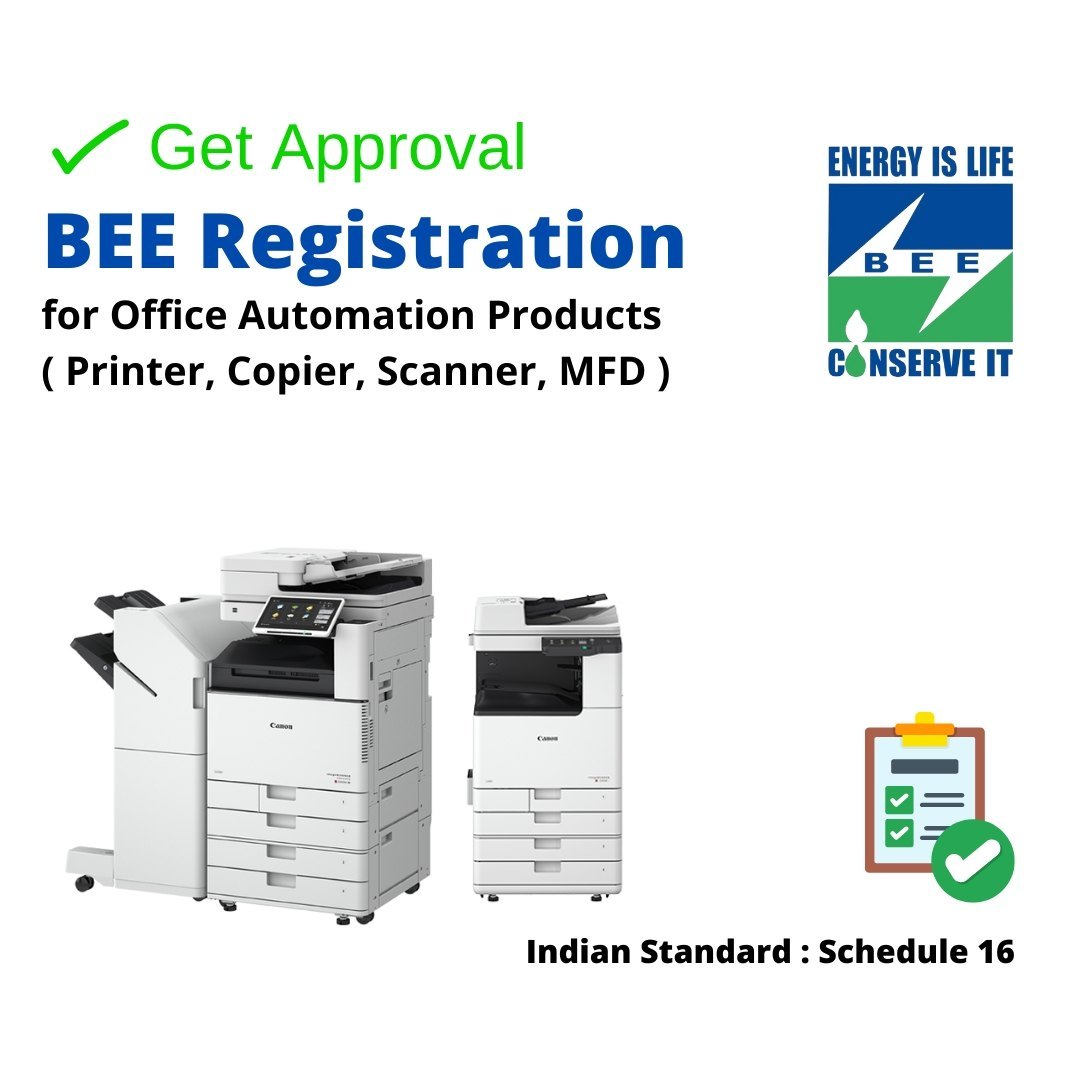
Printers, photocopiers, scanners, and multifunction devices are fixtures of every office, and they have a distinctive energy profile: they spend the overwhelming majority of their time idle or in standby, punctuated by short bursts of active printing or copying. Because there are so many of them and they are so often left powered on, their standby and low-power behaviour has an outsized effect on an organisation’s electricity use. The Bureau of Energy Efficiency (BEE) includes office automation products in its Standards & Labelling programme so that buyers can compare them on energy efficiency. For manufacturers and importers, understanding the BEE Star Label and registration framework for this category is a valuable way to appeal to efficiency- and sustainability-focused corporate and government buyers.
Office automation products sit in the voluntary column of the BEE labelling scheme. Voluntary status means labelling is at the manufacturer’s discretion — but for a product class sold heavily into corporate, institutional, and government procurement, where green criteria increasingly matter, a voluntary efficiency label can be a real competitive advantage. This guide explains how the certification works, the metric behind the stars, the process, documents, timelines, and the mistakes to avoid.
Voluntary Labelling for a Procurement-Driven Category
BEE Star Labelling operates under the Energy Conservation Act, 2001, administered by the Bureau of Energy Efficiency under the Ministry of Power. Product categories sit in either the mandatory or voluntary column, and office automation products are currently voluntary, alongside other lower-consumption and office equipment.
The commercial logic of the voluntary label is strongest precisely here. Office automation products are rarely bought one at a time by individual consumers; they are bought in fleets by businesses, institutions, and government departments through structured procurement, and those buyers increasingly apply sustainability and total-cost-of-ownership criteria. An energy-efficiency label backed by BEE gives a purchasing manager an objective basis to prefer one device over another, and it aligns the product with green-procurement policies that many large organisations and public bodies now follow. For a manufacturer, the star is therefore less about the individual retail shelf and more about qualifying for and winning volume institutional orders.
Energy Efficiency: The Metric Behind the Stars
For office automation products, the rating is based on energy efficiency across a representative usage pattern that reflects how these devices actually operate — long periods in standby and sleep, interspersed with active print, copy, or scan operations. Rather than judging a device on its peak power draw, the measure captures the energy it consumes over a typical duty cycle, which for this category is dominated by low-power states.
The principle is consistent with other BEE categories: a device that delivers the same office function while consuming less energy over the usage pattern earns a higher star rating, up to five stars. Design factors — power-management firmware, sleep-mode behaviour, fuser and imaging efficiency in printers, and standby power in all modes — determine the result. Because standby and sleep dominate the duty cycle, how quickly and how deeply a device powers down when idle often matters more to its rating than its active efficiency.
As always, the certified figure comes from standardised testing rather than marketing claims. Two printers with similar print speeds can post different efficiency results depending on how well their low-power states are engineered, which is exactly the difference the label is designed to reveal.
What Counts, and Why the Duty Cycle Is Unusual
Office automation is a broad umbrella. It typically covers desktop and workgroup printers, photocopiers, scanners, and the multifunction devices that combine printing, copying, scanning, and faxing in a single unit. What unites them from an energy standpoint is an unusual duty cycle: unlike a refrigerator that runs continuously or an air conditioner that runs at high load, these machines are overwhelmingly idle. A busy office multifunction device might spend well under an hour a day actively printing and the remaining twenty-plus hours in some low-power state — ready, sleep, or deep sleep.
This is why the rating framework weights standby and sleep so heavily, and why features such as automatic power-down, fast wake-from-sleep (so users are not tempted to disable sleep), and low deep-sleep draw are the levers that move a device up the star scale. For manufacturers, it reframes the design challenge: the efficiency win is less about making printing itself cheaper and more about making the long hours of doing nothing consume almost nothing at all.
Step-by-Step: How to Get a BEE Star Label for an Office Automation Product
Our team manages each stage end to end, but every applicant should understand the sequence.
- Confirm applicability and criteria. Establish that the device (printer, copier, scanner, multifunction device) falls within the office automation schedule and confirm the efficiency criteria and star bands in force.
- Test at a BEE-recognised / NABL-accredited laboratory. Submit sample units for energy testing across the defined usage pattern to establish the efficiency figure. This report is the basis of the star assignment.
- Register the company and brand on the BEE portal. Create the manufacturer / importer account and obtain your company and brand identifiers, reused across all models.
- Register each model. File the model-level application with the technical specification sheet, the test report, the efficiency data, and the required declarations. Each model needs its own evidence.
- Star assignment and label generation. BEE maps the efficiency to the applicable star band and generates the official label showing the star rating and validity period.
- Affix the label. Apply the approved BEE label, in the prescribed format, on the product / packaging.
- Renew periodically. Labels are valid for a limited period and must be renewed, with updated test data where criteria have changed.
Documents Required for BEE Certification of Office Automation Products
A complete file at the outset is the biggest single lever on approval speed. You will typically need:
For testing and the model application
- Product technical specification sheet (device type, print/copy speed, power modes, standby power)
- Model name and full product description exactly as it will appear on the packaging
- Physical product samples for the laboratory
- Valid energy test report from a NABL-accredited / BEE-recognised laboratory across the usage pattern
- Label draft / artwork in the prescribed BEE format
- Signed model declaration / declaration of conformity
For company and brand registration
- Certificate of Incorporation (MCA/ROC)
- GST registration certificate
- PAN card of the company
- Trademark / brand authorisation documents
- Address proof of the company and manufacturing facility details
- Authorised signatory details, and Board Resolution / Power of Attorney
- Import Export Code (IEC) — for importers
- Brand authorisation letter — where an importer represents an overseas brand
Foreign manufacturers cannot register directly on the BEE portal unless they have an Indian-registered entity; overseas brands must appoint an authorised Indian representative or work through their Indian importer.
Timeline and Cost Planning
A realistic first-model schedule runs roughly four to nine weeks end to end. Energy testing across the defined usage pattern is usually the longest single element, commonly two to four weeks depending on the lab queue and the number of models. Document preparation and company/brand registration can run in parallel and add one to two weeks, and portal processing generally takes a further two to three weeks.
Because product families often share imaging engines and power-management firmware across models, test evidence and documentation leverage well across the range. For a category sold heavily into institutional procurement, the testing investment is typically modest against the value of qualifying for large fleet tenders.
Common Mistakes That Delay Registration
- Focusing on active power alone. The rating is dominated by standby and sleep behaviour across the duty cycle, not peak print power.
- Relying on marketing specs. The star depends on measured energy consumption across the defined usage pattern.
- Model-name drift. The designation on the report, portal, label, and packaging must match exactly.
- Overlooking multi-agency needs. Many of these devices are electronic products with additional safety and connectivity obligations (see below).
- Skipping renewal. A lapsed label should not continue to appear on product.
Office Automation Products Also Need These Approvals
BEE labelling is often one part of a broader compliance picture:
- BIS certification / CRS — many office electronic products fall under mandatory safety registration; see our BIS certification and BIS CRS registration services.
- WPC ETA — devices with Wi-Fi or Bluetooth for wireless printing require WPC ETA approval for their radios.
- EPR for e-waste — producers and importers of electronic equipment must hold EPR registration for e-waste with CPCB.
- Legal Metrology (LMPC) — imported pre-packaged units require LMPC registration.
Pre-Launch Compliance Checklist for Office Automation Products
Before committing to a production run or booking an import consignment, run this verification sequence. First, confirm the exact model designation that will appear on the packaging, the test report, the BEE label, and (for imports) the bill of entry is identical down to every suffix. Second, verify the energy test reflects the defined usage pattern — with proper weighting of standby and sleep — and that the efficiency maps to your intended star rating. Third, check that the label artwork uses the prescribed BEE format and shows the correct star count. Fourth, confirm any applicable BIS, WPC ETA (for wireless models), EPR, and LMPC obligations are progressing in parallel. Fifth, ensure the company/brand registration is live and, for imports, that the registration holder and importer of record are aligned.
For ongoing operations, maintain a compliance register per model: BEE registration and validity, efficiency and star band, energy test reference, and any associated BIS and WPC approvals — so institutional tenders can be answered quickly and renewals never lapse.
Frequently Asked Questions
Is BEE certification mandatory for office automation products?
Currently these products are in the voluntary column of the BEE Standards & Labelling programme. Labelling is optional but valuable for qualifying in sustainability-focused corporate and government procurement.
Which products does the category cover?
Office automation devices such as printers, photocopiers, scanners, and multifunction devices. Confirm the exact scope and criteria under the current schedule.
What decides the star rating?
Energy efficiency across a representative usage pattern dominated by standby and sleep states. Lower energy consumption over the duty cycle earns a higher star.
Why does standby matter so much?
Because office devices spend most of their time idle. How quickly and deeply a device powers down when not in use often affects its rating more than its active-mode efficiency.
Do I need a separate registration for each model?
Yes. Every model requires its own test report and registration, though the company/brand registration is done once and covers all models.
Can a foreign manufacturer register directly?
No. Overseas brands need an Indian-registered entity or must appoint an authorised Indian representative / work through their Indian importer.
Why Choose PCN India Global
- Category expertise — we map each device to the correct schedule and usage-pattern criteria before testing begins
- Procurement-focused positioning — we help you secure the credentials that qualify products for green institutional tenders
- Accredited lab coordination — energy testing across the defined duty cycle, producing mappable data
- Multi-agency coordination — BEE aligned with BIS, WPC, EPR, and LMPC for these electronic products
- Foreign-brand representation — we act as your authorised Indian representative where you have no Indian entity
- End-to-end portal handling — company, brand, and model registration filed, tracked, and driven to label generation
PCN India Global manages the complete BEE Star Label process for office automation products — from usage-pattern energy testing to portal filing, label generation, and renewal, coordinated with your BIS, WPC, EPR, and LMPC obligations. Contact us: WhatsApp +91 80109 05029, email bdm@pcnindiaglobal.com, or start your application today.