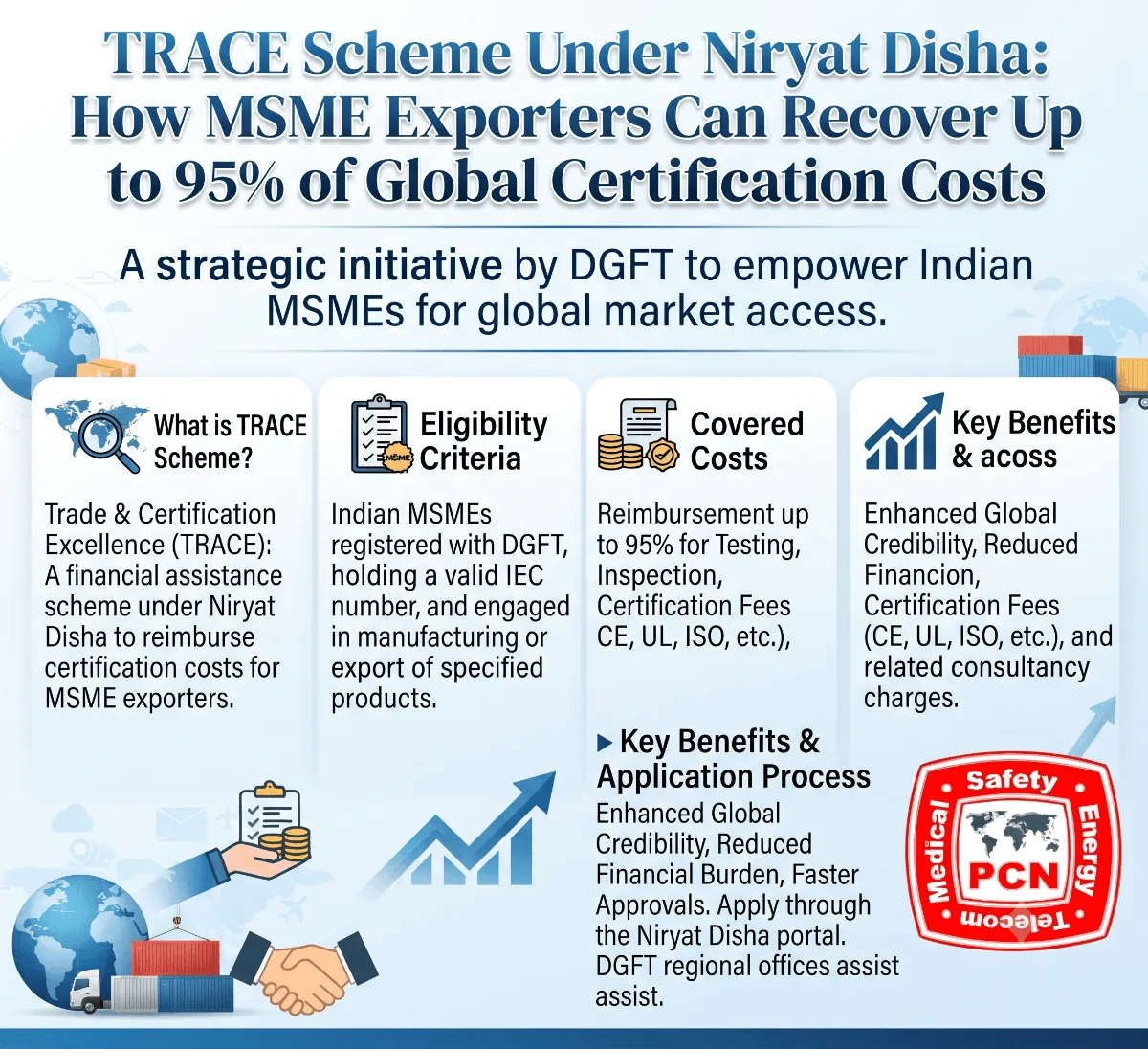

TRACE Scheme Under Niryat Disha: How MSME Exporters Can Recover Up to 95% of Global Certification Costs
Ask any small Indian exporter what slows down a new overseas order and the answer is rarely price. It is paperwork of a very expensive kind: an EU buyer wants a CE technical file, a US distributor wants FCC and UL, a Saudi importer needs a SABER certificate of conformity, and a retail chain in the UK insists on a BRCGS audit. Each of these can cost lakhs of rupees before a single carton is shipped, and for a micro or small enterprise that cost alone can kill the deal.
TRACE — Trade Regulations, Accreditation & Compliance Enablement — is designed to remove exactly that barrier. Notified by DGFT under the Export Promotion Mission’s Niryat Disha pillar, and significantly enhanced in July 2026, it now refunds up to 95% of eligible testing, inspection and certification costs for MSME exporters. Below, PCN India Global breaks down how the scheme works, what it covers and how to sequence your certifications so the reimbursement is not lost on a technicality.
TRACE at a Glance
| Item | Position (as of October 2026) |
|---|---|
| Parent scheme | Export Promotion Mission (EPM) – Niryat Disha; EPM outlay Rs 25,060 crore, FY 2025-26 to FY 2030-31 |
| Launched by | DGFT Trade Notice No. 26/2025-26 dated 20 February 2026 (pilot basis) |
| Major amendment | DGFT Trade Notice No. 09/2026-27 dated 1 July 2026 |
| Who can claim | MSMEs with Udyam registration and an active IEC; merchant exporters only for Annexure-VII tariff lines |
| Reimbursement | Up to 95% (micro & small) / up to 80% (medium) of cost net of taxes, or notified ceiling, whichever is lower |
| Annual cap | Rs 50 lakh per IEC per financial year (higher amounts case-by-case by the Sub-Committee) |
| Eligible list | 462 testing, inspection and certification entries (Annexure-I), reviewed periodically |
| Payment | 50% after certification (RC-1) + 50% after linked exports are shown (RC-2) |
| Portal | DGFT Trade Connect ePlatform (trade.gov.in) |
Niryat Disha: The Ecosystem Arm of the Export Promotion Mission
The Export Promotion Mission brings India’s export incentives under one roof with two sub-schemes. Niryat Protsahan handles financial enablers such as interest subvention, collateral support and export factoring. Niryat Disha handles the non-financial ecosystem — quality, logistics, warehousing and trade intelligence. When the Ministry of Commerce and Industry rolled out seven more EPM interventions on 20 February 2026, four of them came under Niryat Disha:
- TRACE — Trade Regulations, Accreditation & Compliance Enablement: support for testing, certification and conformity assessment.
- FLOW — Facilitating Logistics, Overseas Warehousing & Fulfilment.
- LIFT — Logistics Interventions for Freight & Transport.
- INSIGHT — Integrated Support for Trade Intelligence & Facilitation.
What Changed in July 2026 (Trade Notice 09/2026-27)
The February launch offered 60% to 75% reimbursement with a Rs 25 lakh cap. The 1 July 2026 amendment made the scheme far more attractive and also tied it more closely to actual exports:
- Higher rates by enterprise size — up to 95% for micro and small enterprises, up to 80% for medium enterprises (previously a uniform 60%/75%).
- Double the cap — Rs 50 lakh per IEC per financial year, up from Rs 25 lakh, with case-by-case consideration above that.
- One list instead of two — the Positive List and Priority Positive List were replaced by a single 462-entry list of eligible testing, inspections and certifications.
- Two-instalment payment — 50% on certification, the remaining 50% only after exports linked to that certification are completed and realised.
- Two reimbursement claims — RC-1 after certification and RC-2 after exports, each with its own document set.
Costs You Can Claim
- Product testing — against destination standards such as EN, IEC, UL, ASTM or JIS.
- Inspection — pre-shipment, third-party and factory or facility inspections.
- Certification and licensing — product certificates, market-specific licences and certification prerequisites.
- Audits — quality, food-safety, social and sustainability audits, including buyer-mandated voluntary certifications.
- Traceability systems — where needed to prove origin or chain of custody.
- Recurring compliance — ongoing quality certifications and specific health or safety certificates.
Two limits apply to every claim: the expense must have been incurred on or after 20 February 2026, and taxes, duties and cess are excluded from the reimbursable amount.
Certifications on the 462-Entry Eligible List
The Annexure-I list is broad. Examples that matter most to PCN India Global’s exporter clients include:
- Europe & UK: CE marking (electronics, machinery, toys, PPE, medical devices), RoHS, REACH, UKCA.
- USA & Canada: FCC, UL, US FDA, CPSC-related compliance.
- Middle East: SASO / SABER (Saudi Arabia), ECAS and EQM (UAE).
- Asia-Pacific: KC (Korea), PSE and JIS (Japan), CCC (China), RCM (Australia/NZ), Enterprise Singapore.
- Management systems: ISO 9001, ISO 14001, ISO 22000.
- Food, agri and sustainability: HACCP, FSSC 22000, BRCGS, SQF, IFS, GLOBALG.A.P., MSC, ASC, BAP, SMETA, Fairtrade, Rainforest Alliance.
Because the list is reviewed periodically and entries are tied to specific products and countries, always match your exact certification, scope and destination against the current Annexure-I before booking the lab.
Eligibility Checklist
- Valid Udyam Registration (micro, small or medium).
- Active IEC, not on DGFT’s Denied Entity List.
- Engaged in an international value chain; merchant exporters only for Annexure-VII tariff lines.
- No pending investigation, prosecution, debarment or outstanding dues under foreign-trade, customs, excise, FEMA or COFEPOSA laws.
- No other Central, State or third-party assistance claimed for the same expense.
- Not a deemed export or SEZ supply.
- MSMEs that outgrow MSME status remain eligible for three years after re-classification.
How to Claim TRACE: Step-by-Step
- Shortlist the certification. Confirm it appears on Annexure-I for your product and target country.
- Get a quotation. Obtain the lab or certification-body quote with taxes shown separately; this is the basis of your intended amount.
- File the Intent-to-Claim (IC) on Trade Connect. Enter the sector, certification, certifying agency, purpose, export country and intended amount — before the certificate or test report is issued.
- Complete testing and certification. Routing reports through Quality Setu / Bharat Aayat Niryat Lab may get faster processing.
- File RC-1. Upload the certificate or test report, invoice, proof of payment, evidence of the mandatory or buyer-driven requirement and the no-double-benefit declaration.
- Receive the first 50%. Paid to the bank account linked to your IEC after DGFT approval; claims are consolidated quarterly.
- Export and file RC-2. Within two years of the first instalment, submit shipping bills and realisation proof linked to the certified product to release the remaining 50%.
Documents Required
- Udyam certificate and IEC details.
- Lab / certification-body quotation (for the Intent-to-Claim).
- Certificate, test report or inspection report with issue dates.
- Tax invoice and bank proof of payment.
- Evidence that the requirement is mandatory in the destination market or demanded by the buyer (regulation reference, PO or buyer specification).
- Self-declarations on no double benefit and compliance status.
- For RC-2: shipping bills, export invoices and e-BRC / realisation proof.
Worked Example
A small-enterprise manufacturer of Bluetooth speakers plans to enter the US and Saudi markets. It budgets Rs 4,20,000 (ex-GST) for FCC testing and certification and Rs 3,10,000 for SASO / SABER conformity. Total eligible cost: Rs 7,30,000. At 95%, the potential reimbursement is up to Rs 6,93,500, subject to any notified ceiling for each entry — about Rs 3,46,750 after certification and the balance once the first US and Saudi shipments are realised. The only extra work is filing the Intent-to-Claim before the tests begin and keeping exports mapped to each certificate.
Mistakes That Cost Exporters Their Reimbursement
- Certifying before filing the IC — the most common and most expensive error.
- Including GST in the claim — taxes are not reimbursable.
- Choosing a certification not on Annexure-I — or one listed only for a different country or product scope.
- Letting an IC lapse — if no claim follows within two years, you lose eligibility for the next financial year.
- Exports not linked to the certificate — blocks the second instalment and can trigger recovery of the first.
- Claiming the same cost twice — for example under a State export scheme or an EPC grant.
TRACE Within the Wider Compliance Picture
TRACE funds certification; it does not do the certification for you, and it does not change the destination country’s rules. You still need the right standard, an accepted lab and a complete technical file for each market. On the Indian side, an active IEC and Udyam registration are the entry tickets. Exporters who also sell domestically should remember that Indian approvals — BIS, WPC/ETA, BEE, EPR — run on separate tracks, though some Indian certifications do appear in the Annexure-I list and are worth checking.
This guide reflects DGFT Trade Notice No. 26/2025-26 (20 February 2026) and Trade Notice No. 09/2026-27 (1 July 2026). TRACE runs as a pilot and its list, ceilings and procedure are reviewed periodically, so confirm the latest notice and Annexure-I entry on dgft.gov.in / trade.gov.in before committing to testing spend.
Frequently Asked Questions
Is TRACE a loan or a grant?
Neither — it is a reimbursement. The MSME pays for the testing and certification first, then DGFT reimburses up to 95% (micro and small) or 80% (medium) of the eligible cost, net of taxes, in two instalments.
Can a merchant exporter claim under TRACE?
Only for the six-digit tariff lines notified in Annexure-VII of the TRACE guidelines, where exports mainly move through aggregator models. Manufacturer-exporters with Udyam registration are the core beneficiaries.
Is GST on the testing invoice reimbursed?
No. The eligible amount is the actual cost net of taxes, duties and cess, or the notified ceiling for that certification, whichever is lower.
Can SEZ units or deemed exporters use TRACE?
No. Deemed exports under FTP Chapter 7 and supplies to SEZs are excluded from TRACE support.
What happens if I do not export after getting the certificate?
Under Trade Notice 09/2026-27, the second 50% instalment is released only on proof of exports linked to the certification. If those exports are not shown within two years of the first instalment, the second instalment lapses and the first may be recovered.
Can I claim TRACE for a certificate I already obtained?
Generally not. The Intent-to-Claim has to be filed on the Trade Connect platform before the certificate or test report is obtained, and only expenditure on or after 20 February 2026 qualifies. Plan the IC first, then book the testing.
Why Choose PCN India Global
- Global certification desk — CE, FCC, UL/ETL, KC, PSE, SASO/SABER, UKCA, CCC, RCM, ECAS and more handled under one roof.
- TRACE-first sequencing — we file your Intent-to-Claim before testing so the reimbursement is protected.
- Annexure-I mapping — we check your certification, scope and country against the 462-entry list before you spend.
- Claim-ready documentation — RC-1 and RC-2 files prepared, with export-linkage tracking.
- DGFT and MSME support — IEC, Udyam and DGFT licensing handled alongside.
- ISO system certifications — ISO 9001, 14001, 45001 and 13485 support for buyer-mandated system audits.
Planning to certify products for the EU, USA, Gulf or Asia-Pacific? PCN India Global will map your target markets to the TRACE eligible list, file your Intent-to-Claim, manage the certifications and prepare both reimbursement claims. WhatsApp or call +91 80109 05029, or email bdm@pcnindiaglobal.com, to get started.
Related Compliance Guides
- Global Certification Hub
- CE Marking for the EU
- FCC Certification for the USA
- UL / ETL Certification
- Saudi SASO / SABER Certification
- Korea KC Certification
- DGFT License Services
- ISO 9001 Certification