

BEE Star Rating & Registration for Refrigerators in India: Frost-Free vs Direct Cool, CEC and the Complete Star Label Process

The refrigerator is the one appliance in an Indian home that never switches off. It runs twenty-four hours a day, every day of the year, which makes even a small difference in efficiency compound into a meaningful difference in the annual electricity bill. That relentless duty cycle is why the Bureau of Energy Efficiency (BEE) made refrigerators one of the earliest and most tightly regulated categories in its Standards & Labelling programme. Any brand that manufactures, assembles, or imports refrigerators for sale in India must hold a valid BEE Star Label and registration before the product can lawfully reach the market. Refrigerators sit firmly in BEE’s mandatory scheme. Both of the two dominant technologies — frost-free refrigerators and direct cool refrigerators — are covered, and each is governed by its own testing standard and its own schedule on the BEE portal. The star on the label is calculated from a metric called Comparative Energy Consumption (CEC), and, exactly as with air conditioners, BEE periodically revises the rating tables so that the star continues to mean something as the market gets more efficient. This guide walks manufacturers and importers through the whole picture: why refrigerator certification is mandatory, the difference between frost-free and direct cool from a compliance standpoint, how CEC and Annual Energy Consumption drive the star rating, the standards and testing involved, the step-by-step BEE registration process, the documents required, realistic timelines and costs, and the errors that most frequently cause delays or rejections. Why BEE Certification Is Mandatory for Refrigerators BEE Star Labelling runs under the Energy Conservation Act, 2001, administered by the Bureau of Energy Efficiency under the Ministry of Power. Refrigerators are in the mandatory labelling category, which means no covered model may be manufactured, imported, displayed, or sold in India without valid BEE registration and an affixed star label. The mandatory scope covers the mainstream household refrigeration products: Direct Cool Refrigerators (DCR) — the single-door format still widely sold across India, governed under IS 1476 (Part 1) and its dedicated schedule. Frost-Free Refrigerators (FFR) — the double-door and multi-door format, governed under the frost-free schedule and its performance standard. Because the category is mandatory, non-compliance carries real consequences: seizure of stock, penalties under the Energy Conservation Act, removal from retail shelves, and delisting from e-commerce platforms. Major online marketplaces now routinely require evidence of a live BEE registration before they will list a refrigerator, and institutional and government buyers frequently specify minimum star ratings in their tenders. For a refrigerator brand, the star label is simultaneously a legal permit to sell and a competitive lever at the point of sale. Frost-Free vs Direct Cool: Why the Distinction Matters for Compliance From a consumer’s perspective the difference between frost-free and direct cool is about convenience and price. From a compliance perspective the difference is more fundamental, because the two technologies are tested against different standards and different schedules. Direct cool refrigerators rely on natural convection to circulate cold air and typically require manual defrosting. Their energy performance is evaluated under IS 1476 (Part 1), and BEE registration for direct cool models falls under the corresponding direct cool schedule. Frost-free refrigerators use forced-air circulation and automatic defrosting. Their energy testing follows the frost-free performance standard (commonly referenced as IS 15883 for the frost-free performance and testing methodology), under the separate frost-free schedule. The practical implication is that a brand selling both formats is managing two parallel compliance tracks, each with its own test protocol, its own schedule, and its own star table. Treating them as interchangeable is a common and costly mistake — a frost-free test report cannot be used to register a direct cool model, and vice versa. Understanding CEC and Annual Energy Consumption The refrigerator star rating is built on two closely linked measurements: Annual Energy Consumption (AEC) and Comparative Energy Consumption (CEC). AEC is the total energy, in kilowatt-hours per year, that the model consumes under the standardised test conditions of its applicable standard. Because refrigerators of different internal volumes cannot fairly be compared on raw AEC alone — a large family fridge will always consume more than a small bar fridge — BEE uses CEC, which normalises consumption against the refrigerator’s storage volume to produce a comparable figure. The star assignment then works on a banding principle. BEE defines star rating bands, and the model is awarded the star rating corresponding to the band whose lower limit is less than the model’s CEC and whose upper limit is greater than or equal to it. In plain terms: the lower the normalised energy consumption, the higher the star rating. The energy label itself displays the CEC value alongside the star count — from a minimum of one star to a maximum of five — so that buyers can compare models directly. This volume-normalised approach is what allows a genuinely efficient large refrigerator to earn a high star rating even though its absolute annual consumption is higher than a small, inefficient unit. It also means that accurate volume declaration and accurate test data are both essential; an error in either distorts the CEC and therefore the star result. The Revised Star Tables — Effective January 2026 As with every mature BEE category, the refrigerator star tables are not permanent. BEE tightens them as the market improves so that the star continues to distinguish superior products. The Bureau has revised the star rating tables for both Frost-Free Refrigerators and Direct Cool Refrigerators with effect from 1 January 2026, and the revised tables run through to 31 December 2028. The consequence is the same pattern that catches AC manufacturers: a refrigerator that qualified for a given star rating under the outgoing table may map to a lower star under the new one, even though nothing about the physical product has changed. A model comfortably rated at a certain star level in 2025 can slip a star in 2026 purely because the band boundaries moved. For brands, this makes the revision calendar a planning input, not an
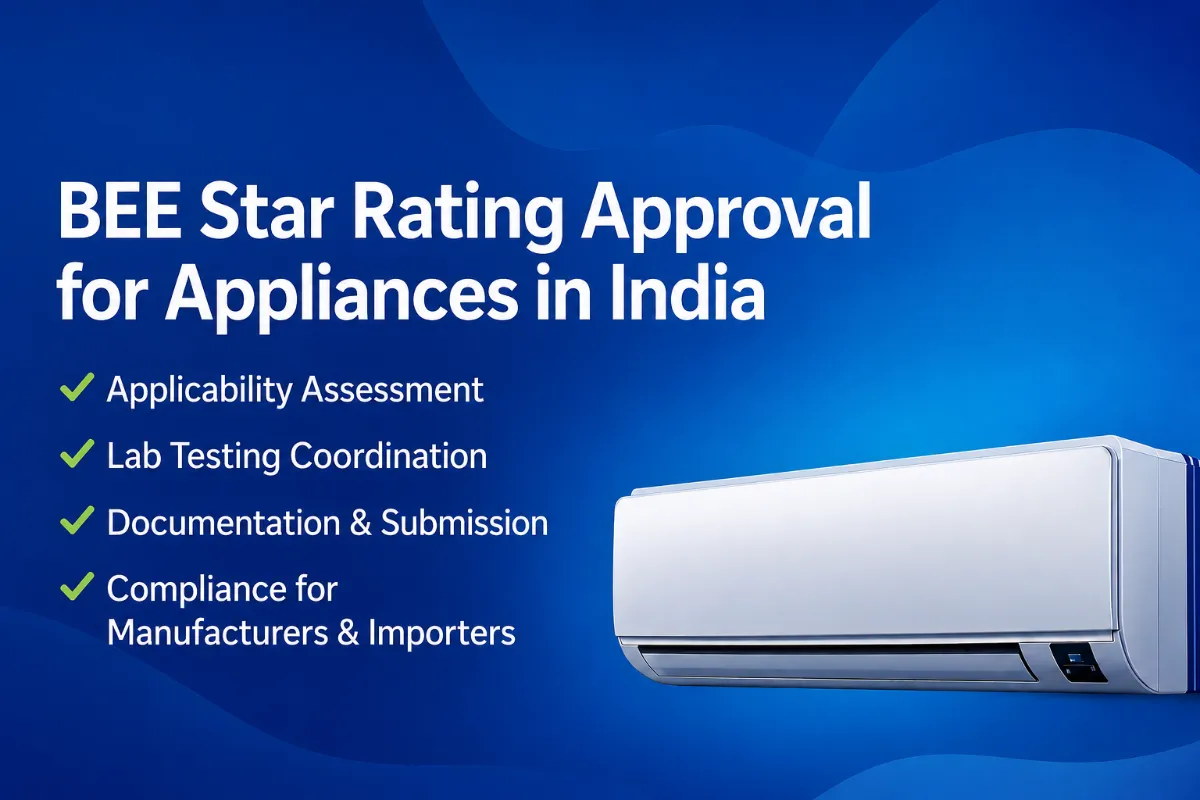
BEE Star Rating & Registration for Room Air Conditioners in India: ISEER, IS 1391 and the Complete Star Label Process

Air conditioners are the single most electricity-hungry appliance in the average Indian home, and they are also one of the fastest-growing consumer categories in the country. That combination is exactly why the Bureau of Energy Efficiency (BEE) placed room air conditioners at the very centre of its mandatory Standards & Labelling programme. If you manufacture, assemble, brand, or import air conditioners for the Indian market, a valid BEE Star Label and registration is not optional — it is a legal precondition for selling your product. The BEE star on the front of every air conditioner is more than a marketing badge. It encodes a laboratory-verified measure of how efficiently the unit converts electricity into cooling, expressed through a metric called ISEER (Indian Seasonal Energy Efficiency Ratio). A higher star rating tells the buyer that the machine will cool the same room while drawing less power from the grid, and it tells regulators that the model meets or exceeds the Minimum Energy Performance Standards set for its category. For brands, the star rating has become a primary purchase driver — Indian consumers now routinely compare 3-star and 5-star models on running cost before they compare price. This guide explains everything a manufacturer or importer needs to understand about BEE certification for room air conditioners: the legal basis, the ISEER metric and how the star bands work, the recent tightening of the rating tables, the standards and testing involved, the step-by-step registration process on the BEE portal, the documentation required, realistic timelines and costs, and the mistakes that most often delay approval or trigger enforcement. Why BEE Certification Is Mandatory for Air Conditioners BEE Star Labelling operates under the Energy Conservation Act, 2001, administered by the Bureau of Energy Efficiency under the Ministry of Power. Product categories enter the programme in one of two ways — voluntary or mandatory. Room air conditioners have been in the mandatory category for years, which means that no covered air conditioner may legally be manufactured, imported, displayed, or sold in India without a valid BEE registration and an affixed star label. The mandatory status covers the mainstream residential and light-commercial cooling products that most brands sell: Split air conditioners (the dominant format in the Indian market) Window air conditioners Inverter (variable-speed) air conditioners, which are tested under a dedicated part of the standard Cassette, tower and certain light-commercial units, depending on capacity and configuration under the applicable schedule Because the category is mandatory, enforcement is real. Products found on sale without a valid star label are liable to seizure, penalties under the Energy Conservation Act, removal from retail shelves, and delisting by major e-commerce platforms. Increasingly, marketplaces such as Amazon and Flipkart demand proof of a live BEE label before they will even list an air-conditioner SKU, and government procurement and large institutional tenders frequently specify minimum star ratings. In practice, then, BEE certification is both a legal gate and a commercial gate. Understanding ISEER: The Metric Behind the Stars The star rating for an air conditioner is derived from its ISEER — Indian Seasonal Energy Efficiency Ratio. ISEER measures the total annual cooling output of the unit divided by the total annual energy it consumes, calculated over a defined Indian usage profile rather than a single laboratory test point. This “seasonal” approach matters because a real air conditioner spends most of its life running at part load, not at maximum output. ISEER is calculated using an India-specific model of how air conditioners are actually used here. The evaluation is based on a temperature bin range spanning roughly 24°C to 43°C and an assumption of about 1,600 hours of cooling operation per year, which reflects Indian climate and usage far better than the parameters baked into US or European efficiency metrics. This is precisely why a machine optimised only for FCC- or CE-style test conditions can post a disappointing ISEER when it is properly tested against the Indian profile. The relationship is simple to state: the higher the ISEER value, the higher the star rating, and the lower the running cost for the end user. BEE publishes ISEER bands for each star level, and a model is awarded the star rating corresponding to the band its measured ISEER falls into. Inverter and fixed-speed units are handled through the appropriate parts of the testing standard because their part-load behaviour differs fundamentally. The Revised Star Rating Tables — Why “the Same AC” Can Drop a Star One of the most important things for any brand to understand is that BEE periodically tightens the ISEER bands. As the overall efficiency of the market improves, BEE raises the bar so that the star label continues to distinguish genuinely superior products. The star rating tables for room air conditioners have been revised again with effect from January 2026. The practical consequence catches many manufacturers by surprise: under the revised norms, a large number of models that qualified as 4-star in 2025 are reclassified as 3-star in 2026 — even though the physical machine, its power draw, and its cooling capacity have not changed at all. Nothing about the hardware is different; the goalposts have moved. A brand that printed cartons, catalogues, and e-commerce listings claiming “4 Star” can suddenly find those claims non-compliant the moment the revised table takes effect. This has direct planning implications. Any manufacturer registering a model near a band boundary should design and test against the upcoming table, not the one expiring, and should synchronise packaging, marketing collateral, and label artwork to the revision date. At PCN India Global we treat the revision calendar as a core part of every AC registration plan, precisely so that clients are not left holding non-compliant inventory when the tables change. The Standard: IS 1391 (Part 1 and Part 2) Testing for BEE certification of room air conditioners is anchored to IS 1391, the Indian Standard developed by the Bureau of Indian Standards that defines the performance, testing methods, and safety requirements for room air conditioners. IS 1391 (Part 1)