
BEE Star Rating & Registration for Refrigerators in India: Frost-Free vs Direct Cool, CEC and the Complete Star Label Process
The refrigerator is the one appliance in an Indian home that never switches off. It runs twenty-four hours a day, every day of the year, which makes even a small difference in efficiency compound into a meaningful difference in the annual electricity bill. That relentless duty cycle is why the Bureau of Energy Efficiency (BEE) made refrigerators one of the earliest and most tightly regulated categories in its Standards & Labelling programme. Any brand that manufactures, assembles, or imports refrigerators for sale in India must hold a valid BEE Star Label and registration before the product can lawfully reach the market.
Refrigerators sit firmly in BEE’s mandatory scheme. Both of the two dominant technologies — frost-free refrigerators and direct cool refrigerators — are covered, and each is governed by its own testing standard and its own schedule on the BEE portal. The star on the label is calculated from a metric called Comparative Energy Consumption (CEC), and, exactly as with air conditioners, BEE periodically revises the rating tables so that the star continues to mean something as the market gets more efficient.
This guide walks manufacturers and importers through the whole picture: why refrigerator certification is mandatory, the difference between frost-free and direct cool from a compliance standpoint, how CEC and Annual Energy Consumption drive the star rating, the standards and testing involved, the step-by-step BEE registration process, the documents required, realistic timelines and costs, and the errors that most frequently cause delays or rejections.
Why BEE Certification Is Mandatory for Refrigerators
BEE Star Labelling runs under the Energy Conservation Act, 2001, administered by the Bureau of Energy Efficiency under the Ministry of Power. Refrigerators are in the mandatory labelling category, which means no covered model may be manufactured, imported, displayed, or sold in India without valid BEE registration and an affixed star label.
The mandatory scope covers the mainstream household refrigeration products:
- Direct Cool Refrigerators (DCR) — the single-door format still widely sold across India, governed under IS 1476 (Part 1) and its dedicated schedule.
- Frost-Free Refrigerators (FFR) — the double-door and multi-door format, governed under the frost-free schedule and its performance standard.
Because the category is mandatory, non-compliance carries real consequences: seizure of stock, penalties under the Energy Conservation Act, removal from retail shelves, and delisting from e-commerce platforms. Major online marketplaces now routinely require evidence of a live BEE registration before they will list a refrigerator, and institutional and government buyers frequently specify minimum star ratings in their tenders. For a refrigerator brand, the star label is simultaneously a legal permit to sell and a competitive lever at the point of sale.
Frost-Free vs Direct Cool: Why the Distinction Matters for Compliance
From a consumer’s perspective the difference between frost-free and direct cool is about convenience and price. From a compliance perspective the difference is more fundamental, because the two technologies are tested against different standards and different schedules.
Direct cool refrigerators rely on natural convection to circulate cold air and typically require manual defrosting. Their energy performance is evaluated under IS 1476 (Part 1), and BEE registration for direct cool models falls under the corresponding direct cool schedule.
Frost-free refrigerators use forced-air circulation and automatic defrosting. Their energy testing follows the frost-free performance standard (commonly referenced as IS 15883 for the frost-free performance and testing methodology), under the separate frost-free schedule.
The practical implication is that a brand selling both formats is managing two parallel compliance tracks, each with its own test protocol, its own schedule, and its own star table. Treating them as interchangeable is a common and costly mistake — a frost-free test report cannot be used to register a direct cool model, and vice versa.
Understanding CEC and Annual Energy Consumption
The refrigerator star rating is built on two closely linked measurements: Annual Energy Consumption (AEC) and Comparative Energy Consumption (CEC). AEC is the total energy, in kilowatt-hours per year, that the model consumes under the standardised test conditions of its applicable standard. Because refrigerators of different internal volumes cannot fairly be compared on raw AEC alone — a large family fridge will always consume more than a small bar fridge — BEE uses CEC, which normalises consumption against the refrigerator’s storage volume to produce a comparable figure.
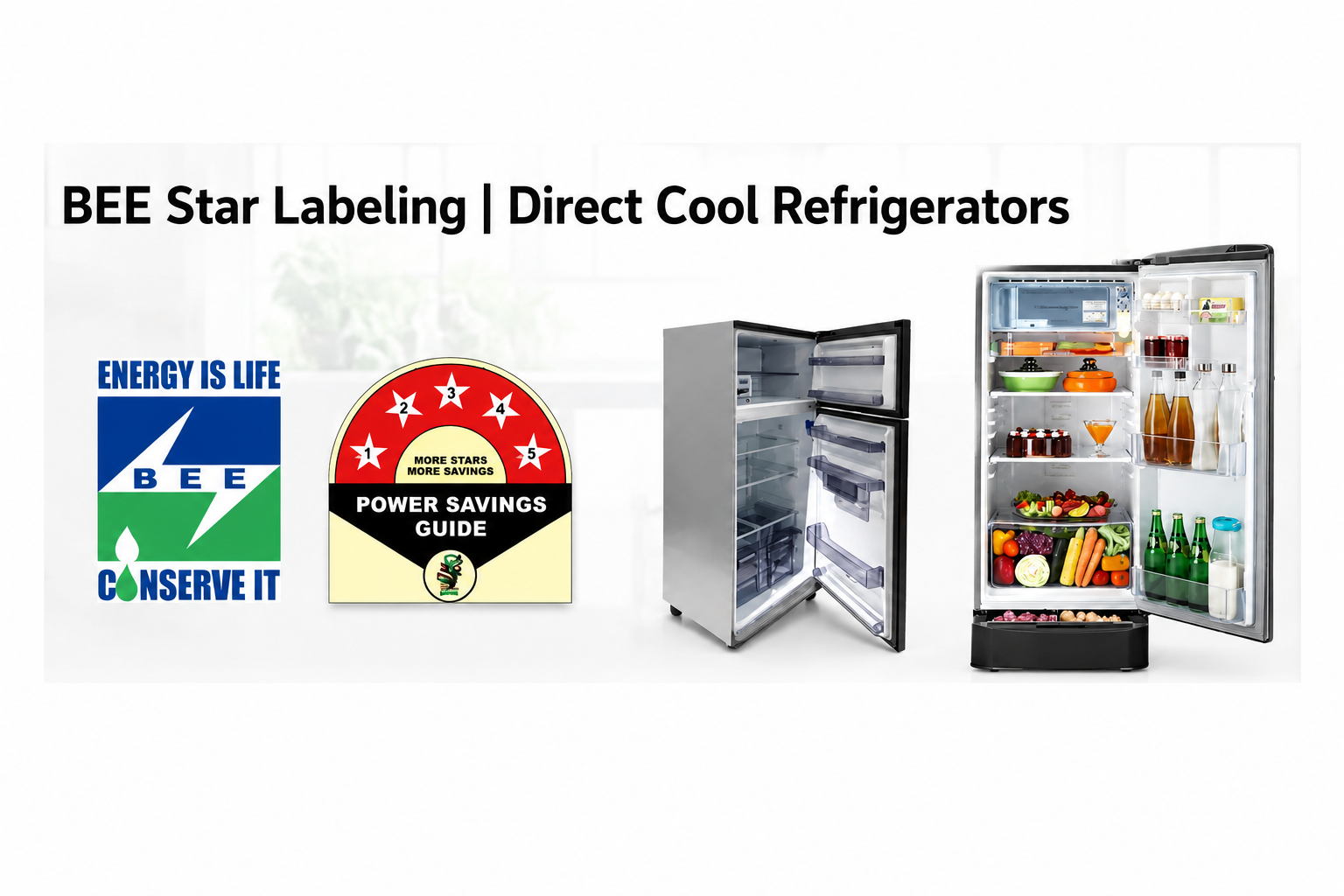
The star assignment then works on a banding principle. BEE defines star rating bands, and the model is awarded the star rating corresponding to the band whose lower limit is less than the model’s CEC and whose upper limit is greater than or equal to it. In plain terms: the lower the normalised energy consumption, the higher the star rating. The energy label itself displays the CEC value alongside the star count — from a minimum of one star to a maximum of five — so that buyers can compare models directly.
This volume-normalised approach is what allows a genuinely efficient large refrigerator to earn a high star rating even though its absolute annual consumption is higher than a small, inefficient unit. It also means that accurate volume declaration and accurate test data are both essential; an error in either distorts the CEC and therefore the star result.
The Revised Star Tables — Effective January 2026
As with every mature BEE category, the refrigerator star tables are not permanent. BEE tightens them as the market improves so that the star continues to distinguish superior products. The Bureau has revised the star rating tables for both Frost-Free Refrigerators and Direct Cool Refrigerators with effect from 1 January 2026, and the revised tables run through to 31 December 2028.
The consequence is the same pattern that catches AC manufacturers: a refrigerator that qualified for a given star rating under the outgoing table may map to a lower star under the new one, even though nothing about the physical product has changed. A model comfortably rated at a certain star level in 2025 can slip a star in 2026 purely because the band boundaries moved.
For brands, this makes the revision calendar a planning input, not an afterthought. Any model registered near a band boundary should be designed and tested against the incoming table, and packaging, catalogues, and online listings must be synchronised to the revision date so that no non-compliant star claim reaches the market. At PCN India Global we build the table-revision timeline into every refrigerator registration plan so clients are never left with stock that has quietly become non-compliant.
Step-by-Step: How to Get a BEE Star Label for a Refrigerator
Our team manages each stage end to end, but every applicant should understand the sequence.
- Confirm the technology and applicable schedule. Determine whether the model is direct cool (IS 1476 Part 1) or frost-free (frost-free schedule / IS 15883) and identify the correct BEE schedule and star table.
- Test at a BEE-recognised / NABL-accredited laboratory. Submit sample units for energy performance testing against the applicable standard to establish AEC and the data needed to compute CEC. The test report underpins the entire application.
- Register the company and brand on the BEE portal. Create the manufacturer / importer account on the official BEE (beestarlabel) portal and obtain your company and brand identifiers. This is done once and reused across all models.
- Register each individual model. File the model-level application with the technical specification sheet, the test report, the CEC / AEC data, storage volume, and the required declarations. Every model needs its own registration and its own test evidence.
- Star assignment and label generation. BEE maps the model’s CEC to the current star band and generates the official label showing the star rating, CEC, and validity period.
- Affix the label and begin sales. Print and affix the approved BEE label, in the prescribed format, on every unit before display or sale.
- Renew periodically. Labels are valid for a limited period. Renewal — with updated test data where the tables have changed — is mandatory to keep the model saleable.
Documents Required for BEE Certification of Refrigerators
A complete file at the outset is the biggest single lever on approval speed. For refrigerators you will typically need:
For testing and the model application
- Product technical specification sheet (gross and storage volume, refrigerant, compressor, defrost type)
- Model name and full product description exactly as it will appear on the carton
- Physical product samples for the laboratory
- Valid test report from a NABL-accredited / BEE-recognised laboratory against IS 1476 (direct cool) or the frost-free standard
- CEC / AEC data and storage volume derived from the test report
- Label draft / artwork in the prescribed BEE format
- Signed model declaration / declaration of conformity
For company and brand registration
- Certificate of Incorporation (MCA/ROC)
- GST registration certificate
- PAN card of the company
- Trademark / brand authorisation documents
- Address proof of the company and manufacturing facility details
- Authorised signatory details, and Board Resolution / Power of Attorney
- Import Export Code (IEC) — for importers
- Brand authorisation letter — where an importer represents an overseas brand
Foreign manufacturers cannot register directly on the BEE portal unless they have an Indian-registered entity; overseas brands must appoint an authorised Indian representative or work through their Indian importer to hold and manage the registration.
Timeline and Cost Planning
A realistic first-model schedule runs roughly five to ten weeks end to end. Energy performance testing is usually the longest single element, commonly two to four weeks depending on laboratory queue and the number of models. Document preparation and company/brand registration can proceed in parallel and typically add one to two weeks, and portal processing of a complete model application generally takes a further two to four weeks. Where a brand launches a range built on shared platforms, test evidence and documentation can be leveraged across models, so the per-model effort drops after the first few registrations.
The expensive path is always the avoidable one: discovering after a production run that a model was tested to the wrong standard for its technology, or registered against an expiring table, and then having to re-test, re-label, and delist during a peak selling window. That cost dwarfs the entire compliance budget.
Common Mistakes That Delay Refrigerator Registration
- Mixing up the standards. Testing a frost-free unit to the direct cool protocol (or vice versa) invalidates the report. Confirm technology and standard before testing.
- Volume declaration errors. Because CEC is volume-normalised, an inaccurate storage-volume figure produces the wrong star result.
- Ignoring the revised tables. Registering or marketing to an expiring band leaves inventory non-compliant when the 2026 table takes effect. File against the incoming table.
- Model-name drift. The model designation on the report, the portal, the label, and the carton must match exactly — a single suffix mismatch triggers verification failures.
- Importer/entity mismatch. For imports, the BEE registration holder, the IEC holder, and the importer of record should be aligned.
- Skipping renewal. A lapsed label makes every unit on the shelf a non-compliant product.
Refrigerators Often Need These Approvals Too
BEE labelling is rarely the only requirement. Depending on the product and how it is sold, a refrigerator brand entering India may also need:
- BIS certification — safety compliance under the applicable Indian Standard, managed alongside the BEE energy label. See our BIS ISI certification service.
- EPR registration for e-waste — producers and importers of electrical and electronic equipment must hold EPR registration for e-waste with CPCB.
- Legal Metrology (LMPC) — imported pre-packaged products require LMPC registration and correct package declarations.
- WPC ETA — smart / connected refrigerators with Wi-Fi or Bluetooth need WPC ETA approval for their radios.
A coordinated compliance plan overlaps these lead times so that no single missing certificate delays the launch.
Pre-Launch Compliance Checklist for Refrigerators
Before committing to a production run or booking an import consignment, run this verification sequence. First, confirm the exact model designation that will appear on the carton, the test report, the BEE label, and (for imports) the bill of entry is identical down to every suffix. Second, verify that the unit was tested against the correct standard for its technology — IS 1476 for direct cool, the frost-free standard for frost-free — and that the declared storage volume matches the test report, because CEC depends on it. Third, confirm the model’s CEC maps to your intended star rating under the currently effective (2026–2028) table, not an expiring one. Fourth, check that the label artwork uses the prescribed BEE format and shows the correct star count and CEC. Fifth, ensure the company/brand registration is live and, for imports, that the registration holder and importer of record are aligned, and that parallel approvals — BIS, EPR, LMPC, WPC where applicable — are progressing together.
For ongoing operations, maintain a compliance register per model: BEE registration number and validity date, CEC and star band, test report reference, storage volume, and the star table edition it was certified against. When BEE announces the next revision, that register immediately flags which SKUs are at risk of dropping a star, so you can re-test and re-label ahead of time.
Frequently Asked Questions
Is BEE certification mandatory for all refrigerators in India?
Yes. Both direct cool and frost-free refrigerators fall under the mandatory BEE Standards & Labelling scheme. No covered model may be manufactured, imported, or sold without a valid registration and an affixed star label.
What is the difference between direct cool and frost-free for BEE purposes?
They are tested under different standards and registered under different schedules. Direct cool follows IS 1476 (Part 1); frost-free follows the frost-free performance standard (commonly IS 15883). A report for one technology cannot be used to register the other.
What is CEC and how does it set my star rating?
Comparative Energy Consumption normalises a model’s annual energy consumption against its storage volume so that fridges of different sizes can be compared fairly. BEE assigns the star corresponding to the band your CEC falls into — lower CEC means more stars.
Why might my refrigerator lose a star in 2026?
BEE revised the star tables for both frost-free and direct cool refrigerators effective 1 January 2026 (running to 31 December 2028). A model can map to a lower star under the tighter bands even though the hardware is unchanged. Plan against the new table.
Do I need separate registrations for each model?
Yes. Every model requires its own test report and registration, though the company and brand registration is completed once and covers all models under that brand.
Can a foreign manufacturer register directly?
No. Overseas brands need an Indian-registered entity or must appoint an authorised Indian representative / work through their Indian importer.
Does the BEE label need renewal?
Yes. Labels are valid for a limited period and must be renewed — with updated test data where the tables have changed — to remain compliant.
Why Choose PCN India Global
- Technology-correct testing — we confirm direct cool vs frost-free and route each model to the right standard and schedule before testing begins
- Revision-aware planning — we track the 2026–2028 table changes so your SKUs never drop a star unexpectedly
- Accurate CEC handling — we verify storage-volume declarations so your star result is right the first time
- End-to-end portal handling — company, brand, and model registration filed, tracked, and driven to label generation
- Foreign-brand representation — we act as your authorised Indian representative where you have no Indian entity
- One integrated timeline — BEE sequenced with BIS, EPR, LMPC, and WPC so your launch date holds
PCN India Global manages the complete BEE Star Label process for direct cool and frost-free refrigerators — from testing and CEC assessment to portal filing, label generation, and renewal. Contact us: WhatsApp +91 80109 05029, email bdm@pcnindiaglobal.com, or start your application today.