
CDSCO Licence for Cardiac Catheters in India: Class C Registration, ISO 10555 and Process
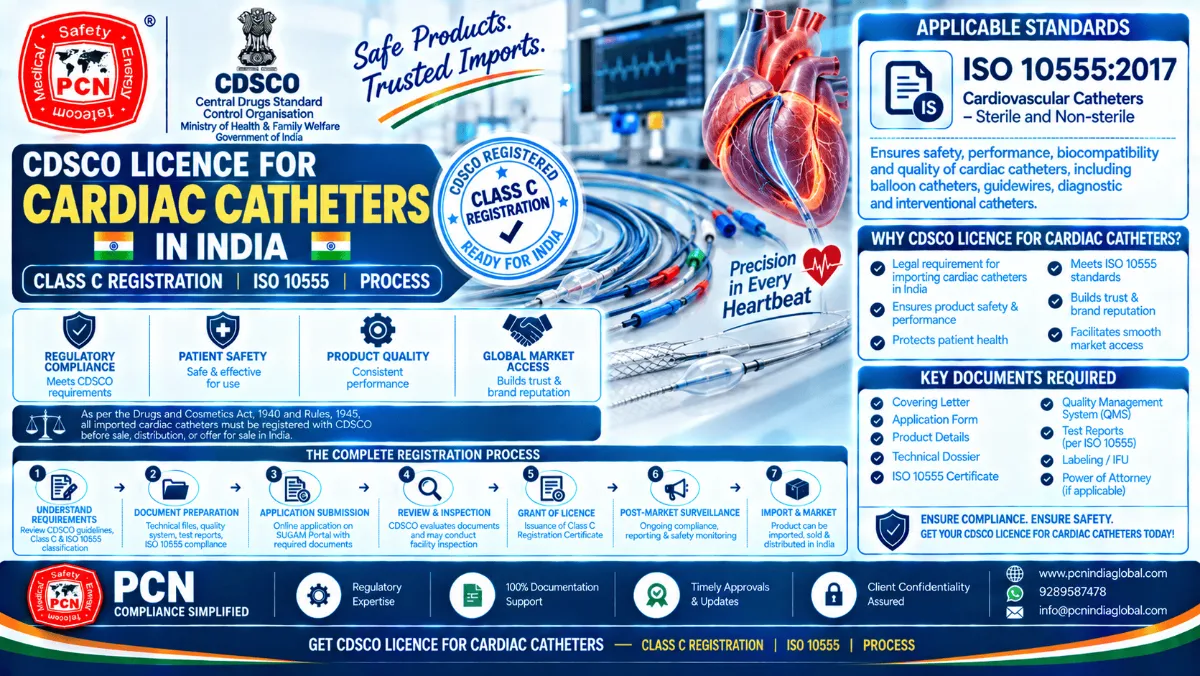
A cardiac catheter is threaded through the vascular system into the heart to diagnose or treat coronary and structural disease — angiography, angioplasty, electrophysiology and beyond. Because it enters the central circulatory system, CDSCO regulates the cardiac catheter as a Class C device (with specialised ablation and structural-heart catheters reaching the higher end). This guide sets out the full CDSCO registration pathway for cardiac catheters under the Medical Devices Rules, 2017 — classification, licence route, ISO 10555, the documents, the fees and the timeline.
Is a CDSCO Licence for Cardiac Catheters Mandatory in India?
Yes. A cardiac catheter is a notified Class C medical device and cannot be manufactured, imported or sold in India without a CDSCO licence. Because it is Class C, a domestic manufacturer applies to the Central Licensing Authority in Form MD-7 for a Form MD-9 licence; an importer applies in Form MD-14 for a Form MD-15 import licence. Diagnostic (angiographic), guiding and balloon catheters are covered, with each type and size declared.
Risk Classification of Cardiac Catheters
Every medical device in India is placed in one of four risk classes (A, B, C, D) under the First Schedule of the Medical Devices Rules, 2017. The class fixes the authority, the form, the fee, the audit route and the timeline.
Cardiac catheters are classified as Class C (moderate-to-high risk). A cardiac catheter is a surgically invasive device that connects to the central circulatory system, which places it in Class C (moderate-to-high risk) under the First Schedule — and electrophysiology/ablation and some structural-heart catheters sit at the upper bound. Where a device could fall in two classes the higher class applies, and an accessory is classified in its own right; always confirm against the current CDSCO classification list.
CDSCO Licence for Cardiac Catheters: Which Licence You Need
- To manufacture cardiac catheters in India (Class C) — apply in Form MD-7 to the Central Licensing Authority (CDSCO headquarters); the licence is granted in Form MD-9. A CDSCO joint audit team inspects the manufacturing site before the licence is granted — site inspection is mandatory for Class C and D.
- To import cardiac catheters (any class) — the overseas manufacturer appoints an Indian Authorised Agent who files Form MD-14 with the Central Licensing Authority; the import licence is granted in Form MD-15.
- Test licence — for a small quantity imported or made for testing, evaluation, demonstration or clinical investigation: Form MD-12 application, Form MD-13 licence.
- Loan licence — using another licensee’s approved premises: Form MD-4 (Class A/B) or Form MD-8 (Class C/D) for a licence in Form MD-6 or MD-10.
Applicable Standards for Cardiac Catheters
Cardiac catheters are evaluated against the intravascular-catheter standards plus sterility and biocompatibility:
- ISO 10555-1 — sterile, single-use intravascular catheters: general requirements.
- ISO 10555-4 — balloon dilatation catheters, where applicable.
- ISO 11070 — sterile single-use intravascular introducers, dilators and guidewires supplied with the catheter.
- ISO 594 / ISO 80369-7 — luer connectors to prevent misconnection.
- ISO 11135 / 11137 — sterilisation validation (EO or radiation).
- ISO 10993 series — biocompatibility of the catheter and coatings for blood-contacting use.
Documents Required for Cardiac Catheters CDSCO Licensing
Whether you file for a manufacturing or an import licence, CDSCO expects the same core technical dossier built around the device:
- Covering letter and application form — Form MD-3 / MD-7 (manufacture) or Form MD-14 (import) on the CDSCO Medical Device Online portal, stating every device, variant and site.
- Device Master File (DMF) — device description and intended use, materials, design and manufacturing information, ISO 14971 risk file, verification/validation data, sterilisation validation where applicable, shelf-life/stability data and the Essential Principles checklist.
- Plant Master File (PMF) — site layout, equipment, utilities/HVAC, organisation chart with competent technical staff and the QMS procedures governing production.
- ISO 13485 QMS certificate — current, with a scope covering the device.
- Essential Principles of Safety and Performance — a completed checklist mapping the device against each applicable principle with the standard/evidence relied on.
- Risk management file (ISO 14971) — hazards, risk controls and residual-risk justification.
- Test / performance reports — against the applicable BIS/IS or ISO/IEC standards from an accredited laboratory.
- Labels, IFU and packaging — meeting the labelling requirements of the Medical Devices Rules (manufacturer, licence number, sterile status, single-use symbols).
- Undertaking and declaration of conformity to the Essential Principles and applicable standards.
- Government fee receipt — paid online through the CDSCO portal.
Device-specific documents on top of the core set for cardiac catheters:
- ISO 10555 test reports — tensile/bond strength, kink resistance, flow/burst (for balloon catheters) and tip performance.
- Sterilisation validation with the sterility assurance level (SAL 10⁻⁶).
- Haemocompatibility and biocompatibility (ISO 10993) for blood-contacting components and any hydrophilic coating.
- Radiopacity and dimensional data for each French size and length.
- Shelf-life / stability data supporting the expiry.
- Country-of-origin approval and Free Sale Certificate for imports (US FDA / CE or equivalent).
For an import licence (Form MD-14) there are three further essentials:
- Free Sale Certificate (FSC) — from the National Regulatory Authority of the country of origin, legalised (apostille/embassy attestation).
- Country-of-origin regulatory approval — US FDA 510(k)/PMA, EU CE certificate or equivalent.
- Power of Attorney and Authorised Agent licence — notarised, legalised PoA to the Indian Authorised Agent, plus the agent’s valid wholesale/manufacturing licence.
QMS & Essential Principles — What CDSCO Checks
- Essential Principles of Safety and Performance (Fifth Schedule) — the device must be safe and perform as intended, with risks reduced as far as possible; shown through recognised standards and the risk-management file.
- Quality Management System (ISO 13485) — design controls, supplier control, process validation, traceability, complaint handling and CAPA, evidenced at audit.
- Risk management (ISO 14971) — a living file with residual risks justified and communicated in the IFU.
- Clinical evidence — proportionate to the class: clinical evaluation for lower-risk devices and clinical investigation data for many Class C/D and novel devices.
Label & IFU Requirements Specific to Cardiac Catheters
Cardiac-catheter labelling is checked for size, sterility and single-use messaging:
- French size, usable length and catheter type, with the exact reference number.
- Manufacturer name and address, and the CDSCO licence number.
- Batch/lot number, date of manufacture and use-by date.
- “STERILE” with the sterilisation-method symbol and a single-use symbol.
- Radiopaque-marker and, for balloon catheters, rated burst pressure and compliance information in the IFU.
Diagnostic, Guiding, Balloon or Ablation: Confirm the Catheter and Class
“Cardiac catheter” spans several devices that share ISO 10555 but differ in evidence and even class. A diagnostic angiographic catheter and a guiding catheter are Class C; a balloon dilatation catheter (ISO 10555-4) carries burst and compliance evidence; an electrophysiology or ablation catheter, and structural-heart delivery catheters, sit at the upper end with additional data. Fix exactly which catheter you are registering before drawing test reports, because the dossier depth and the class follow from it.
Step-by-Step: CDSCO Registration Process
- Confirm the classification. Fix the risk class against the CDSCO classification list and the First Schedule — Class C here — which decides the form, authority, fee and audit route.
- Choose the route. Manufacture (Form MD-7 → MD-9) or import (Form MD-14 → MD-15). Importers appoint an Indian Authorised Agent holding a valid manufacturing or wholesale licence.
- Build the Device Master File and Plant Master File. Assemble device description, materials, design and process data, the ISO 14971 risk file, sterilisation/stability data and the site file with the QMS.
- Complete the Essential Principles checklist. Map the device against each applicable essential principle and cite the BIS/IS or ISO/IEC standard or test report relied on.
- Draw the test and performance reports. Test to the applicable standards at an accredited laboratory; sterile and measuring devices carry additional validation.
- Register and file on the CDSCO Medical Device Online portal. Create the account, pay the government fee online and upload the full dossier under the correct form.
- Site audit / inspection. A CDSCO joint audit team inspects the manufacturing site before the licence is granted — site inspection is mandatory for Class C and D.
- Respond to queries and receive the licence. Answer the deficiency letter within the stipulated period; on approval the licence issues in Form MD-9 (manufacture) or MD-15 (import).
Government Fees and Timeline
Fees are set in the Second Schedule of the Medical Devices Rules and paid online through the CDSCO portal. For manufacture of a Class C device the fee is Rs 50,000 per site plus Rs 1,000 for each distinct device, paid to the Central Licensing Authority (CDSCO headquarters). Import fees under Form MD-15 are charged per site and per device in USD — roughly USD 1,000 per site plus USD 50 per device for lower-risk devices, up to about USD 3,000 per site plus USD 1,500 per device for Class C and D. A test licence (Form MD-13) carries a modest fee. Always confirm the current figure on the CDSCO portal before filing.
A complete Class C manufacturing file is typically cleared in about six to nine months; an import (MD-15) file usually takes six to nine months. Every deficiency letter effectively restarts the clock. Unlike the old registration certificates, an MDR 2017 licence does not expire — it stays valid as long as the retention fee (equal to the licence fee) is paid every five years and the conditions of licence are met.
Common Mistakes That Trigger a CDSCO Query
Class C blood-contacting devices draw detailed queries. The recurring reasons are:
- Sterilisation validation missing or not matching the actual cycle.
- Balloon catheters without rated-burst-pressure and compliance data.
- Haemocompatibility data absent for blood-contacting coatings.
- Ablation/EP catheters filed against the plain diagnostic-catheter evidence set.
- Free Sale Certificate scope not covering all sizes/types on import.
Related Approvals to Plan Alongside CDSCO
- DGFT Importer-Exporter Code — mandatory for any importer of record before the first consignment.
- Wholesale / sale licence (Form 20B/21B or Form MD-42) — for stocking and distributing the device; the Indian Authorised Agent for an import licence must already hold one.
- Legal Metrology (LMPC) registration — importers of pre-packaged devices declare MRP, net quantity, importer details and country of origin on the pack.
- BIS certification — where the device or its electrical components fall under a mandatory BIS/CRS scheme.
Post-Approval Obligations
- Print the licence number on the label and keep the Essential Principles conformity current.
- Operate a Post-Market Surveillance (PMS) system and file the Periodic Safety Update Report (PSUR) on the schedule for the device’s class.
- Report adverse events and field safety corrective actions through the Materiovigilance Programme of India (MvPI) and to CDSCO within the prescribed timelines.
- Report any change in device, materials, site, labelling or QMS, and any regulatory action or recall in another country.
- Retain distribution records for traceability and allow CDSCO to draw samples and inspect the premises.
- Pay the retention fee every five years to keep the licence in force, and track BIS/ISO standard revisions.
Frequently Asked Questions
What CDSCO class is a cardiac catheter?
A cardiac catheter is Class C, so a domestic manufacturer files Form MD-7 for an MD-9 licence with the Central Licensing Authority, and an importer files Form MD-14 for an MD-15 licence. Ablation/EP and structural-heart catheters can sit higher.
Which standard applies to cardiac catheters in India?
ISO 10555-1 for intravascular catheters, ISO 10555-4 for balloon catheters, and ISO 11070 for introducers/guidewires supplied with them, plus ISO 10993 haemocompatibility.
Is a site inspection required?
Yes — for Class C manufacture, a CDSCO joint audit team inspects the site before the MD-9 licence is granted; overseas sites may be inspected on import.
Do balloon catheters need extra evidence?
Yes — rated burst pressure, compliance and fatigue data are expected on top of the general ISO 10555 requirements.
How long does cardiac-catheter registration take?
Budget roughly six to nine months for a complete Class C manufacturing (MD-9) or import (MD-15) file with sterility and biocompatibility evidence.
Does the licence expire?
No — the MDR 2017 licence is perpetual, subject to the five-yearly retention fee and continued compliance.
Why Choose PCN India Global
- Classification triage — we confirm the correct risk class for your cardiac catheters against the current CDSCO list before anything is drafted.
- Route selection — manufacture (MD-5/MD-9) or import (MD-15), with the Indian Authorised Agent arrangement handled.
- Dossier build — Device Master File, Plant Master File, Essential Principles checklist and ISO 13485/ISO 14971 readiness.
- Standards and testing — the right BIS/IS or ISO/IEC standards mapped and accredited test reports coordinated.
- End-to-end online filing — application, audit support, query response and the licence grant managed for you.
- Adjacent approvals — DGFT/IEC, LMPC, wholesale/sale licence and BIS coordinated alongside your CDSCO licence.
PCN India Global manages the complete CDSCO process for cardiac catheters — from classification and route selection to Device and Plant Master File preparation, online filing, audit support and the licence grant. WhatsApp or call +91 80109 05029, or email admin@pcnindiaglobal.com, to get your registration underway.
Related Compliance Guides
- CDSCO Licence for Coronary Stents
- CDSCO Registration for Syringes
- CDSCO Licence for Surgical Gloves
- CDSCO Licence for Ventilators