
CDSCO Licence for Condoms in India: Class B Registration and ISO 4074
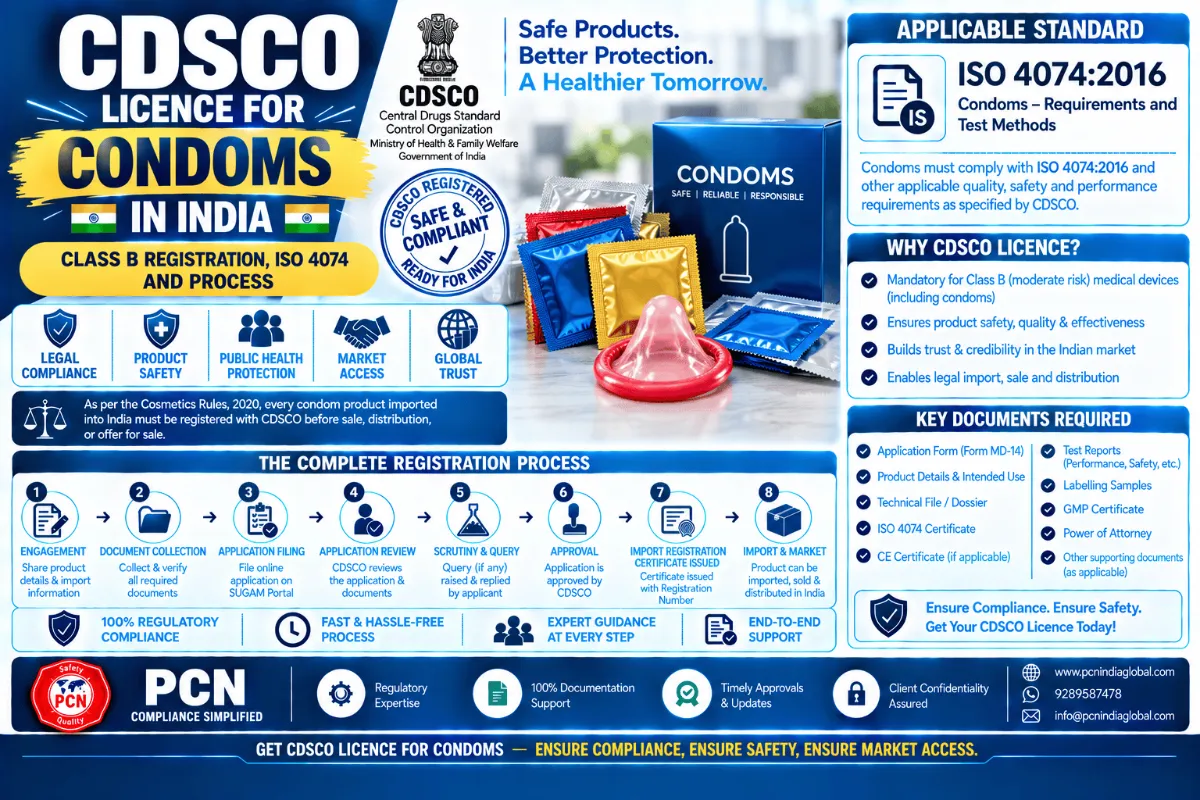
A condom is a barrier contraceptive that also prevents the transmission of infection, so its integrity is a genuine public-health matter. CDSCO regulates the male latex condom as a Class B medical device with a defined burst-volume, leakage and freedom-from-holes test regime and validated manufacturing behind the licence. This guide covers the full CDSCO registration pathway for condoms under the Medical Devices Rules, 2017 — classification, licence route, ISO 4074 and IS 3701, the documents, the fees and the timeline.
Is a CDSCO Licence Mandatory for Condoms?
Yes. A condom is a notified Class B medical device and cannot be manufactured, imported or sold in India without a CDSCO licence. A domestic manufacturer holds a Form MD-5 licence from the State Licensing Authority; an importer holds a Form MD-15 import licence through an Indian Authorised Agent. Plain, lubricated, textured and flavoured latex condoms are covered, with any added substance evidenced.
Risk Classification of Condoms
Every medical device in India is placed in one of four risk classes (A, B, C, D) under the First Schedule of the Medical Devices Rules, 2017. The class fixes the authority, the form, the fee, the audit route and the timeline.
Condoms are classified as Class B (low-to-moderate risk). A condom is a barrier device used briefly that prevents pregnancy and infection, where failure carries a real health consequence, placing it in Class B under the First Schedule. Where a device could fall in two classes the higher class applies, and an accessory is classified in its own right; always confirm against the current CDSCO classification list.
Which CDSCO Licence You Need for Condoms
- To manufacture condoms in India (Class B) — apply in Form MD-3 to the State Licensing Authority (SLA); the licence is granted in Form MD-5. A CDSCO-empanelled Notified Body audits the site. For Class A the audit is post-grant; for Class B it is carried out before the licence is granted.
- To import condoms (any class) — the overseas manufacturer appoints an Indian Authorised Agent who files Form MD-14 with the Central Licensing Authority; the import licence is granted in Form MD-15.
Applicable Standards for Condoms
Condoms have Indian and international standards and are checked closely against them:
- ISO 4074 — natural rubber latex male condoms: requirements and test methods (burst volume/pressure, freedom from holes, leakage).
- IS 3701 — the Indian Standard for rubber condoms.
- ISO 23409 — where synthetic (non-latex) male condoms are registered.
- ISO 10993 series — biocompatibility, including sensitisation, for the latex and any lubricant.
- Lubricant and additive evidence — for lubricated, spermicidal or flavoured variants.
- Shelf-life / stability data supporting the expiry.
Documents Required for Condoms CDSCO Licensing
The core CDSCO dossier is the same for every medical device: the application on CDSCO’s online medical device portal, Device Master File, Plant Master File, ISO 13485 certificate, Essential Principles checklist, ISO 14971 risk file, labels and IFU, undertakings and the fee receipt. The full checklist, with what each document must contain, is in our CDSCO medical device registration guide. Below is what CDSCO specifically expects to see for condoms.
Label & IFU Requirements Specific to Condoms
Condom labelling is checked for standard conformity, expiry and storage:
- Product name, nominal width and type (plain/lubricated/textured), and material.
- Batch/lot number, date of manufacture and use-by (expiry) date.
- A single-use symbol and storage-away-from-heat instructions.
- Latex-allergy caution and directions for use in/on the pack.
Plain Barrier vs Spermicidal / Medicated Condom
A plain or simply lubricated latex condom is a Class B device. But a condom carrying a spermicide (e.g. nonoxynol-9) or another medicinal substance becomes a drug-device combination, with the active substance regulated in its own right. Similarly, a synthetic non-latex condom follows a different standard (ISO 23409). Settle the variant scope and any active substance at the outset, because it changes the class, the standard and the evidence.
Step-by-Step: CDSCO Registration Process
Every device follows the same online filing route, which we walk through step by step in our complete CDSCO registration guide. For condoms, these are the steps that need the most attention:
- Confirm the classification. Fix the risk class against the CDSCO classification list and the First Schedule — Class B here — which decides the form, authority, fee and audit route.
- Site audit / inspection. A CDSCO-empanelled Notified Body audits the site. For Class A the audit is post-grant; for Class B it is carried out before the licence is granted.
Government Fees and Timeline
Fees are set in the Second Schedule of the Medical Devices Rules and paid online through the CDSCO portal. For manufacture of a Class B device the fee is Rs 5,000 per site plus Rs 500 for each distinct device, paid to the State Licensing Authority (SLA). Import fees under Form MD-15 are charged per site and per device in USD — roughly USD 1,000 per site plus USD 50 per device for lower-risk devices, up to about USD 3,000 per site plus USD 1,500 per device for Class C and D. A test licence (Form MD-13) carries a modest fee. Always confirm the current figure on the CDSCO portal before filing.
A complete Class B manufacturing file is typically cleared in about three to six months; an import (MD-15) file usually takes six to nine months. Every deficiency letter effectively restarts the clock. Unlike the old registration certificates, an MDR 2017 licence does not expire — it stays valid as long as the retention fee (equal to the licence fee) is paid every five years and the conditions of licence are met.
Common Mistakes That Trigger a CDSCO Query
Common query reasons for condom applications are:
- Burst-volume/pressure or freedom-from-holes results outside ISO 4074 / IS 3701 limits.
- Spermicidal condoms filed as plain devices, ignoring the drug-device fork.
- Stability data not supporting the labelled shelf-life under Indian conditions.
- Lubricant/additive with no composition or safety data.
- Free Sale Certificate scope not covering all variants on import.
Frequently Asked Questions
What CDSCO class is a condom?
A male latex condom is Class B. A domestic manufacturer files Form MD-3 for an MD-5 licence from the State Licensing Authority; an importer files Form MD-14 for an MD-15 licence.
Which standard applies to condoms in India?
ISO 4074 for natural-rubber-latex male condoms and the Indian Standard IS 3701, with ISO 23409 for synthetic condoms and ISO 10993 biocompatibility.
Is a spermicidal condom treated differently?
Yes — a condom carrying a spermicide or other medicinal substance is a drug-device combination, and the active substance is regulated in its own right.
Is a factory audit required?
Yes — for Class B manufacture a CDSCO-empanelled Notified Body audits the site before the MD-5 licence is granted.
How long does condom registration take?
A complete Class B manufacturing (MD-5) file is usually cleared in about three to six months; an import (MD-15) file typically takes six to nine months.
Why Choose PCN India Global
- Classification triage — we confirm the correct risk class for your condoms against the current CDSCO list before anything is drafted.
PCN India Global manages the complete CDSCO process for condoms — from classification and route selection to Device and Plant Master File preparation, online filing, audit support and the licence grant. WhatsApp or call +91 80109 05029, or email admin@pcnindiaglobal.com, to get your registration underway.
Related Compliance Guides
- CDSCO Licence for Coronary Stents
- CDSCO Registration for Syringes
- CDSCO Licence for Surgical Gloves
- CDSCO Licence for Ventilators
Need help? PCN India Global handles end-to-end CDSCO medical device registration for manufacturers and importers.
Related guides
- CDSCO Licence for Contact Lenses in India: Class B Registration and ISO 18369
- CDSCO Licence for Coronary Stents in India
- CDSCO Licence for COVID-19, Dengue & Malaria Rapid Test Kits in India: Class C IVD Registration
- CDSCO Licence for CT Scanners in India: Class C Registration and IEC 60601-2-44
- CDSCO Licence for Defibrillators in India: Class C Registration and IEC 60601-2-4
- CDSCO Licence for Dental Chairs in India: Class B Registration and ISO 6875
More Medical Devices Guides
- CDSCO Licence for Cardiac Catheters in India: Class C Registration and ISO 10555
- CDSCO Licence for Adhesive Bandages in India
- CDSCO Licence for Blood Collection Tubes in India: Class A Registration and ISO 6710
- CDSCO Licence for Coronary Stents in India
- CDSCO Licence for Blood Gas Analysers in India: Class C IVD Registration
- CDSCO Licence for COVID-19, Dengue & Malaria Rapid Test Kits in India: Class C IVD Registration