
WPC ETA & Import Licence for Drones in India: 2026 Guide
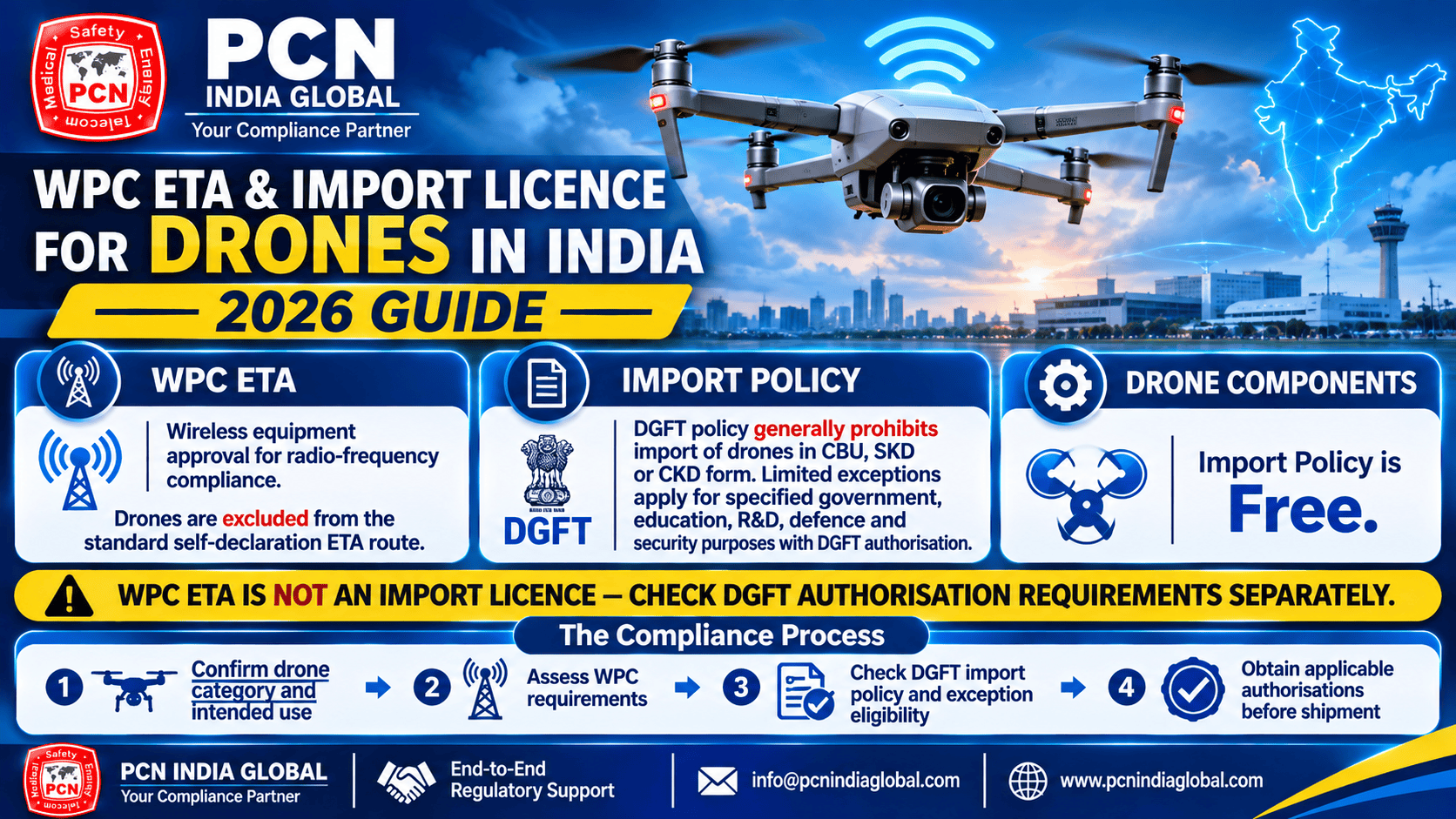
Drones are the exception to almost every general statement about Indian wireless approvals. Most radio products clear the Wireless Planning and Coordination (WPC) Wing through a straightforward self-declaration route. Drones do not. WPC ETA for drones runs through a different procedure, sits alongside a DGCA registration requirement, and is wrapped in an import policy that is more restrictive than for any other category in this guide.
If you manufacture, import, or distribute drones in India, this article explains the radio side of compliance, how it interacts with DGCA and DGFT requirements, and where projects typically stall.
Why WPC ETA for Drones Works Differently
The WPC Wing, under the Department of Telecommunications (DoT), regulates radio spectrum in India. Most wireless consumer products operate on de-licensed bands and qualify for the self-declaration Equipment Type Approval (ETA) route described in our complete WPC ETA approval guide.
Drones carry multiple radios — a control link, a telemetry link, and usually a video downlink — operating together on an airborne platform that can stray well beyond its operator. In short, that combination of mobility, altitude and multiple simultaneous transmitters is why the regulator does not extend the simple self-declaration exemption to them. As a result, WPC ETA for drones is handled through the Regional Licensing Office (RLO) procedure, with a full RF test report rather than a light-touch declaration.
Equally important, a drone is an aircraft. That brings in the Directorate General of Civil Aviation (DGCA) entirely separately from the radio question. The two tracks are independent, and satisfying one does nothing for the other.
Radios and Bands in Scope of WPC ETA for Drones
| Function | Typical band | Standard | Notes |
|---|---|---|---|
| Control / RC link | 2400–2483.5 MHz | EN 300 328 | Primary command and control |
| Video downlink | 5725–5875 MHz | EN 301 893 | Band varies by model |
| Telemetry | 2.4 GHz / sub-GHz | EN 300 328 / EN 300 220 | Often a separate radio |
| GNSS | 1.1–1.6 GHz | — | Receive-only, generally no ETA |
| Payload radios | Varies | Per band | RFID, LiDAR telemetry, survey links |
Three points matter in practice.
Every on-board radio must appear in the RF test report. For example, drones commonly carry three or four transmitters. Filing on the control link alone is the most frequent cause of rejection in this category.
The 5 GHz video downlink deserves specific attention. Indian power limits and band segments differ from those used in other markets, and the lower 5 GHz segment is indoor-only — plainly inapplicable to an aerial platform. Confirm that the video link’s band and power match a permitted Indian configuration before testing. See our guide to WPC de-licensed frequency bands and the 2.4 GHz and 5 GHz band guide.
Payload radios count. A survey drone carrying a telemetry transmitter or tag reader has those radios in scope too.
The Three Separate Tracks
Drone compliance in India is not one process. It is three, and they run on different clocks.
1. WPC ETA for drones — the radios
ETA through the RLO procedure, supported by an RF test report covering every transmitter. This is the subject of this guide.
2. DGCA — the aircraft
Drones must be registered on the Digital Sky platform and receive a Unique Identification Number. Depending on category and intended operation, type certification and operator requirements also apply. DGCA classifies drones by all-up weight — nano, micro, small, medium and large — and obligations scale with category. A nano drone has lighter aircraft-side obligations, but note that its control radio still requires WPC approval.
3. DGFT — importing
Drone import policy in India has been restrictive, with import of complete drones subject to significant restriction and exemptions applied for defined purposes such as R&D, defence and security. Import policy has generally treated components differently from complete aircraft. Moreover, this policy has changed more than once, so confirm the current position on the DGFT portal before committing to a shipment — our DGFT licence services page covers import authorisation routes.
The practical consequence: a drone project can have perfect radio compliance and still be unable to import. Check the DGFT position first, before spending on RF testing.
Documents Required for WPC ETA for Drones
Company documents:
- Certificate of Incorporation or business registration
- GST registration certificate
- PAN card of the applicant company
- Import Export Code (IEC) from DGFT
- Board resolution or authorization letter naming the signatory
- Registered office address proof
Technical documents:
- Drone datasheet including all-up weight and category
- Block diagram showing every on-board transmitter
- Operating bands, channel plans and output power for each radio
- Antenna specifications
- User manual and operating instructions
- DGCA registration details and UIN, where already obtained
- RF test report from a NABL-accredited Indian lab or ILAC-recognised foreign lab covering every transmitter
Overseas manufacturers need an authorization letter appointing an Authorized Indian Representative (AIR) unless they hold an Indian liaison or branch office.
WPC ETA for Drones: Step-by-Step Process
- Import feasibility check. Establish the DGFT position for your specific product and intended use before anything else.
- Radio inventory. Document every transmitter including payload radios.
- RF testing at an accredited lab against the applicable standard per band.
- SARAL Sanchar registration of the applicant company.
- ETA filing through the RLO procedure, with the ₹10,000 government fee per application.
- Query handling with WPC.
- DGCA track in parallel — Digital Sky registration and UIN.
Timeline: WPC ETA for drones takes longer and is less predictable than consumer wireless categories. The RLO route, multiple radios and the parallel DGCA track all add time. Treat six to twelve weeks as a planning baseline and validate against your specific product.
Validity: the ETA remains valid for the model unless the radio configuration changes. However, DGCA obligations are separate and continuing.
Related approvals: radio approval is rarely the only Indian requirement. Lithium-ion battery packs and chargers supplied with the drone may need BIS CRS registration, and if the drone or its ground station includes cellular connectivity, check whether TEC MTCTE approval applies.
Kits, Components and Drones Assembled in India
Import restriction on complete drones has pushed a good deal of activity toward domestic assembly, and that raises a question worth answering early: does a drone assembled in India from imported components avoid the radio approval?
No. WPC approval follows the radio, not the border. A drone assembled domestically still transmits on Indian spectrum and still needs ETA for its on-board transmitters. What domestic assembly changes is the import position — components have generally been treated differently from complete aircraft under import policy — not the spectrum position.
There is a useful consequence, though. If the flight controller or video transmitter you are integrating is a module that already holds its own approval, and you integrate it without altering its antenna, output power or RF firmware, you may be able to rely on that existing approval rather than testing the assembled aircraft from scratch. For Indian assemblers sourcing established modules, this is often the fastest legitimate route — and it is worth confirming before any test spend.
FPV and hobby kits sit in an awkward position. A kit sold as components may clear import more easily than a ready-to-fly aircraft, but once assembled and flown it is a drone operating on Indian spectrum, with both DGCA and WPC implications for whoever puts it in the air.
Testing Practicalities for Drones
In practice, drone RF testing differs from testing a static consumer device, and a lab unfamiliar with aerial platforms will slow you down.
Expect the lab to need the aircraft, the controller and the video receiver together, since the links are tested as operating pairs rather than as isolated transmitters. In addition, expect questions about how to put the aircraft into a continuous-transmit state for measurement — manufacturers who can supply a test-mode firmware build save days here. And expect antenna orientation to matter: a drone’s antennas are positioned for flight, and measured EIRP varies with orientation in ways that a desktop device’s do not.
Therefore, choosing a lab with prior drone experience is not a nicety. It is usually the difference between a two-week test and a two-month one.
Where Drone Projects Stall
- Import policy discovered late. Money spent on RF testing for a product that cannot be imported in its intended configuration.
- Partial radio coverage. Control link tested, video downlink or telemetry omitted.
- Band mismatch. Video downlink configured for a band plan permitted elsewhere but not in India.
- DGCA assumed to cover everything. Digital Sky registration is the aircraft; it is not radio approval.
- Payload radios overlooked on survey and industrial drones.
Frequently Asked Questions
Is DGCA registration enough, or do I need WPC too?
Both. DGCA covers the aircraft and its operation; WPC covers the radios on board. Neither substitutes for the other.
Do nano drones need WPC ETA approval?
The DGCA weight category affects aircraft-side obligations, not the radio requirement. A nano drone’s control link is still a transmitter requiring approval.
Why can’t I use self-declaration for WPC ETA for drones?
Drones are not covered by the de-licensed self-declaration exemption. ETA is processed through the Regional Licensing Office procedure with a full RF test report.
Can I import drones into India freely?
No. Drone import has been subject to significant restriction, with exemptions for defined purposes. Confirm the current DGFT position for your product and use case before shipping.
Does my payload radio need separate approval?
Any additional transmitter must be covered in the RF test report supporting the application.
What is the government fee for WPC ETA for drones?
₹10,000 per ETA application, alongside separate DGCA and import-related costs.
Get End-to-End Drone Compliance
PCN India Global Corporation maps the full Indian route for drone manufacturers and importers — DGFT import feasibility first, then WPC ETA for drones through the RLO procedure, with the DGCA Digital Sky track run alongside. Contact us before you commit to testing, so the import position is confirmed up front.
Need help? PCN India Global handles end-to-end WPC ETA approval for manufacturers and importers.
Related guides
- WPC ETA Certification for Bluetooth Speakers in India: Band, Testing, Fees and BIS CRS
- WPC ETA Certification for Smart Meters in India: RF Mesh, Zigbee and Cellular Routes
- WPC ETA Certification for Smartwatches & Wearables in India: BLE, Wi-Fi, eSIM and BIS CRS
- WPC ETA Certification for Wi-Fi Routers in India: Bands, Documents, Fees and Timeline
- WPC ETA for 433 MHz & Sub-GHz Short Range Devices in India: IoT Sensors, Remote Controls & LPWAN Compliance (GSR 680 E, GSR 698 E & GSR 1047 E)
- WPC ETA for RFID & NFC Devices in India: 865–867 MHz, 13.56 MHz & the De-Licensed RFID Bands (GSR 564 E, GSR 884 E & GSR 1047 E)
More WPC-ETA Approval Guides
- Documents Required for WPC ETA Certificate in India
- WPC ETA Certification for Bluetooth Speakers in India: Band, Testing, Fees and BIS CRS
- WPC ETA Certification for Smartwatches & Wearables in India: BLE, Wi-Fi, eSIM and BIS CRS
- WPC ETA Certification for Smart Meters in India: RF Mesh, Zigbee and Cellular Routes
- WPC ETA Certification for Wi-Fi Routers in India: Bands, Documents, Fees and Timeline
- WPC ETA for Ultra-Wideband (UWB) Devices in India: GSR 1046 E, Permitted Applications & the Approval Process