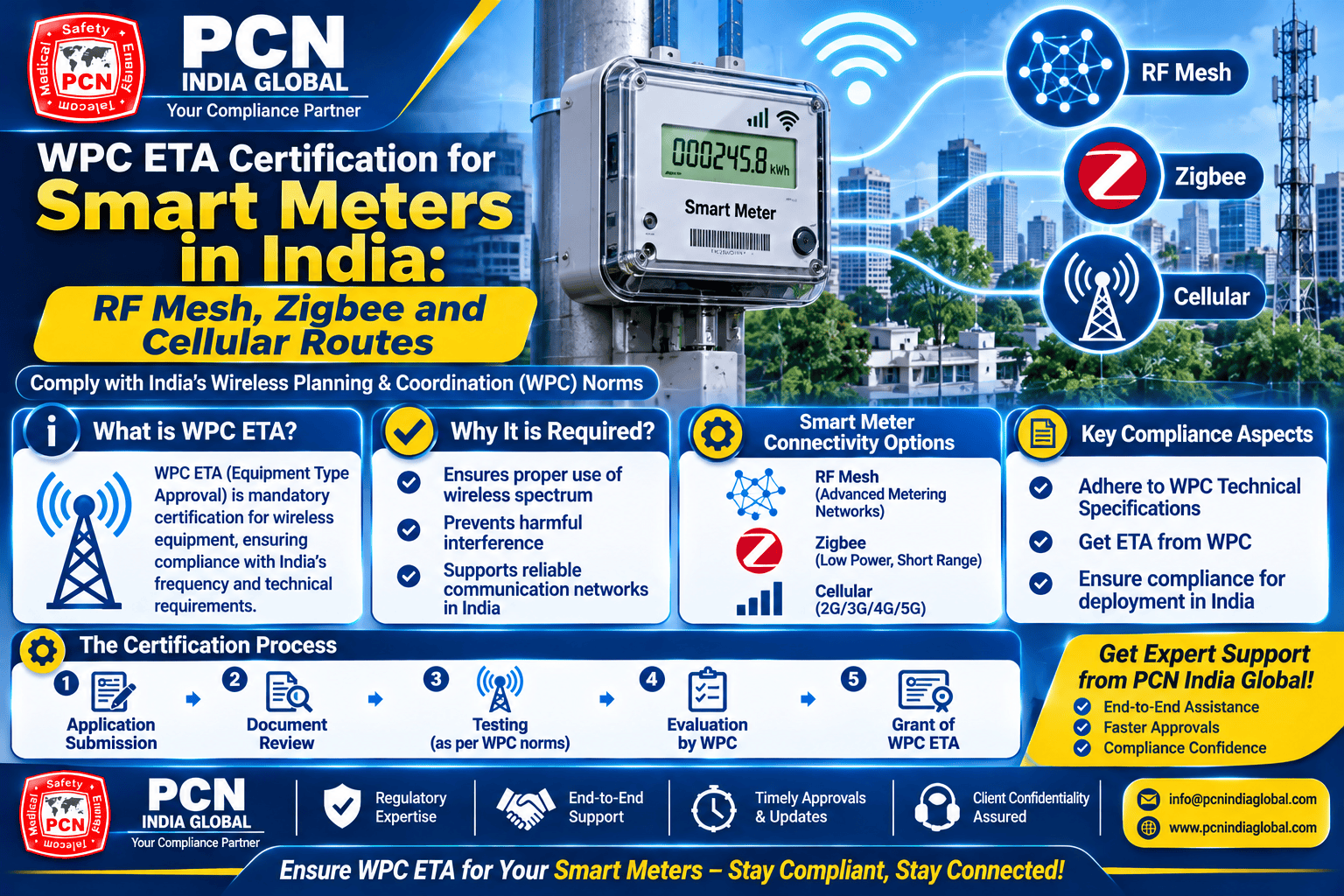

WPC ETA Certification for Smart Meters in India: RF Mesh, Zigbee and Cellular Routes
India’s smart metering rollout is one of the largest in the world, and almost every meter deployed under it carries a radio. That radio is what brings the product under the Wireless Planning and Coordination (WPC) Wing. WPC ETA for smart meters is mandatory before anyone can import, sell or deploy a wireless meter in India — and because utilities usually procure meters through large tenders, a missing approval does not just delay a shipment, it can disqualify a bid. This guide covers WPC ETA for smart meters step by step.
This guide explains which meter communication technologies trigger WPC Equipment Type Approval (ETA), where the cellular route differs sharply from the de-licensed route, what documents and testing you need, and the other Indian approvals a meter typically needs alongside.
Why Smart Meters Fall Under WPC
In practice, the WPC Wing, part of the Department of Telecommunications (DoT), governs radio spectrum use in India under the Indian Telegraph Act, 1885 and the Indian Wireless Telegraphy Act, 1933. Any device that transmits on radio frequencies needs its model approved before it enters the market.
In addition, a conventional meter is not a radio device. A smart meter almost always is — whether it reports consumption over an RF mesh, Zigbee, a sub-GHz LPWAN link, or a cellular module. The moment you design in a transmitter, Equipment Type Approval applies. For the broader framework, see our complete guide to WPC ETA approval in India.
Importantly, this applies equally to smart water meters and gas meters, not only electricity meters. The regulator cares about the radio, not the utility.
Smart Meter Communication Bands and Standards
Meters use a wider spread of radio technologies than most consumer products, and the approval route differs depending on which one you have designed in.
| Technology | Typical band | Approval route | Applicable standard |
|---|---|---|---|
| RF mesh / LPWAN | 865–867 MHz | De-licensed, ETA | EN 302 208 / EN 300 220 |
| Zigbee / 802.15.4 | 2400–2483.5 MHz | De-licensed, ETA | EN 300 328 |
| Sub-GHz SRD | 433.05–434.79 MHz | De-licensed, ETA (low power) | EN 300 220 |
| NB-IoT / LTE-M / 4G | Licensed cellular bands | Not self-declaration — see below | 3GPP TS 36 series |
The 865–867 MHz band is the workhorse of Indian smart metering. It is de-licensed within specified power limits and is the same band used for UHF RFID — our guide to the 865–867 MHz band covers the power and duty-cycle conditions in detail.
The 433 MHz band appears in some older or low-data-rate meter designs. Permitted power there is very low, and designs that work legally in other markets frequently exceed the Indian limit. See our 433 MHz and sub-GHz short range device guide.
For the complete picture of which bands India has de-licensed, see our guide to WPC de-licensed frequency bands in India.
The Cellular Exception That Changes Everything
Also, this is the single most important distinction for meter manufacturers, and it is where projects gain or lose months.
A meter communicating over a de-licensed band — RF mesh at 865–867 MHz, Zigbee at 2.4 GHz — follows the standard self-declaration ETA route described below. It is relatively quick and predictable.
A meter communicating over a licensed cellular band — NB-IoT, LTE-M, 4G — does not sit in the de-licensed self-declaration exemption. Cellular modules operate on spectrum licensed to telecom operators, and the compliance route runs differently. Depending on how the module connects and what it does, TEC MTCTE certification may also be triggered, because the device attaches to a public telecom network.
Many utility-grade meters are dual-mode: RF mesh for neighbourhood area networking plus a cellular fallback. Those meters need both routes mapped, and an RF test report per radio module.
The Module Shortcut Worth Checking First
Before commissioning a full test campaign, establish one thing: is the radio inside your meter a pre-approved module?
Many meter designs integrate a third-party communication module that already holds its own ETA. Where you incorporate an approved module without modification to its RF characteristics, antenna, or firmware, it may be possible to rely on the module’s existing approval rather than testing the whole meter from scratch.
The qualifier matters. If you have changed the antenna, altered output power, or modified the RF firmware, the module’s approval no longer describes your product and fresh testing applies. Establishing this early routinely saves several weeks and a full test fee — it is the first question worth asking on any meter project.
Documents Required for Smart Meter ETA
Company documents:
- Certificate of Incorporation or business registration
- GST registration certificate
- PAN card of the applicant company
- Import Export Code (IEC) from DGFT for imported meters
- Board resolution or authorization letter naming the signatory
- Registered office address proof
Technical documents:
- Meter datasheet with full communication specifications
- Block diagram of the RF section, showing each radio module
- Operating bands, channel plan, output power and duty cycle
- Antenna specification and gain
- User or installation manual
- Module approval details, where an approved module is used
- RF test report from a NABL-accredited Indian lab or ILAC-recognised foreign lab, covering every transmitting module
Foreign manufacturers additionally need an authorization letter appointing an Authorized Indian Representative (AIR), unless they hold an Indian liaison or branch office. For utility tenders this appointment deserves thought: the applicant holds the ETA in its own name, and tying it to a single distributor can constrain you later.
WPC ETA for Smart Meters: The WPC ETA Process for Smart Meters
- Radio inventory. List every transmitter in the meter — primary comms, fallback comms, any HAN or optical-adjacent radio. Each needs test coverage.
- Module approval check. Determine whether you can rely on an integrated module’s existing ETA.
- RF testing. Test at an accredited lab against the applicable standard for each band.
- SARAL Sanchar registration. Register the applicant on the DoT portal.
- Fee payment. ₹10,000 per ETA application, paid online.
- Submission and query handling. Upload documentation and respond to WPC clarifications.
- Grant. Download the digitally signed ETA certificate.
Timeline: two to four weeks for a clean de-licensed-band application with testing complete. Cellular-route products take longer because of the additional certification layer.
Validity: lifetime of the model, with no renewal — unless the radio design changes.
Other Approvals a Smart Meter Needs
WPC ETA covers only the radio. A meter is also a measuring instrument and an electrical product, which brings in:
- BIS certification against the applicable Indian Standard for the meter itself — see BIS ISI mark certification.
- Legal Metrology approval, because utilities use the meter for billing and therefore for trade measurement.
- TEC MTCTE, where the meter attaches to a public telecom network.
Utility tenders frequently require evidence of all applicable approvals at bid stage. Sequencing them one after another is how manufacturers miss tender windows; running them in parallel is how they make them.
What Utility Tenders Actually Ask For
Utilities rarely buy smart meters one at a time. Suppliers win them through utility and discom tenders, and that changes how you should sequence compliance.
Tender documents commonly require evidence of applicable approvals at bid submission, not at delivery. A manufacturer holding a technically excellent meter but no ETA cannot simply promise to obtain one later — the bid is evaluated on what exists. Because ETA attaches to the model and takes weeks, you have to plan compliance against the tender calendar rather than the production calendar.
Two further points follow. First, tenders often specify a communication technology — RF mesh at 865–867 MHz, or NB-IoT — which determines your approval route before you have made a design choice. Reading the comms specification early tells you whether you are on the fast de-licensed path or the longer cellular one.
Second, where a tender permits multiple communication variants of the same meter, each variant with a different radio is a different approval. A single “approved meter” is not a portfolio. Plan an ETA per radio configuration you intend to offer.
Why Smart Meter Applications Get Held
- Only the primary radio tested, with the cellular fallback module omitted
- Antenna gain in the test configuration differs from the production antenna, pushing EIRP over the limit
- Reliance on a module approval after the antenna or RF firmware was modified
- Duty cycle or power exceeding the 865–867 MHz or 433 MHz conditions
- Test report in the overseas manufacturer’s name with no authorization letter to the Indian applicant
WPC ETA for Smart Meters: FAQs
Does a smart water meter need WPC ETA?
Yes, if it transmits wirelessly. The requirement follows the radio, not the utility being measured. BIS and Legal Metrology requirements apply separately to the meter hardware.
My meter only has a cellular SIM — do I still need WPC ETA?
Cellular radios operate on licensed spectrum and do not fall under the de-licensed self-declaration route. The compliance path runs through the cellular/DoT route and may trigger TEC MTCTE. Map the correct path against your specific module and network attachment.
Can I rely on my communication module’s existing ETA?
Often yes, where you integrate the approved module without modification to its antenna, output power or RF firmware. Any of those changes means fresh testing.
Do I need a separate test report for each radio?
Yes. A meter with RF mesh plus a cellular fallback needs test evidence covering both.
What is the government fee?
₹10,000 per ETA application.
How long is the ETA valid?
For the lifetime of the meter model, unless the radio design changes.
Official sources: SARAL Sanchar portal · Department of Telecommunications
Certify Your Smart Meter for the Indian Market
PCN India Global Corporation supports meter manufacturers through the full Indian approval map — WPC ETA, module approval assessment, BIS, Legal Metrology and TEC where applicable — including AIR representation for overseas brands. Contact us for a compliance plan matched to your meter’s communication architecture. PCN India Global handles WPC ETA for smart meters from start to finish.
Need help? PCN India Global handles end-to-end WPC ETA approval for manufacturers and importers.
Related guides
- WPC ETA Certification for Smartwatches & Wearables in India: BLE, Wi-Fi, eSIM and BIS CRS
- WPC ETA Certification for Wi-Fi Routers in India: Bands, Documents, Fees and Timeline
- WPC ETA for 433 MHz & Sub-GHz Short Range Devices in India: IoT Sensors, Remote Controls & LPWAN Compliance (GSR 680 E, GSR 698 E & GSR 1047 E)
- WPC ETA for RFID & NFC Devices in India: 865–867 MHz, 13.56 MHz & the De-Licensed RFID Bands (GSR 564 E, GSR 884 E & GSR 1047 E)
- WPC ETA for Ultra-Wideband (UWB) Devices in India: GSR 1046 E, Permitted Applications & the Approval Process
- WPC ETA for Wi-Fi & Bluetooth Devices in India: 2.4 GHz, 5 GHz & 6 GHz Bands Explained (GSR 45 E, GSR 1048 E & GSR 316 E)
More WPC-ETA Approval Guides
- WPC ETA Certification for Smartwatches & Wearables in India: BLE, Wi-Fi, eSIM and BIS CRS
- WPC ETA Certification for Wi-Fi Routers in India: Bands, Documents, Fees and Timeline
- WPC ETA Certification for Bluetooth Speakers in India: Band, Testing, Fees and BIS CRS
- WPC ETA for Ultra-Wideband (UWB) Devices in India: GSR 1046 E, Permitted Applications & the Approval Process
- WPC ETA & Import Licence for Drones in India: 2026 Guide
- WPC ETA for Wireless Chargers & Inductive Devices in India: The kHz Bands Explained (GSR 870 E, 697 E & 996 E)