
WPC ETA Certification for Bluetooth Speakers in India: Band, Testing, Fees and BIS CRS
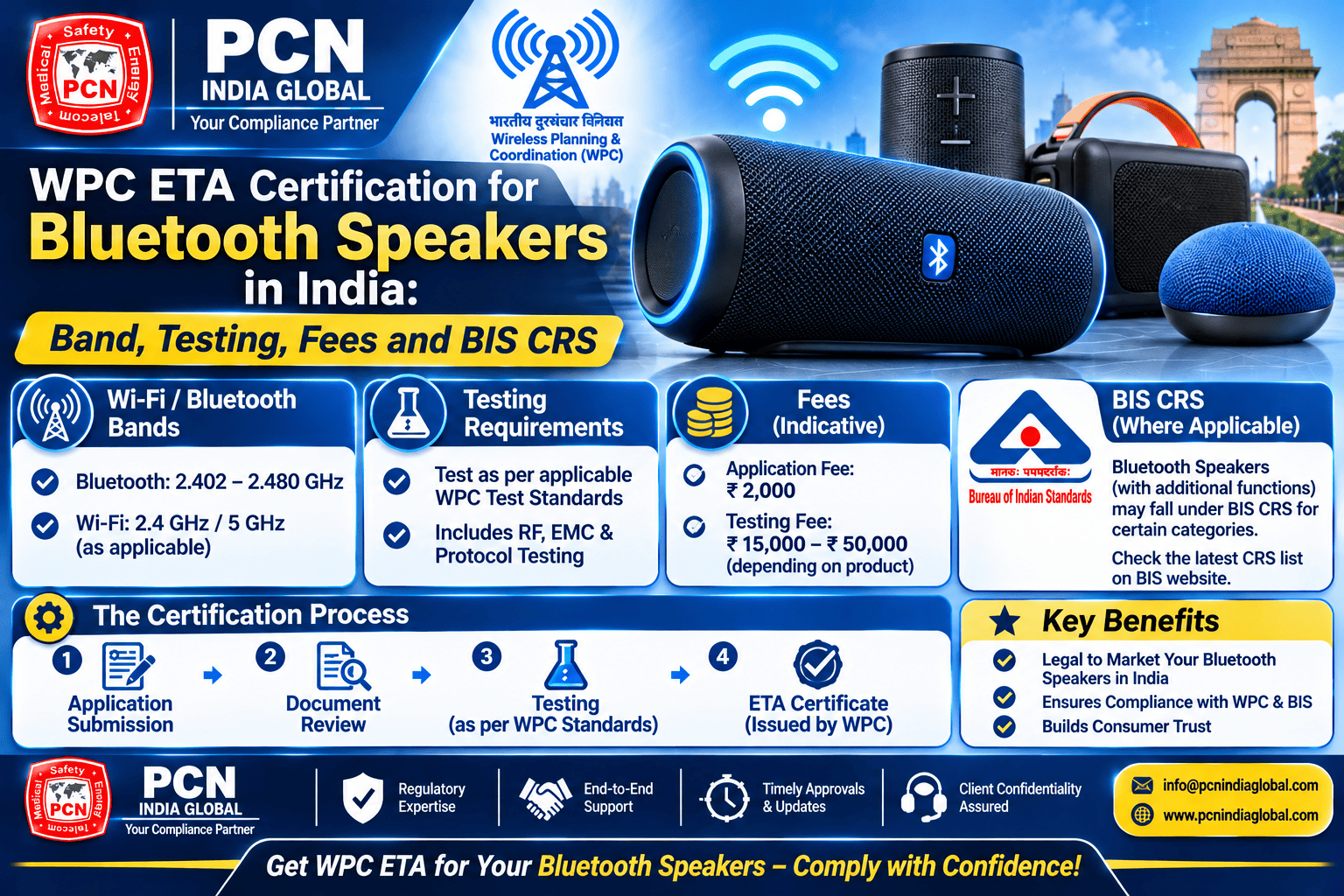
Bluetooth speakers are one of the highest-volume wireless imports into India, and one of the most frequently detained at customs. The reason is almost always the same: the importer secured one approval and assumed it was enough. WPC ETA for Bluetooth speakers is mandatory — and so, separately, is BIS registration. Missing either one stops the consignment. This guide covers WPC ETA for Bluetooth speakers step by step.
This guide covers both requirements, how they differ, what testing and documents are needed, realistic timelines and costs, and the specific traps that catch speaker importers — party speakers with microphones, TWS variants, and bundled chargers.
▶ Watch: WPC ETA Approval: How to Get an ETA Certificate for Wi-Fi & Bluetooth Devices in India
Why a Bluetooth Speaker Needs WPC ETA
In practice, the Wireless Planning and Coordination (WPC) Wing, part of the Department of Telecommunications (DoT), regulates radio spectrum in India under the Indian Telegraph Act, 1885 and the Indian Wireless Telegraphy Act, 1933. Any device model that transmits on radio frequencies requires Equipment Type Approval (ETA).
In addition, a Bluetooth speaker transmits on the 2.4 GHz band every time it pairs and streams. That band is de-licensed in India — the consumer needs no spectrum licence to use the speaker — but the product model still requires ETA before it can be imported or sold.
Importantly, this catches importers because a Bluetooth speaker feels like a simple consumer product, not telecom equipment. From the regulator’s perspective it is a radio transmitter, and it is treated as one. For the full framework, see our complete guide to WPC ETA approval in India.
Band, Power and Standard
| Function | Band | Condition | Standard |
|---|---|---|---|
| Bluetooth / BLE audio | 2400–2483.5 MHz | De-licensed within power limits | EN 300 328 |
| Wi-Fi (smart speakers) | 2.4 GHz / 5 GHz | De-licensed within power limits | EN 300 328 / EN 301 893 |
| FM receive | 88–108 MHz | Receive-only | No ETA needed |
| Wireless microphone link | Varies by design | Must be assessed separately | Per band |
Also, most portable speakers are straightforward: a single Bluetooth radio on 2.4 GHz, tested against EN 300 328. Our Wi-Fi and Bluetooth band guide sets out the power and channel conditions.
Complications arise with three variants:
Smart speakers with voice assistants add Wi-Fi, often dual-band. Both bands need test coverage.
Party speakers bundled with wireless microphones are the biggest trap in this category. The speaker’s Bluetooth radio is one transmitter; the wireless mic link is another, frequently on a different band entirely. Importers routinely file on the Bluetooth radio alone and are queried when the product literature shows a mic. If a wireless mic is in the box, it must be in the test report.
FM radio is receive-only and does not itself require ETA, since nothing is transmitted.
The Second Mandatory Approval: BIS CRS
WPC ETA covers the radio. It says nothing about electrical safety — and that is a separate, equally mandatory requirement.
Bluetooth speakers fall under the BIS Compulsory Registration Scheme (CRS) as consumer audio electronics. Our dedicated guide to BIS CRS registration for Bluetooth and wireless speakers covers the applicable standard and the registration process.
Three things importers consistently underestimate:
The charger is often a separate registration. A speaker supplied with an external power adaptor pulls that adaptor into CRS in its own right — see BIS CRS for adaptors and chargers. A compliant speaker with a non-compliant adaptor is still a held consignment.
BIS CRS takes longer than WPC ETA. It requires sample testing at a BIS-recognised Indian laboratory and a registration process with its own queue. If both are started together, BIS is usually the critical path. If BIS is started after ETA is granted, launch slips by weeks.
EPR applies at the business level. Speakers are electronic goods, so brands and importers also carry EPR obligations for e-waste.
TWS Earbuds Follow the Same Logic
True wireless earbuds sit in the same compliance shape as speakers: a 2.4 GHz Bluetooth radio requiring WPC ETA, plus BIS CRS for safety, plus the charging case which is itself an electrical product. Our guide to BIS CRS for wireless earbuds and TWS covers the specifics.
If you are importing a range — speakers, earbuds, neckbands — map the approvals across the full catalogue at once. Each model needs its own ETA, but testing and filing can be sequenced efficiently when planned together rather than model by model.
Documents Required for WPC ETA for Bluetooth Speakers
Company documents:
- Certificate of Incorporation or business registration
- GST registration certificate
- PAN card of the applicant company
- Import Export Code (IEC) from DGFT
- Board resolution or authorization letter naming the signatory
- Registered office address proof
Technical documents:
- Product datasheet with Bluetooth version, band and output power
- Block diagram of the RF section
- Antenna specification
- User manual
- Existing FCC or CE reports as supporting evidence
- RF test report from a NABL-accredited Indian lab or ILAC-recognised foreign lab, covering every transmitter including any bundled wireless microphone
Overseas brands need an authorization letter appointing an Authorized Indian Representative (AIR) unless they hold an Indian liaison or branch office.
WPC ETA for Bluetooth Speakers: Process, Fees and Timeline
- Radio inventory. Confirm every transmitter in the box — speaker, mic, Wi-Fi.
- RF testing at an accredited lab against EN 300 328 (and EN 301 893 where Wi-Fi is present).
- SARAL Sanchar registration of the applicant company.
- Fee payment — ₹10,000 per ETA application.
- Submission of documentation.
- Query handling with WPC.
- Grant of the ETA certificate.
Timeline: two to four weeks for a clean application with testing complete. Run BIS CRS in parallel from day one.
Validity: lifetime of the model, no renewal, unless the radio changes. A new fabric finish is not a new model; a new Bluetooth chipset is.
Planning Approvals Across an Audio Range
Few importers bring in a single speaker. A typical catalogue spans portable speakers, party speakers, soundbars, neckbands and TWS earbuds — and each model needs its own ETA. Handled model by model, that becomes an expensive, drawn-out programme. Handled as a portfolio, it compresses considerably.
The economics turn on shared hardware. Where several models use the same Bluetooth chipset, same antenna design and same RF firmware, a single test campaign can often support multiple applications, because the RF evidence is the same. Where models use different chipsets, they are genuinely different radios and need separate testing.
So the first step on a range is not filing — it is grouping. Map your catalogue by RF platform rather than by product name. Models sharing a platform get tested once; models on different platforms get budgeted separately. Importers who skip this step routinely pay for the same test three times.
The same grouping logic applies to BIS CRS, though the categories differ: speakers, earbuds and adaptors each sit in their own registration category regardless of shared internals.
What It Costs and How to Sequence It
The government fee is fixed and modest at ₹10,000 per ETA application. The real cost drivers are testing and time.
RF testing cost depends on how many bands and radios are involved — a single-radio Bluetooth speaker is at the inexpensive end; a smart speaker with dual-band Wi-Fi plus Bluetooth plus a mic link is materially more. BIS CRS adds its own sample testing cost at a BIS-recognised Indian lab.
On sequencing, the rule is simple: start BIS CRS on day one, not after ETA is granted. BIS is the longer track. Teams that run them sequentially typically add six to eight weeks to launch for no reason, because the two processes have no dependency on each other. They consume different evidence and can run entirely in parallel.
Why Speaker Applications Get Held
- A bundled wireless microphone omitted from the RF test report
- Smart speaker filed on Bluetooth alone, with Wi-Fi untested
- WPC ETA obtained but BIS CRS not started, or started too late
- Bundled adaptor without its own BIS registration
- Test report in the overseas manufacturer’s name with no authorization letter to the Indian applicant
- Declared output power inconsistent between datasheet and test report
WPC ETA for Bluetooth Speakers: FAQs
Do I need both WPC ETA and BIS for a Bluetooth speaker?
Yes. WPC ETA covers the 2.4 GHz radio; BIS CRS covers electrical safety. Both are mandatory and both are checked at import.
Does a party speaker with a wireless microphone need extra approval?
The wireless microphone is a separate transmitter and must be covered in the RF test report. FM receive functions do not require ETA, as they do not transmit.
Are TWS earbuds treated the same way?
Yes — the same WPC ETA plus BIS CRS logic applies, and the charging case is an electrical product in its own right.
How long does the whole process take?
WPC ETA typically runs two to four weeks once testing is complete. BIS CRS usually takes longer and should be run in parallel rather than after.
What is the government fee for WPC ETA?
₹10,000 per ETA application.
Do I need a new ETA for each colour variant?
No. ETA attaches to the radio characteristics of the model. Cosmetic variants do not need fresh approval; a changed Bluetooth chipset or antenna does.
Official sources: SARAL Sanchar portal · Department of Telecommunications · Bureau of Indian Standards
Certify Your Bluetooth Speaker for India
PCN India Global Corporation runs WPC ETA and BIS CRS together for audio brands and importers — covering the speaker, any bundled microphone, and the adaptor — so both approvals land before your shipment does. Contact us for a model-by-model compliance plan. PCN India Global handles WPC ETA for Bluetooth speakers from start to finish.
Need help? PCN India Global handles end-to-end WPC ETA approval for manufacturers and importers.
Related guides
- WPC ETA Certification for Smart Meters in India: RF Mesh, Zigbee and Cellular Routes
- WPC ETA Certification for Smartwatches & Wearables in India: BLE, Wi-Fi, eSIM and BIS CRS
- WPC ETA Certification for Wi-Fi Routers in India: Bands, Documents, Fees and Timeline
- WPC ETA for 433 MHz & Sub-GHz Short Range Devices in India: IoT Sensors, Remote Controls & LPWAN Compliance (GSR 680 E, GSR 698 E & GSR 1047 E)
- WPC ETA for RFID & NFC Devices in India: 865–867 MHz, 13.56 MHz & the De-Licensed RFID Bands (GSR 564 E, GSR 884 E & GSR 1047 E)
- WPC ETA for Ultra-Wideband (UWB) Devices in India: GSR 1046 E, Permitted Applications & the Approval Process
More WPC-ETA Approval Guides
- WPC ETA & Import Licence for Drones in India: 2026 Guide
- WPC ETA Certification for Smartwatches & Wearables in India: BLE, Wi-Fi, eSIM and BIS CRS
- Documents Required for WPC ETA Certificate in India
- WPC ETA Certification for Smart Meters in India: RF Mesh, Zigbee and Cellular Routes
- WPC ETA Certification for Wi-Fi Routers in India: Bands, Documents, Fees and Timeline
- WPC ETA for Ultra-Wideband (UWB) Devices in India: GSR 1046 E, Permitted Applications & the Approval Process