
WPC ETA Certification for Smartwatches & Wearables in India: BLE, Wi-Fi, eSIM and BIS CRS
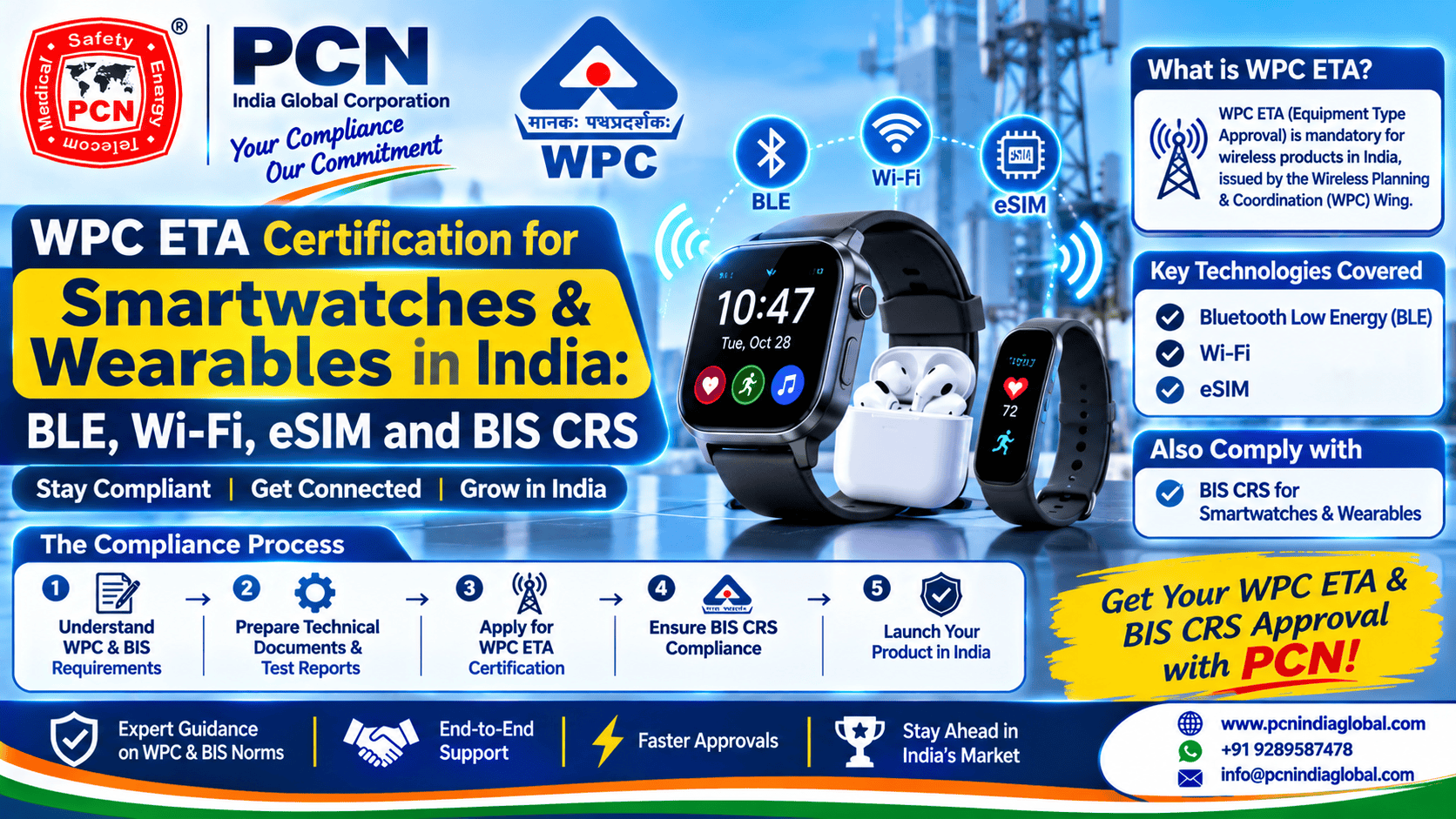
Smartwatches and fitness wearables are among the fastest-moving categories in Indian consumer electronics — and among the most heavily regulated at import. A wearable carries multiple radios in a very small package, and every one of them brings the product under the Wireless Planning and Coordination (WPC) Wing. WPC ETA for smartwatches is mandatory before the device can be imported or sold in India. This guide covers WPC ETA for smartwatches and other wearables step by step.
Equally important, and routinely missed: a smartwatch needs a second, entirely separate mandatory approval under BIS. Brands that plan only for the radio approval lose weeks at the port. This guide covers both, plus the eSIM complication that changes the route for cellular models.
Why Wearables Need WPC Approval
The WPC Wing, under the Department of Telecommunications (DoT), governs radio spectrum in India under the Indian Telegraph Act, 1885 and the Indian Wireless Telegraphy Act, 1933. Any product model that transmits on radio frequencies requires Equipment Type Approval (ETA) before market entry.
In practice, a smartwatch is a dense bundle of transmitters. At minimum it runs Bluetooth Low Energy to pair with a phone. Mid-range and premium models add Wi-Fi. Many include GNSS. Cellular models add an LTE radio and an eSIM. Each transmitting function must be covered by the RF test report that the ETA is granted against. The complete WPC ETA approval guide sets out the framework across all device types.
Wearable Radios, Bands and Standards
| Function | Band | Standard | ETA required? |
|---|---|---|---|
| Bluetooth / BLE | 2400–2483.5 MHz | EN 300 328 | Yes |
| Wi-Fi 2.4 GHz | 2400–2483.5 MHz | EN 300 328 | Yes |
| Wi-Fi 5 GHz | 5150–5350 / 5725–5875 MHz | EN 301 893 | Yes |
| GNSS (GPS) receive-only | 1.1–1.6 GHz | — | Generally no |
| NFC | 13.56 MHz | Short-range conditions | Yes, if transmitting |
| LTE / eSIM | Licensed cellular bands | 3GPP TS 36 series | Separate route — see below |
Two points deserve emphasis.
GNSS alone does not trigger ETA. A pure receiver does not transmit, and receive-only functions generally fall outside the approval. But almost no smartwatch is GNSS-only — the BLE radio brings it in regardless.
Low power does not mean exempt. BLE output is tiny, and manufacturers sometimes assume that puts the device below the threshold of interest. It does not. The 2.4 GHz band is de-licensed, meaning no individual user licence is needed — but the device model still requires ETA. Our Wi-Fi and Bluetooth band guide covers the conditions in detail.
The eSIM and Cellular Complication
In addition, a Bluetooth-only or Wi-Fi-enabled smartwatch sits comfortably in the de-licensed self-declaration ETA route. A cellular smartwatch does not.
LTE radios operate on spectrum licensed to telecom operators, outside the de-licensed exemption. A cellular wearable therefore carries an additional compliance layer, and because it attaches to a public telecom network, TEC MTCTE certification may also be triggered.
For brands launching a product family — a Bluetooth model and an LTE variant of the same watch — this means two different approval paths and two different timelines. Treating them as one project with one deadline is a common planning error.
The Second Mandatory Approval: BIS CRS
Importantly, this is the requirement most wearable importers underestimate.
Smartwatches and wearables fall under the BIS Compulsory Registration Scheme (CRS), which covers electrical and electronic product safety. WPC approves the radio; BIS approves the safety of the product and its charger. Neither substitutes for the other, and customs checks for both.
Our dedicated guide to BIS CRS registration for smartwatches and wearables covers the applicable standard, the testing, and the registration process.
Two practical notes. First, the charging cradle or adaptor is frequently a registered category in its own right — a watch that passes on its own can still be held because of its charger. Second, BIS CRS involves factory and sample testing at a BIS-recognised Indian lab, which has its own lead time. Started late, it becomes the critical path.
Also, a third requirement applies at the business level rather than per product: wearables are electronic goods, so brands placing them on the Indian market also carry EPR obligations for e-waste.
Health Sensors: Where Wearables Become Medical Devices
This boundary catches premium brands.
A step counter or heart-rate monitor sold as a wellness feature stays a consumer electronic product. But where a wearable makes a diagnostic claim — ECG interpretation, atrial fibrillation detection, blood pressure measurement, SpO2 presented for clinical use — it can cross into medical device territory and attract CDSCO regulation on top of WPC and BIS.
The deciding factor is usually the claim made in marketing and labelling, not the sensor itself. If your product literature implies clinical diagnosis, assess the medical device position before launch. Wearables that genuinely transmit on medical bands have their own rules — see our guide to WPC ETA for wireless medical devices.
Documents Required for WPC ETA for Smartwatches
Company documents: Certificate of Incorporation, GST registration, PAN, Import Export Code (IEC), board resolution or authorization letter, and registered office address proof.
Technical documents:
- Product datasheet with full radio specifications
- Block diagram of the RF section showing every transmitter
- Operating bands, channel plans and output power
- Antenna details
- User manual
- Existing FCC, CE or IC reports as supporting evidence
- RF test report from a NABL-accredited Indian lab or ILAC-recognised foreign lab, covering every transmitting function
Overseas brands — which is most of this category — also need an authorization letter appointing an Authorized Indian Representative (AIR), unless they hold an Indian liaison or branch office. The AIR files in its own name and holds the approval, so choose with your distribution strategy in mind.
WPC ETA for Smartwatches: The Process and What It Costs
- Radio inventory. List every transmitter in the watch, including NFC if it transmits.
- RF testing at an accredited lab against the applicable standard per band.
- SARAL Sanchar registration for the applicant company on the DoT portal.
- Fee payment — ₹10,000 per ETA application, online.
- Submission of test report, technical documents and company papers.
- Query handling with WPC.
- Grant of the digitally signed ETA certificate.
Timeline: two to four weeks for a clean Bluetooth/Wi-Fi application once testing is complete. Run BIS CRS alongside, not after — it is usually the longer track.
Validity: lifetime of the model, no renewal, unless the radio design changes. Note that a new colourway or strap is not a new model; a new SoC or antenna is.
White-Label and OEM Wearables: Whose Approval Is It?
A large share of the Indian wearable market is white-labelled. A brand sources a reference design from an ODM, applies its own name and firmware, and launches. This raises a question that causes real delay: can you use the ODM’s existing approval?
Generally, no. The ETA is issued to an applicant for a model. If you are selling under your own brand name, the approval needs to exist in a form that covers your product as marketed. What you can often reuse is the underlying evidence — the RF test report for identical hardware. Where the radio, antenna and RF firmware are genuinely unchanged from the tested reference design, that report can support your application without a fresh test campaign.
The qualification matters. Brands frequently ask the ODM to tweak transmit power, change the antenna layout to fit a different case, or ship modified RF firmware. Any of those changes mean the original report no longer describes your product, and testing restarts.
Two practical habits save weeks here. Ask the ODM for the full test report, not a certificate summary — you need the measured data and the accreditation details. And confirm in writing that the RF section of your variant is identical to the tested unit, because that is the question WPC will effectively be asking.
Variants, Sizes and When You Need a New ETA
Wearables ship in families: 42 mm and 46 mm cases, several strap colours, sometimes a “lite” model. Not all of these are new approvals.
ETA attaches to radio characteristics. A different strap material or dial finish changes nothing relevant. A different case size, however, often means a different antenna geometry — and that does change RF behaviour. The test lab is the right place to settle whether two sizes share an RF design or not, and settling it before filing avoids a query that arrives after your launch date.
Why Wearable Applications Get Held
- Test report covers BLE but omits Wi-Fi or NFC
- Only the watch tested, with the charging cradle’s BIS requirement unaddressed
- LTE variant filed on the de-licensed route alongside the Bluetooth model
- Marketing claims implying clinical diagnosis, raising a medical device question mid-application
- Test report in the overseas brand’s name with no authorization letter to the Indian applicant
WPC ETA for Smartwatches: FAQs
Does a Bluetooth-only fitness band need WPC ETA?
Yes. BLE is a transmitter on the 2.4 GHz band, and low output power does not create an exemption.
Do I need both WPC ETA and BIS CRS for a smartwatch?
Yes, in almost all cases. WPC covers the radio; BIS CRS covers electrical safety of the product and charger. Both are checked at import.
What about a smartwatch with eSIM or LTE?
Cellular radios fall outside the de-licensed self-declaration route and carry an additional compliance layer, potentially including TEC MTCTE. Plan a longer timeline than the Bluetooth variant.
Does GPS need its own approval?
A receive-only GNSS function generally does not require ETA, as it does not transmit. The watch’s other radios still do.
Is a new strap colour a new ETA?
No. ETA attaches to the model’s radio characteristics. Cosmetic variants do not require fresh approval; changes to the radio, antenna or SoC do.
What is the government fee?
₹10,000 per ETA application.
Official sources: SARAL Sanchar portal · Department of Telecommunications · Bureau of Indian Standards
Get Your Wearable Certified for India
PCN India Global Corporation handles WPC ETA and BIS CRS together for wearable brands — radio inventory, lab coordination, AIR representation, SARAL filing and CRS registration — so the two tracks finish together rather than sequentially. Contact us for a compliance map for your model range. PCN India Global handles WPC ETA for smartwatches and wearables from start to finish.
Need help? PCN India Global handles end-to-end WPC ETA approval for manufacturers and importers.
Related guides
- WPC ETA Certification for Wi-Fi Routers in India: Bands, Documents, Fees and Timeline
- WPC ETA for 433 MHz & Sub-GHz Short Range Devices in India: IoT Sensors, Remote Controls & LPWAN Compliance (GSR 680 E, GSR 698 E & GSR 1047 E)
- WPC ETA for RFID & NFC Devices in India: 865–867 MHz, 13.56 MHz & the De-Licensed RFID Bands (GSR 564 E, GSR 884 E & GSR 1047 E)
- WPC ETA for Ultra-Wideband (UWB) Devices in India: GSR 1046 E, Permitted Applications & the Approval Process
- WPC ETA for Wi-Fi & Bluetooth Devices in India: 2.4 GHz, 5 GHz & 6 GHz Bands Explained (GSR 45 E, GSR 1048 E & GSR 316 E)
- WPC ETA for Wireless Chargers & Inductive Devices in India: The kHz Bands Explained (GSR 870 E, 697 E & 996 E)
More WPC-ETA Approval Guides
- WPC ETA Certification for Bluetooth Speakers in India: Band, Testing, Fees and BIS CRS
- WPC ETA Certification for Smart Meters in India: RF Mesh, Zigbee and Cellular Routes
- WPC ETA & Import Licence for Drones in India: 2026 Guide
- WPC ETA Certification for Wi-Fi Routers in India: Bands, Documents, Fees and Timeline
- Documents Required for WPC ETA Certificate in India
- WPC ETA for Ultra-Wideband (UWB) Devices in India: GSR 1046 E, Permitted Applications & the Approval Process