
CDSCO Licence for COVID-19, Dengue & Malaria Rapid Test Kits in India: Class C IVD Registration
A rapid antigen test detects SARS-CoV-2 proteins to give a fast result at the point of care or at home. Because it detects an infectious agent and its result affects isolation and treatment decisions, CDSCO regulates the COVID-19 antigen kit as a Class C in-vitro diagnostic (IVD), with a validated performance-evaluation report behind the licence. This guide covers the full CDSCO registration pathway for COVID antigen test kits under the Medical Devices Rules, 2017 — classification, licence route, the performance evidence, the documents, the fees and the timeline.
Is a CDSCO Licence Mandatory for COVID-19 Antigen Test Kits?
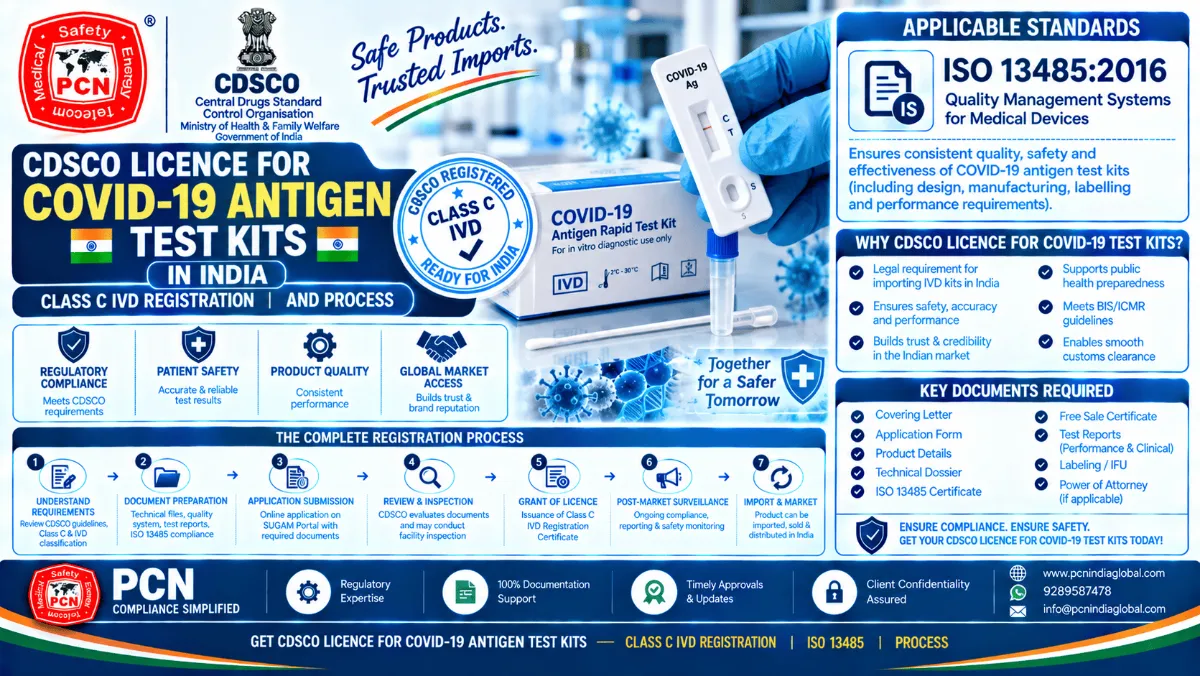
Yes. A COVID-19 antigen test kit is a notified in-vitro diagnostic and cannot be manufactured, imported or sold in India without a CDSCO licence. Because detecting an infectious agent is Class C, a domestic manufacturer applies to the Central Licensing Authority in Form MD-7 for a Form MD-9 licence, and an importer applies in Form MD-14 for a Form MD-15 import licence. Kit performance is validated at a designated evaluation laboratory (e.g. ICMR-approved), and self-test formats carry additional lay-user requirements.
Risk Classification of COVID-19 Antigen Test Kits
Every medical device in India is placed in one of four risk classes (A, B, C, D) under the First Schedule of the Medical Devices Rules, 2017. The class fixes the authority, the form, the fee, the audit route and the timeline.
COVID-19 Antigen Test Kits are classified as Class C (moderate-to-high risk). An IVD that detects an infectious agent (SARS-CoV-2), where an incorrect result carries individual and public-health consequences, is classified at Class C under the IVD classification rules. Where a device could fall in two classes the higher class applies, and an accessory is classified in its own right; always confirm against the current CDSCO classification list.
Which CDSCO Licence You Need for COVID-19 Antigen Test Kits
- To manufacture COVID-19 antigen test kits in India (Class C) — apply in Form MD-7 to the Central Licensing Authority (CDSCO headquarters); the licence is granted in Form MD-9. A CDSCO joint audit team inspects the manufacturing site before the licence is granted — site inspection is mandatory for Class C and D.
- To import COVID-19 antigen test kits (any class) — the overseas manufacturer appoints an Indian Authorised Agent who files Form MD-14 with the Central Licensing Authority; the import licence is granted in Form MD-15.
- Test licence — for a small quantity imported or made for testing, evaluation, demonstration or clinical investigation: Form MD-12 application, Form MD-13 licence.
Applicable Standards for COVID-19 Antigen Test Kits
COVID antigen kits are evaluated principally on performance evidence, supported by IVD quality and labelling standards:
- Performance Evaluation Report (PER) — clinical sensitivity and specificity against RT-PCR, at a designated evaluation laboratory.
- ICMR / national validation where applicable for SARS-CoV-2 assays.
- ISO 13485 — quality management system for the IVD manufacturer.
- ISO 23640 — stability evaluation of the IVD reagents.
- ISO 14971 — risk management, including false-negative consequences.
- ISO 18113 — IVD labelling and information supplied by the manufacturer.
Documents Required for COVID-19 Antigen Test Kits CDSCO Licensing
The core CDSCO dossier is the same for every medical device: the application on CDSCO’s online medical device portal, Device Master File, Plant Master File, ISO 13485 certificate, Essential Principles checklist, ISO 14971 risk file, labels and IFU, undertakings and the fee receipt. The full checklist, with what each document must contain, is in our CDSCO medical device registration guide. Below is what CDSCO specifically expects to see for covid-19 antigen test kits.
Label & IFU Requirements Specific to COVID-19 Antigen Test Kits
IVD labelling (ISO 18113) is checked for lot, expiry and intended-use information:
- Product name, IVD symbol, the analyte (SARS-CoV-2 antigen), specimen type and “for self-testing” where applicable.
- Lot/batch number, date of manufacture and expiry date.
- Storage conditions and the reading time-window.
- Confirmatory-testing statement and result interpretation in the IFU.
Professional vs Self-Test, and the Designated-Lab Validation
COVID antigen kits come as professional-use and self-test formats, and self-tests need a lay-user usability study and plain-language instructions. Common to both is that SARS-CoV-2 assay performance is validated at a designated evaluation laboratory (such as an ICMR-approved centre) before the licence issues — you cannot self-certify performance. Build the designated-lab evaluation into the timeline from the start, and confirm the current requirements, as pandemic-era assay rules are updated from time to time.
Step-by-Step: CDSCO Registration Process
Every device follows the same online filing route, which we walk through step by step in our complete CDSCO registration guide. For covid-19 antigen test kits, these are the steps that need the most attention:
- Confirm the classification. Fix the risk class against the CDSCO classification list and the First Schedule — Class C here — which decides the form, authority, fee and audit route.
- Draw the test and performance reports. Test to the applicable standards at an accredited laboratory; sterile and measuring devices carry additional validation.
- Site audit / inspection. A CDSCO joint audit team inspects the manufacturing site before the licence is granted — site inspection is mandatory for Class C and D.
Government Fees and Timeline
Fees are set in the Second Schedule of the Medical Devices Rules and paid online through the CDSCO portal. For manufacture of a Class C device the fee is Rs 50,000 per site plus Rs 1,000 for each distinct device, paid to the Central Licensing Authority (CDSCO headquarters). Import fees under Form MD-15 are charged per site and per device in USD — roughly USD 1,000 per site plus USD 50 per device for lower-risk devices, up to about USD 3,000 per site plus USD 1,500 per device for Class C and D. A test licence (Form MD-13) carries a modest fee. Always confirm the current figure on the CDSCO portal before filing.
A complete Class C manufacturing file is typically cleared in about six to nine months; an import (MD-15) file usually takes six to nine months. Every deficiency letter effectively restarts the clock. Unlike the old registration certificates, an MDR 2017 licence does not expire — it stays valid as long as the retention fee (equal to the licence fee) is paid every five years and the conditions of licence are met.
Common Mistakes That Trigger a CDSCO Query
Common query reasons for COVID-antigen IVD applications are:
- Performance data not from a designated laboratory, or below the required sensitivity/specificity.
- Limit-of-detection or cross-reactivity data missing.
- Stability data not supporting the labelled shelf-life.
- Self-test kit without a lay-user usability study.
- Free Sale Certificate scope not covering the exact kit on import.
Dengue & Malaria Rapid Test Kits: Same Class C Route
Dengue and malaria rapid diagnostic test kits follow the same CDSCO pathway described above: they are Class C IVDs, so a domestic manufacturer files Form MD-7 for an MD-9 licence and an importer files Form MD-14 for an MD-15 licence with the Central Licensing Authority. The documents, labelling, fees and timeline are the same. What changes is the analyte scope and the evidence behind it.
Dengue and malaria kits come in several analyte configurations — dengue NS1 antigen, IgM/IgG antibodies and combo cards; malaria Pf/Pv (and pan-species) — and each analyte claimed must be evidenced. Validation at a designated evaluation laboratory (often linked to ICMR/NIMR reference panels) is required before the licence issues, and it sits on the critical path, so build it into the timeline early.
Does each analyte need its own evidence?
Yes. Every analyte claimed on the kit (dengue NS1/IgM/IgG; malaria Pf/Pv) must be supported by its own performance data.
Why does cross-reactivity matter for dengue?
Dengue shares antigens with other flaviviruses, so CDSCO expects cross-reactivity data showing the kit is specific.
Frequently Asked Questions
What CDSCO class is a COVID antigen test kit?
A SARS-CoV-2 antigen kit is a Class C IVD, so a domestic manufacturer files Form MD-7 for an MD-9 licence with the Central Licensing Authority, and an importer files Form MD-14 for an MD-15 licence.
Is designated-laboratory validation required?
Yes — SARS-CoV-2 assay performance is validated at a designated evaluation laboratory (e.g. ICMR-approved) before the licence issues; confirm the current requirements.
What performance evidence does CDSCO expect?
Clinical sensitivity and specificity against RT-PCR, plus limit of detection, cross-reactivity and stability, with a lay-user study for self-tests.
Do IVDs use different forms?
No — IVDs use the same MDR 2017 forms (MD-9 for Class C manufacture, MD-15 for import); the distinguishing requirement is the performance-evaluation evidence.
How long does registration take?
Plan beyond the usual six to nine months where the designated-laboratory evaluation adds time to a complete file.
Why Choose PCN India Global
- Classification triage — we confirm the correct risk class for your COVID-19 antigen test kits against the current CDSCO list before anything is drafted.
- Standards and testing — the right BIS/IS or ISO/IEC standards mapped and accredited test reports coordinated.
PCN India Global manages the complete CDSCO process for COVID-19 antigen test kits — from classification and route selection to Device and Plant Master File preparation, online filing, audit support and the licence grant. WhatsApp or call +91 80109 05029, or email admin@pcnindiaglobal.com, to get your registration underway.
Related Compliance Guides
- CDSCO Licence for Dengue & Malaria Kits
- CDSCO Licence for Coronary Stents
- CDSCO Registration for Syringes
- CDSCO Licence for Surgical Gloves
Need help? PCN India Global handles end-to-end CDSCO medical device registration for manufacturers and importers.
Related guides
- CDSCO Licence for CT Scanners in India: Class C Registration and IEC 60601-2-44
- CDSCO Licence for Defibrillators in India: Class C Registration and IEC 60601-2-4
- CDSCO Licence for Dental Chairs in India: Class B Registration and ISO 6875
- CDSCO Licence for Dental Implants in India: Class C Registration and ISO 14801
- CDSCO Licence for Dialysers in India: Class C Registration and ISO 8637
- CDSCO Licence for Digital Thermometers in India: Class B Registration and ISO 80601-2-56
More Medical Devices Guides
- CDSCO Licence for Coronary Stents in India
- CDSCO Licence for Contact Lenses in India: Class B Registration and ISO 18369
- CDSCO Licence for Adhesive Bandages in India
- CDSCO Licence for Blood Bags in India: Class C Registration and ISO 3826
- CDSCO Licence for Condoms in India: Class B Registration and ISO 4074
- CDSCO Licence for Autoclaves & Sterilizers in India: Class B Registration and ISO 17665