BIS ISI Certification for Stainless Steel Pipes and Tubes in India: IS 17875, IS 17876 and the Complete Licensing Process
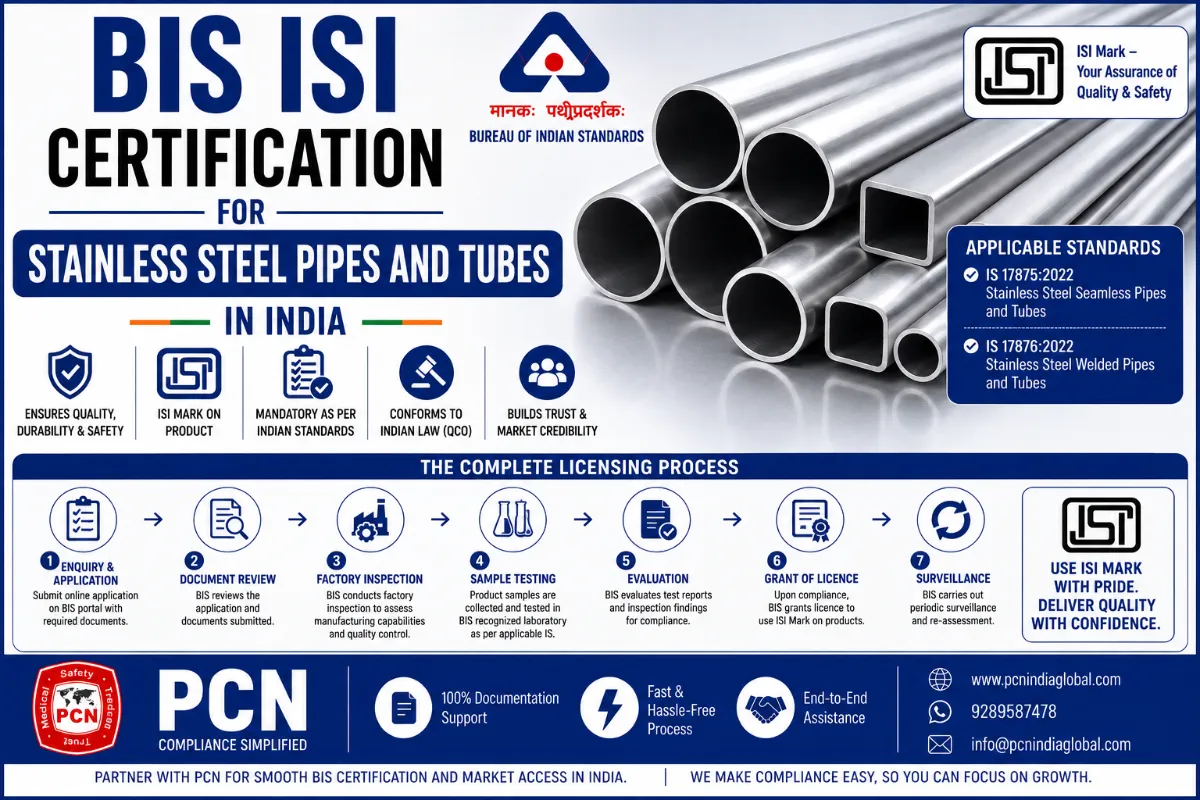
Stainless steel pipes and tubes are the arteries of modern industry — carrying water, chemicals, food products, and gases through plants, buildings, dairies, breweries, pharmaceutical facilities, and process industries across India. Because failures in piping mean leaks, contamination, and safety hazards, the government has brought this category under compulsory BIS certification. The Stainless Steel Pipes and Tubes (Quality Control) Order, 2025 — notified by the Department for Promotion of Industry and Internal Trade (DPIIT) vide S.O. 693(E) dated 10 February 2025 — makes the ISI mark mandatory for stainless steel seamless and welded pipes and tubes for general service, certified under Scheme-I of the BIS (Conformity Assessment) Regulations, 2018, the same ISI Mark Scheme that governs steel products on the BIS list of products under compulsory certification. The QCO came into force on 1 August 2025, which means the obligation is already live: no manufacturer — Indian or foreign — can manufacture, import, distribute, sell, hire, lease, store, or exhibit for sale covered stainless steel pipes and tubes in India without a valid BIS licence and the Standard Mark. For an industry with hundreds of domestic mills and a substantial import flow from overseas producers, the order reshapes sourcing, production, and customs clearance in one stroke. This guide explains the covered products and standards, the step-by-step ISI licensing process, documents, timelines, common mistakes, and how pipe and tube certification fits into the wider India compliance picture. Why Stainless Steel Pipes and Tubes Fall Under Mandatory BIS Certification Quality Control Orders are the government’s instrument for making an Indian Standard mandatory. Once a QCO is notified under the BIS Act, 2016, covered products cannot be placed on the Indian market without the ISI mark granted under a valid BIS licence. The stainless steel pipes QCO follows the same policy logic the government has applied across the steel sector since 2020: raise the quality floor, curb substandard and misdeclared imports, and protect downstream users who cannot verify metallurgy at the point of purchase. The safety and quality rationale is substantial. A stainless steel pipe that fails in service can leak aggressive chemicals, contaminate food or pharmaceutical product streams, or burst under pressure. Substandard material — wrong grade chemistry, poor weld integrity, inadequate wall thickness, or defective surface finish — is invisible to the buyer but decisive in service life and safety. Certified conformity to the Indian Standard verifies chemical composition, mechanical properties, dimensional tolerances, and testing regimes at the mill itself. For manufacturers, the QCO is also a commercial gate: project buyers, EPC contractors, government procurement, and organised distribution now verify BIS licences for covered pipes and tubes, and customs authorities check compliance at import. Which Products Are Covered: IS 17875 and IS 17876 The QCO covers stainless steel pipes and tubes for general service under two dedicated Indian Standards published in 2022: Indian Standard Product Category Typical Products Covered IS 17875:2022 Stainless Steel Seamless Pipes and Tubes for General Service Seamless SS pipes and tubes in austenitic, ferritic and duplex grades for water lines, plumbing, structural and general industrial service IS 17876:2022 Stainless Steel Welded Pipes and Tubes for General Service ERW / welded SS pipes and tubes for general engineering, water distribution, railings, furniture tube and industrial applications The distinction between the two standards is the manufacturing route — seamless versus welded — and each has its own test regime reflecting the risks of that route: weld integrity testing matters for IS 17876, while seamless production controls dominate IS 17875. Related stainless tube products carry their own separate compulsory standards — notably IS 6913 for stainless steel tubes for the food and beverage industry — so a mill producing both general-service and food-grade tube ranges should map every product line to its correct standard before applying. As always, manufacturers should confirm the exact applicability and current edition of each standard against the latest BIS notification, because the licence is granted per standard, per manufacturing location. Who Must Comply — and From When The QCO binds every link in the supply chain. Indian mills need a BIS licence under Scheme-I for each manufacturing premises and each applicable standard. Importers cannot clear covered pipes and tubes through customs unless the foreign manufacturing site itself holds a BIS licence — obtained through the Foreign Manufacturers Certification Scheme (FMCS), under which BIS audits the overseas mill and grants the ISI licence to the foreign entity, which must also appoint an Authorised Indian Representative (AIR). Traders, stockists, and distributors are equally barred from storing or selling non-compliant material. The order came into force on 1 August 2025 — roughly 180 days from notification — and applies to all covered production and imports from that date. Products manufactured for export are outside the QCO’s scope, a standard exemption that lets export-oriented mills serve overseas customers to their specifications. Every consignment destined for the Indian market, however, must originate from a licensed site. A year into enforcement, BIS market surveillance and customs scrutiny of stainless pipe consignments are well established, and unlicensed material faces seizure and penal action under the BIS Act, 2016 — imprisonment of up to two years and/or fines starting at ₹2 lakh for a first offence. What IS 17875 and IS 17876 Actually Test Understanding what conformity requires clarifies why certification takes preparation. The standards evaluate stainless steel pipes and tubes across four broad areas. Chemical composition — the steel must match the specified grade chemistry. Spectrometric analysis verifies the percentages of chromium, nickel, molybdenum, carbon, and other elements that define corrosion resistance and mechanical behaviour. Grade substitution — supplying a cheaper grade against a higher-grade declaration — is precisely the malpractice the QCO targets. Mechanical properties — tensile strength, yield strength, elongation, and hardness are tested to confirm the material performs under load. Flattening and flaring tests verify ductility and the tube’s ability to withstand forming and installation stresses. Weld and structural integrity — for welded tubes under IS 17876, weld soundness is examined through bend tests and non-destructive examination; for