
BIS CRS Registration for LED Luminaires in India: Fixed and Recessed Downlights (IS 10322)
Fixed LED luminaires and recessed downlights follow different sections of the same IS 10322 standard, and both need BIS CRS registration before sale in India. This guide covers BIS CRS registration for LED luminaires in one place, so you can plan surface-mounted and recessed fittings together.
Products covered in this guide: Fixed General Purpose LED Luminaires, Recessed LED Luminaires (Downlights).
Fixed General Purpose LED Luminaires
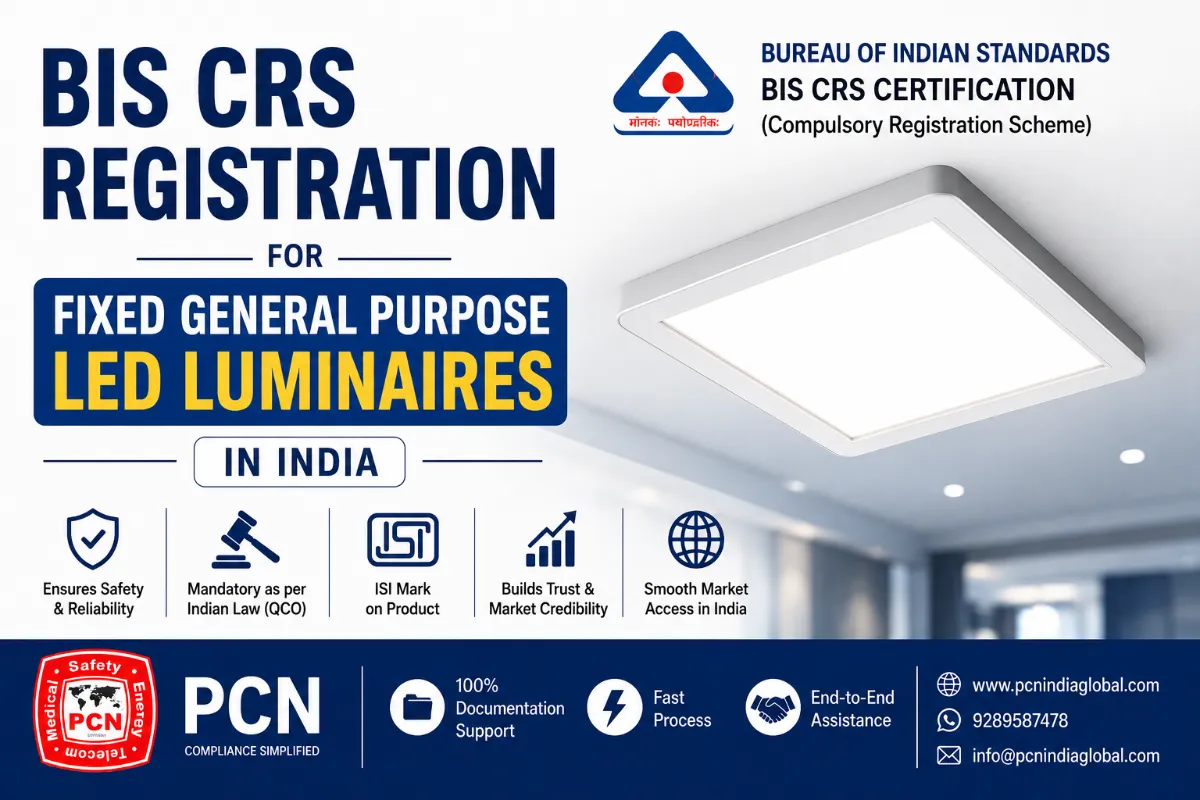
Fixed general purpose LED luminaires are the everyday indoor lighting of modern India — the panel lights, battens, tube fittings, surface-mounted ceiling fixtures, and wall lights that illuminate homes, offices, shops, schools, and hospitals. Unlike a retrofit bulb screwed into an existing holder, a fixed luminaire is a complete lighting fitting with its LED module, driver, optics, and housing built in and installed as a permanent part of the building. This guide covers BIS CRS registration for fixed general purpose LED luminaires in India: the applicable standard, testing, documents and the complete process.
Because these are notified lighting products, fixed general purpose LED luminaires fall under the BIS Compulsory Registration Scheme (CRS). A covered luminaire needs registration before it goes on sale in India. This makes BIS CRS registration the mandatory safety gateway to this enormous general-lighting market. Fixed luminaires are one of the highest-volume lighting categories, sold to consumers, electricians, builders, and institutions alike, and their permanent installation makes robust electrical safety essential.
This guide explains the applicable standard, the CRS self-declaration process, the documents required, realistic timelines, and how the safety registration fits within the wider lighting-compliance picture.
Why Fixed LED Luminaires Fall Under CRS
In practice, the Compulsory Registration Scheme operates under the Electronics and Information Technology Goods (Requirement of Compulsory Registration) Order, administered by BIS under the BIS Act, 2016. Fixed general purpose LED luminaires are on the CRS list, meaning a covered luminaire needs testing against the applicable Indian Standard, registration with BIS, and marking with its registration number before it can be manufactured, imported, sold, distributed, or stored for sale in India.
In addition, the safety rationale is direct. A fixed luminaire connects permanently to the building’s mains wiring, contains driver electronics, and sits on ceilings and walls where users and electricians interact with it during installation and maintenance. Substandard construction, poor insulation, or weak driver design can create electric-shock or fire hazards in the installation. CRS ensures every luminaire meets a common safety baseline verified by India-specific testing.
Selling an unregistered notified luminaire is an offence under the BIS Act, and registration is also a commercial gate: electrical distributors, project buyers, and marketplaces verify it, and customs checks it at import.
The Applicable Standard: IS 10322 (Part 5/Section 1)
Fixed general purpose LED luminaires register under IS 10322 (Part 5/Section 1):2012, the Indian Standard for luminaires — particular requirements for fixed general purpose luminaires, within the IS 10322 series (aligned with the international IEC 60598 luminaire-safety family).
Importantly, the IS 10322 series covers the general and particular safety requirements for luminaires, with Part 5 addressing particular luminaire categories and Section 1 addressing fixed general purpose luminaires specifically. The standard covers protection against electric shock, thermal behaviour, mechanical construction and mounting, the safety of terminals and internal wiring. In addition, the integrity of the driver installation.
Manufacturers should confirm the exact applicable standard, section, and current edition against the latest BIS notification before testing, since certification rests on demonstrated conformity to the correct standard. The luminaire must be tested at a BIS-recognised laboratory and shown to conform before it can be registered.
What the CRS Safety Test Examines
Understanding what the laboratory checks clarifies why registration matters. The luminaire-safety standard evaluates the fitting against a defined set of hazards. Electric-shock protection is verified for the mains-connected wiring and terminals, and for the barrier between live parts and any accessible surface — important for a fitting handled during installation.
Labs assess thermal behaviour so the LED module and driver stay within safe temperatures during continuous operation, since indoor luminaires often run for long hours. Labs examine mechanical construction and the mounting arrangement, since a ceiling or wall fitting must be securely fixed and its housing robust. The integrity of internal wiring, terminal blocks, and the driver installation is checked, and fault-condition behaviour is confirmed.
Because a fixed luminaire connects permanently to the building wiring, and electricians handle it, the safety of its wiring, terminals, and construction is central. That is why India requires local testing rather than accepting overseas certificates alone.
A High-Volume Category Where the Driver Still Rules
Fixed general purpose luminaires are perhaps the broadest LED-lighting category by volume, spanning slim ceiling panels, LED battens and tube fittings, surface downlights, and decorative wall and ceiling fixtures — and understanding what unites them helps a manufacturer approach certification efficiently.
Whatever the form factor, the safety and reliability of a fixed luminaire depend above all on its driver, the electronic control gear that powers the LEDs. A change of driver can alter the very characteristics the registration certifies, which is why the driver and critical components are central to the file.
Also, this has a practical, cost-saving implication for a manufacturer with a wide catalogue: designing ranges around a small number of well-characterised, compliant driver and housing platforms lets a broad set of luminaire SKUs be certified efficiently through series/family grouping, provided the models genuinely share a platform. A slim panel and a batten built on the same driver and construction approach can often share a registration, while genuinely different designs need their own coverage.
For a high-volume general-lighting brand, getting this platform-and-grouping strategy right is the key to certifying a large range both compliantly and economically — the same discipline that makes the products reliable also makes them efficient to register.
Fixed Luminaires Within the Wider Compliance Picture
Luminaire certification connects to the broader lighting picture:
- LED driver registration — the driver may itself be a separately notified product; see our BIS CRS registration service.
- EPR for e-waste — producers and importers of electrical/electronic equipment must hold EPR registration for e-waste with CPCB.
- Smart-lighting features — luminaires with wireless controls need WPC ETA approval for their radios.
- Legal Metrology (LMPC) — pre-packaged units require LMPC registration.
In practice, a coordinated plan handles the luminaire’s CRS registration alongside the driver, EPR. In addition, any smart-control WPC so the product reaches market fully compliant.
Recessed LED Luminaires (Downlights)
Recessed LED downlights are the sleek, flush-mounted fixtures that define modern interior lighting across India, set into false ceilings in homes, offices, hotels, showrooms, and retail spaces to give clean, glare-controlled illumination without visible hardware. A recessed luminaire is a complete lighting fitting designed to be embedded into a ceiling cavity, with its LED module, driver, and optics housed in a body that sits largely out of sight. This guide covers BIS CRS registration for recessed LED downlights in India: the applicable standard, testing, documents and the complete process.
The Applicable Standard: IS 10322 (Part 5/Section 2)
Recessed LED luminaires register under IS 10322 (Part 5/Section 2):2012, the Indian Standard for luminaires, particular requirements for recessed luminaires, within the IS 10322 series, aligned with the international IEC 60598 luminaire-safety family.
Part 5 addresses particular luminaire categories, and Section 2 addresses recessed luminaires specifically, reflecting the additional considerations of a fixture embedded in a building surface. The standard covers protection against electric shock, thermal behaviour with particular attention to the recessed installation, mechanical construction and the recessing arrangement, and the safety of terminals, wiring, and the driver.
Manufacturers should confirm the exact applicable standard, section, and current edition against the latest BIS notification before testing, since certification rests on demonstrated conformity to the correct standard. The luminaire must be tested at a BIS-recognised laboratory and shown to conform before it can be registered.
What the CRS Safety Test Examines
Understanding what the laboratory checks clarifies why registration matters for a downlight. The recessed-luminaire safety standard evaluates the fitting against a defined set of hazards. Electric-shock protection is verified for the mains wiring and terminals.
Thermal behaviour receives particular attention because a recessed fixture sits in a confined ceiling cavity where heat cannot escape as freely as from a surface fitting, so the luminaire and its surroundings must not reach unsafe temperatures, a central concern for downlights, which are often installed in insulated ceilings or near combustible materials. Labs examine mechanical construction and the recessing and retention arrangement, since the fixture must be securely held in the ceiling. The integrity of the driver installation and internal wiring is checked, and fault-condition behaviour is confirmed.
Because a recessed luminaire is embedded in a ceiling where heat builds up and where it sits near building materials, thermal safety in the recessed condition is the defining concern. That is why India requires local testing rather than accepting overseas certificates alone.
Why “Recessed” Is Its Own Category
In addition, the reason recessed luminaires have a dedicated standard, and the key insight for a manufacturer, is that embedding a light fitting into a ceiling fundamentally changes its thermal environment and its safety considerations compared with a surface-mounted fixture. A surface luminaire dissipates heat into the open air of the room. A recessed one traps much of that heat in the ceiling cavity, often surrounded by insulation, plasterboard, or timber, where it cannot escape freely.
Importantly, this makes thermal management the central engineering challenge of a good downlight, the driver and LED must be designed and positioned so the fixture stays safely within temperature limits even in a poorly ventilated or insulated ceiling, across the temperature extremes of an Indian year. It also raises fire-safety considerations, since a recessed fixture that runs too hot sits in direct contact with building materials.
Also, this is precisely why the recessed category follows its own section of the standard rather than the general fixed-luminaire requirements, and why a manufacturer cannot assume a surface fitting’s design or registration carries over to a recessed version. For a downlight maker, designing genuinely for the recessed thermal condition, and testing to the recessed standard, is both the mark of a safe product and the foundation of a clean CRS registration.
Recessed Luminaires Within the Wider Compliance Picture
Downlight certification connects to the broader lighting picture:
- LED driver registration, the driver may itself be a separately notified product; see our BIS CRS registration service.
- EPR for e-waste, producers and importers must hold EPR registration for e-waste with CPCB.
- Smart-lighting features, downlights with wireless controls need WPC ETA approval for their radios.
- Legal Metrology (LMPC), pre-packaged units require LMPC registration.
A coordinated plan handles the downlight’s CRS registration alongside the driver, EPR. In addition, any smart-control WPC so the product reaches market fully compliant.
Step-by-Step: BIS CRS Registration for a Fixed Luminaire
CRS is a test-and-register scheme with no factory inspection. Our team manages each stage end to end, but every applicant should understand the sequence.
- Confirm the standard and section. Verify the luminaire falls under CRS and the applicable standard, IS 10322 (Part 5/Section 1), and its current edition.
- Test at a BIS-recognised laboratory. Submit luminaire samples for testing against the standard.
- Prepare documentation. Compile technical details, driver and critical-component data, construction details, company and brand documents, and — for foreign makers — the Authorised Indian Representative (AIR) nomination.
- File the online application. Submit on the BIS portal with the test report and documents.
- BIS scrutiny and grant. BIS reviews and grants the registration with a unique R-number.
- Mark and self-declare. Apply the standard mark and R-number on the luminaire and packaging, and issue the self-declaration.
- Maintain and renew. Keep conformity under BIS surveillance and renew periodically; act on the registration if the driver or critical components change.
Documents Required for BIS CRS Registration for LED Luminaires
A complete file at the outset is the biggest single lever on approval speed. You will typically need:
- Test report from a BIS-recognised laboratory against IS 10322 (Part 5/Section 1)
- Product technical specifications and datasheets
- Driver / control-gear and critical-component details
- Construction and mounting details
- Bill of materials
- Company registration and business documents
- Trademark / brand authorisation documents
- Details of the manufacturing unit
- For foreign manufacturers: Authorised Indian Representative (AIR) nomination and undertakings
- Marking / label artwork showing the standard reference and R-number
- Authorised signatory details and application declarations
Timeline and Cost Planning
A realistic CRS schedule for a fixed luminaire is commonly a few weeks to a couple of months end to end, with laboratory testing the pacing item. Once you file a complete application with a valid test report, BIS scrutiny and grant are relatively quick.
Laboratory testing fees dominate costs, followed by BIS application and registration fees and, for foreign makers, the AIR arrangement. Because fixed-luminaire ranges are broad and share driver and housing platforms, BIS series/family guidelines that allow related fittings to be grouped are especially valuable here, letting a large general-lighting catalogue be certified efficiently. Handle the EPR registration in parallel.
Common Mistakes That Delay a Fixed Luminaire Registration
- Testing to the wrong section. Fixed general purpose luminaires use IS 10322 (Part 5/Section 1); confirm the section and edition before testing.
- Driver changes after registration. Substituting the registered driver can require action on the registration.
- Under-using series grouping. For a broad catalogue, failing to group SKUs on genuinely shared platforms multiplies cost.
- Importer-as-registrant confusion. The manufacturer holds the CRS registration; foreign makers must appoint an AIR.
- Wiring/terminal gaps. Terminal and internal-wiring integrity is central; incomplete evidence stalls the process.
- Model/brand mismatches. The brand and model on the luminaire, label, test report, and application must match exactly.
Pre-Supply Compliance Checklist for Fixed LED Luminaires
Before committing to supply, run this verification sequence. First, confirm the applicable standard IS 10322 (Part 5/Section 1) and obtain a passing test report covering electric-shock protection, thermal behaviour, and mechanical construction. Second, ensure the manufacturer is set up as the CRS registration holder, with a resident AIR for foreign makers. Third, confirm the registration matches the luminaire and driver you will actually supply. Fourth, verify EPR (e-waste), any driver registration, and, for smart fixtures, WPC. Fifth, align the brand and model across the luminaire, packaging, test report, and application, using series grouping to cover the range efficiently.
For ongoing operations, maintain a compliance register per model: R-number and validity, the standard and edition, driver and construction details, and EPR records, so component changes and renewals are handled proactively.
BIS CRS Registration for LED Luminaires: Frequently Asked Questions
Is BIS CRS registration mandatory for fixed general purpose LED luminaires?
Yes. Fixed general purpose LED luminaires are on the CRS list and must be tested against IS 10322 (Part 5/Section 1), registered with BIS, and marked with the R-number before being manufactured, imported, sold, distributed, or stored for sale in India.
Which standard applies?
IS 10322 (Part 5/Section 1):2012, the particular safety requirements for fixed general purpose luminaires within the IS 10322 luminaire-safety series, aligned with IEC 60598.
What does the safety test actually check?
Electric-shock protection at terminals and accessible surfaces, thermal behaviour of the LED module and driver, mechanical construction and mounting security. In addition, the integrity of internal wiring and the driver installation.
Why Choose PCN India Global
- Fixed-luminaire expertise, we manage IS 10322 (Part 5/Section 1) registration across panels, battens, and fittings
- Lab coordination, testing at BIS-recognised laboratories, right the first time
- AIR for foreign makers, we act as your Authorised Indian Representative and hold the India compliance interface
- Series optimisation, we group luminaire SKUs on shared driver and housing platforms to minimise testing
- Driver and EPR handling, we manage any driver registration and the e-waste obligation
- Surveillance and renewal tracking, so your registrations stay valid and driver changes are managed
PCN India Global manages the complete BIS CRS registration process for fixed general purpose LED luminaires, from IS 10322 testing to R-number grant and renewal, coordinated with the driver, EPR, and smart-control obligations these fixtures carry.
Contact us: WhatsApp +91 80109 05029, email admin@pcnindiaglobal.com, or start your application today.
Related Compliance Guides
- BIS CRS Registration for Thin-Film Solar PV Modules
- BIS CRS Registration for Franking & Mail-Processing Machines
- BIS CRS Registration for LED Hand Lamps
Related Guides
- BIS CRS Registration for Electronic Musical Systems & Keyboards in India
- BIS CRS Registration for Smart Card Readers in India
- BIS CRS Registration for Cash Registers in India
Need expert help? See our BIS CRS registration services.
Need help? PCN India Global handles end-to-end BIS CRS registration for manufacturers and importers.
Related guides
- BIS CRS Registration for LED Street & Road Lighting Luminaires in India: IS 10322
- BIS CRS Registration for Lithium-Ion Batteries in India (IS 16046): Complete Compliance Guide
- BIS CRS Registration for Microwave Ovens in India: IS 302-2-25
- BIS CRS Registration for Mobile Phones in India: Standards, Process and the Complete Compliance Picture
- BIS CRS Registration for Optical Disc & DVD/Blu-ray Players in India: IS 616 / IS 62368-1
- BIS CRS Registration for POS Terminals & Cash Registers in India: IS 13252
More BIS CRS Guides
- BIS CRS Registration for LED Lighting Chains & Rope Lights in India: IS 10322 (Part 5/Sections 7 & 9)
- BIS CRS Registration for Electronic Musical Systems & Keyboards in India: IS 616:2017
- BIS CRS Registration for LED Emergency Lighting Luminaires in India: IS 10322 (Part 5/Section 8)
- BIS CRS Registration for Audio Amplifiers in India: IS 616:2017
- BIS CRS Registration for Electronic Clocks with Mains Power in India: IS 302-2-26
- BIS CRS Registration for Biometric Scanners & Card Readers in India: Fingerprint, Iris, Barcode, Smart Card and Passport Readers