
BIS ISI Certification for Stainless Steel Cookware: IS 14756:2022 and the Cookware QCO 2024
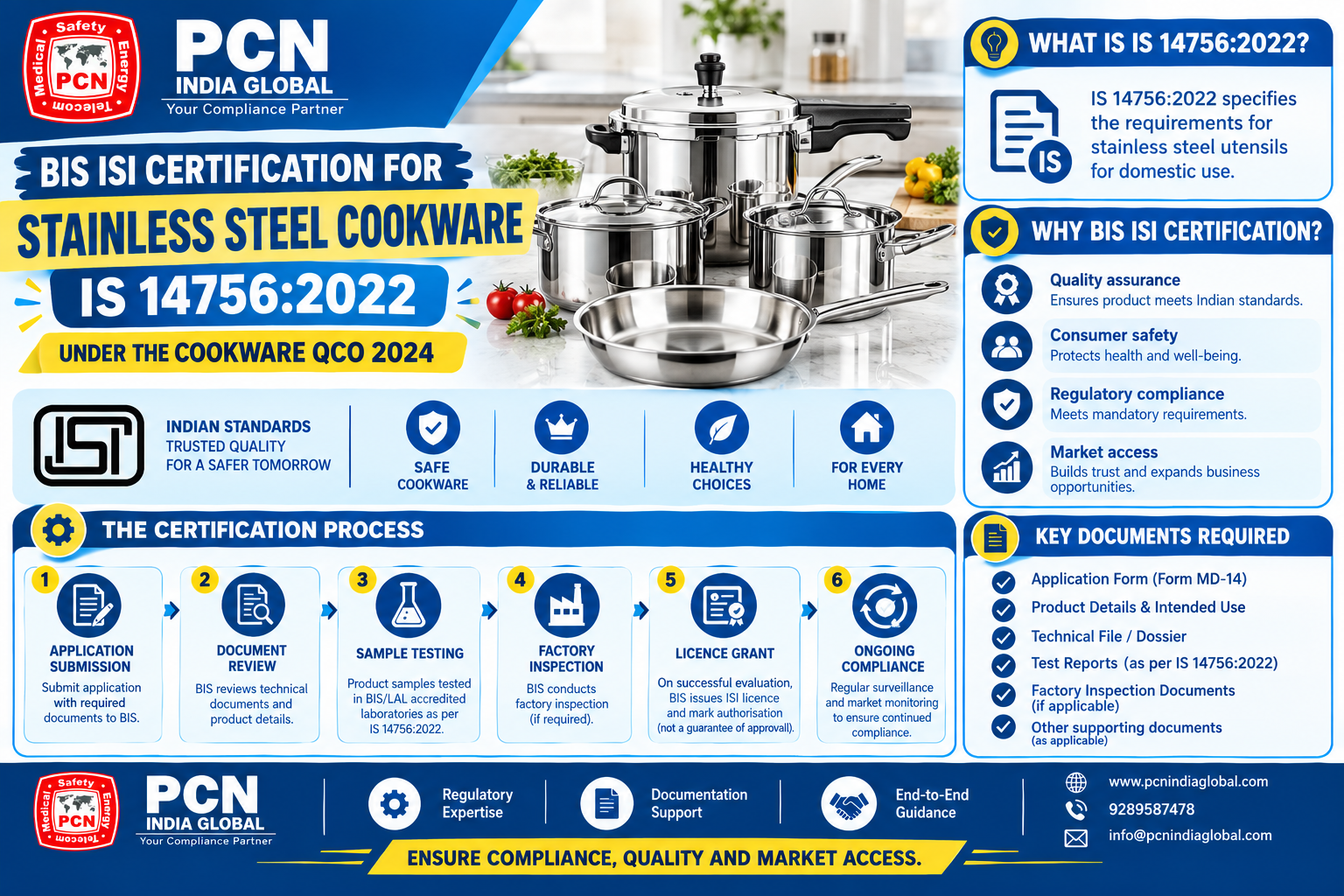
Stainless steel pots, pans, kadhais, tawas and serving utensils sold in India must now carry the ISI mark. The Cookware and Utensils (Quality Control) Order, 2024, issued by the Ministry of Commerce and Industry, makes IS 14756:2022 compulsory for stainless steel cookware. This affects every manufacturer, brand owner and importer in the kitchenware category.
Products Covered by the Cookware QCO 2024
| Product | Indian Standard |
|---|---|
| Stainless steel cookware and utensils | IS 14756:2022 |
| Wrought aluminium utensils | IS 1660:2009 |
| Stainless steel sinks for domestic use | IS 13983:1994 |
| Round open-top sanitary cans (tinplate) | IS 9396 (Part 1):1987 |
| Aluminium cans for beverages | IS 14407:1996 |
This post focuses on stainless steel cookware. The licensing route is the same for the other products on the list. Not sure whether your product is covered? Use our BIS QCO Product Checker.
What IS 14756:2022 Requires
- Material grade: the stainless steel grades permitted for food-contact cookware, verified by chemical composition
- Thickness and construction: minimum sheet thickness, and requirements for clad or sandwich bottoms
- Workmanship: finish, smooth edges, and how firmly handles and lids are fixed
- Performance: tests for handles, stability and resistance to use conditions
- Marking: manufacturer identity, steel grade, capacity or size, and the Standard Mark with the licence number
Who Needs the Licence
Licences are granted to the manufacturing unit, not to traders. Indian factories apply under the domestic BIS ISI mark scheme. Overseas factories in China, Vietnam, Korea or Europe apply through the BIS FMCS scheme and must appoint an Authorised Indian Representative. Brand owners who outsource production must make sure each contract factory holds its own licence in the brand’s name.
Certification Process
- Map your product range into families of grade, thickness and construction to keep testing to a minimum.
- Set up in-house testing for routine checks such as composition verification and thickness.
- Send samples to a BIS-recognised laboratory for testing to IS 14756:2022.
- File the application on Manak Online, with test reports and factory documents.
- BIS conducts a factory inspection and draws samples.
- BIS grants the licence, and you mark each piece with the ISI mark and CM/L number.
Typical Timeline
| Stage | Typical duration |
|---|---|
| Gap analysis, AIR appointment & document prep | 2–3 weeks |
| Application under FMCS & scrutiny | 2–3 weeks |
| Overseas factory audit & sample drawal | 4–8 weeks |
| Independent testing in India | 3–6 weeks |
| Grant of licence | 2–4 weeks after test report |
Durations are indicative and depend on sample readiness, lab queues and audit scheduling. See our BIS certification cost and timeline breakdown for fee heads.
Related Compliance
Pre-packed cookware sold at retail also needs Legal Metrology declarations on the pack. Importers additionally need LMPC registration. Plan both alongside BIS so that shipments are not held at port.
Common Mistakes
- Declaring a steel grade on the product that differs from the grade on the mill test certificate
- Testing one model and assuming it covers the whole catalogue across different grades or thicknesses
- Applying for the licence in the name of the brand owner instead of the actual factory
Frequently Asked Questions
Is BIS certification mandatory for stainless steel cookware?
Yes. The Cookware and Utensils (Quality Control) Order, 2024 makes IS 14756:2022 compulsory for stainless steel cookware and utensils manufactured, imported or sold in India.
Which products are covered by the Cookware QCO 2024?
Stainless steel cookware (IS 14756:2022), wrought aluminium utensils (IS 1660:2009), stainless steel sinks (IS 13983:1994), tinplate sanitary cans (IS 9396 Part 1:1987) and aluminium beverage cans (IS 14407:1996).
Can an importer get the BIS licence for cookware?
No. The licence is issued to the manufacturing factory. Foreign factories apply under FMCS and appoint an Authorised Indian Representative. The importer buys from the licensed factory.
Do aluminium utensils need a separate licence?
Yes. Aluminium utensils fall under IS 1660:2009, which needs its own BIS licence separate from IS 14756:2022.
Get Certified with PCN India Global
PCN India Global handles BIS ISI mark certification end to end for Indian and foreign manufacturers: gap analysis, test planning at BIS-recognised labs, documentation, factory audit preparation, and post-licence surveillance. Call +91 80109 05029 or WhatsApp us to get a product-specific checklist and timeline. Email: bdm@pcnindiaglobal.com