
BIS Certification for Footwear: 3 QCOs Explained
Walk into any Indian shoe store today and turn over a pair of sports shoes, rubber chappals or safety boots: you should find an ISI mark and a CM/L licence number. That is not a marketing badge. Since the government brought footwear under compulsory certification, selling, importing or stocking covered footwear without a valid BIS licence is an offence under the BIS Act, 2016.
The difficulty for brands is that footwear is not covered by one order but by three separate Quality Control Orders (QCOs), each with its own list of Indian Standards. This guide helps you work out which one applies to your product range, and what it takes to get licensed.
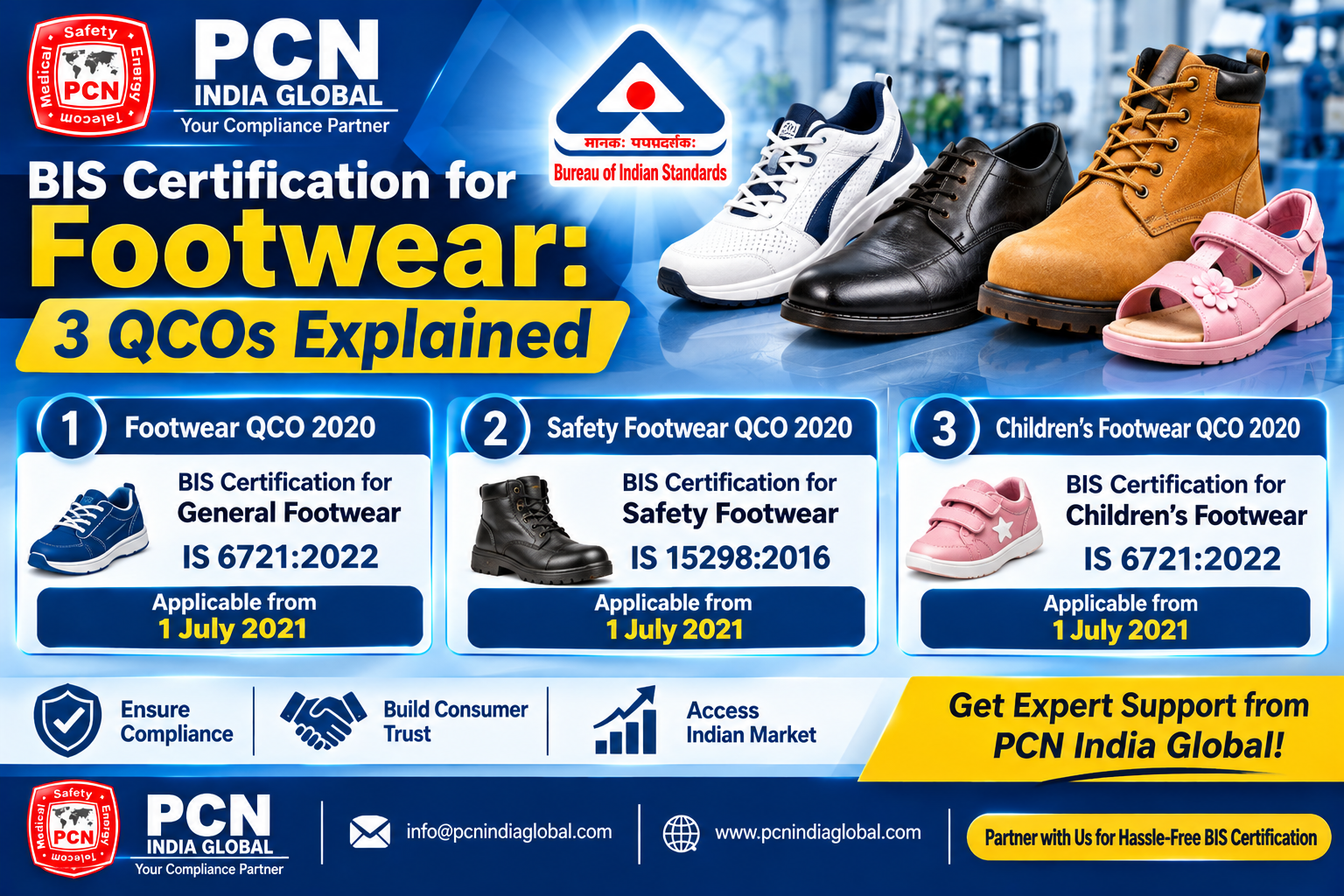
The three footwear QCOs at a glance
| Quality Control Order | What it covers | Typical buyers affected |
|---|---|---|
| Footwear made from Leather and other Materials (QC) Order, 2020 (S.O. 3860(E)), amended in 2024 | Canvas shoes and boots, leather safety shoes, sports footwear, shoes for services and general purpose | Fashion and sports brands, uniform suppliers, importers of finished shoes |
| Footwear made from All Rubber and All Polymeric Material and its Components (QC) Order, 2020 (S.O. 3858(E)) | Hawai chappals, PVC sandals, gum boots, PU and rubber soles and heels | Mass-market slipper makers, sole and component suppliers |
| Personal Protective Equipment – Footwear (QC) Order, 2020 (S.O. 3857(E)), amended in 2021 | Safety, protective and occupational footwear under IS 15298 | PPE distributors, industrial safety brands, EPC contractors |
Which standard does my product fall under?
Start with the material of the upper and the end use, not the product name on your catalogue. A “sneaker” could be general-purpose sports footwear or performance footwear, and each has its own part of IS 15844.
Sports and everyday shoes
- IS 15844 (Part 1): 2023: Sports footwear for general purpose
- IS 15844 (Part 2): 2023: Performance sports footwear
- IS 15844 (Part 3): 2024: Professional sports footwear
- IS 17043 (Part 1 & 2): 2024: Shoes for services and shoes for general purpose
- IS 3735 / IS 3736: Canvas shoes and canvas boots with rubber sole
Rubber and polymer footwear and components
- IS 10702: 1992: Rubber Hawai chappal
- IS 6721: 1972: PVC sandals
- IS 5557 / IS 5557 (Part 2): Industrial rubber knee and ankle boots, all-rubber gum boots
- IS 13995: Unlined moulded rubber boots; IS 12254: PVC industrial boots
- Components: IS 5676 (moulded rubber soles and heels), IS 6664 (microcellular sheets), IS 6719 (PVC soles and heels), IS 13893 (semi-rigid PU soles)
Safety, protective and specialist footwear
- IS 15298 (Parts 2, 3 & 4): Safety, protective and occupational footwear (PPE)
- IS 1989 (Parts 1 & 2): Leather safety boots for miners and heavy metal industries
- IS 11226 / IS 14544: Leather safety footwear with direct-moulded rubber or PVC soles
- IS 3976: Safety rubber canvas boots for miners
- IS 17012, IS 17037, IS 16994: Tactical boots, anti-riot shoes, footwear for municipal scavenging work
If your range spans several of these, you will normally need a separate licence (or inclusion of the product in an existing licence) for each standard. Grouping models correctly at the start saves both testing cost and months of back-and-forth with BIS.
How a footwear brand gets the ISI licence
- Map every SKU to an IS standard. Size ranges, sole construction and upper material all matter.
- Set up in-house testing. BIS expects the factory to run the routine tests listed in the Scheme of Inspection and Testing, for example sole thickness, flex resistance and bond strength, depending on the standard.
- File the application. Indian factories apply on Manak Online. Overseas factories apply under the Foreign Manufacturers Certification Scheme (FMCS) and must appoint an Authorised Indian Representative (AIR).
- Factory inspection and sampling. A BIS officer audits the production line and quality controls, then draws samples.
- Independent testing. Samples are tested in a BIS or BIS-recognised laboratory against the full standard.
- Grant of licence. Once the reports pass, BIS grants the licence and you can apply the ISI mark with your CM/L number on each pair or its packaging.
Where footwear applications usually get stuck
- Wrong standard part: sports shoes filed under Part 1 when the design is clearly performance footwear.
- Component vs finished product: sole makers assume their customer’s licence covers them. It doesn’t, if the sole itself is a notified product.
- Inadequate in-house lab: missing equipment for the routine tests is one of the most common inspection observations.
- Marking errors: the ISI mark, licence number and standard number must follow BIS marking rules exactly.
For importers: no licence, no clearance
Customs checks covered footwear against the BIS licence database at the port. If the overseas factory isn’t licensed for that standard, the shipment can be held, re-exported or destroyed. Importers should confirm the licence status and scope before placing orders, not after the container lands. You can check whether a product is notified using our QCO Checker or the full ISI Mark product list.
How PCN India Global helps footwear brands
We map your full range to the right standards, do a gap check on your factory lab, prepare the documents, coordinate the BIS inspection and testing, and act as AIR for overseas manufacturers under FMCS. After grant, we handle renewals, inclusions of new models and surveillance queries.
Talk to our footwear certification team: +91 80109 05029 | bdm@pcnindiaglobal.com
Frequently asked questions
Is BIS certification mandatory for all footwear in India?
It is mandatory for the footwear types and components covered by the three footwear QCOs: leather and other materials, all-rubber and polymeric, and PPE footwear. Check your exact product against the notified IS standards before manufacture or import.
Do sports shoes need the ISI mark?
Yes. Sports footwear is covered by IS 15844, split into general-purpose, performance and professional footwear. The correct part depends on the design and intended use.
Can a foreign shoe factory get a BIS licence?
Yes, under the Foreign Manufacturers Certification Scheme (FMCS). The factory must appoint an Authorised Indian Representative, pass a BIS factory inspection and have samples tested in India.
Do shoe soles need separate BIS certification?
Soles and heels made of moulded rubber, microcellular rubber, PVC or semi-rigid PU are notified products in their own right (IS 5676, IS 6664, IS 6719, IS 13893), so component makers need their own licence.