
BIS ISI Certification for TMT Bars: IS 1786:2008 Under the Steel QCO
High-strength deformed (HSD) steel bars, commonly sold as TMT bars, are one of the most closely watched products under India’s Steel and Steel Products (Quality Control) Order. Every rebar used in Indian construction, whether rolled locally or imported, must conform to IS 1786:2008 and carry the ISI mark.
Grades Under IS 1786:2008
The standard specifies the grades Fe 415, Fe 415D, Fe 415S, Fe 500, Fe 500D, Fe 500S, Fe 550, Fe 550D and Fe 600. The number is the minimum 0.2% proof stress in N/mm². “D” grades have tighter limits on chemistry and higher ductility, and “S” grades are meant for earthquake-resistant construction.
Key Tests
- Chemical composition: carbon, sulphur, phosphorus, and S+P combined
- Mechanical: 0.2% proof stress, tensile strength, elongation, and the tensile-to-yield ratio
- Bend and rebend tests for ductility
- Mass per metre and rib geometry tolerances
- Marking: a rolled-in brand or manufacturer identification and grade on the bar, and the ISI mark on the tag
Input Material Rules: A Recent Tightening
The Ministry of Steel has tightened its rules so that BIS-licensed rolling mills must also use BIS-compliant input material, such as billets. Importers and foreign mills should check their billet sources as part of the licence application. See the source note below.
Who Needs the Licence
- Every Indian rolling mill producing TMT or HSD bars
- Foreign steel mills exporting rebars to India, through FMCS, with an AIR
- Stockists and importers must buy only from licensed mills. Customs checks the CM/L number.
Certification Process
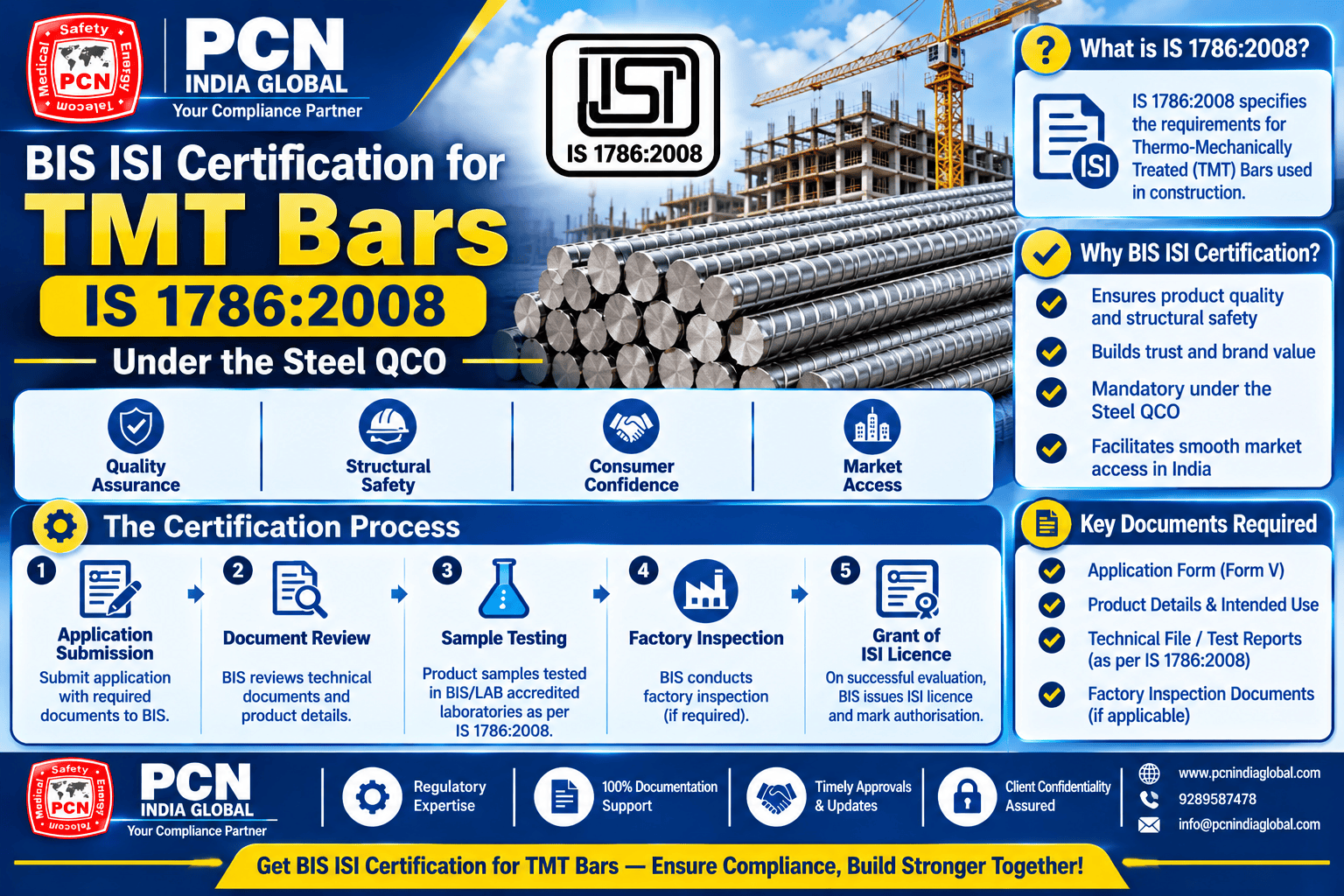
- Assess the mill lab, including the spectrometer, universal testing machine (UTM) and bend-test rig, against the scheme of testing and inspection (STI).
- Test samples by grade and diameter range at a BIS-recognised lab.
- Apply on Manak Online with process, raw-material and heat-treatment (quenching) details.
- BIS inspects the mill and draws samples from the line and from stock.
- BIS grants the licence, and you mark bundles and bars.
Typical Timeline
| Stage | Typical duration |
|---|---|
| Gap analysis, AIR appointment & document prep | 2–3 weeks |
| Application under FMCS & scrutiny | 2–3 weeks |
| Overseas factory audit & sample drawal | 4–8 weeks |
| Independent testing in India | 3–6 weeks |
| Grant of licence | 2–4 weeks after test report |
Durations are indicative and depend on sample readiness, lab queues and audit scheduling. See our BIS certification cost and timeline breakdown for fee heads.
Common Mistakes
- Applying for Fe 500D when the S+P chemistry only meets Fe 500 limits
- Rolled-in marks that are not legible across all diameters
- Undocumented billet sources that are not BIS-compliant
Frequently Asked Questions
Is BIS certification mandatory for TMT bars?
Yes. Under the Steel and Steel Products (Quality Control) Order, high-strength deformed steel bars must conform to IS 1786:2008 and carry the ISI mark.
What is the difference between Fe 500 and Fe 500D?
Both have a minimum 0.2% proof stress of 500 N/mm². Fe 500D has tighter limits on sulphur and phosphorus and higher elongation, which gives better ductility.
Can foreign steel mills export TMT bars to India?
Yes, once they hold a BIS licence to IS 1786:2008 under FMCS. The rebars must also meet the input-material requirements set by the Ministry of Steel.
Does one licence cover all TMT grades?
One IS 1786 licence can cover several grades and diameters, but each grade and size must be included in the licence scope and backed by test reports.
Get Certified with PCN India Global
PCN India Global handles BIS ISI mark certification end to end for Indian and foreign manufacturers: gap analysis, test planning at BIS-recognised labs, documentation, factory audit preparation, and post-licence surveillance. Call +91 80109 05029 or WhatsApp us to get a product-specific checklist and timeline.