
BEE Star Rating & Registration for Induction Hobs in India: Energy Consumption, IS 19014 and the Complete Star Label Process
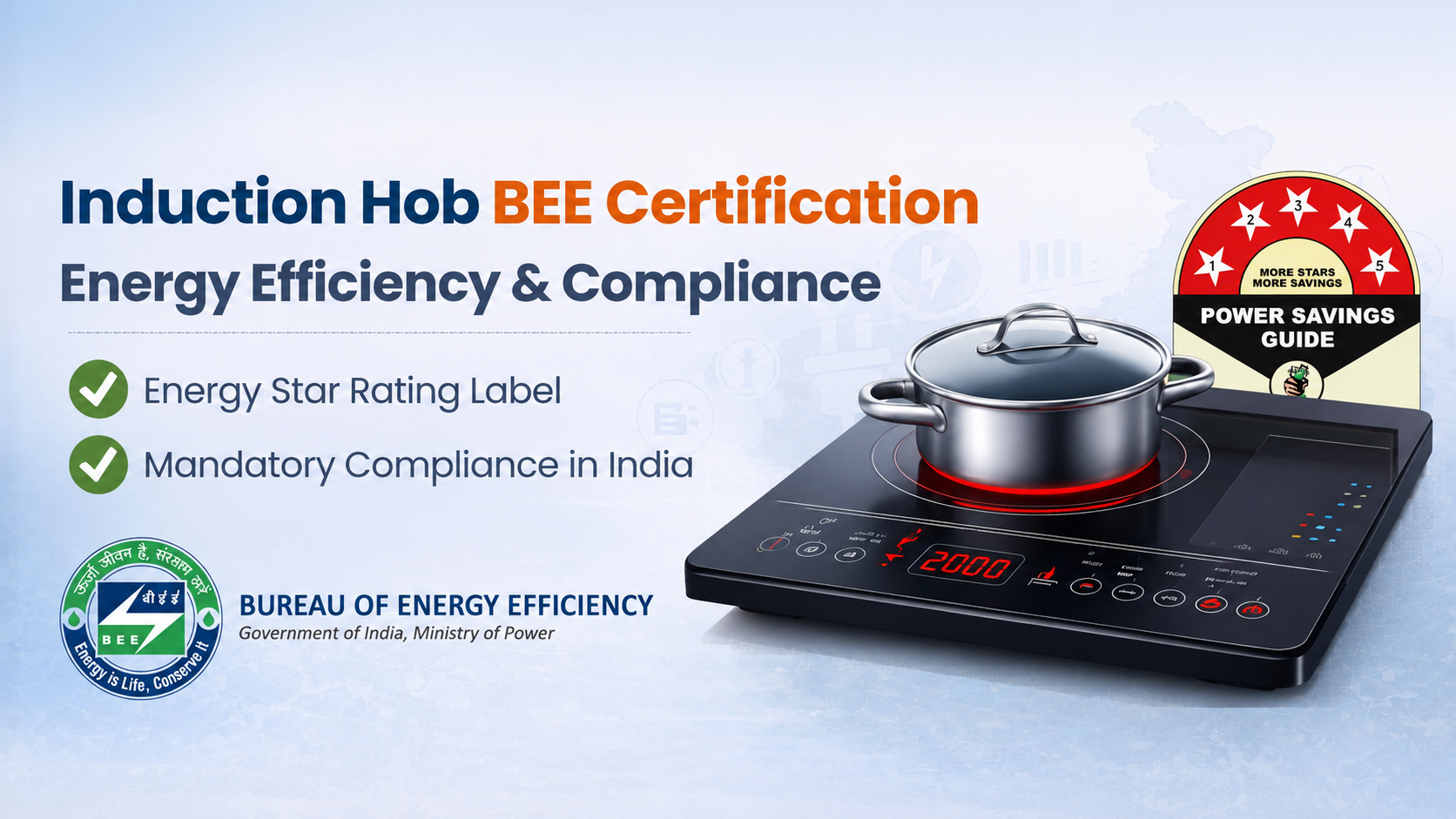
Induction cooking has moved from a niche appliance to a mainstream fixture in Indian kitchens, prized for its speed, safety, and precise control. Because an induction hob converts electricity directly into heat in the cookware, it is inherently more efficient than many alternatives — but efficiency still varies significantly between models, and that variation is exactly what the Bureau of Energy Efficiency (BEE) set out to make visible. The BEE star label on an induction hob tells the buyer how much energy the appliance uses to do a standard cooking job, allowing genuine comparison. For manufacturers and importers, understanding the BEE Star Label and registration requirements for induction hobs is now essential, because the category is moving firmly into mandatory territory.
Induction hobs are covered under a dedicated BEE schedule (commonly referenced as Schedule 34), and the programme has set a clear mandatory pathway: from 1 July 2026 to 31 December 2028, induction hobs must follow the Indian Standard IS 19014:2022 to display BEE star labels. That timeline matters — brands that treat induction hob labelling as optional risk being caught out when the mandatory phase locks in. This guide explains how the certification works, the energy metric behind the stars, the standard and testing involved, the step-by-step process, the documents required, and realistic timelines and costs.
The Move to Mandatory Labelling
BEE Star Labelling operates under the Energy Conservation Act, 2001, administered by the Bureau of Energy Efficiency under the Ministry of Power. Product categories sit in either the voluntary or mandatory column, and induction hobs have a defined mandatory labelling window running from 1 July 2026 to 31 December 2028, tied to IS 19014:2022. Once a category is mandatory, the rules are firm: no covered induction hob may be manufactured, imported, displayed, or sold without a valid BEE registration and an affixed star label.
Enforcement mechanisms mirror those for other mandatory appliances — unlabelled products can face seizure and penalties under the Energy Conservation Act, retailers can be required to withdraw non-compliant stock, and e-commerce platforms increasingly demand proof of a live registration before listing. For a fast-growing category like induction cooking, getting ahead of the mandatory date is the difference between an uninterrupted market presence and a scramble to comply.
Ehob: The Energy Metric Behind the Stars
The star rating for an induction hob is based on its energy consumption in a standardised cooking task, captured by a metric BEE refers to as Ehob — the electrical energy, in watt-hours, consumed per 1,000 grams of water load heated under defined test conditions. In effect, the test measures how much electricity the hob needs to heat a standard quantity of water, which serves as a proxy for cooking efficiency.
The logic is the inverse of the fan and lamp metrics: for induction hobs, lower energy consumption means a better rating. A hob that heats the standard load using fewer watt-hours is more efficient and earns more stars, up to a maximum of five, shown in one-star intervals. Because the metric is defined against a fixed water load and controlled conditions, it produces a like-for-like comparison across models regardless of brand claims about “power levels” or wattage settings.
This makes accurate, standard-conforming testing decisive. Two hobs with the same nominal wattage can post quite different Ehob values depending on coil design, cookware coupling, control electronics, and thermal losses — so the measured result, not the spec sheet, determines the star.
The Standard: IS 19014:2022
Testing for BEE certification of induction hobs is anchored to IS 19014:2022, the Indian Standard that defines the performance and energy-measurement methodology for induction hobs during the mandatory labelling window. Compliance with this standard is the reference point for establishing the Ehob value and therefore the star rating. Manufacturers should ensure their test programme is built explicitly around IS 19014:2022 conditions; testing against generic international protocols will not necessarily produce results that map to the Indian star bands.
Alongside the BEE energy label, induction hobs are electrical appliances that generally attract BIS safety compliance as well, so most brands manage a combined BIS-plus-BEE file for the same product. Coordinating the two workstreams from the outset avoids the common trap of securing one approval while the other becomes the bottleneck.
Step-by-Step: How to Get a BEE Star Label for an Induction Hob
Our team manages each stage end to end, but every applicant should understand the sequence.
- Confirm applicability and the mandatory timeline. Establish that the model falls within the induction-hob schedule and plan against the mandatory window and IS 19014:2022.
- Test at a BEE-recognised / NABL-accredited laboratory. Submit sample hobs for energy testing against IS 19014:2022 to establish the Ehob value. This report is the basis of the star assignment.
- Register the company and brand on the BEE portal. Create the manufacturer / importer account on the official BEE (beestarlabel) portal and obtain your company and brand identifiers, reused across all models.
- Register each model. File the model-level application with the technical specification sheet, the test report, the Ehob data, and the required declarations. Each model needs its own registration and its own test evidence.
- Star assignment and label generation. BEE maps the Ehob value to the applicable star band and generates the official label showing the star rating and validity period.
- Affix the label and sell. Print and affix the approved BEE label, in the prescribed format, on every unit / pack before display or sale.
- Renew periodically. Labels are valid for a limited period and must be renewed, with updated test data where criteria have changed.
Documents Required for BEE Certification of Induction Hobs
A complete file at the outset is the biggest single lever on approval speed. You will typically need:
For testing and the model application
- Product technical specification sheet (rated power, number of zones, control type)
- Model name and full product description exactly as it will appear on the carton
- Physical product samples for the laboratory
- Valid test report from a NABL-accredited / BEE-recognised laboratory against IS 19014:2022 (Ehob data)
- Label draft / artwork in the prescribed BEE format
- Signed model declaration / declaration of conformity
For company and brand registration
- Certificate of Incorporation (MCA/ROC)
- GST registration certificate
- PAN card of the company
- Trademark / brand authorisation documents
- Address proof of the company and manufacturing facility details
- Authorised signatory details, and Board Resolution / Power of Attorney
- Import Export Code (IEC) — for importers
- Brand authorisation letter — where an importer represents an overseas brand
Foreign manufacturers cannot register directly on the BEE portal unless they have an Indian-registered entity; overseas brands must appoint an authorised Indian representative or work through their Indian importer.
Timeline and Cost Planning
A realistic first-model schedule runs roughly five to nine weeks end to end. Energy testing against IS 19014:2022 is usually the longest single element, commonly two to four weeks depending on lab queue and the number of models. Document preparation and company/brand registration can run in parallel and add one to two weeks, and portal processing generally takes a further two to four weeks.
Where a brand registers a range built on shared coil and control platforms, test evidence and documentation leverage across models. The labelling fee for induction hobs is tiered by rating — lower for higher-star models — which gently rewards more efficient designs. Given the fixed mandatory start date, the smartest plan is to complete testing and registration comfortably ahead of it rather than against the deadline.
Common Mistakes That Delay Induction Hob Registration
- Testing to the wrong protocol. Only testing built around IS 19014:2022 conditions produces Ehob values that map to the Indian star bands.
- Relying on nominal wattage. The star depends on measured Ehob, not the spec-sheet power rating; two same-wattage hobs can rate differently.
- Leaving it to the deadline. With a fixed mandatory start, late testing risks a gap in saleability.
- Treating BIS and BEE as one step. Hobs need both safety compliance and the BEE energy label; run them in parallel.
- Model-name drift. The designation on the report, portal, label, and carton must match exactly.
- Skipping renewal. A lapsed label makes every unit on the shelf non-compliant.
Induction Hobs Also Need These Approvals
BEE labelling rarely travels alone:
- BIS certification — safety compliance under the applicable Indian Standard; see our BIS certification service, with electronic-product categories routed via BIS CRS registration where applicable.
- EPR for e-waste — producers and importers of electrical and electronic equipment must hold EPR registration for e-waste with CPCB.
- Legal Metrology (LMPC) — imported pre-packaged hobs require LMPC registration and correct package declarations.
Pre-Launch Compliance Checklist for Induction Hobs
Before committing to a production run or booking an import consignment, run this verification sequence. First, confirm the exact model designation that will appear on the carton, the test report, and the BEE label is identical down to every suffix. Second, verify that the laboratory tested against IS 19014:2022 and that the resulting Ehob maps to your intended star rating. Third, check that the label artwork uses the prescribed BEE format and shows the correct star count. Fourth, confirm the BIS safety approval is in place or progressing in parallel, since the BEE label alone does not make the product legal. Fifth, ensure the company/brand registration is live and, for imports, that the registration holder and importer of record are aligned, with EPR and LMPC progressing on the same schedule.
For ongoing operations, keep a compliance register per model: BEE registration number and validity, Ehob and star band, test report reference, and the associated BIS registration — so the mandatory window is met comfortably and renewals never lapse.
Frequently Asked Questions
Is BEE certification mandatory for induction hobs?
Induction hobs have a defined mandatory labelling window running from 1 July 2026 to 31 December 2028, tied to IS 19014:2022. Within that window, covered models must carry a valid BEE registration and star label to be sold.
What decides the star rating?
The Ehob metric — the electrical energy (in watt-hours) the hob consumes to heat a standard 1,000 g water load under test conditions. Lower energy consumption means a higher star rating.
Which standard is used for testing?
IS 19014:2022, which defines the performance and energy-measurement methodology for induction hobs during the mandatory window.
Does nominal wattage determine the rating?
No. Two hobs of the same wattage can post different Ehob values depending on design and losses. The measured Ehob, not the spec sheet, sets the star.
Do I need a separate registration for each model?
Yes. Every model requires its own test report and registration, though the company and brand registration is done once and covers all models under the brand.
Can a foreign manufacturer register directly?
No. Overseas brands need an Indian-registered entity or must appoint an authorised Indian representative / work through their Indian importer.
Why Choose PCN India Global
- Standard-correct testing — we build the test programme around IS 19014:2022 so the Ehob result maps to the right star the first time
- Deadline-aware planning — we complete testing and registration ahead of the mandatory window, not against it
- Coordinated BIS + BEE handling — safety and energy approvals run in parallel so neither becomes the bottleneck
- End-to-end portal handling — company, brand, and model registration filed, tracked, and driven to label generation
- Foreign-brand representation — we act as your authorised Indian representative where you have no Indian entity
- One integrated timeline — BEE sequenced with BIS, EPR, and LMPC so your launch date holds
PCN India Global manages the complete BEE Star Label process for induction hobs — from IS 19014:2022 testing and Ehob assessment to portal filing, label generation, and renewal, coordinated with your BIS approval. Contact us: WhatsApp +91 80109 05029, email bdm@pcnindiaglobal.com, or start your application today.