
CDSCO Licence for Enteral Feeding Tubes in India: Class B Registration and ISO 20695
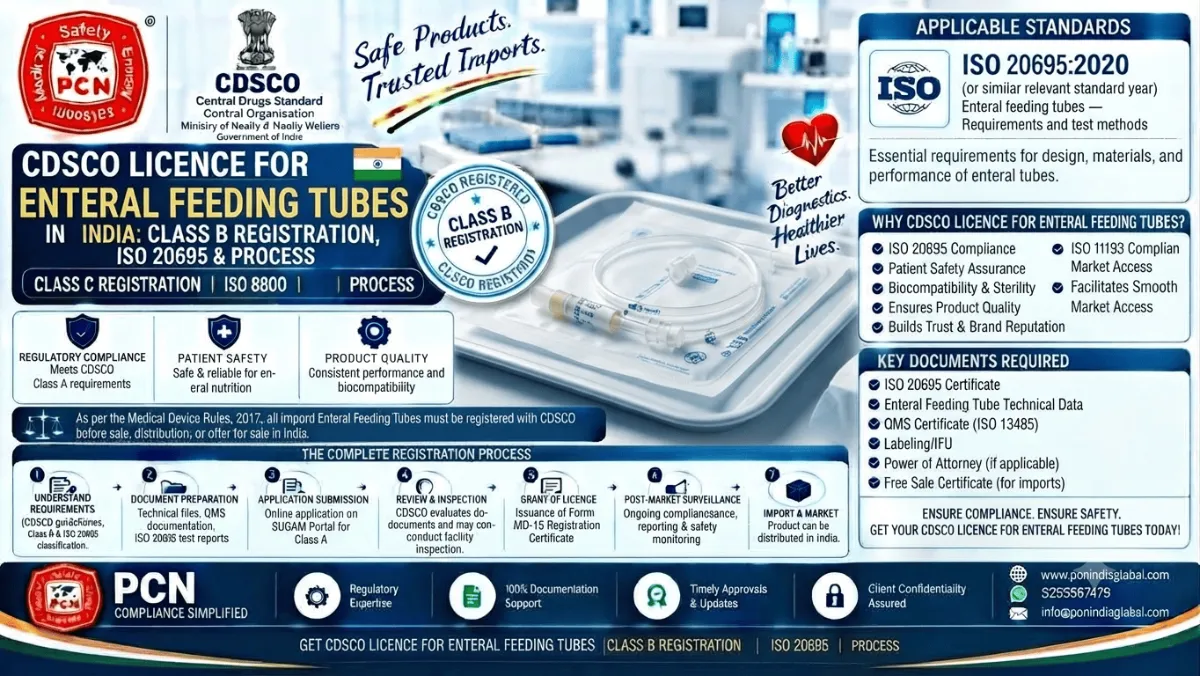
An enteral feeding tube delivers nutrition and medication directly to the stomach or intestine when a patient cannot eat normally — from short-term nasogastric tubes to longer-term gastrostomy (PEG) tubes. Because it enters the body and connects to the GI tract, CDSCO regulates the enteral feeding tube as a Class B device with the enteral-equipment standards and the ENFit connector requirement behind the licence. This guide covers the full CDSCO registration pathway for enteral feeding tubes under the Medical Devices Rules, 2017 — classification, licence route, ISO 20695, the documents, the fees and the timeline. (Confirm the class for long-term/implanted gastrostomy devices against the current CDSCO list.) This guide explains CDSCO registration for enteral feeding tubes in India — risk class, licence forms, standards, documents, fees and timeline.
Is a CDSCO Registration Mandatory for Enteral Feeding Tubes?
Yes. An enteral feeding tube is a notified Class B medical device and cannot be manufactured, imported or sold in India without a CDSCO licence. A domestic manufacturer holds a Form MD-5 licence from the State Licensing Authority. An importer holds a Form MD-15 import licence through an Indian Authorised Agent. Nasogastric, nasojejunal and gastrostomy tubes, and enteral syringes/giving sets, fall within the framework.
Risk Classification of Enteral Feeding Tubes
Enteral Feeding Tubes are classified as Class B (low-to-moderate risk). An enteral feeding tube is a surgically invasive device introduced through a body orifice (or stoma) that connects to the GI tract, placing it in Class B (low-to-moderate risk) under the First Schedule. Long-term gastrostomy devices may be classified higher. Where a device could fall in two classes the higher class applies, and an accessory is classified in its own right. Always confirm against the current CDSCO classification list.
Which CDSCO Licence You Need for Enteral Feeding Tubes
- To manufacture enteral feeding tubes in India (Class B) — apply in Form MD-3 to the State Licensing Authority (SLA). The licensing authority grants the licence in Form MD-5. A CDSCO-empanelled Notified Body audits the site. For Class A the audit is post-grant. For Class B the Notified Body conducts it before the licensing authority grants the licence.
- To import enteral feeding tubes (any class) — the overseas manufacturer appoints an Indian Authorised Agent who files Form MD-14 with the Central Licensing Authority; CDSCO grants the import licence in Form MD-15.
Applicable Standards for Enteral Feeding Tubes
Enteral feeding tubes are evaluated against the enteral-equipment standards plus the misconnection-prevention connector:
- ISO 20695 — enteral feeding systems: design and testing.
- ISO 80369-3 — small-bore connectors (ENFit) for enteral applications, to prevent tubing misconnections.
- ISO 10993 series — biocompatibility of the tube and connectors.
- ISO 11135 / 11137 — sterilisation validation.
- Radiopacity and flow/kink performance as required.
- Shelf-life / stability data supporting the expiry.
Documents Required for CDSCO Registration of Enteral Feeding Tubes
The core CDSCO dossier is the same for every medical device: the application on CDSCO’s online medical device portal, Device Master File, Plant Master File, ISO 13485 certificate, Essential Principles checklist, ISO 14971 risk file, labels and IFU, undertakings and the fee receipt. The full checklist, with what each document must contain, is in our CDSCO medical device registration guide. Below is what CDSCO specifically expects to see for enteral feeding tubes.
Device-Specific Documents for Enteral Feeding Tubes
Device-specific documents on top of the core set for enteral feeding tubes:
- ISO 20695 test reports — flow, tensile, kink and radiopacity performance.
- ISO 80369-3 (ENFit) connector conformity to prevent misconnection.
- Sterilisation validation with the sterility assurance level.
- Biocompatibility (ISO 10993) for the tube and connectors.
- Balloon/retention-device evidence for gastrostomy tubes.
- Country-of-origin approval / Free Sale Certificate for imports.
Label & IFU Requirements Specific to Enteral Feeding Tubes
Enteral-feeding-tube labelling is checked for size, connector and sterility:
- French size, length, tube type (NG/NJ/gastrostomy) and connector (ENFit), with the reference number.
- Batch/lot number, date of manufacture and use-by date.
- “STERILE” with the sterilisation-method symbol and a single-use symbol.
- “For enteral use only” and placement/verification information in the IFU.
ENFit Connectors: Misconnection Prevention
The defining requirement for modern enteral devices is the ENFit (ISO 80369-3) connector — an enteral-specific design introduced worldwide to stop dangerous tubing misconnections (e.g. enteral feed into an IV line). CDSCO expects enteral feeding tubes to use the correct small-bore enteral connector, not a luer. Beyond that, short-term nasogastric tubes and long-term gastrostomy (PEG) tubes differ in retention design and can differ in class. Fix the tube type and the connector standard at the outset.
Step-by-Step CDSCO Registration Process for Enteral Feeding Tubes
Every device follows the same online filing route, which we walk through step by step in our complete CDSCO registration guide. For enteral feeding tubes, these are the steps that need the most attention:
- Confirm the classification. Fix the risk class against the CDSCO classification list and the First Schedule — Class B here — which decides the form, authority, fee and audit route.
- Site audit / inspection. A CDSCO-empanelled Notified Body audits the site. For Class A the audit is post-grant. For Class B the Notified Body conducts it before the licensing authority grants the licence.
CDSCO Registration Fees and Timeline for Enteral Feeding Tubes
A complete Class B manufacturing file typically clears in about three to six months. An import (MD-15) file usually takes six to nine months. Every deficiency letter effectively restarts the clock. Unlike the old registration certificates, an MDR 2017 licence does not expire — it stays valid as long as you pay the retention fee (equal to the licence fee) every five years and meet the conditions of licence.
Common Mistakes That Trigger a CDSCO Query
Common query reasons for enteral-feeding-tube applications are:
- Wrong connector — a luer instead of the ENFit (ISO 80369-3) enteral connector.
- Sterilisation validation missing or not matching the cycle.
- Gastrostomy tubes without retention/balloon evidence.
- Biocompatibility not covering the intended dwell time.
- Free Sale Certificate scope not covering all sizes/types on import.
FAQs on CDSCO Registration for Enteral Feeding Tubes
What CDSCO class is an enteral feeding tube?
An enteral feeding tube is Class B. A domestic manufacturer files Form MD-3 for an MD-5 licence. An importer files Form MD-14 for an MD-15 licence. Confirm the class for long-term gastrostomy devices on the current CDSCO list.
Which standards apply to enteral feeding tubes in India?
ISO 20695 for enteral feeding systems and ISO 80369-3 (ENFit) for the enteral connector, with ISO 10993 biocompatibility and validated sterilisation.
What is ENFit and why does it matter?
ENFit (ISO 80369-3) is the enteral-specific small-bore connector introduced to prevent dangerous tubing misconnections; CDSCO expects enteral tubes to use it rather than a luer.
Does CDSCO require a factory audit?
Yes — for Class B manufacture a CDSCO-empanelled Notified Body audits the site before the licensing authority grants the MD-5 licence.
How long does registration take?
A complete Class B manufacturing (MD-5) file usually clears in about three to six months. An import (MD-15) file typically takes six to nine months.
Related CDSCO Registration Guides
Need end-to-end help? See our CDSCO registration services, or read these related guides:
- CDSCO Registration for COVID-19 Antigen Test Kits in India
- CDSCO Registration for Blood Bags in India
- CDSCO Registration for Eyebrow Pencil & Brow Products in India
Official references: Central Drugs Standard Control Organisation (CDSCO) and the CDSCO MD Online portal.
Why Choose PCN India Global
- Classification triage — we confirm the correct risk class for your enteral feeding tubes against the current CDSCO list before we draft anything.
PCN India Global manages the complete CDSCO process for enteral feeding tubes — from classification and route selection to Device and Plant Master File preparation, online filing, audit support and the licence grant. WhatsApp or call +91 80109 05029, or email admin@pcnindiaglobal.com, to get your registration underway.
Related Compliance Guides
- CDSCO Licence for TENS Units
- CDSCO Licence for Pulse Oximeters
- CDSCO Licence for Oxygen Masks & Cannula
- CDSCO Licence for Infant Incubators
Need help? PCN India Global handles end-to-end CDSCO medical device registration for manufacturers and importers.
Related guides
- CDSCO Licence for Guidewires in India: Class C Registration and ISO 11070
- CDSCO Licence for Hearing Aids in India: Class B Registration and IEC 60118
- CDSCO Licence for Heart Valves in India: Class D Registration and ISO 5840
- CDSCO Licence for HIV Test Kits in India: Class D IVD Registration
- CDSCO Licence for Hospital Beds in India: Class B Registration and IEC 60601-2-52
- CDSCO Licence for Implantable Pacemakers in India: Class D Registration and ISO 14708
More Medical Devices Guides
- CDSCO Licence for Blood Glucose Test Strips in India: Class C IVD Registration
- CDSCO Licence for Endotracheal Tubes in India: Class B Registration and ISO 5361
- CDSCO Licence for Guidewires in India: Class C Registration and ISO 11070
- CDSCO Licence for Endoscopes in India: Class C Registration and ISO 8600
- CDSCO Licence for Hearing Aids in India: Class B Registration and IEC 60118
- CDSCO Licence for Electrosurgical Units in India: Class C Registration and IEC 60601-2-2