
CDSCO Licence for Guidewires in India: Class C Registration and ISO 11070
A guidewire is the thin, steerable wire that leads catheters and devices to the right place inside the vascular system — small, but its performance directly affects the safety of every interventional procedure it enables. Because it enters the circulatory system, CDSCO regulates the guidewire as a Class C device with the intravascular-accessory standard, sterility and biocompatibility behind the licence. This guide covers the full CDSCO registration pathway for guidewires under the Medical Devices Rules, 2017 — classification, licence route, ISO 11070, the documents, the fees and the timeline. This guide explains CDSCO registration for guidewires in India — risk class, licence forms, standards, documents, fees and timeline.
Is a CDSCO Registration Mandatory for Guidewires?
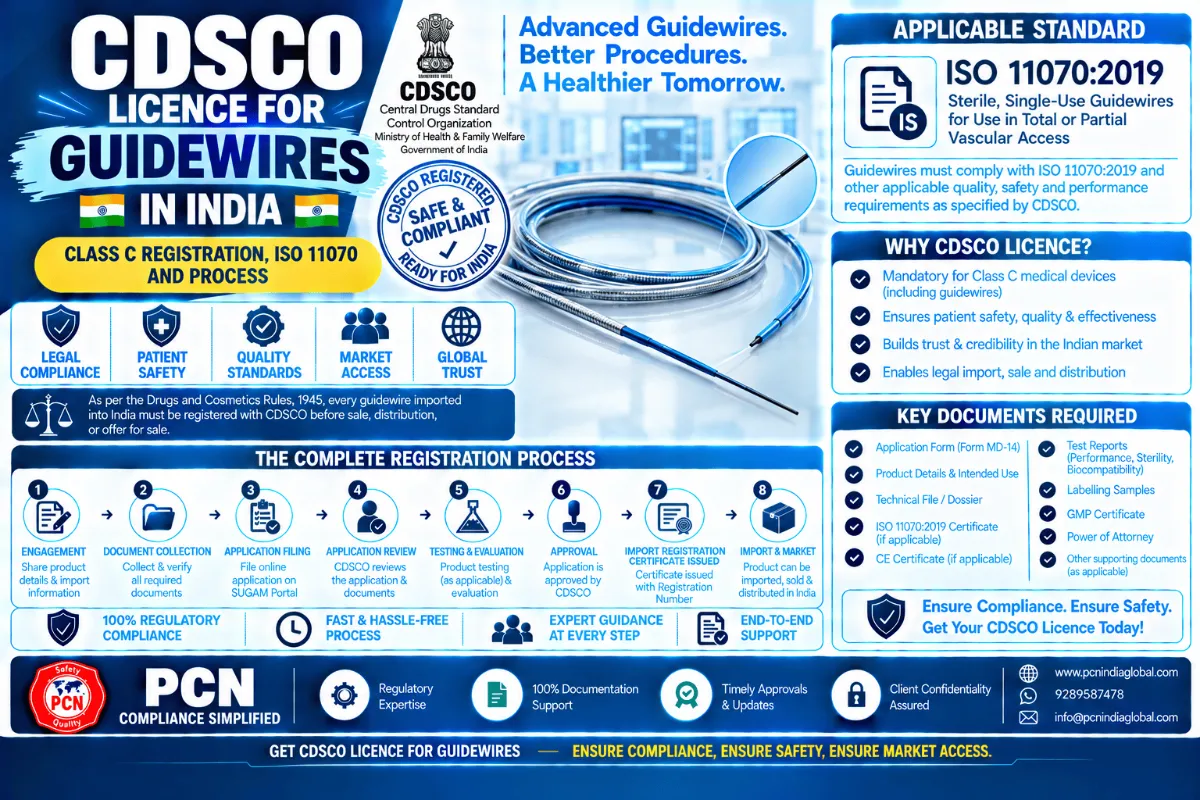
Yes. A guidewire is a notified Class C medical device and cannot be manufactured, imported or sold in India without a CDSCO licence. Because it is Class C, a domestic manufacturer applies to the Central Licensing Authority in Form MD-7 for a Form MD-9 licence. An importer applies in Form MD-14 for a Form MD-15 import licence. Diagnostic and interventional guidewires, coated and uncoated, are covered, with each type and size declared.
Risk Classification of Guidewires
Guidewires are classified as Class C (moderate-to-high risk). A guidewire is a surgically invasive device that connects to the central circulatory system for short-term use, placing it in Class C (moderate-to-high risk) under the First Schedule. Where a device could fall in two classes the higher class applies, and an accessory is classified in its own right. Always confirm against the current CDSCO classification list.
Which CDSCO Licence You Need for Guidewires
- To manufacture guidewires in India (Class C) — apply in Form MD-7 to the Central Licensing Authority (CDSCO headquarters). The licensing authority grants the licence in Form MD-9. A CDSCO joint audit team inspects the manufacturing site before the licensing authority grants the licence — site inspection is mandatory for Class C and D.
- To import guidewires (any class) — the overseas manufacturer appoints an Indian Authorised Agent who files Form MD-14 with the Central Licensing Authority; CDSCO grants the import licence in Form MD-15.
Applicable Standards for Guidewires
Guidewires are evaluated against the intravascular-accessory standard plus sterility and biocompatibility:
- ISO 11070 — sterile single-use intravascular catheter introducers, dilators, needles and guidewires.
- ISO 10993 series — haemocompatibility and biocompatibility of the wire and any coating (e.g. PTFE, hydrophilic).
- ISO 11135 / 11137 — sterilisation validation (EO or radiation).
- Tensile, flexibility, torque and tip-flexibility performance as required by the standard.
- Coating-integrity and particulate evidence for coated guidewires.
- Corrosion resistance data for the wire material.
Documents Required for CDSCO Registration of Guidewires
The core CDSCO dossier is the same for every medical device: the application on CDSCO’s online medical device portal, Device Master File, Plant Master File, ISO 13485 certificate, Essential Principles checklist, ISO 14971 risk file, labels and IFU, undertakings and the fee receipt. The full checklist, with what each document must contain, is in our CDSCO medical device registration guide. Below is what CDSCO specifically expects to see for guidewires.
Device-Specific Documents for Guidewires
Device-specific documents on top of the core set for guidewires:
- ISO 11070 test reports — tensile, flexibility, torque, tip performance and fracture resistance.
- Sterilisation validation with the sterility assurance level (SAL 10⁻⁶).
- Haemocompatibility (ISO 10993) for the wire and coating.
- Coating-integrity and particulate-release data for coated guidewires.
- Shelf-life / stability data supporting the expiry.
- Country-of-origin approval / Free Sale Certificate for imports.
Label & IFU Requirements Specific to Guidewires
Guidewire labelling is checked for size, sterility and single-use messaging:
- Diameter (inch/mm), usable length, tip configuration and coating, with the reference number.
- Batch/lot number, date of manufacture and use-by date.
- “STERILE” with the sterilisation-method symbol and a single-use symbol.
- Compatible catheter/introducer sizes and handling information in the IFU.
Coated vs Uncoated, and the Particulate Question
Guidewires split into uncoated and coated (PTFE, silicone or hydrophilic) types. Coatings improve trackability but introduce their own risks — coating integrity and particulate shedding are recognised safety concerns and draw specific evidence requirements. Decide which guidewire types, sizes and coatings you are registering, and evidence coating integrity for coated wires. A coating claim without integrity/particulate data is a common cause of queries.
Step-by-Step CDSCO Registration Process for Guidewires
Every device follows the same online filing route, which we walk through step by step in our complete CDSCO registration guide. For guidewires, these are the steps that need the most attention:
- Confirm the classification. Fix the risk class against the CDSCO classification list and the First Schedule — Class C here — which decides the form, authority, fee and audit route.
CDSCO Registration Fees and Timeline for Guidewires
A complete Class C manufacturing file typically clears in about six to nine months. An import (MD-15) file usually takes six to nine months. Every deficiency letter effectively restarts the clock. Unlike the old registration certificates, an MDR 2017 licence does not expire — it stays valid as long as you pay the retention fee (equal to the licence fee) every five years and meet the conditions of licence.
Common Mistakes That Trigger a CDSCO Query
Class C blood-contacting devices draw detailed queries. The recurring reasons are:
- Sterilisation validation missing or not matching the actual cycle.
- Coated guidewires without coating-integrity/particulate data.
- Haemocompatibility absent for the wire or coating.
- Tip-flexibility/fracture-resistance data incomplete.
- Free Sale Certificate scope not covering all sizes/types on import.
FAQs on CDSCO Registration for Guidewires
What CDSCO class is a guidewire?
A guidewire is Class C, so a domestic manufacturer files Form MD-7 for an MD-9 licence with the Central Licensing Authority, and an importer files Form MD-14 for an MD-15 licence.
Which standard applies to guidewires in India?
ISO 11070 for sterile single-use intravascular guidewires (and related introducers), with ISO 10993 haemocompatibility and validated sterilisation.
Do coated guidewires need extra evidence?
Yes — coating integrity and particulate-release data are expected for coated (e.g. hydrophilic) guidewires, on top of the general ISO 11070 requirements.
Does CDSCO require a site inspection?
Yes — for Class C manufacture, a CDSCO joint audit team inspects the site before the licensing authority grants the MD-9 licence.
How long does guidewire registration take?
Budget roughly six to nine months for a complete Class C manufacturing (MD-9) or import (MD-15) file.
Related CDSCO Registration Guides
Need end-to-end help? See our CDSCO registration services, or read these related guides:
- CDSCO Registration for Dengue & Malaria Rapid Test Kits in India
- CDSCO Registration for Blood Bags in India
- CDSCO Registration for Condoms in India
- CDSCO Registration for Adhesive Bandages in India
Official references: Central Drugs Standard Control Organisation (CDSCO) and the CDSCO MD Online portal.
Why Choose PCN India Global
- Classification triage — we confirm the correct risk class for your guidewires against the current CDSCO list before we draft anything.
PCN India Global manages the complete CDSCO process for guidewires — from classification and route selection to Device and Plant Master File preparation, online filing, audit support and the licence grant. WhatsApp or call +91 80109 05029, or email admin@pcnindiaglobal.com, to get your registration underway.
Related Compliance Guides
- CDSCO Licence for Surgical Staplers
- CDSCO Licence for Insulin Pens
- CDSCO Licence for COVID Antigen Kits
- CDSCO Licence for Dengue & Malaria Kits
Need help? PCN India Global handles end-to-end CDSCO medical device registration for manufacturers and importers.
Related guides
- CDSCO Licence for Hearing Aids in India: Class B Registration and IEC 60118
- CDSCO Licence for Heart Valves in India: Class D Registration and ISO 5840
- CDSCO Licence for HIV Test Kits in India: Class D IVD Registration
- CDSCO Licence for Hospital Beds in India: Class B Registration and IEC 60601-2-52
- CDSCO Licence for Implantable Pacemakers in India: Class D Registration and ISO 14708
- CDSCO Licence for Medical Gloves in India: Surgical Gloves (Class B) and Examination Gloves (Class A)
More Medical Devices Guides
- CDSCO Licence for Hearing Aids in India: Class B Registration and IEC 60118
- CDSCO Licence for Blood Glucose Test Strips in India: Class C IVD Registration
- CDSCO Licence for HIV Test Kits in India: Class D IVD Registration
- CDSCO Licence for Enteral Feeding Tubes in India: Class B Registration and ISO 20695
- CDSCO Licence for Heart Valves in India: Class D Registration and ISO 5840
- CDSCO Licence for Endotracheal Tubes in India: Class B Registration and ISO 5361