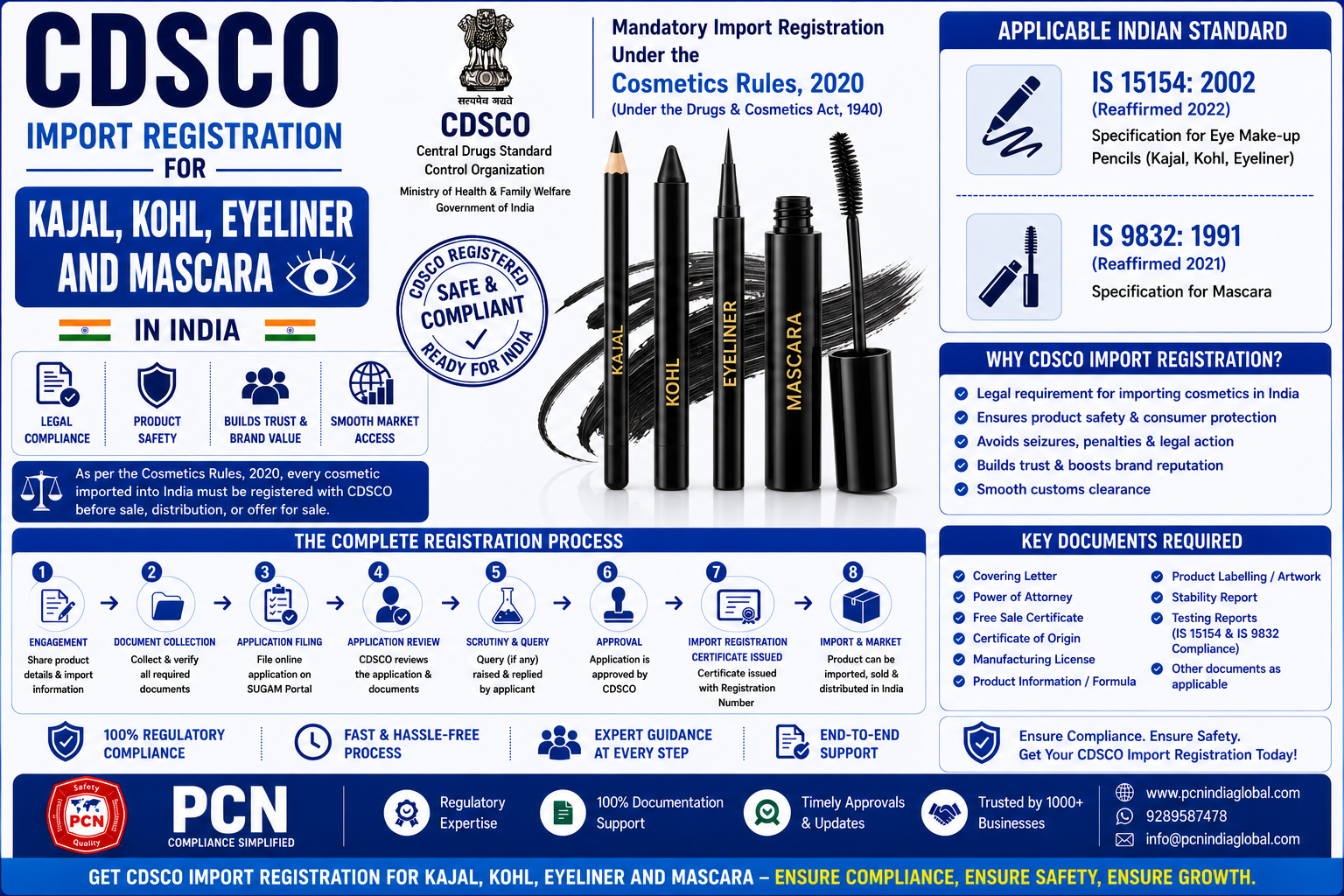
CDSCO Import Registration for Kajal, Kohl, Eyeliner and Mascara in India: IS 15154, IS 9832 and the Complete Process

Eye preparations sit closer to the body’s most sensitive tissue than almost any other cosmetic category, and CDSCO’s scrutiny reflects it. Traditional kohl formulations in particular carry a known lead-contamination risk, and the colourants permitted for general cosmetic use are not automatically permitted around the eye — several coal-tar colours accepted elsewhere on the face are specifically excluded here. This guide covers CDSCO import registration for kajal, kohl, eyeliner and mascara under the Cosmetics Rules, 2020 — the applicable standards, eye-area colourant restrictions, lead and mercury limits, documents, labelling, the registration process, fees, timeline and the two issues that dominate query letters in this category. How Kajal, Kohl, Eyeliner and Mascara Is Regulated Under CDSCO No cosmetic — kajal, kohl, eyeliner and mascara included — may be imported into India unless it is registered by the Central Licensing Authority under Rule 12(1) of the Cosmetics Rules, 2020. Registration is tied to the specific brand, formulation, pack sizes and manufacturing premises, not granted at company level. Every cosmetic imported into India is registered against the Fourth Schedule category it falls under, using Form COS-1 filed on the CDSCO SUGAM portal. Approval is issued as an Import Registration Certificate in Form COS-2, valid for five years. This product group falls under the Eye preparations category of the Fourth Schedule. Applicable Indian Standards for Eye Preparations Indian Standard Product IS 15154 Kajal IS 9832 Cosmetic pencils Eyeliner and mascara formulations are assessed against the closest applicable standard for their format, with additional eye-area-specific safety data layered on top regardless of the base standard used. Documents Required for Eye Preparation CDSCO Registration Every Form COS-1 application needs the core document set described above. On top of this base, kajal, kohl, eyeliner and mascara need: Label Requirements Specific to Eye Preparations Step-by-Step: CDSCO Import Registration Process Fees and Timeline Government fees are paid online via Bharatkosh: USD 1,000 for the eye preparations category, USD 500 per manufacturing site, and USD 50 for each shade of kajal, eyeliner or mascara formulation. Typical approval time is 4 to 6 months from acceptance of a complete application; missing eye-irritation or lead data is a common cause of added delay in this category. The Registration Certificate is valid for five years. Common Mistakes That Trigger a CDSCO Query Related Approvals to Plan Alongside CDSCO Frequently Asked Questions Is CDSCO registration mandatory for imported kajal and eyeliner? Yes. Under Rule 12(1) of the Cosmetics Rules, 2020, no eye preparation — kajal, kohl, eyeliner or mascara — can be imported into India unless it is registered with CDSCO and holds a valid Import Registration Certificate (Form COS-2). Which Indian Standard applies to kajal? IS 15154 covers kajal, testing pH, heavy metals, grittiness and microbiological limits. IS 9832 covers cosmetic pencils, and eyeliner/mascara are assessed against the closest applicable standard for their format. Why is lead testing so strict for kajal and kohl? Traditional kohl formulations carry a documented lead-contamination risk, so CDSCO scrutinises lead test reports for this category more closely than for most other cosmetics. Can any colour be used in an eyeliner or mascara? No. Colourants for eye-area products must be on the specific eye-area permitted list under IS 4707 (Part 1) — several coal-tar colours allowed elsewhere on the face are excluded here. Is mercury allowed in eye-area cosmetics? Only as a preservative and only up to 70 ppm (0.007%) — this is a narrower allowance than for other cosmetic categories. How long does CDSCO registration take for eye preparations? Typically 4 to 6 months from acceptance of a complete application; missing eye-irritation or lead data is a common cause of added delay in this category. Why Choose PCN India Global PCN India Global manages the complete CDSCO import registration process for kajal, kohl, eyeliner and mascara — from eye-area colourant compliance to Form COS-2 grant and five-year renewal tracking. Contact us: WhatsApp +91 80109 05029, email bdm@pcnindiaglobal.com, or start your application today. Related Compliance Guides
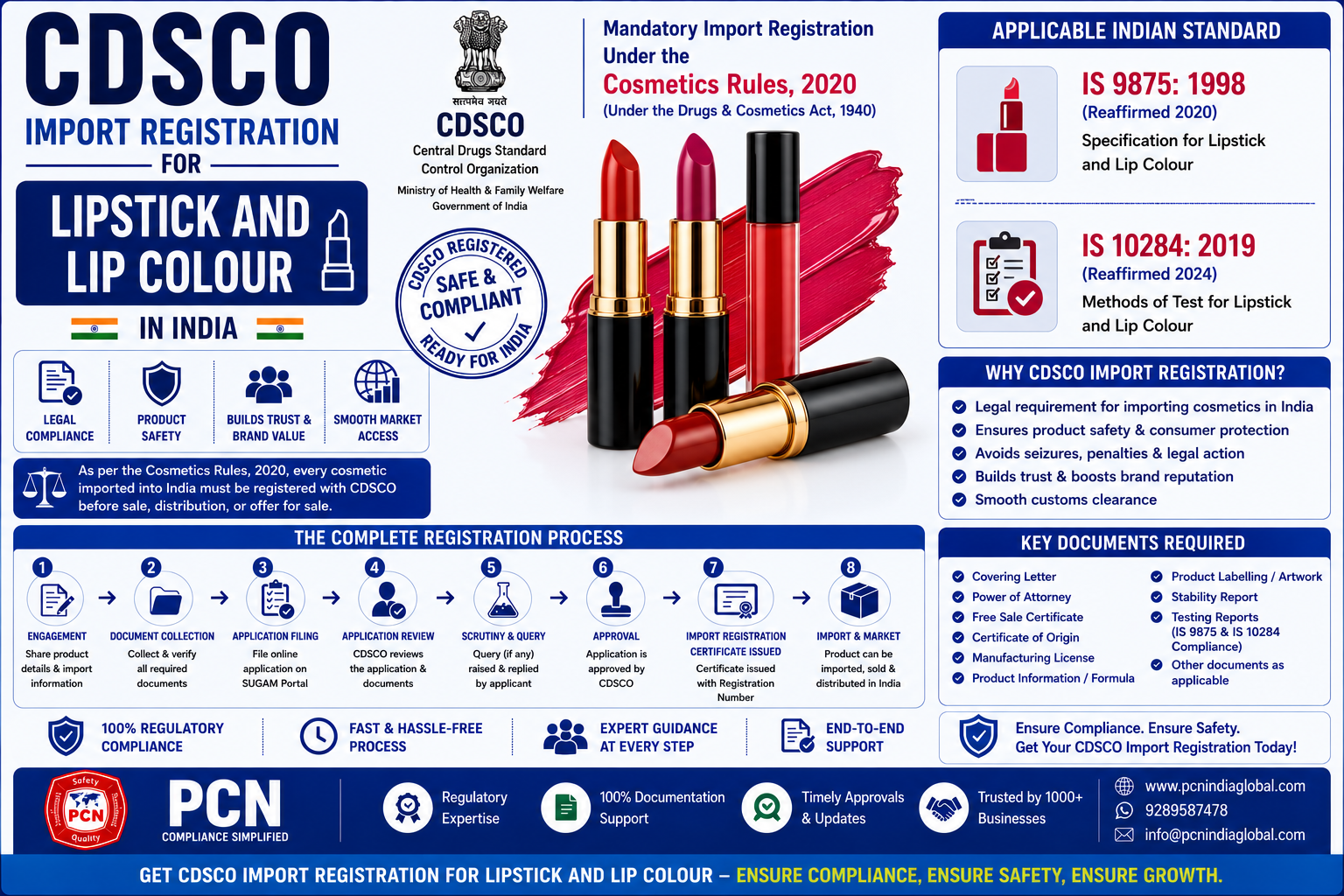
CDSCO Import Registration for Lipstick and Lip Colour in India: IS 9875, IS 10284 and the Complete Process

A lipstick range rarely ships as one product — it ships as a shade card, sometimes twenty or thirty variants deep. Each of those shades is a separate chargeable variant under CDSCO, and each colourant used across the range has to trace back to a permitted Colour Index number under Indian rules, whether or not it is permitted in the brand’s home market. This guide covers CDSCO import registration for lipstick and lip colour under the Cosmetics Rules, 2020 — the applicable standards, colourant compliance, documents, labelling, the registration process, fees, timeline and the reconciliation issue that most often stalls large shade ranges. How Lipstick and Lip Colour Is Regulated Under CDSCO No cosmetic — lipstick and lip colour included — may be imported into India unless it is registered by the Central Licensing Authority under Rule 12(1) of the Cosmetics Rules, 2020. Registration is tied to the specific brand, formulation, shade and manufacturing premises, not granted at company level. Every cosmetic imported into India is registered against the Fourth Schedule category it falls under, using Form COS-1 filed on the CDSCO SUGAM portal. Approval is issued as an Import Registration Certificate in Form COS-2, valid for five years. Lipstick and lip colour falls under the Colour cosmetics / lip care preparations category of the Fourth Schedule. Applicable Indian Standards for Lipstick Indian Standard Product IS 9875 Lipstick IS 10284 Lipsalve Documents Required for Lipstick CDSCO Registration Every Form COS-1 application needs the core document set described above. On top of this base, lipstick and lip colour need: CoA against IS 9875 — melting point, breaking point, drop test, perfume and rancidity, and freedom from grittiness. Colourant declaration listing every colour by Colour Index (CI) number, mapped to IS 4707 (Part 1) and the Tenth Schedule. Heavy metals test report on the colourants: arsenic not more than 2 ppm, lead not more than 20 ppm, other heavy metals not more than 100 ppm in total. Shade-wise composition sheet — each shade is a separate variant and attracts a USD 50 fee. Declaration that no lead or arsenic compounds have been used for colouring. Microbiological report. Label Requirements Specific to Lipstick Shade name and shade number on the unit pack. Ingredient list — not mandatory where net content is 30 g or less, but recommended. Registration Certificate number preceded by “RC” or “Reg. Cert. No.” on the unit pack. Step-by-Step: CDSCO Import Registration Process Classify the product. Confirm it meets the definition of “cosmetic” and map it to the Colour cosmetics / lip care preparations category of the Fourth Schedule. Appoint the Indian Agent. Execute the Authorisation covering the full shade range, notarised and apostilled or embassy-attested. Assemble the technical dossier. Ingredient list with INCI names and percentages, the CoA against IS 9875, a shade-wise composition sheet, colourant CI-number declarations for every shade, heavy metals data, labels for every shade and the Free Sale Certificate covering the full shade range. Align the label to Chapter VI. Shade name and number must appear on the unit pack. Pay the fee on Bharatkosh. Compute category + site + variant (per shade) fees and retain the challan. File Form COS-1 on SUGAM. Upload the full checklist including the correlation chart reconciling every shade across documents. Respond to CDSCO queries. For lipstick, queries most often concern colourants that are permitted abroad but absent from India’s IS 4707 (Part 1) list, and shade lists across the Authorisation, FSC and Form COS-1 that don’t reconcile. Receive Form COS-2. Print the RC number on every unit pack before goods are cleared for sale. Fees and Timeline Government fees are paid online via Bharatkosh: USD 1,000 for the colour cosmetics / lip care category, USD 500 per manufacturing site, and USD 50 for every shade in the range — so a 24-shade lipstick line attracts 24 x USD 50 in variant fees alone. Typical approval time is 4 to 6 months from acceptance of a complete application; large shade ranges with reconciliation issues across documents are a common source of added delay. The Registration Certificate is valid for five years. Common Mistakes That Trigger a CDSCO Query Use of a CI number not listed in India — a colourant permitted in the EU or US but absent from IS 4707 (Part 1) and the Tenth Schedule will not be accepted, regardless of its regulatory status elsewhere. Shade lists that don’t reconcile — the shade range in the Authorisation, the Free Sale Certificate and Form COS-1 must match exactly; even one shade named or numbered differently across the three documents triggers a query. Missing heavy metals data on colourants. Apostille or attestation defects on the Authorisation or FSC. Related Approvals to Plan Alongside CDSCO LMPC registration — lipstick is a pre-packaged commodity requiring MRP, net quantity and importer declarations on the pack. DGFT Importer-Exporter Code — mandatory for any importer of record before the first consignment. EPR registration for plastic waste — lipstick bullets and cases fall under CPCB’s EPR framework. Frequently Asked Questions Is CDSCO registration mandatory for imported lipstick? Yes. Under Rule 12(1) of the Cosmetics Rules, 2020, no lipstick or lip colour can be imported into India unless it is registered with CDSCO and holds a valid Import Registration Certificate (Form COS-2). What is the difference between IS 9875 and IS 10284? IS 9875 covers lipstick, while IS 10284 covers lipsalve — a related but distinct product format with its own specification. Are all lipstick colourants permitted in India? No. Every colourant must be listed by CI number under IS 4707 (Part 1) and the Tenth Schedule. A colourant permitted in the EU or US but absent from the Indian list cannot be used. Does each lipstick shade need a separate fee? Yes. Every shade is treated as a separate variant, chargeable at USD 50 each, and must be individually listed in the Authorisation, the Free Sale Certificate and Form COS-1. How long does lipstick CDSCO registration take? Typically 4 to 6 months from acceptance of

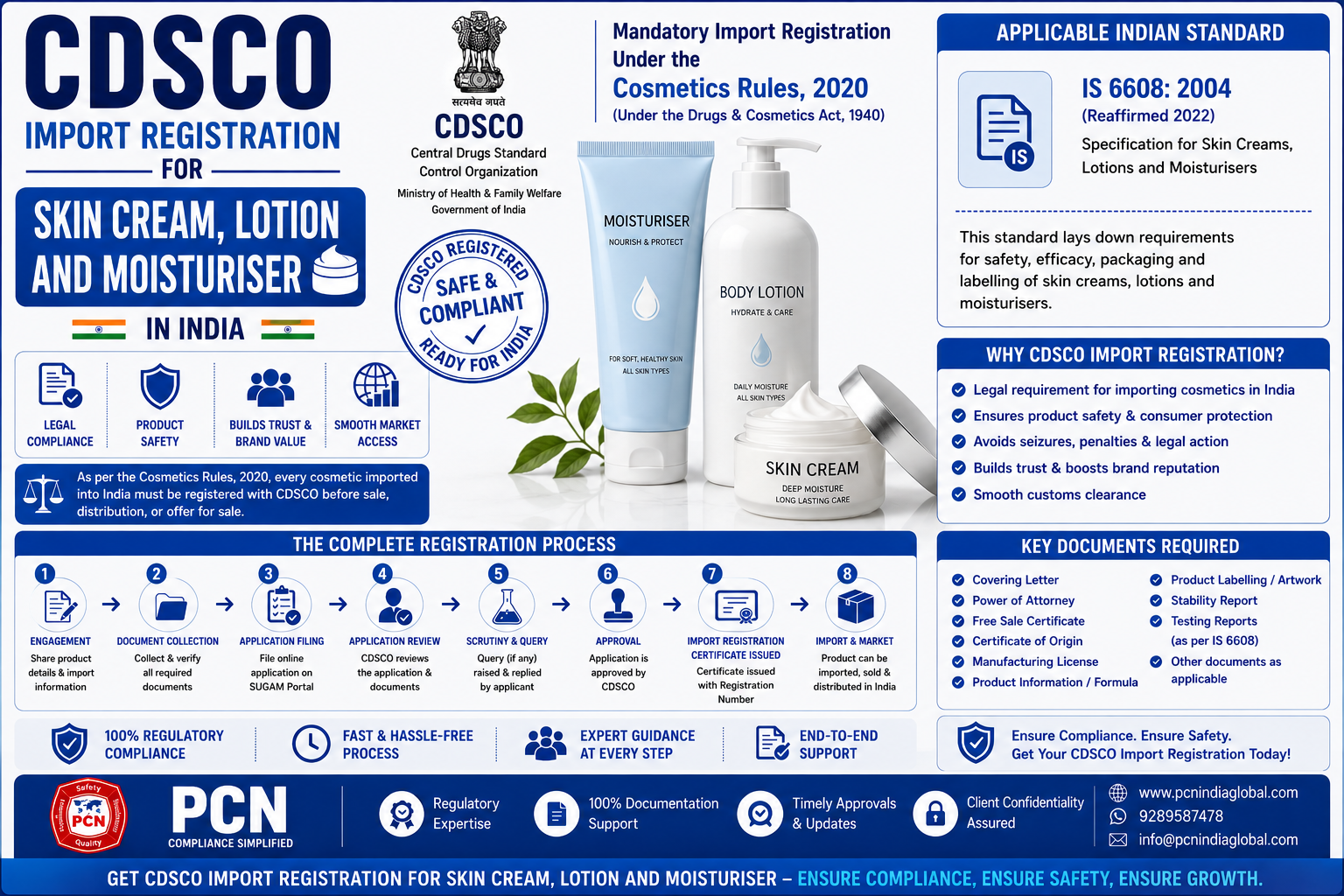
CDSCO Import Registration for Skin Cream, Lotion and Moisturiser in India: IS 6608 and the Complete Process

Skin care is India’s largest cosmetic import category by product count, and it is also the category where marketing language most often collides with the legal definition of a cosmetic. A cream that merely moisturises is one thing; a cream that promises to “treat eczema” or “remove scars” has, in CDSCO’s eyes, become a drug. This guide covers CDSCO import registration for skin creams, lotions and moisturisers under the Cosmetics Rules, 2020 — the applicable standard, the documents required, claim substantiation, labelling, the registration process, fees, timeline and the single most common reason this category gets stopped at review. How Skin Cream, Lotion and Moisturiser Is Regulated Under CDSCO No cosmetic — including skin creams, lotions and moisturisers — may be imported into India unless it is registered by the Central Licensing Authority under Rule 12(1) of the Cosmetics Rules, 2020. Registration is tied to the specific brand, formulation, pack sizes and manufacturing premises, not granted at company level. Every cosmetic imported into India is registered against the Fourth Schedule category it falls under, using Form COS-1 filed on the CDSCO SUGAM portal. Approval is issued as an Import Registration Certificate in Form COS-2, valid for five years. Skin cream, lotion and moisturiser falls under the Skin care preparations category of the Fourth Schedule. Applicable Indian Standard for Skin Cream Skin creams are tested against IS 6608 (skin creams), which covers pH, non-volatile matter, water content, freedom from grittiness and rancidity, and stability at elevated temperature. Lotions and moisturisers formulated on the same base are generally assessed against the same standard where a closely applicable Indian Standard exists — confirm the exact scope with your testing laboratory for your specific product form. Documents Required for Skin Cream CDSCO Registration Every Form COS-1 application needs the core document set described above. On top of this base, skin creams, lotions and moisturisers need: CoA against IS 6608 — pH, non-volatile matter, water content, freedom from grittiness and rancidity, and stability at elevated temperature. Microbiological limits report. Heavy metals report or manufacturer undertaking (lead, arsenic, mercury and other heavy metals). Preservative efficacy / challenge test data, where requested by CDSCO. Claim substantiation dossier for any anti-ageing, brightening, firming or repair claim made on the label or marketing material. Declaration confirming the absence of hydroquinone, mercury compounds and corticosteroids — these are drug or prohibited substances in skin-lightening products. Label Requirements Specific to Skin Cream Warning and directions for safe use, where a hazard exists. Address of the actual manufacturer, or “Made in ____” where the product is contract manufactured. For containers of 30 g or less (solid / semi-solid), manufacturer name and principal place of manufacture with PIN code is sufficient. Step-by-Step: CDSCO Import Registration Process Classify the product. Confirm it meets the definition of “cosmetic” under Section 3(aaa) and map it to the Skin care preparations category of the Fourth Schedule. Appoint the Indian Agent. Execute the Authorisation in the format of the First Schedule, signed jointly by manufacturer and agent, then notarised and apostilled or embassy-attested. Assemble the technical dossier. Ingredient list with INCI names and percentages, the CoA against IS 6608, heavy metals and microbiological data, claim substantiation for any active-sounding marketing language, labels for every variant, GMP/ISO 22716 evidence and the Free Sale Certificate. Align the label to Chapter VI. Indian labelling is non-negotiable; India-specific content may be stickered at a bonded warehouse. Pay the fee on Bharatkosh. Compute category + site + variant fees and retain the challan. File Form COS-1 on SUGAM. Upload the full checklist including the correlation chart. Respond to CDSCO queries. For skin care, queries most often concern marketing claims that stray into therapeutic territory — CDSCO reviews the label and marketing copy for exactly this before granting registration. Receive Form COS-2. Print the RC number on every unit pack before goods are cleared for sale. Fees and Timeline Government fees are paid online via Bharatkosh (head of account 0210041040000-00-1): USD 1,000 for the skin care preparations category (USD 1,000 for each additional category), USD 500 per manufacturing site, and USD 50 for every shade, fragrance or formulation variant within a product line. A new cosmetic ingredient not previously used in India attracts a further USD 500 permission fee. Typical approval time is 4 to 6 months from acceptance of a complete application; claim-related queries are a common source of delay, so pre-clearing marketing language against Rule 36 before filing helps. The Registration Certificate is valid for five years, and any change must be reported within 30 days. Common Mistakes That Trigger a CDSCO Query Marketing claims that stray into therapeutic territory — Rule 36 prohibits false or misleading claims, and phrases such as “treats eczema” or “removes scars” convert the product into a drug, taking it out of the CDSCO cosmetic route entirely. Free Sale Certificate scope mismatch — the FSC lists fewer or differently named products than Form COS-1. Apostille or attestation defects on the Authorisation or FSC. Skin-lightening formulations with prohibited actives — hydroquinone, mercury compounds and corticosteroids are drug or prohibited substances; their presence blocks cosmetic registration outright. Related Approvals to Plan Alongside CDSCO LMPC registration — skin creams and lotions are pre-packaged commodities requiring MRP, net quantity and importer declarations on the pack. DGFT Importer-Exporter Code — mandatory for any importer of record before the first consignment. EPR registration for plastic waste — jars and tubes packaged in plastic fall under CPCB’s EPR framework. Frequently Asked Questions Is CDSCO registration mandatory for imported skin creams? Yes. Under Rule 12(1) of the Cosmetics Rules, 2020, no skin cream, lotion or moisturiser can be imported into India unless it is registered with CDSCO and holds a valid Import Registration Certificate (Form COS-2). Which Indian Standard applies to skin creams? IS 6608 covers skin creams, testing pH, non-volatile matter, water content, grittiness, rancidity and thermal stability. Confirm applicability for lotions and specialised moisturiser formats with your testing laboratory. Can I claim my cream “treats” a skin condition? No. Therapeutic claims such

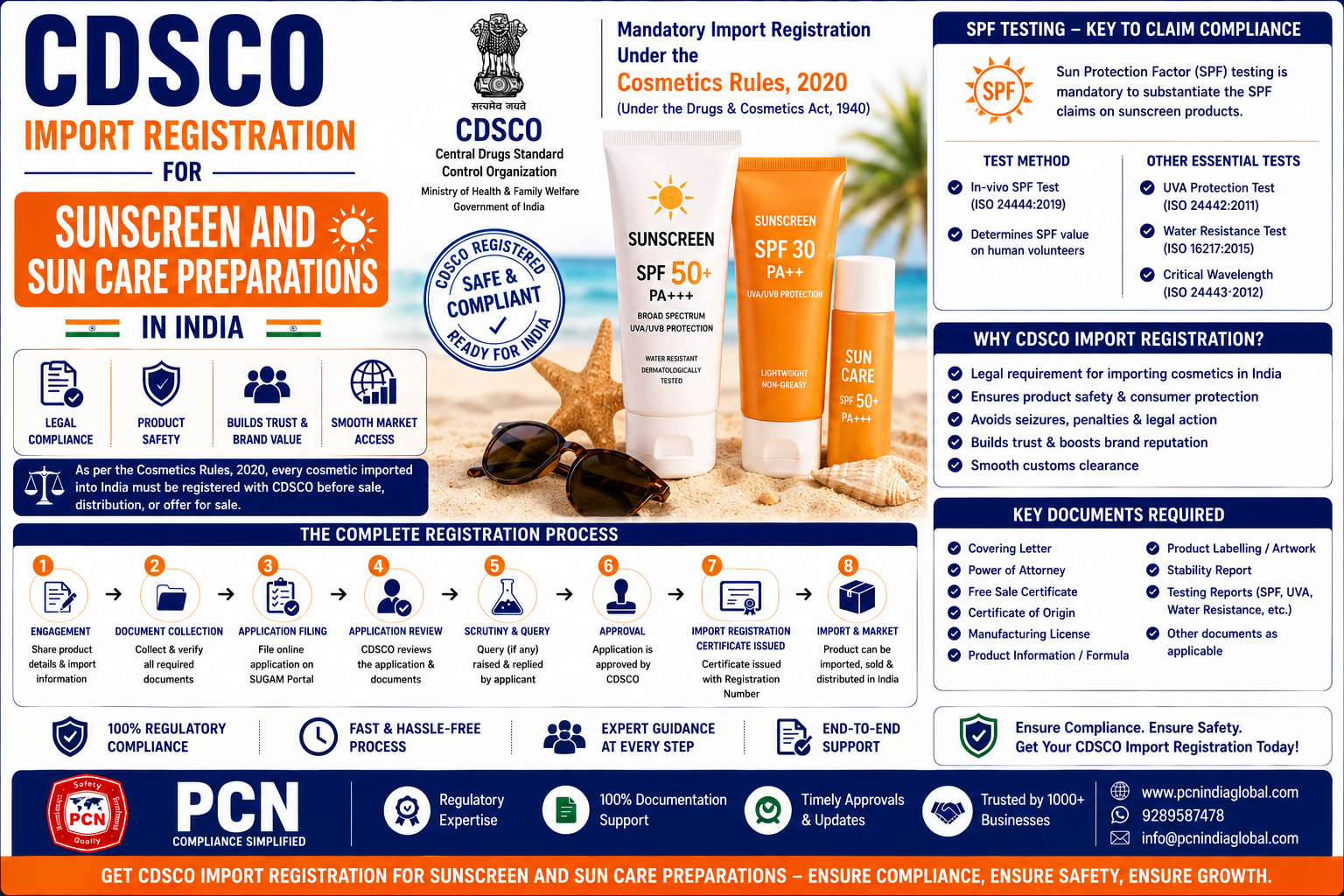
CDSCO Import Registration for Sunscreen and Sun Care Preparations in India: SPF Testing and the Complete Process

Sunscreen occupies an unusual position in the CDSCO framework: no Indian Standard is listed for it in the Ninth Schedule. That does not mean it is lightly regulated — it means the burden shifts to the country-of-origin standard and a stack of internationally recognised SPF, UVA and water-resistance test reports that CDSCO cross-checks directly against the claims printed on the pack. This guide covers CDSCO import registration for sunscreen and sun care preparations under the Cosmetics Rules, 2020 — the test reports required in the absence of an Indian Standard, documentation, labelling, the registration process, fees, timeline and the correlation check that trips up more sunscreen applications than almost any other category. How Sunscreen Is Regulated Under CDSCO No cosmetic — sunscreen included — may be imported into India unless it is registered by the Central Licensing Authority under Rule 12(1) of the Cosmetics Rules, 2020. Registration is tied to the specific brand, formulation, pack sizes and manufacturing premises, not granted at company level. Every cosmetic imported into India is registered against the Fourth Schedule category it falls under, using Form COS-1 filed on the CDSCO SUGAM portal. Approval is issued as an Import Registration Certificate in Form COS-2, valid for five years. Sunscreen falls under the Sun protection preparations category of the Fourth Schedule. Applicable Standard for Sunscreen No Indian Standard is listed in the Ninth Schedule for sunscreen. Instead, the product must meet the standards and specifications applicable in the country of origin, plus every requirement of the Cosmetics Rules, 2020. In practice this means the dossier leans heavily on internationally recognised test protocols rather than a single IS number. Documents Required for Sunscreen CDSCO Registration Every Form COS-1 application needs the core document set described above. On top of this base, sunscreen and sun care preparations need: SPF test report — in vivo, ISO 24444 or equivalent, from an accredited laboratory. UVA protection report — ISO 24443 (in vitro) or the PPD method, where a UVA or PA rating is claimed. Water resistance test report (ISO 16217 / ISO 18861), if “water resistant” is claimed on the pack. List of UV filters with exact percentages, cross-referenced against the country-of-origin positive list. Photostability and accelerated stability data. Country-of-origin standard and specification, since no Ninth Schedule standard applies. Label Requirements Specific to Sunscreen SPF value and UVA rating consistent with the submitted test report — CDSCO checks this correlation directly. Directions on quantity and reapplication frequency. Any “broad spectrum” claim must be supported by the UVA report on file. Step-by-Step: CDSCO Import Registration Process Classify the product. Confirm it meets the definition of “cosmetic” and map it to the Sun protection preparations category of the Fourth Schedule. Appoint the Indian Agent. Execute the Authorisation in the format of the First Schedule, notarised and apostilled or embassy-attested. Assemble the technical dossier. The SPF and UVA test reports, the UV filter list with percentages, photostability data, the country-of-origin specification, labels for every SKU, GMP/ISO 22716 evidence and the Free Sale Certificate. Align the label to Chapter VI. The printed SPF and UVA rating must match the test report exactly. Pay the fee on Bharatkosh. Compute category + site + variant fees and retain the challan. File Form COS-1 on SUGAM. Upload the full checklist including the correlation chart. Respond to CDSCO queries. For sunscreen, queries most often concern the SPF value printed on the pack exceeding the tested value, or an SPF report from a non-accredited laboratory. Receive Form COS-2. Print the RC number on every unit pack before goods are cleared for sale. Fees and Timeline Government fees are paid online via Bharatkosh: USD 1,000 for the sun protection preparations category, USD 500 per manufacturing site, and USD 50 for each SPF strength, tint shade or format variant. A new cosmetic ingredient not previously used in India attracts a further USD 500 permission fee. Typical approval time is 4 to 6 months from acceptance of a complete application, though gathering internationally accredited SPF/UVA reports can itself take time if not already on hand. The Registration Certificate is valid for five years. Common Mistakes That Trigger a CDSCO Query SPF on the pack higher than the tested value — CDSCO checks the printed SPF and UVA/PA rating directly against the submitted test report, and any mismatch is an immediate query. Treating a tinted sunscreen as a single SKU — each shade of a tinted sunscreen is a chargeable variant at USD 50, not a single product; under-declaring shades as one SKU is a common and costly error. Free Sale Certificate scope mismatch across documents. SPF report sourced from a non-accredited laboratory. Related Approvals to Plan Alongside CDSCO LMPC registration — sunscreen is a pre-packaged commodity requiring MRP, net quantity and importer declarations on the pack. DGFT Importer-Exporter Code — mandatory for any importer of record before the first consignment. EPR registration for plastic waste — tubes and bottles fall under CPCB’s EPR framework. Frequently Asked Questions Is CDSCO registration mandatory for imported sunscreen? Yes. Under Rule 12(1) of the Cosmetics Rules, 2020, no sunscreen can be imported into India unless it is registered with CDSCO and holds a valid Import Registration Certificate (Form COS-2). Which Indian Standard applies to sunscreen? None. No Indian Standard is listed in the Ninth Schedule for sun protection preparations — the product must instead meet the country-of-origin standard plus all Cosmetics Rules, 2020 requirements. What test reports does CDSCO require for sunscreen? An in vivo SPF report (ISO 24444 or equivalent), a UVA protection report (ISO 24443 or PPD method) where a UVA/PA rating is claimed, and a water-resistance report if “water resistant” is claimed. Does the SPF on the label have to match the test report exactly? Yes. CDSCO checks the printed SPF and UVA rating directly against the submitted test report — printing a higher SPF than tested is one of the most common query triggers for this category. How long does sunscreen CDSCO registration take? Typically 4 to 6 months from acceptance

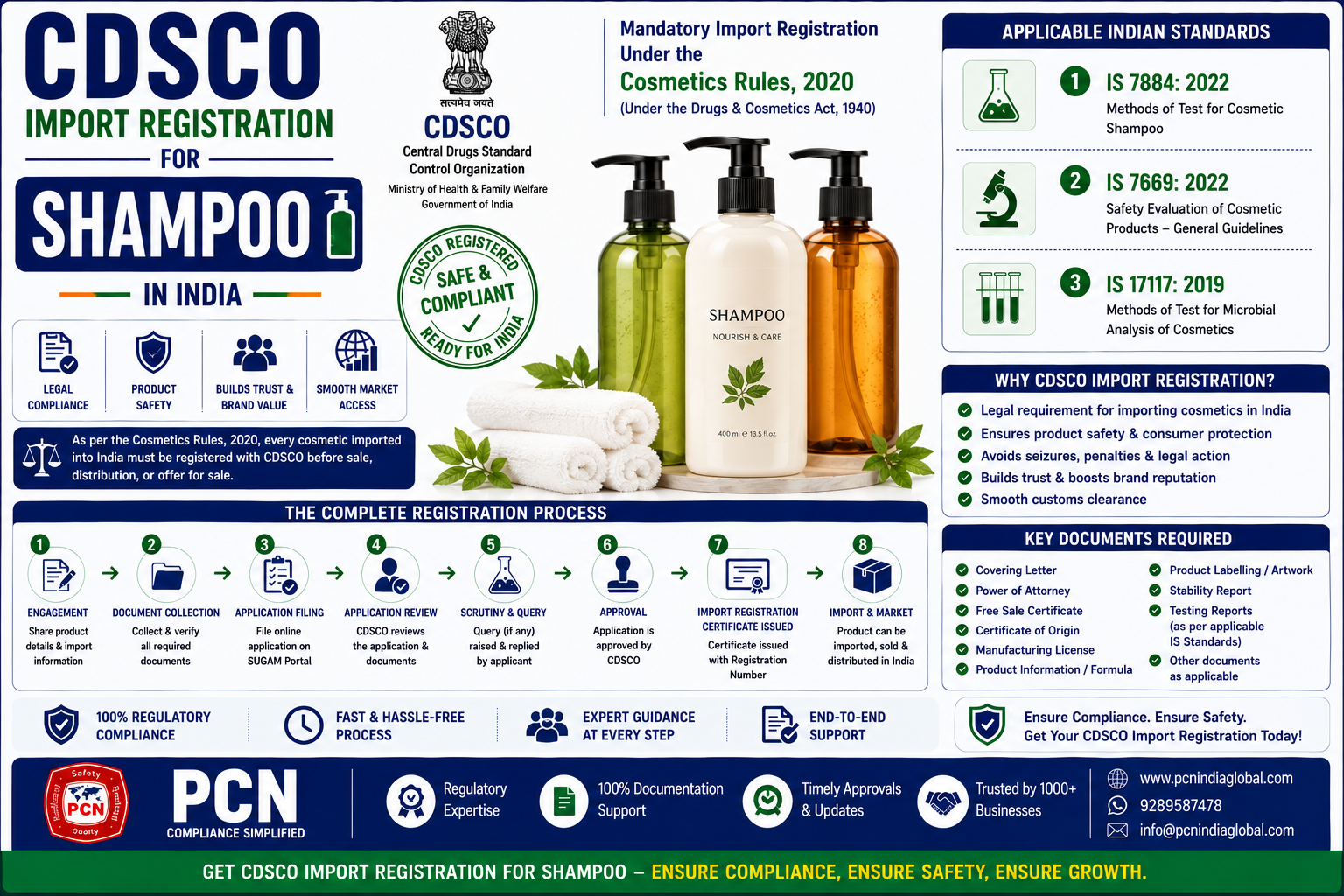
CDSCO Import Registration for Shampoo in India: IS 7884, IS 7669, IS 17117 and the Complete Process

Shampoo is bought and repurchased more often than almost any other cosmetic on the Indian market, which is exactly why CDSCO scrutinises it closely at the point of import. A synthetic-detergent shampoo, a soap-based shampoo and a baby shampoo are not interchangeable in regulatory terms — each is tested against its own Indian Standard, and each carries its own documentation trail before a single bottle can clear customs. This guide walks through CDSCO import registration for shampoo under the Cosmetics Rules, 2020 — the applicable standards, the documents needed beyond the core CDSCO file, product-specific label requirements, the registration process, fees, timeline and the mistakes that most often trigger a CDSCO query for this category. How Shampoo Is Regulated Under CDSCO No cosmetic — shampoo included — may be imported into India unless it is registered by the Central Licensing Authority under Rule 12(1) of the Cosmetics Rules, 2020. Registration is product-level, not company-level: it is tied to the specific brand, formulation, pack sizes and the exact manufacturing premises where the shampoo is made. Every cosmetic imported into India is registered against the Fourth Schedule category it falls under, using Form COS-1 filed on the CDSCO SUGAM portal. Approval is issued as an Import Registration Certificate in Form COS-2, valid for five years. Shampoo falls under the Hair care preparations category of the Fourth Schedule. Applicable Indian Standards for Shampoo Indian Standard Shampoo Type IS 7884 Synthetic detergent based shampoo IS 7669 Soap-based shampoo IS 17117 Hair shampoo for babies The correct standard depends on the shampoo’s base formulation, not its marketing category — an “anti-dandruff” or “herbal” shampoo is still tested against IS 7884 or IS 7669 depending on whether it is detergent-based or soap-based, unless it is a baby shampoo, which is tested separately against IS 17117. Documents Required for Shampoo CDSCO Registration Every Form COS-1 application needs the core document set — covering letter, manufacturer’s Authorisation (First Schedule), Part-I of the Second Schedule, ingredient list (INCI, with percentages), product labels, finished-product specification and test method, Free Sale Certificate, non-animal testing declaration, heavy metal declaration, GMP/ISO 22716 certificate, correlation chart, and the Bharatkosh fee receipt. On top of this base, shampoo needs: Certificate of Analysis against IS 7884 (or the applicable standard) — pH, total solids, matter insoluble in alcohol, foaming power, detergency, surface tension and stability. Microbiological test report — total viable count and absence of pathogens. Preservative system declaration with the concentration of each preservative used. Declaration on 1,4-dioxane and ethylene oxide residues where ethoxylated surfactants are used in the formulation. For anti-dandruff shampoo: a declaration on the active ingredient and its concentration. Zinc pyrithione and climbazole are treated as cosmetic actives; ketoconazole and similar antifungals are drugs and cannot be registered under COS-1. For baby shampoo: CoA against IS 17117, including ocular irritation / tear-free substantiation. Label Requirements Specific to Shampoo Beyond the general Chapter VI requirements — product name, manufacturer name and address, batch number, expiry date, net content, Registration Certificate number, and full ingredient list for larger packs — shampoo carries these product-specific label points: Directions for use and any rinse-off cautions. Full ingredient list preceded by the word “INGREDIENTS” — not required for packs of 60 ml or less. Net content by fluid measure, in the Indian metric system. Step-by-Step: CDSCO Import Registration Process Classify the product. Confirm it meets the definition of “cosmetic” under Section 3(aaa) and map it to the Hair care preparations category of the Fourth Schedule — this drives the fee and certificate scope. Appoint the Indian Agent. Execute the Authorisation in the format of the First Schedule, signed jointly by the manufacturer and agent, then notarised and apostilled (Hague member states) or attested by the Indian Embassy. Assemble the technical dossier. Ingredient list with INCI names and percentages, the CoA against the applicable IS, microbiological and preservative data, labels for every variant, GMP/ISO 22716 evidence and the Free Sale Certificate. Align the label to Chapter VI. Indian labelling is non-negotiable and one of the top rejection reasons; India-specific content may be stickered at a bonded warehouse. Pay the fee on Bharatkosh. Compute category + site + variant fees and retain the challan. File Form COS-1 on SUGAM. Upload the full checklist, including the correlation chart tying each product serial number to the Free Sale Certificate and the Authorisation. Respond to CDSCO queries. For shampoo, queries typically concern cosmetic-versus-drug misclassification of medicated anti-dandruff formulations, CoA parameters that don’t match the IS 7884 parameter set, and pack sizes on the label not matching what’s declared in Form COS-1. Receive Form COS-2. Print the RC number on every unit pack, with the certificate holder’s name and address, before goods are cleared for sale. Fees and Timeline Government fees are paid online via Bharatkosh (head of account 0210041040000-00-1): USD 1,000 for the hair care preparations category (and USD 1,000 for each additional category), USD 500 per manufacturing site, and USD 50 for each variant — each shade, fragrance or formulation variant. A new cosmetic ingredient not previously used in India attracts a further USD 500 permission fee. Typical approval time is 4 to 6 months from acceptance of a complete application — each CDSCO query restarts the effective clock, so document quality at first filing is the single biggest lever on timeline. The Registration Certificate is valid for five years, and any change in labelling, composition, testing or specification must be reported to the Licensing Authority within 30 days. Common Mistakes That Trigger a CDSCO Query Cosmetic-versus-drug misclassification — an anti-dandruff shampoo using a drug-grade antifungal (e.g. ketoconazole) instead of a permitted cosmetic active (zinc pyrithione, climbazole) cannot be registered as a cosmetic at all. Free Sale Certificate scope mismatch — the FSC lists fewer or differently named products than Form COS-1; the correlation chart must reconcile all three documents line by line. Apostille or attestation defects — the Authorisation or FSC is notarised but not apostilled, or the apostille does not cover the annexed product list. CoA parameters that