
BIS Certification for Fire Detection & Alarm Systems in India: The 2025 Quality Control Order, IS/ISO 7240 and the Complete ISI Process
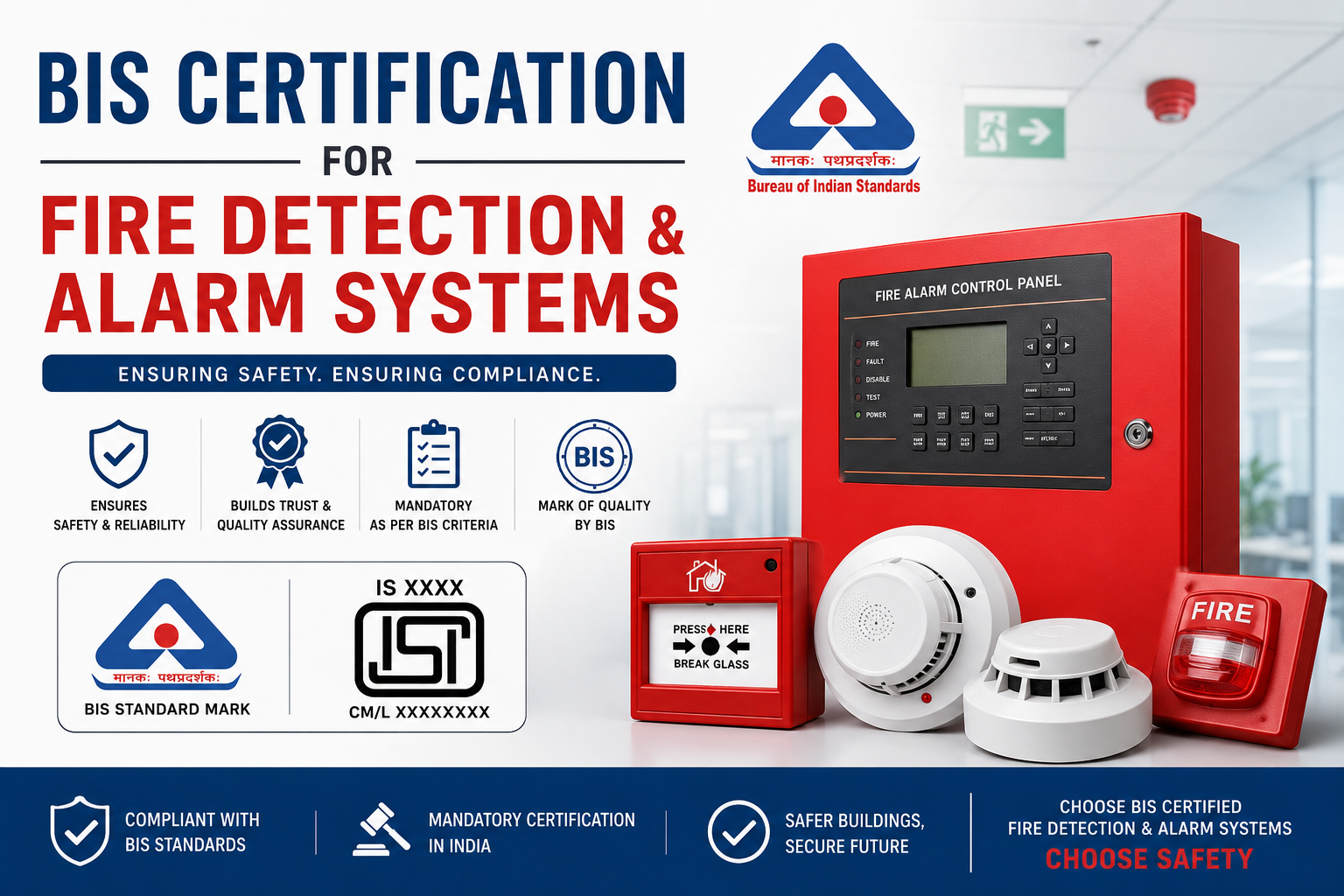
A fire detection and alarm system is a product whose failure is measured in lives. Smoke detectors, flame detectors, control panels, and alarm devices are the silent guardians of homes, offices, factories, hospitals, and public buildings, and when a fire starts they have one job: to detect it early and raise the alarm reliably. Because so much depends on these devices performing exactly as intended, the Bureau of Indian Standards (BIS) has brought fire detection and alarm systems under mandatory certification. For manufacturers and importers, BIS ISI certification against the applicable Indian Standards is now the gateway to lawfully supplying these products in India. The requirement is anchored in the Fire Detection and Alarm Systems (Quality Control) Order, 2025, through which the Government of India has reinforced its commitment to fire safety and product standardisation. Under the order, covered fire-detection components must comply with the corresponding Indian Standard — largely the IS/ISO 7240 series, India’s adoption of the international fire-detection standards that align with the well-known EN 54 family — and bear the ISI Mark under a valid BIS licence. This guide explains what the order covers, how the standards are structured across detector types, how the certification process works for Indian and foreign manufacturers, the documents required, realistic timelines and costs, and the mistakes that most often delay a licence. The Legal Framework: The 2025 QCO and the ISI Mark BIS certification operates under the Bureau of Indian Standards Act, 2016. Through the Fire Detection and Alarm Systems (Quality Control) Order, 2025, the Central Government has made conformity to the corresponding Indian Standards — and display of the ISI Mark under a BIS licence — mandatory for covered products. From the effective date, a covered fire-detection component cannot be produced, traded, stocked, sold, or imported in India unless it bears the ISI Mark with a valid CM/L number. Entities that do not comply may be penalised under the BIS Act, 2016, including fines and legal consequences. Products manufactured solely for export are generally outside the order’s scope. Because the order is recent and enforcement is phased, manufacturers should confirm the exact covered components, applicable standard editions, and effective dates against the current BIS position. The underlying obligation is constant: for each notified component, the ISI Mark under a BIS licence is the passport to the Indian market — and, in this category more than most, it is also a statement that the device will perform when it matters. The Standards: The IS/ISO 7240 Series Across Detector Types Like other safety-critical categories, fire detection is specified through a family of standards, each covering a different component or detector type. India’s standards align with the international IS/ISO 7240 series (which parallels the EN 54 family), so a complete fire-detection system is built from components each certified against the standard for its type. The table below summarises the main detector and component types the order addresses. Component / detector type Standard basis (IS/ISO 7240 series, aligned with EN 54) Fire alarm control and indicating equipment (panel) Control-panel part of the series Point smoke detectors Smoke-detector part (parallels EN 54-7) Flame detectors Flame-detector part (parallels EN 54-10) Heat detectors Heat-detector part Multi-sensor detectors with carbon monoxide (CO) CO / multi-sensor parts (parallel EN 54-30 / 54-31) Video fire detectors IS/ISO 7240-29 (video fire detection) Sounders / alarm devices and input-output devices Corresponding parts of the series Across these, the order captures the core building blocks of a modern fire-detection system — the control panel that manages the system, the smoke, heat, and flame detectors that sense a fire in different ways, the newer multi-sensor and carbon-monoxide detectors that improve reliability and reduce false alarms, and the video fire detectors used in large or challenging spaces. A manufacturer certifies each component against its applicable standard, so a company supplying a full system will hold multiple licences. Manufacturers should confirm the exact list of covered components and the applicable standard editions under the 2025 order as implementation proceeds. Who Needs BIS Certification for Fire Detection Systems The requirement reaches across the fire-safety supply chain: Indian manufacturers of fire-detection components, who must hold a BIS licence to apply the ISI Mark to each covered component before selling in India. Importers and foreign manufacturers, whose components must be certified — foreign factories through the BIS Foreign Manufacturers Certification Scheme (FMCS) — before import. Much of the advanced detection hardware in India is imported, making FMCS central to this category. System integrators and panel builders, who must ensure the detectors and devices they install and supply are certified components. Because a functioning system combines many certified parts, the compliance picture for a full-line supplier can involve several licences, which should be planned together. Step-by-Step: The BIS ISI Certification Process BIS grants ISI licences under Scheme-I of the BIS (Conformity Assessment) Regulations. Our team manages each stage end to end, but every applicant should understand the sequence. Confirm applicability and standards. Map each component to its Indian Standard within the IS/ISO 7240 series and confirm it falls within the notified scope. Prepare the factory and in-house testing. BIS certification is factory-based; the unit must have the manufacturing capability and the in-house testing facilities to verify conformity on an ongoing basis. File the application on the BIS portal. Submit through the BIS Manak online system with the required documentation, per component. Foreign manufacturers apply under FMCS and nominate an Authorised Indian Representative (AIR). Factory inspection. A BIS officer inspects the unit, verifies the process and testing capability, and witnesses testing. Sample testing. Samples are drawn and tested — in the factory and/or at a BIS-recognised laboratory — against the applicable standard, including the demanding performance and reliability tests fire-detection standards require. Grant of licence. On satisfactory inspection and results, BIS grants the licence with a CM/L number for that component. Marking and surveillance. The manufacturer applies the ISI Mark and CM/L number, and maintains conformity under ongoing BIS surveillance, renewing the licence periodically. Documents Required for BIS Certification A