
CDSCO Licence for Blood Gas Analysers in India: Class C IVD Registration
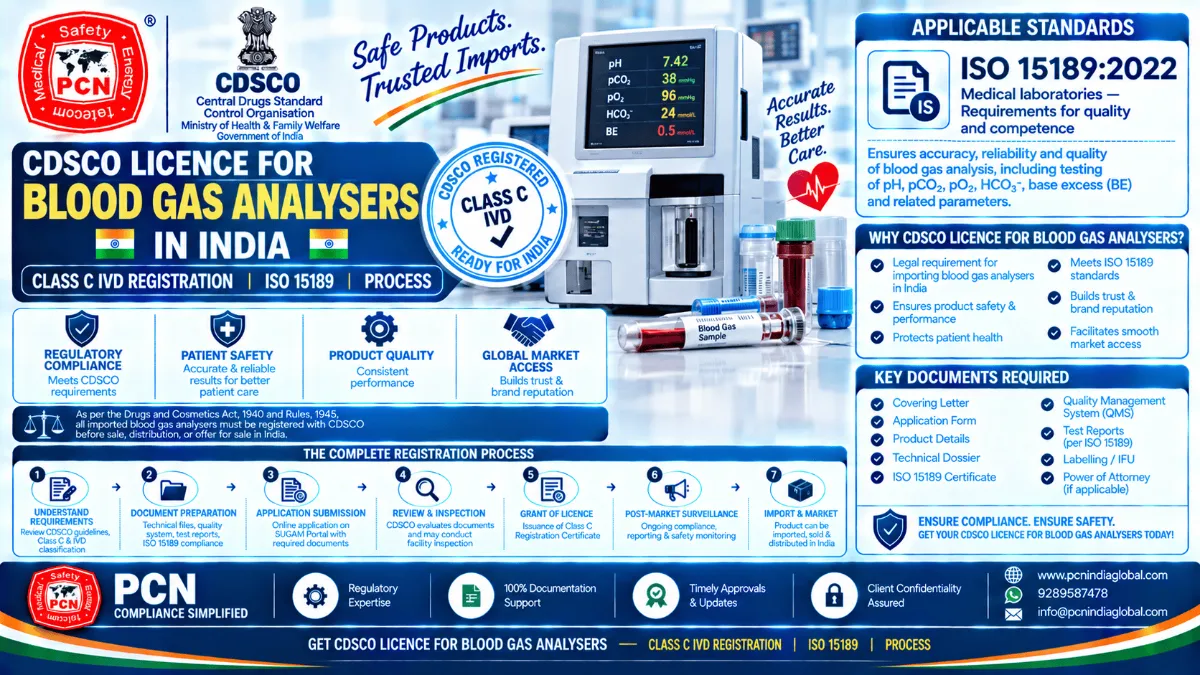
A blood gas analyser measures pH, pO₂, pCO₂ and often electrolytes and metabolites from a blood sample, driving urgent decisions in the ICU, OT and emergency room. Because it is an in-vitro diagnostic whose results guide critical care, CDSCO regulates the blood gas analyser as a Class C IVD with a performance-evaluation report behind the licence. This guide covers the full CDSCO registration pathway for blood gas analysers under the Medical Devices Rules, 2017 — classification, licence route, the performance evidence, the documents, the fees and the timeline. This guide explains CDSCO registration for blood gas analysers in India — risk class, licence forms, standards, documents, fees and timeline.
Is CDSCO Registration for Blood Gas Analysers Mandatory in India?
Yes. A blood gas analyser is a notified in-vitro diagnostic and cannot be manufactured, imported or sold in India without a CDSCO licence. Because its measurements are used in critical-care decisions, it is a Class C IVD: a domestic manufacturer applies to the Central Licensing Authority in Form MD-7 for a Form MD-9 licence, and an importer applies in Form MD-14 for a Form MD-15 import licence. Benchtop and point-of-care analysers, and their cartridges/reagents, fall within the framework.
Risk Classification of Blood Gas Analysers
Blood Gas Analysers are classified as Class C (moderate-to-high risk). An IVD analyser whose results directly inform urgent critical-care decisions, where an incorrect result carries a significant patient risk, is classified at Class C under the IVD classification rules. Where a device could fall in two classes the higher class applies, and an accessory is classified in its own right. Always confirm against the current CDSCO classification list.
CDSCO Licence for Blood Gas Analysers: Which Licence You Need
- To manufacture blood gas analysers in India (Class C) — apply in Form MD-7 to the Central Licensing Authority (CDSCO headquarters). The licensing authority grants the licence in Form MD-9. A CDSCO joint audit team inspects the manufacturing site before the licensing authority grants the licence — site inspection is mandatory for Class C and D.
- To import blood gas analysers (any class) — the overseas manufacturer appoints an Indian Authorised Agent who files Form MD-14 with the Central Licensing Authority; CDSCO grants the import licence in Form MD-15.
- Test licence — for a small quantity imported or made for testing, evaluation, demonstration or clinical investigation: Form MD-12 application, Form MD-13 licence.
Applicable Standards for Blood Gas Analysers
Blood gas analysers are evaluated principally on performance evidence, supported by IVD quality and electro-medical standards:
- Performance Evaluation Report (PER) — accuracy, precision, linearity and comparison to reference methods for each analyte.
- ISO 13485 — quality management system for the IVD manufacturer.
- ISO 23640 — stability evaluation of the IVD reagents/cartridges.
- IEC 61010-2-101 — safety of IVD medical equipment (and IEC 60601-1-2/IEC 61326 EMC).
- ISO 14971 — risk management, including erroneous-result consequences.
- ISO 18113 — IVD labelling and information supplied by the manufacturer.
Documents Required for CDSCO Registration of Blood Gas Analysers
The core CDSCO dossier is the same for every medical device: the application on CDSCO’s online medical device portal, Device Master File, Plant Master File, ISO 13485 certificate, Essential Principles checklist, ISO 14971 risk file, labels and IFU, undertakings and the fee receipt. The full checklist, with what each document must contain, is in our CDSCO medical device registration guide. Below is what CDSCO specifically expects to see for blood gas analysers.
Device-Specific Documents for Blood Gas Analysers
Device-specific documents on top of the core set for blood gas analysers:
- Analytical performance reports — accuracy, precision, linearity and reportable range per analyte (pH, pO₂, pCO₂, electrolytes).
- Cartridge/reagent and calibrator specifications and stability (ISO 23640).
- IVD equipment safety (IEC 61010-2-101) and EMC evidence.
- Traceability of calibration to reference measurement procedures.
- Interference and quality-control data.
- Country-of-origin approval / Free Sale Certificate for imports.
- Free Sale Certificate (FSC) — from the National Regulatory Authority of the country of origin, legalised (apostille/embassy attestation).
- Power of Attorney and Authorised Agent licence — notarised, legalised PoA to the Indian Authorised Agent, plus the agent’s valid wholesale/manufacturing licence.
QMS & Essential Principles — What CDSCO Checks
- Clinical evidence — proportionate to the class: clinical evaluation for lower-risk devices and clinical investigation data for many Class C/D and novel devices.
Label & IFU Requirements Specific to Blood Gas Analysers
IVD labelling (ISO 18113) is checked for analytes, lot and calibration information:
- Device name, IVD symbol and the analytes/parameters reported.
- Lot/batch number (cartridges/reagents), calibration information and expiry date.
- Storage conditions and the reportable range per analyte.
- Quality-control and maintenance information in the IFU.
Analyser and Consumables: One System
A blood gas analyser is an instrument plus its cartridges, reagents and calibrators, and the analytical performance evidence ties them together — the instrument alone is not the whole product. Each analyte reported (pH, gases, electrolytes, metabolites) needs its own performance data, and the consumables need stability and lot data. Register the analyser with its defined consumables and evidence each reported parameter — a parameter claimed without performance data is the classic query.
Step-by-Step CDSCO Registration Process for Blood Gas Analysers
Every device follows the same online filing route, which we walk through step by step in our complete CDSCO registration guide. For blood gas analysers, these are the steps that need the most attention:
- Confirm the classification. Fix the risk class against the CDSCO classification list and the First Schedule — Class C here — which decides the form, authority, fee and audit route.
- Complete the Essential Principles checklist. Map the device against each applicable essential principle and cite the BIS/IS or ISO/IEC standard or test report relied on.
CDSCO Registration Fees and Timeline for Blood Gas Analysers
A complete Class C manufacturing file typically clears in about six to nine months. An import (MD-15) file usually takes six to nine months. Every deficiency letter effectively restarts the clock. Unlike the old registration certificates, an MDR 2017 licence does not expire — it stays valid as long as you pay the retention fee (equal to the licence fee) every five years and meet the conditions of licence.
Common Mistakes That Trigger a CDSCO Query
Common query reasons for blood-gas-analyser IVD applications are:
- A reported analyte without accuracy/precision/linearity data.
- Cartridge/reagent stability (ISO 23640) missing.
- IVD equipment safety (IEC 61010-2-101) or EMC evidence absent.
- Calibration traceability not demonstrated.
- Free Sale Certificate scope not covering the analyser/consumables on import.
Related Approvals to Plan Alongside CDSCO
- Legal Metrology (LMPC) registration — importers of pre-packaged devices declare MRP, net quantity, importer details and country of origin on the pack.
FAQs on CDSCO Registration for Blood Gas Analysers
What CDSCO class is a blood gas analyser?
A blood gas analyser is a Class C IVD, so a domestic manufacturer files Form MD-7 for an MD-9 licence with the Central Licensing Authority, and an importer files Form MD-14 for an MD-15 licence.
What performance evidence does CDSCO expect?
Accuracy, precision, linearity and reportable range for each analyte (pH, pO₂, pCO₂, electrolytes), with calibration traceability and consumable stability.
Are the cartridges and reagents part of the registration?
Yes — the analyser is registered as a system with its defined cartridges, reagents and calibrators, and their stability and lot data are part of the evidence.
Do IVDs use different forms?
No — IVDs use the same MDR 2017 forms (MD-9 for Class C manufacture, MD-15 for import). The distinguishing requirement is the performance-evaluation evidence.
How long does registration take?
Budget roughly six to nine months for a complete Class C IVD manufacturing (MD-9) or import (MD-15) file.
Why Choose PCN India Global
- Classification triage — we confirm the correct risk class for your blood gas analysers against the current CDSCO list before we draft anything.
PCN India Global manages the complete CDSCO process for blood gas analysers — from classification and route selection to Device and Plant Master File preparation, online filing, audit support and the licence grant. WhatsApp or call +91 80109 05029, or email admin@pcnindiaglobal.com, to get your registration underway.
Related Compliance Guides
- CDSCO Licence for Ostomy Bags
- CDSCO Licence for Enteral Feeding Tubes
- CDSCO Licence for TENS Units
- CDSCO Licence for Pulse Oximeters
Related CDSCO Registration Guides
Need end-to-end help? See our CDSCO registration services, or read these related guides:
- CDSCO Registration for Coronary Stents in India
- CDSCO Registration for Contact Lenses in India
- CDSCO Registration for Autoclaves & Sterilizers in India
- CDSCO Registration for Eyebrow Pencil & Brow Products in India
Official references: Central Drugs Standard Control Organisation (CDSCO) and the CDSCO MD Online portal.
Need help? PCN India Global handles end-to-end CDSCO medical device registration for manufacturers and importers.
Related guides
- CDSCO Licence for Blood Glucose Test Strips in India: Class C IVD Registration
- CDSCO Licence for Blood Pressure Monitors in India: Class B Registration and IEC 80601-2-30
- CDSCO Licence for Blood Tubing Sets in India: Class C Registration and ISO 8637-2
- CDSCO Licence for Bone Cement in India: Class D Registration and ISO 5833
- CDSCO Licence for Cardiac Catheters in India: Class C Registration and ISO 10555
- CDSCO Licence for Cochlear Implants in India: Class D Registration and ISO 14708-7
More Medical Devices Guides
- CDSCO Licence for Blood Pressure Monitors in India: Class B Registration and IEC 80601-2-30
- CDSCO Licence for Blood Collection Tubes in India: Class A Registration and ISO 6710
- CDSCO Licence for Blood Tubing Sets in India: Class C Registration and ISO 8637-2
- CDSCO Licence for Cardiac Catheters in India: Class C Registration and ISO 10555
- CDSCO Licence for Cochlear Implants in India: Class D Registration and ISO 14708-7
- CDSCO Licence for Condoms in India: Class B Registration and ISO 4074