
CDSCO Licence for Endoscopes in India: Class C Registration and ISO 8600
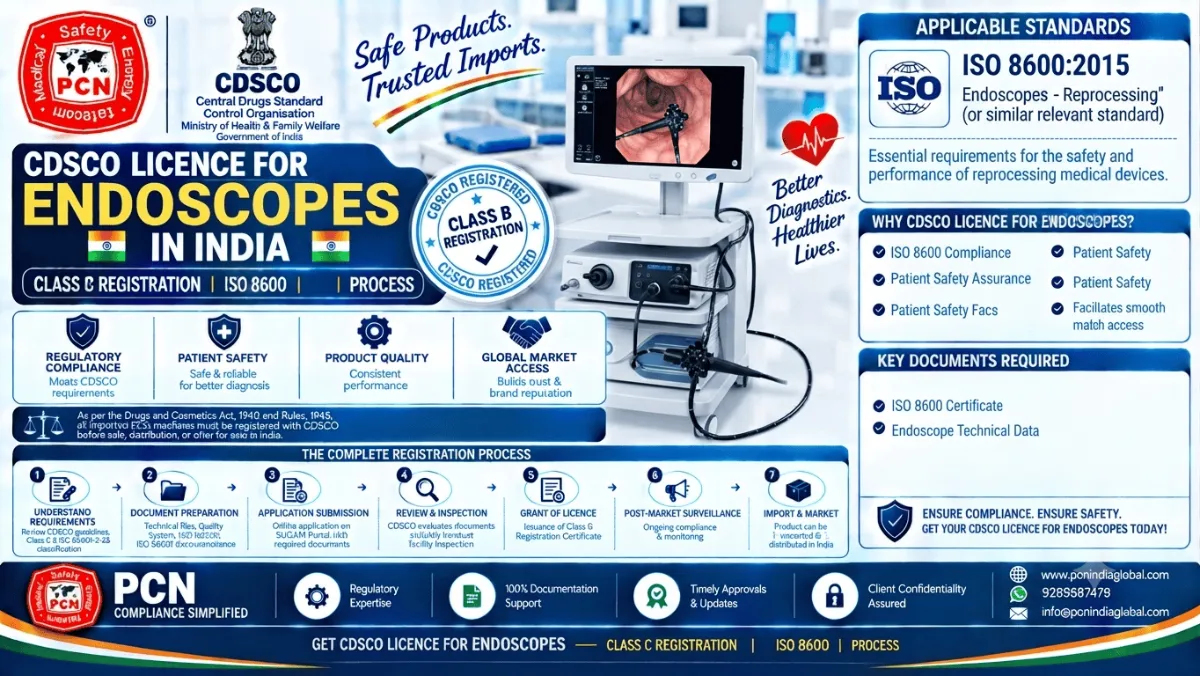
An endoscope lets a clinician see inside the body — the GI tract, airways, joints or abdomen — and often carries instruments to treat what it finds. Because it is an invasive device that contacts internal tissue and is usually reused, CDSCO regulates the endoscope as a Class C device with the endoscope standard, biocompatibility and reprocessing validation behind the licence. This guide covers the full CDSCO registration pathway for endoscopes under the Medical Devices Rules, 2017 — classification, licence route, ISO 8600, the documents, the fees and the timeline. This guide explains CDSCO registration for endoscopes in India — risk class, licence forms, standards, documents, fees and timeline.
Is a CDSCO Registration Mandatory for Endoscopes?
Yes. An endoscope is a notified Class C medical device and cannot be manufactured, imported or sold in India without a CDSCO licence. Because it is Class C, a domestic manufacturer applies to the Central Licensing Authority in Form MD-7 for a Form MD-9 licence. An importer applies in Form MD-14 for a Form MD-15 import licence. Flexible and rigid endoscopes, and their light sources and processors, are declared with the system.
Risk Classification of Endoscopes
Endoscopes are classified as Class C (moderate-to-high risk). An endoscope is a surgically invasive device that contacts internal tissue, typically reused, where inadequate reprocessing carries a cross-infection risk, placing it in Class C (moderate-to-high risk) under the First Schedule. Where a device could fall in two classes the higher class applies, and an accessory is classified in its own right. Always confirm against the current CDSCO classification list.
Which CDSCO Licence You Need for Endoscopes
- To manufacture endoscopes in India (Class C) — apply in Form MD-7 to the Central Licensing Authority (CDSCO headquarters). The licensing authority grants the licence in Form MD-9. A CDSCO joint audit team inspects the manufacturing site before the licensing authority grants the licence — site inspection is mandatory for Class C and D.
- To import endoscopes (any class) — the overseas manufacturer appoints an Indian Authorised Agent who files Form MD-14 with the Central Licensing Authority; CDSCO grants the import licence in Form MD-15.
Applicable Standards for Endoscopes
Endoscopes are evaluated against the endoscope standard plus biocompatibility and reprocessing:
- ISO 8600 series — optics and photonics: medical endoscopes and endotherapy devices.
- ISO 10993 series — biocompatibility of patient-contacting components.
- ISO 17664 — information supplied by the manufacturer for the processing of medical devices (reprocessing validation).
- IEC 60601-1 / -1-2 — where the endoscope system includes electrical equipment (light source/processor).
- IEC 60601-2-18 — endoscopic equipment, where applicable.
- Sterilisation / high-level-disinfection validation for reusable endoscopes.
Documents Required for CDSCO Registration of Endoscopes
The core CDSCO dossier is the same for every medical device: the application on CDSCO’s online medical device portal, Device Master File, Plant Master File, ISO 13485 certificate, Essential Principles checklist, ISO 14971 risk file, labels and IFU, undertakings and the fee receipt. The full checklist, with what each document must contain, is in our CDSCO medical device registration guide. Below is what CDSCO specifically expects to see for endoscopes.
Device-Specific Documents for Endoscopes
Device-specific documents on top of the core set for endoscopes:
- ISO 8600 performance reports — optical performance, field of view and mechanical integrity.
- Reprocessing validation (ISO 17664) — cleaning, disinfection and sterilisation instructions and evidence.
- Biocompatibility (ISO 10993) for patient-contacting parts.
- Electrical-safety / EMC evidence for the light source and processor.
- Channel-integrity and leak-test data for flexible endoscopes.
Label & IFU Requirements Specific to Endoscopes
Endoscope labelling and the IFU are checked for type, reprocessing and compatibility:
- Device name, type (flexible/rigid), working length and channel details.
- Batch/serial identification and the date of manufacture.
- Reusable/single-use status and the validated reprocessing method.
- Compatible light source/processor and endotherapy accessories in the IFU.
Reprocessing Is the Core Risk
The defining risk for a reusable endoscope is cross-infection from inadequate reprocessing — a recurring theme in device-safety alerts worldwide. CDSCO expects validated cleaning, disinfection and, where applicable, sterilisation instructions (ISO 17664) that a hospital can actually follow, plus channel-integrity and leak-test evidence for flexible scopes. Single-use endoscopes sidestep reprocessing but need their own sterility evidence. Decide reusable vs single-use and get the reprocessing validation right — it is the make-or-break of an endoscope file.
Step-by-Step CDSCO Registration Process for Endoscopes
Every device follows the same online filing route, which we walk through step by step in our complete CDSCO registration guide. For endoscopes, these are the steps that need the most attention:
- Confirm the classification. Fix the risk class against the CDSCO classification list and the First Schedule — Class C here — which decides the form, authority, fee and audit route.
CDSCO Registration Fees and Timeline for Endoscopes
A complete Class C manufacturing file typically clears in about six to nine months. An import (MD-15) file usually takes six to nine months. Every deficiency letter effectively restarts the clock. Unlike the old registration certificates, an MDR 2017 licence does not expire — it stays valid as long as you pay the retention fee (equal to the licence fee) every five years and meet the conditions of licence.
Common Mistakes That Trigger a CDSCO Query
For Class C reusable invasive devices, the recurring query reasons are:
- Reprocessing instructions not validated (ISO 17664) or not hospital-executable.
- Channel-integrity/leak-test data missing for flexible endoscopes.
- Biocompatibility not covering all patient-contacting parts.
- Electrical-safety evidence absent for the light source/processor.
- Free Sale Certificate scope not covering the system on import.
FAQs on CDSCO Registration for Endoscopes
What CDSCO class is an endoscope?
An endoscope is Class C, so a domestic manufacturer files Form MD-7 for an MD-9 licence with the Central Licensing Authority, and an importer files Form MD-14 for an MD-15 licence.
Which standard applies to endoscopes in India?
The ISO 8600 series for medical endoscopes, with ISO 17664 reprocessing validation, ISO 10993 biocompatibility and electrical-safety evidence for the light source/processor.
Why is reprocessing so important?
Reusable endoscopes carry a cross-infection risk if not properly reprocessed, so CDSCO expects validated, executable cleaning/disinfection/sterilisation instructions.
Does CDSCO require a site inspection?
Yes — for Class C manufacture, a CDSCO joint audit team inspects the site before the licensing authority grants the MD-9 licence.
How long does endoscope registration take?
Budget roughly six to nine months for a complete Class C manufacturing (MD-9) or import (MD-15) file.
Related CDSCO Registration Guides
Need end-to-end help? See our CDSCO registration services, or read these related guides:
- CDSCO Registration for Dengue & Malaria Rapid Test Kits in India
- CDSCO Registration for Blood Bags in India
- CDSCO Registration for Condoms in India
- CDSCO Registration for Adhesive Bandages in India
Official references: Central Drugs Standard Control Organisation (CDSCO) and the CDSCO MD Online portal.
Why Choose PCN India Global
- Classification triage — we confirm the correct risk class for your endoscopes against the current CDSCO list before we draft anything.
PCN India Global manages the complete CDSCO process for endoscopes — from classification and route selection to Device and Plant Master File preparation, online filing, audit support and the licence grant. WhatsApp or call +91 80109 05029, or email admin@pcnindiaglobal.com, to get your registration underway.
Related Compliance Guides
- CDSCO Licence for Heart Valves
- CDSCO Licence for Bone Cement
- CDSCO Licence for Contact Lenses
- CDSCO Licence for Contact Lens Solutions
Need help? PCN India Global handles end-to-end CDSCO medical device registration for manufacturers and importers.
Related guides
- CDSCO Licence for Endotracheal Tubes in India: Class B Registration and ISO 5361
- CDSCO Licence for Enteral Feeding Tubes in India: Class B Registration and ISO 20695
- CDSCO Licence for Guidewires in India: Class C Registration and ISO 11070
- CDSCO Licence for Hearing Aids in India: Class B Registration and IEC 60118
- CDSCO Licence for Heart Valves in India: Class D Registration and ISO 5840
- CDSCO Licence for HIV Test Kits in India: Class D IVD Registration
More Medical Devices Guides
- CDSCO Licence for Endotracheal Tubes in India: Class B Registration and ISO 5361
- CDSCO Licence for Electrosurgical Units in India: Class C Registration and IEC 60601-2-2
- CDSCO Licence for Enteral Feeding Tubes in India: Class B Registration and ISO 20695
- CDSCO Licence for ECG Machines in India: Class B Registration and IEC 60601-2-25
- CDSCO Licence for Blood Glucose Test Strips in India: Class C IVD Registration
- CDSCO Licence for Digital Thermometers in India: Class B Registration and ISO 80601-2-56