
CDSCO Licence for Anaesthesia Machines in India: Class C Registration and ISO 80601-2-13
An anaesthesia machine (workstation) delivers a precise mix of anaesthetic agent and gases and ventilates the patient throughout surgery — a system where an error in delivery or a missed alarm is critical. CDSCO regulates the anaesthesia workstation as a Class C device with the anaesthesia-workstation particular standard, electrical safety and alarms behind the licence. This guide covers the full CDSCO registration pathway for anaesthesia machines under the Medical Devices Rules, 2017 — classification, licence route, ISO 80601-2-13, the documents, the fees and the timeline. This guide explains CDSCO registration for anaesthesia machines in India — risk class, licence forms, standards, documents, fees and timeline.
Is CDSCO Registration for Anaesthesia Machines Mandatory in India?
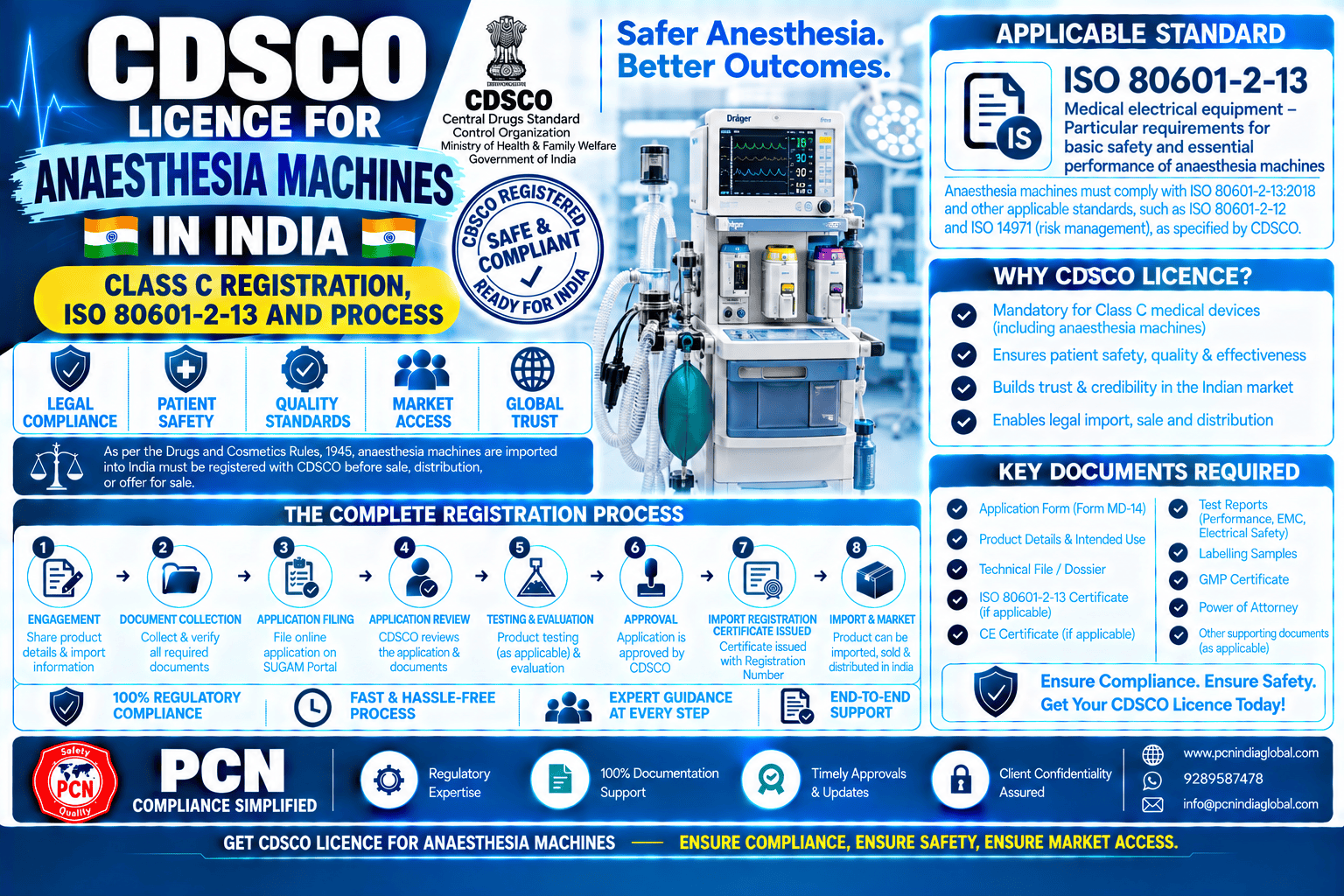
Yes. An anaesthesia machine is a notified Class C medical device and cannot be manufactured, imported or sold in India without a CDSCO licence. Because it is Class C, a domestic manufacturer applies to the Central Licensing Authority in Form MD-7 for a Form MD-9 licence. An importer applies in Form MD-14 for a Form MD-15 import licence. The workstation and its integrated ventilator, vaporisers and monitoring are declared as a system.
Risk Classification of Anaesthesia Machines
Anaesthesia Machines are classified as Class C (moderate-to-high risk). An anaesthesia workstation is an active, life-supporting device controlling gas and agent delivery and ventilation, where failure is directly life-threatening, placing it in Class C (moderate-to-high risk) under the First Schedule. Where a device could fall in two classes the higher class applies, and an accessory is classified in its own right. Always confirm against the current CDSCO classification list.
CDSCO Licence for Anaesthesia Machines: Which Licence You Need
- To manufacture anaesthesia machines in India (Class C) — apply in Form MD-7 to the Central Licensing Authority (CDSCO headquarters). The licensing authority grants the licence in Form MD-9. A CDSCO joint audit team inspects the manufacturing site before the licensing authority grants the licence — site inspection is mandatory for Class C and D.
Applicable Standards for Anaesthesia Machines
Anaesthesia machines are evaluated against the workstation particular standard plus the electro-medical framework:
- ISO 80601-2-13 — basic safety and essential performance of an anaesthetic workstation.
- IEC 60601-1 — general electrical safety for medical electrical equipment.
- IEC 60601-1-2 — electromagnetic compatibility (EMC).
- IEC 60601-1-8 — alarm systems.
- ISO 5356 / ISO 80369 — breathing-system and gas connectors to prevent misconnection.
- ISO 10993 series — biocompatibility of the patient-contacting breathing circuit.
Documents Required for CDSCO Registration of Anaesthesia Machines
The core CDSCO dossier is the same for every medical device: the application on CDSCO’s online medical device portal, Device Master File, Plant Master File, ISO 13485 certificate, Essential Principles checklist, ISO 14971 risk file, labels and IFU, undertakings and the fee receipt. The full checklist, with what each document must contain, is in our CDSCO medical device registration guide. Below is what CDSCO specifically expects to see for anaesthesia machines.
Device-Specific Documents for Anaesthesia Machines
- ISO 80601-2-13 performance report — gas/agent delivery accuracy, ventilation and hypoxic-guard performance.
- IEC 60601-1 / -1-2 / -1-8 reports for electrical safety, EMC and alarms.
- Vaporiser and gas-monitoring evidence for integrated components.
- Software / firmware documentation for the control system.
- Risk-management file (ISO 14971) addressing hypoxia, gas failure and agent overdose.
Label & IFU Requirements Specific to Anaesthesia Machines
Anaesthesia-machine labelling and the IFU are checked for gas, safety and connector information:
- Device name, model and serial number, and the gases/agents supported.
- Rated electrical/gas supply and the IEC 60601 applied-part symbols.
- Batch/serial identification and the date of manufacture.
- Hypoxic-guard, alarm, vaporiser and cleaning information in the IFU.
Workstation as a System: Ventilator, Vaporisers, Monitoring
An anaesthesia workstation integrates several regulated functions — the anaesthetic gas delivery, an integrated ventilator, vaporisers and gas/agent monitoring — and CDSCO assesses the system’s essential performance, including the hypoxic guard and the connector safety that prevents misconnection. Register the workstation with its integrated components and cite ISO 80601-2-13 as the anchor standard, drawing in the ventilator and monitoring particular standards as needed. Fix the configuration before drawing test reports.
Step-by-Step CDSCO Registration Process for Anaesthesia Machines
Every device follows the same online filing route, which we walk through step by step in our complete CDSCO registration guide. For anaesthesia machines, these are the steps that need the most attention:
- Confirm the classification. Fix the risk class against the CDSCO classification list and the First Schedule — Class C here — which decides the form, authority, fee and audit route.
- Register and file on the CDSCO online medical device portal (cdscomdonline.gov.in). Create the account, pay the government fee online and upload the full dossier under the correct form.
CDSCO Registration Fees and Timeline for Anaesthesia Machines
A complete Class C manufacturing file typically clears in about six to nine months. An import (MD-15) file usually takes six to nine months. Every deficiency letter effectively restarts the clock. Unlike the old registration certificates, an MDR 2017 licence does not expire — it stays valid as long as you pay the retention fee (equal to the licence fee) every five years and meet the conditions of licence.
Common Mistakes That Trigger a CDSCO Query
For active Class C life-support equipment, the recurring query reasons are:
- Gas/agent delivery accuracy or hypoxic-guard performance not evidenced to ISO 80601-2-13.
- Missing alarm-system (IEC 60601-1-8) evidence.
- Connector conformity (ISO 5356 / ISO 80369) not demonstrated.
- Thin software verification/validation for the control system.
- Free Sale Certificate scope not covering the model on import.
FAQs on CDSCO Registration for Anaesthesia Machines
What CDSCO class is an anaesthesia machine?
An anaesthesia workstation is Class C, so a domestic manufacturer files Form MD-7 for an MD-9 licence with the Central Licensing Authority, and an importer files Form MD-14 for an MD-15 licence.
Which standard applies to anaesthesia machines in India?
ISO 80601-2-13 for anaesthetic workstations, with IEC 60601-1 electrical safety, IEC 60601-1-2 EMC and IEC 60601-1-8 alarms.
Are the integrated ventilator and vaporisers assessed?
Yes — the workstation is evaluated as a system, including the integrated ventilator, vaporisers, gas monitoring and the hypoxic guard.
Does CDSCO require a site inspection?
Yes — for Class C manufacture, a CDSCO joint audit team inspects the site before the licensing authority grants the MD-9 licence.
How long does registration take?
Budget roughly six to nine months for a complete Class C manufacturing (MD-9) or import (MD-15) file.
Why Choose PCN India Global
- End-to-end CDSCO portal filing — application, audit support, query response and the licence grant managed for you.
Related Compliance Guides
- CDSCO Licence for Endoscopes
- CDSCO Licence for Heart Valves
- CDSCO Licence for Bone Cement
- CDSCO Licence for Contact Lenses
Related CDSCO Registration Guides
Need end-to-end help? See our CDSCO registration services, or read these related guides:
- CDSCO Registration for COVID-19 Antigen Test Kits in India
- CDSCO Registration for Blood Bags in India
- CDSCO Registration for Condoms in India
Official references: Central Drugs Standard Control Organisation (CDSCO) and the CDSCO MD Online portal.
Need help? PCN India Global handles end-to-end CDSCO medical device registration for manufacturers and importers.
Related guides
- CDSCO Licence for Autoclaves & Sterilizers in India: Class B Registration and ISO 17665
- CDSCO Licence for Blood Bags in India: Class C Registration and ISO 3826
- CDSCO Licence for Blood Collection Tubes in India: Class A Registration and ISO 6710
- CDSCO Licence for Blood Gas Analysers in India: Class C IVD Registration
- CDSCO Licence for Blood Glucose Test Strips in India: Class C IVD Registration
- CDSCO Licence for Blood Pressure Monitors in India: Class B Registration and IEC 80601-2-30
More Medical Devices Guides
- CDSCO Licence for Surgical Sutures in India: Class C Registration and Pharmacopoeia
- CDSCO Registration for Disposable Syringes in India: Class B Licence and IS 10258
- CDSCO Licence for Powered Surgical Instruments in India
- CDSCO Licence for Oxygen Masks & Nasal Cannula in India
- CDSCO Licence for Patient Monitors in India: Class C Registration and IEC 60601-2-27
- CDSCO Licence for Implantable Pacemakers in India: Class D Registration and ISO 14708