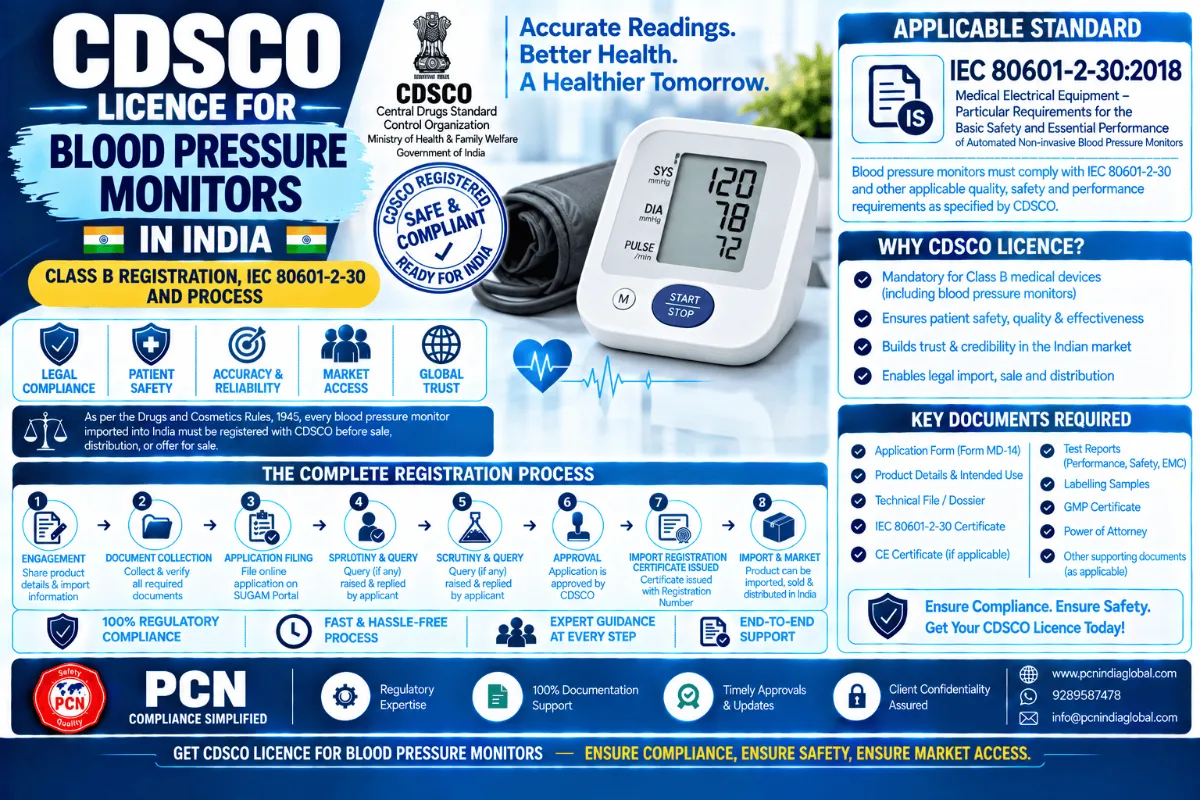

CDSCO Licence for Blood Pressure Monitors in India: Class B Registration and IEC 80601-2-30
A blood pressure monitor produces a number that drives diagnosis and medication decisions, so its accuracy is a clinical matter — a consistently wrong reading changes treatment. CDSCO regulates the BP monitor as a Class B measuring device with the non-invasive-sphygmomanometer particular standard and clinical-accuracy validation behind the licence. This guide covers the full CDSCO registration pathway for blood pressure monitors under the Medical Devices Rules, 2017 — classification, licence route, IEC 80601-2-30, the documents, the fees and the timeline. This guide explains CDSCO registration for blood pressure monitors in India — risk class, licence forms, standards, documents, fees and timeline.
Is CDSCO Registration for Blood Pressure Monitors Mandatory in India?
Yes. A blood pressure monitor is a notified Class B medical device and cannot be manufactured, imported or sold in India without a CDSCO licence. A domestic manufacturer holds a Form MD-5 licence from the State Licensing Authority. An importer holds a Form MD-15 import licence through an Indian Authorised Agent. Automated (oscillometric) arm and wrist monitors, and aneroid/mercury sphygmomanometers, fall within the framework.
Risk Classification of Blood Pressure Monitors
Blood Pressure Monitors are classified as Class B (low-to-moderate risk). A blood pressure monitor has a measuring function whose reading informs diagnosis and treatment, and CDSCO classifies devices with a measuring function at Class B under the First Schedule. Where a device could fall in two classes the higher class applies, and an accessory is classified in its own right. Always confirm against the current CDSCO classification list.
CDSCO Licence for Blood Pressure Monitors: Which Licence You Need
- To manufacture blood pressure monitors in India (Class B) — apply in Form MD-3 to the State Licensing Authority (SLA). The licensing authority grants the licence in Form MD-5. A CDSCO-empanelled Notified Body audits the site. For Class A the audit is post-grant. For Class B the Notified Body conducts it before the licensing authority grants the licence.
- To import blood pressure monitors (any class) — the overseas manufacturer appoints an Indian Authorised Agent who files Form MD-14 with the Central Licensing Authority; CDSCO grants the import licence in Form MD-15.
Applicable Standards for Blood Pressure Monitors
BP monitors are evaluated against the non-invasive-sphygmomanometer particular standard plus clinical-accuracy validation:
- IEC 80601-2-30 — basic safety and essential performance of automated non-invasive sphygmomanometers.
- ISO 81060-2 — clinical investigation of automated measurement type for accuracy.
- ISO 81060-1 — non-automated (aneroid/mercury) sphygmomanometers, where applicable.
- IEC 60601-1/IEC 60601-1-2 — electrical safety and EMC for automated monitors.
- IEC 60601-1-11 — where intended for the home-healthcare environment.
- ISO 10993 series — biocompatibility of the cuff where skin-contacting.
Documents Required for CDSCO Registration of Blood Pressure Monitors
The core CDSCO dossier is the same for every medical device: the application on CDSCO’s online medical device portal, Device Master File, Plant Master File, ISO 13485 certificate, Essential Principles checklist, ISO 14971 risk file, labels and IFU, undertakings and the fee receipt. The full checklist, with what each document must contain, is in our CDSCO medical device registration guide. Below is what CDSCO specifically expects to see for blood pressure monitors.
Device-Specific Documents for Blood Pressure Monitors
Device-specific documents on top of the core set for blood pressure monitors:
- ISO 81060-2 clinical-accuracy validation — the headline evidence for an automated BP monitor.
- IEC 80601-2-30 performance report and IEC 60601-1 / -1-2 electrical safety/EMC.
- Cuff-range and calibration data across the arm/wrist sizes offered.
- Software/algorithm documentation for the oscillometric measurement.
- Biocompatibility for the skin-contacting cuff.
Label & IFU Requirements Specific to Blood Pressure Monitors
BP-monitor labelling and the IFU are checked for accuracy and use information:
- Device name, model and measurement range, and cuff-size range.
- Rated power/battery and the IEC 60601 symbols (automated monitors).
- Batch/serial identification and the date of manufacture.
- Stated accuracy, cuff-fitting and measurement-technique information in the IFU.
Automated vs Manual, and the Clinical-Accuracy Study
Two things shape a BP-monitor dossier. First, an automated (oscillometric) monitor and a manual (aneroid/mercury) sphygmomanometer follow different standards — IEC 80601-2-30/ISO 81060-2 versus ISO 81060-1. Second, for automated monitors the clinical-accuracy validation (ISO 81060-2) is the make-or-break evidence: a monitor without a proper accuracy study will not clear, however good its electronics. Note that mercury devices face phase-out on environmental grounds. Fix the device type and secure the accuracy study early.
Step-by-Step CDSCO Registration Process for Blood Pressure Monitors
Every device follows the same online filing route, which we walk through step by step in our complete CDSCO registration guide. For blood pressure monitors, these are the steps that need the most attention:
- Confirm the classification. Fix the risk class against the CDSCO classification list and the First Schedule — Class B here — which decides the form, authority, fee and audit route.
- Site audit / inspection. A CDSCO-empanelled Notified Body audits the site. For Class A the audit is post-grant. For Class B the Notified Body conducts it before the licensing authority grants the licence.
CDSCO Registration Fees and Timeline for Blood Pressure Monitors
A complete Class B manufacturing file typically clears in about three to six months. An import (MD-15) file usually takes six to nine months. Every deficiency letter effectively restarts the clock. Unlike the old registration certificates, an MDR 2017 licence does not expire — it stays valid as long as you pay the retention fee (equal to the licence fee) every five years and meet the conditions of licence.
Common Mistakes That Trigger a CDSCO Query
Common query reasons for BP-monitor applications are:
- No ISO 81060-2 clinical-accuracy validation for an automated monitor.
- IEC 80601-2-30 / IEC 60601-1 reports missing or not for the exact model.
- Cuff-range/calibration data not covering all sizes offered.
- Wrong standard cited for a manual vs automated device.
- Free Sale Certificate scope not covering the model on import.
FAQs on CDSCO Registration for Blood Pressure Monitors
What CDSCO class is a blood pressure monitor?
A BP monitor is Class B because it has a measuring function. A domestic manufacturer files Form MD-3 for an MD-5 licence. An importer files Form MD-14 for an MD-15 licence.
Which standard applies to BP monitors in India?
IEC 80601-2-30 for automated non-invasive monitors with ISO 81060-2 clinical-accuracy validation, and ISO 81060-1 for manual sphygmomanometers.
What is the most important evidence for an automated monitor?
The ISO 81060-2 clinical-accuracy validation — a monitor without a proper accuracy study will not clear, regardless of its electronics.
Does CDSCO require a factory audit?
Yes — for Class B manufacture a CDSCO-empanelled Notified Body audits the site before the licensing authority grants the MD-5 licence.
How long does BP-monitor registration take?
A complete Class B manufacturing (MD-5) file usually clears in about three to six months. An import (MD-15) file typically takes six to nine months.
Why Choose PCN India Global
- Classification triage — we confirm the correct risk class for your blood pressure monitors against the current CDSCO list before we draft anything.
PCN India Global manages the complete CDSCO process for blood pressure monitors — from classification and route selection to Device and Plant Master File preparation, online filing, audit support and the licence grant. WhatsApp or call +91 80109 05029, or email admin@pcnindiaglobal.com, to get your registration underway.
Related Compliance Guides
- CDSCO Licence for Electrosurgical Units
- CDSCO Licence for Anaesthesia Machines
- CDSCO Licence for Endoscopes
- CDSCO Licence for Heart Valves
Related CDSCO Registration Guides
Need end-to-end help? See our CDSCO registration services, or read these related guides:
- CDSCO Registration for Blood Bags in India
- CDSCO Registration for Eyebrow Pencil & Brow Products in India
- CDSCO Registration for Condoms in India
- CDSCO Registration for Contact Lenses in India
Official references: Central Drugs Standard Control Organisation (CDSCO) and the CDSCO MD Online portal.
Need help? PCN India Global handles end-to-end CDSCO medical device registration for manufacturers and importers.
Related guides
- CDSCO Licence for Blood Tubing Sets in India: Class C Registration and ISO 8637-2
- CDSCO Licence for Bone Cement in India: Class D Registration and ISO 5833
- CDSCO Licence for Cardiac Catheters in India: Class C Registration and ISO 10555
- CDSCO Licence for Cochlear Implants in India: Class D Registration and ISO 14708-7
- CDSCO Licence for Condoms in India: Class B Registration and ISO 4074
- CDSCO Licence for Contact Lenses in India: Class B Registration and ISO 18369
More Medical Devices Guides
- CDSCO Licence for Blood Tubing Sets in India: Class C Registration and ISO 8637-2
- CDSCO Licence for Blood Gas Analysers in India: Class C IVD Registration
- CDSCO Licence for Cochlear Implants in India: Class D Registration and ISO 14708-7
- CDSCO Licence for Blood Collection Tubes in India: Class A Registration and ISO 6710
- CDSCO Licence for Bone Cement in India: Class D Registration and ISO 5833
- CDSCO Licence for Cardiac Catheters in India: Class C Registration and ISO 10555