
BIS Certification for Cables in India: Cables QCO 2020 and All 13 IS Standards
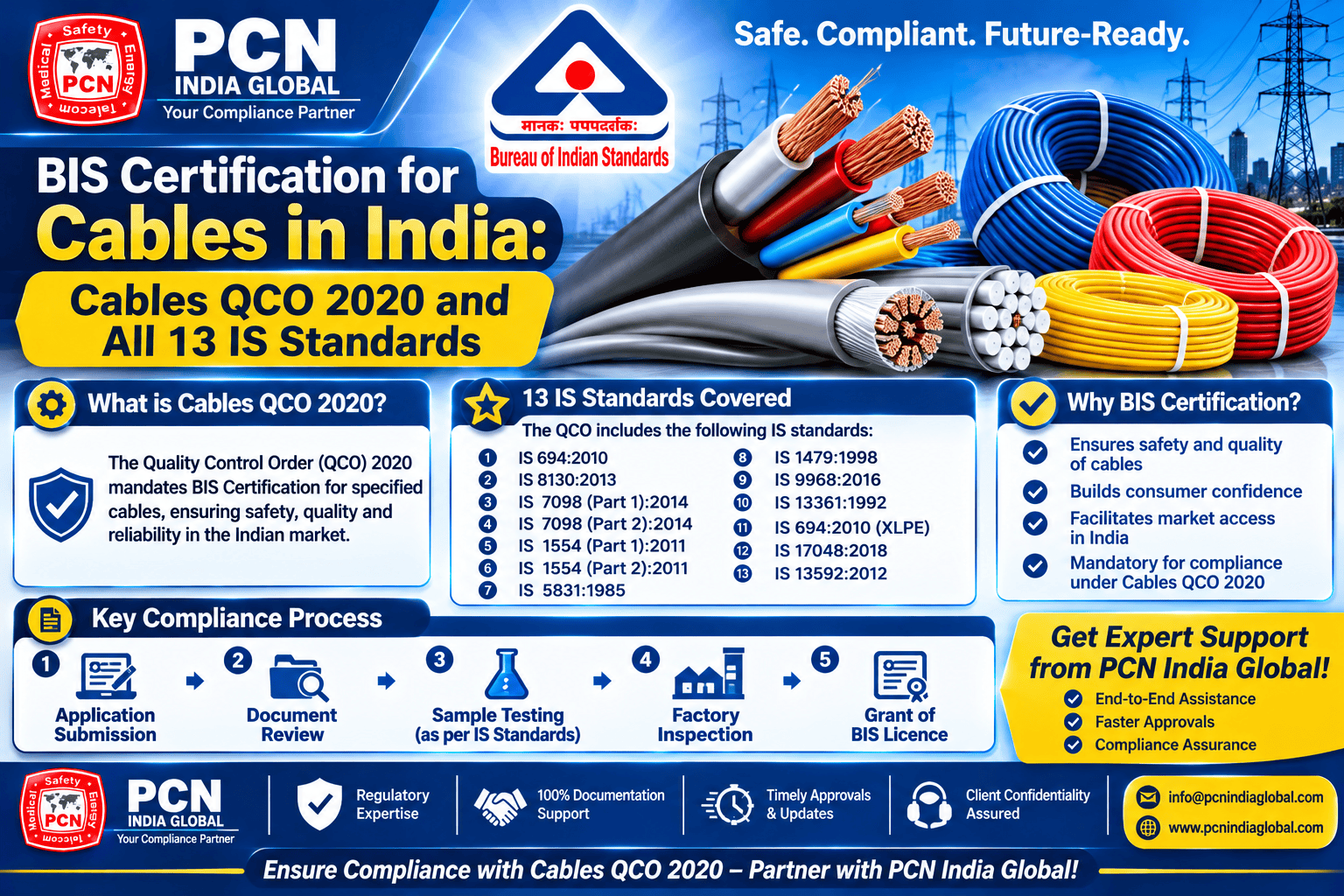
A cable failure is rarely just a cable failure. It becomes a fire, an outage or a mine-safety incident. That is why the Cables (Quality Control) Order, 2020 (S.O. 294(E), 21 January 2020) made BIS certification compulsory for 13 power, control and special-purpose cable standards. This sits alongside the older 2003 order that already covered basic building wires. This guide covers BIS certification for cables step by step.
QCO tracker: See which other products are about to need the ISI mark on our BIS QCO tracker.
In practice, we wrote this guide for cable manufacturers, importers and the EPC and utility buyers who specify them. It compares the notified cable types side by side.
Notified cable standards compared
| Cable type | IS Standard | Insulation / construction | Typical application |
|---|---|---|---|
| PVC insulated heavy-duty cables | IS 1554 (Part 1) | PVC, up to and including 1100 V | LV power distribution, industrial wiring |
| PVC insulated heavy-duty cables | IS 1554 (Part 2) | PVC, 3.3 kV to 11 kV | MV distribution |
| XLPE insulated PVC-sheathed cables | IS 7098 (Part 1) | XLPE, up to 1100 V | LV power, higher current ratings |
| XLPE insulated thermoplastic-sheathed cables | IS 7098 (Part 2) | XLPE, 3.3 kV to 33 kV | Utility and industrial MV networks |
| XLPE insulated thermoplastic-sheathed cables | IS 7098 (Part 3) | XLPE, 66 kV to 220 kV | HV transmission |
| Aerial bunched cables | IS 14255 | Up to 1100 V, overhead | Rural and urban LT overhead lines |
| Halogen-free flame-retardant (HFFR) cables | IS 17048:2018 | HFFR compounds, up to 1100 V | Metro, hospitals, data centres, public buildings |
| Elastomer insulated cables | IS 9968 (Part 2) | Elastomer, 3.3 kV to 33 kV | Flexible MV applications |
| Welding cables | IS 9857 | Flexible elastomeric | Arc welding equipment leads |
| Thermocouple compensating cables | IS 8784 | Matched conductor alloys | Process instrumentation |
| Flexible cables for mines | IS 14494:2019 | Elastomer insulated | Mining machinery |
| Flexible cables for miners’ cap-lamps | IS 2593 | Flexible | Cap-lamp sets |
| Shot firing cables | IS 5950 | For use other than in shafts | Blasting operations |
The 2003 electrical QCO covers building wires under IS 694 and IS 9968 (Part 1).
What the lab tests
Cable standards combine routine tests on every drum, acceptance tests on samples from a lot and type tests on the design. Depending on the standard, expect:
- Conductor resistance and construction checks
- High-voltage test and insulation resistance
- Insulation and sheath thickness and their tensile and elongation properties, including after ageing
- Hot set test for XLPE
- Flame-retardance, smoke-density and halogen-acid tests for HFFR
- Partial discharge on MV and HV XLPE cables
Your in-house lab must handle the routine and acceptance tests specified in the Scheme of Inspection and Testing. HV type tests are where most overseas applicants need careful planning.
For buyers: how to verify a cable supplier
- Ask for the BIS licence and confirm its scope covers the exact standard, voltage grade, conductor size range and number of cores you are buying.
- Check the licence status on the BIS portal. Suspended or expired licences remain a real risk.
- Inspect drum and cable markings for the ISI mark and CM/L number.
- For imports, insist on proof that the overseas factory holds an FMCS licence before shipment.
For manufacturers: the licensing route
Indian plants apply on Manak Online. Overseas plants apply under FMCS with an Authorised Indian Representative and a performance bank guarantee. BIS then inspects the extrusion and testing set-up, draws samples for independent testing and grants the licence. You add new sizes and voltage grades later through inclusion.
How PCN India Global helps
We plan licence scope across your size and voltage range, check lab readiness against the testing scheme, manage BIS inspection and testing, and act as AIR for overseas cable makers. Contact +91 80109 05029 | admin@pcnindiaglobal.com
Official sources: Bureau of Indian Standards (BIS) · Manak Online licensing portal
Cables BIS FAQs
Is BIS certification mandatory for XLPE cables?
Yes. XLPE insulated cables under IS 7098 Parts 1, 2 and 3 are notified under the Cables (Quality Control) Order, 2020.
Does the Cables QCO cover HFFR cables?
Yes. IS 17048:2018 covers halogen-free flame-retardant cables for working voltages up to and including 1100 V.
Do imported power cables need the ISI mark?
Yes. Importers can only bring in notified cables if the overseas factory holds a BIS licence under FMCS and the cables carry the ISI mark. PCN India Global handles BIS certification for cables from start to finish.
Need help? PCN India Global handles end-to-end BIS ISI mark certification for manufacturers and importers.
Related guides
- BIS Certification for Deep Groove Ball Bearings: IS 6455:2020 and the Bearings QCO 2025
- BIS Certification for Flux Cored Solder Wire in India: IS 1921, the Withdrawn Quality Control Order and What It Means Now
- BIS Certification for Service Valves for Air Conditioning & Refrigeration in India: IS 19409:2025
- BIS ISI Certification for Air Coolers and Air Filters in India: IS 3315 and IS 17570 (Part 1)
- BIS ISI Certification for Ceiling Fans: IS 374:2019 Under the Electric Ceiling Type Fans QCO 2023
- BIS ISI Certification for Cross Recessed Screws in India: IS 7483, IS 7485, IS 7486 and IS 18480
More ISI Mark Guides
- BIS ISI Certification for TMT Bars: IS 1786:2008 Under the Steel QCO
- BIS ISI Certification for Domestic LPG Gas Stoves: IS 4246:2002 Explained
- BIS Certification for Bicycles in India: Retro-Reflector QCO, IS 10613 and IS/ISO 6742-2 Explained
- BIS ISI Certification for Domestic Pressure Cookers: IS 2347:2017 Under the Pressure Cooker QCO 2020
- BIS ISI Certification for Two-Wheeler Helmets: IS 4151:2015 and the Helmet QCO 2020
- Electrical Appliances QCO 2026: BIS ISI Certification Under IS 302 for Manufacturers and Importers